Fernand Léger was a pioneering French modernist painter whose foundational training as an architectural draftsman profoundly shaped his structured, geometric approach to art. After absorbing the influence of Paul Cézanne and collaborating among avant-garde circles in Paris, Léger developed a distinct variation of Cubism characterized by cylindrical, tubular forms, a style contemporary critics dubbed "Tubism." His military service in World War I, where he survived a gas attack, deepened his fascination with the in...
Fernand Léger was a pioneering French modernist painter whose foundational training as an architectural draftsman profoundly shaped his structured, geometric approach to art. After absorbing the influence of Paul Cézanne and collaborating among avant-garde circles in Paris, Léger developed a distinct variation of Cubism characterized by cylindrical, tubular forms, a style contemporary critics dubbed "Tubism." His military service in World War I, where he survived a gas attack, deepened his fascination with the industrial beauty of modern machinery and inspired his goal to create art accessible to working-class audiences. This perspective catalyzed his "Mechanical Period" during the 1920s, a phase marked by vibrant, machine-like compositions and urban motifs that celebrated industrial progress.
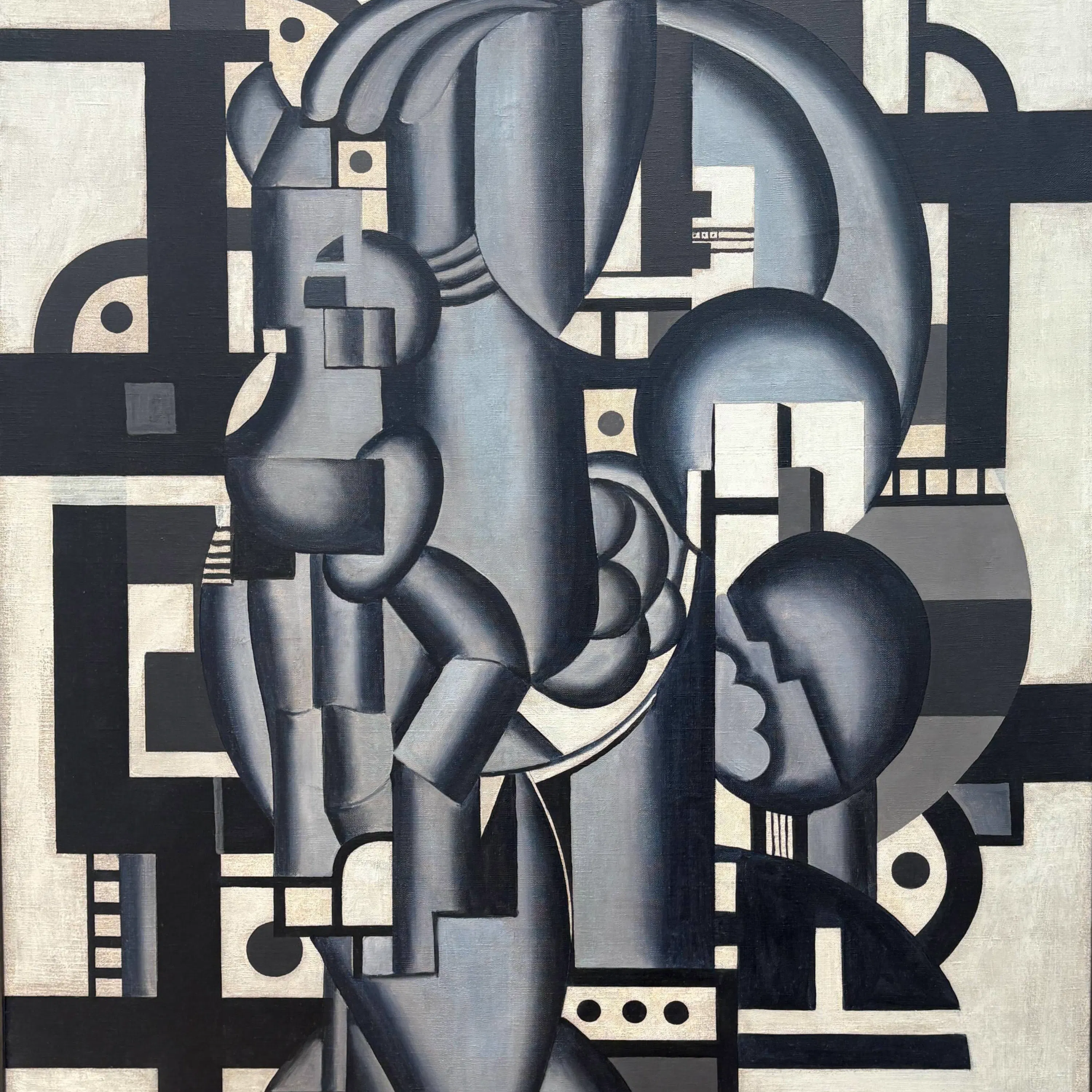
Léger's 1921–1927 painting Composition in Blue, housed in the Art Institute of Chicago, exemplifies this mechanical aesthetic and demonstrates rigorous principles of design. Utilizing a limited monochromatic blue palette, hard-edged geometry, and carefully balanced line weights, the piece synthesizes three-dimensional volumetric shapes with flat planes. Beneath its paint layers, conservation analysis reveals a structured grid system that Léger used to systematically map the canvas. By translating machine components into universal abstract harmonies, Léger transformed industrial forms into a lasting modern aesthetic.
Listen Ad-Free on Patreon.
For just $3 per month, you can get ad-free versions of Fun Facts Daily, Who ARTed and Art Smart. Head over to https://www.patreon.com/cw/FunFactsDailyPod if you are interested.
Who ARTed is an Airwave Media Podcast. If you are interested in advertising on this or any other Airwave Media show, email: advertising@airwavemedia.com
Learn more about your ad choices. Visit megaphone.fm/adchoices
View more