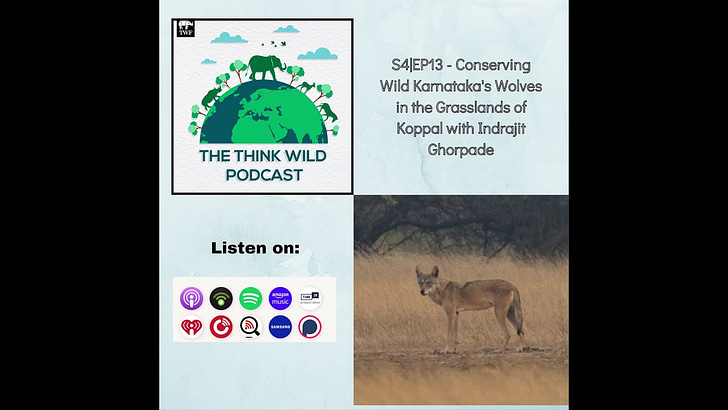
In this compelling episode of The Think Wildlife Podcast, host Anish Banerjee speaks with Indrajit Ghorpade, founder of the Deccan Conservation Foundation, about wolf conservation in the Koppal District of Karnataka and the overlooked biodiversity of the Deccan Plateau. The conversation offers a rare, ground-level perspective on the Indian wolf and the urgent need to rethink how India approaches grassland conservation and biodiversity management outside forested...
In this compelling episode of The Think Wildlife Podcast, host Anish Banerjee speaks with Indrajit Ghorpade, founder of the Deccan Conservation Foundation, about wolf conservation in the Koppal District of Karnataka and the overlooked biodiversity of the Deccan Plateau. The conversation offers a rare, ground-level perspective on the Indian wolf and the urgent need to rethink how India approaches grassland conservation and biodiversity management outside forested landscapes.
Koppal District, located in the Deccan Plateau, represents one of the last strongholds of the Indian wolf, a subspecies of the gray wolf uniquely adapted to India’s arid and semi-arid grasslands. Often misunderstood and neglected, the Indian wolf has survived for centuries in human-dominated landscapes shaped by pastoralism and dryland agriculture. Indrajit explains how wolf conservation in this region is inseparable from protecting grassland ecosystems that are routinely misclassified as wastelands, despite supporting exceptional grassland biodiversity.
The episode explores the ecological importance of open grasslands for species such as wolves, blackbucks, foxes, hyenas, and ground-nesting birds, and why the loss of these habitats has driven widespread declines across Indian biodiversity. Indrajit reflects on how tiger-centric conservation narratives have overshadowed species like the Indian wolf, leading to gaps in policy, funding, and public awareness. Through years of fieldwork, research, and advocacy, his work has helped establish India’s second wolf sanctuary at Bankapur, demonstrating that targeted protection can make a measurable difference even in fragmented landscapes.
A key theme of the discussion is coexistence. Wolves in Koppal largely survive outside protected areas, navigating livestock grazing, agriculture, roads, and renewable energy infrastructure. Indrajit unpacks the realities of human–wolf interactions, the role of free-ranging dogs, hybridization concerns, and the importance of education in reducing conflict. Rather than portraying wolves as threats, the episode reframes them as keystone predators essential for regulating ecosystems and sustaining long-term biodiversity conservation.
Listeners will gain insight into why grassland conservation is central to the future of Karnataka biodiversity and the biodiversity of India more broadly. From blackbucks roaming open plains to wolves using rocky outcrops as breeding refuges, the episode highlights how wild Karnataka extends far beyond forests and protected reserves. This conversation is essential listening for anyone interested in wolf conservation, Indian wolf conservation, gray wolf conservation, grassland biodiversity, and the future of biodiversity management in India’s most neglected ecosystems.
#wolf #wolfconservation #IndianWolf #Indianwolfconservation #graywolf #graywolfconservation #grassland #grasslandconservation #biodiversityconservation #biodiversitymanagement #Indianbiodiversity #grasslandbiodiversity #blackbucks #wildKarnataka #Karnatakabiodiversity #biodiversityofKarnataka #biodiversityofIndia
Get full access to The Think Wildlife Podcast at anishbanerjee.substack.com/subscribe
View more