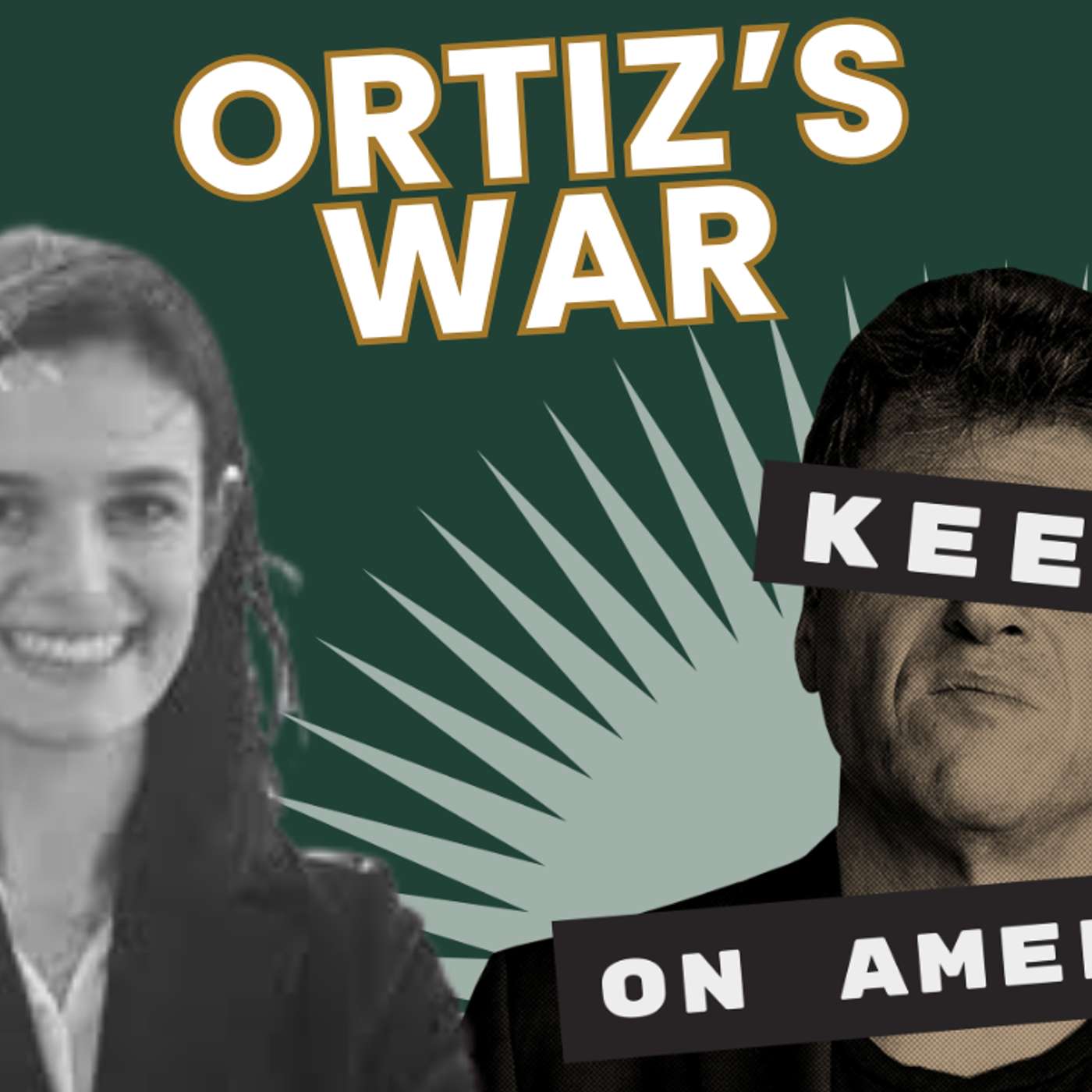
Grandfathers, grandfathers. Yesterday, David Baerwald talked about his grandfather, Ernst Baerwald, an American spy in Second World War Japan. Today, Katie S. Sanders talks about her grandfather, Murray Simon, whose life was saved by an American spy in Second World War France. In Ortiz’s War, co-authored with historian Nicholas Reynolds, Sanders writes about Peter Ortiz, who became the Allies’ secret weapon against the Nazis in France. With his stunning looks, Ortiz might have been a Holl...
Grandfathers, grandfathers. Yesterday, David Baerwald talked about his grandfather, Ernst Baerwald, an American spy in Second World War Japan. Today, Katie S. Sanders talks about her grandfather, Murray Simon, whose life was saved by an American spy in Second World War France. In Ortiz’s War, co-authored with historian Nicholas Reynolds, Sanders writes about Peter Ortiz, who became the Allies’ secret weapon against the Nazis in France.
With his stunning looks, Ortiz might have been a Hollywood creation. Polylingual Franco-American aristocrat, French Foreign Legion, race-car driver, circus lion tamer, the most battle-decorated member of America’s first spy agency. He even played himself (anonymous brave soldier) in a number of post-war Hollywood movies. I wish he was my grandfather.
Five Takeaways
• The Spy Who Saved Her Grandfather. Murray Simon was a 23-year-old Jewish kid from Queens who had never flown before the Army Air Forces trained him — then sent him over occupied France in a black-painted B-24 Liberator carrying spy supplies and carrier pigeons for the resistance. Shot down on May 6, 1944, a month before D-Day, on an OSS mission whose standing advice was don’t get shot down — spies were tortured and killed, not taken prisoner — he was hidden by a Bulgarian-born Jew passing as Catholic, a man with an eight-month-old daughter and a pregnant wife who was “already supposed to be dead” and opened his door anyway. Smuggled onward, Murray was intercepted by Peter Ortiz — and made it home to the GI Bill, a family, and what he called “the warm womb of Uncle Sam.” Katie never met him; the book is her way of meeting him. “I gravitate towards stories of resistance, probably in part because I’m a product of one.” Publication day: the anniversary of the liberation of Paris.
• No Peacetime Soldier. Peter J. Ortiz’s résumé reads like an unpublishable novel: son of a founding editor of Paris Vogue; French boarding-school runaway into the Foreign Legion (North Africa, Casablanca included); merchant seaman, dude-ranch manager, race-car driver, circus lion tamer; wounded fighting the Germans in 1940, captured, serially escaped — once off a hospital train under a dead soldier’s identity; docked in New York the day after Pearl Harbor and enlisted in the Marines, rising to become the most battle-decorated member of the OSS and one of the most decorated Marines of the war. His military file: not a good candidate for a desk job, ever. He spoke five languages, not Wikipedia’s ten (“Wikipedia is a storyteller”), walked into bars in occupied France wearing his Marine uniform, and wrote his own epitaph in a twenty-page memoir: “I’m no peacetime soldier.” Afterward: John Ford’s Hollywood, minor roles, his own uniforms as costume — and no bragging, ever.
• The Heroic Surrender at Centron. The book’s climax is Operation Union II, August 1944 — Ortiz’s own inter-Allied mission into the Alps, culminating in the massive “Le Grand Parachutage” supply drop to the Maquis. He recruited his own Parris Island parachute instructors — Marines who remembered the legionnaire who blew them all away at boot camp — plus Francis Coolidge: Harvard dropout, fellow Foreign Legion veteran, and great-great-great-grandson of Thomas Jefferson. When his patrol was surrounded at the village of Centron by vastly superior German forces on a murderous late-war rampage, Ortiz chose saving the town over fighting — the surrender as the war’s most heroic act, bravery as the capacity to think while being shot at. Centron celebrates him every year; Katie was just there with Marines stationed in Germany, for the eighty-second anniversary. Guiding lights: noblesse oblige, Don Quixote, and a lifelong allergy to McCarthyism.
• Wild Bill’s Wartime Startup. The OSS — forerunner of the CIA, whose Langley lobby still holds Wild Bill Donovan’s statue — was, in Katie’s telling, a wartime startup: 13,000 military and civilian personnel, mostly Wall Street lawyers, bankers, cryptographers, and cartographers, with a tiny operational subset that included Moe Berg, Virginia Hall trekking the Pyrenees on a wooden leg, and Ortiz. Donovan — World War One Medal of Honor recipient, FDR’s “secret legs,” the man who could “see an acorn, envision an oak tree” — was banned from D-Day as the one man carrying too many secrets, and went sniffing around anyway. J. Edgar Hoover was considered for the job and rejected, with Churchill’s SOE helping tip the choice. “I respect Donovan a lot more than I respect J. Edgar Hoover.” The lineage runs straight to today’s Navy SEALs and MARSOC — including past Keen On guest Brandon Webb.
• Are We in 1939? Katie walks the museum timelines — 1933, and it’s “not great”; 1936, and the warnings mount; “I certainly hope we’re not in 1939.” Against Andrew’s needling about greatest-generation nostalgia (via Brandon Webb’s complicated heroism, Kristin Beck’s good-and-evil seduction, Richard Overy’s question of whether the war ever ended, and Matt Damon’s regret-soaked Odysseus), she holds the line: someone like Ortiz is great in any time — and especially needed when democracy is under threat. The warfare itself has closed its chapter: her grandfather’s black-painted bomber and carrier pigeons have become Ukraine’s drones, delivering aid with less risk and less human connection alike. What survives the technology is the lesson: heroes don’t brag — her grandfather and Ortiz would be mortified by the spotlight — and by illuminating what they did, the rest of us might learn to do the right thing.
About the Guest
Katie S. Sanders is an award-winning journalist who has written for National Geographic, The New York Times, Washington Post Magazine, TIME, Smithsonian, and Vanity Fair. Her reporting has brought her to the CIA, the White House, and the homes and reunions of World War II veterans and Holocaust survivors. After discovering that her late grandfather — a Jewish-American pilot shot down over France — was rescued by Peter Ortiz, she teamed up with the historian Nicholas Reynolds (Writer, Sailor, Soldier, Spy) to co-author Ortiz’s War (Harper Horizon, August 25, 2026). A summa cum laude graduate of the University of Pennsylvania, she lives in Brookline, Massachusetts.
References:
• Ortiz’s War: The Allies’ Secret Weapon Against the Nazis in France by Nicholas Reynolds and Katie S. Sanders (Harper Horizon, August 25, 2026).
• Writer, Sailor, Soldier, Spy by Nicholas Reynolds — the co-author’s Hemingway biography, the book that put him on Katie’s radar.
• The Fire Agent by David Baerwald — yesterday’s episode: another grandfather, another secret war, rendered as fiction where this one insists on fact.
• &nb...