We squeeze in one more episode before Will's vacation, tying the single-season record in the process. The mailbag then demands a reckoning on whether Magneto's powers are really limited to ferrous metals, along with the origins of the S tier and the truth-value of conditional predictions. The main event is Hunter v. United States, which holds that a plea bargain's appeal waiver is unenforceable when enforcing it would work a "miscarriage of justice." We try to figure out where that rule could possibly come from — contract law? Rule 11? the supervisory power? procedural common law? — and why an opi...
We squeeze in one more episode before Will's vacation, tying the single-season record in the process. The mailbag then demands a reckoning on whether Magneto's powers are really limited to ferrous metals, along with the origins of the S tier and the truth-value of conditional predictions. The main event is Hunter v. United States, which holds that a plea bargain's appeal waiver is unenforceable when enforcing it would work a "miscarriage of justice." We try to figure out where that rule could possibly come from — contract law? Rule 11? the supervisory power? procedural common law? — and why an opinion this law-free commanded this much agreement, while the separate writings range from a declaration of war on plea bargaining itself to a hunt for a sounder source of authority. Along the way: a field trip to the shuttered taproom of Ybarra v. Illinois fame, and thanks to the expanding Divided Argument production universe.
Highlights
[00:00:21] Opening: squeezing in one more before Will's vacation — and tying the single-season episode record.
[00:01:42] The only Court news: Trump v. California, the mail-in-voting application, is fully briefed.
[00:03:15] Mailbag: "lead is not magnetic." Are Magneto's powers limited to ferrous metals? The comic-book record says no.
[00:05:40] Why is S the top tier? Japanese video-game rank screens and contested backronyms.
[00:08:09] Parsec retcons in Star Wars, and the art of redeeming past misstatements.
[00:09:09] Caleb Rogers on the logic of conditional predictions: "if A, then B" is true whenever not-A.
[00:11:08] Thank-yous to the production universe — and the show is now on YouTube.
[00:12:06] Jessie Henderson's field trip: the Aurora Tap of Ybarra v. Illinois fame, located and (sadly) shuttered.
[00:15:30] The main event: Hunter v. United States — appeal waivers in federal plea bargains.
[00:21:30] The wrinkle: a forced-medication condition, and a judge who says "you have a right to appeal" anyway (cf. Class v. United States).
[00:24:45] Plea bargains as free-floating general contract law — territory of the forthcoming Epps & D'Onfro Harvard Law Review paper.
[00:26:52] The circuit split: the Fifth Circuit's statutory-maximum rule vs. everyone else's miscarriage-of-justice exception.
[00:29:16] The real puzzle: where does any of this authority come from — Rule 11? the judiciary's own self-image?
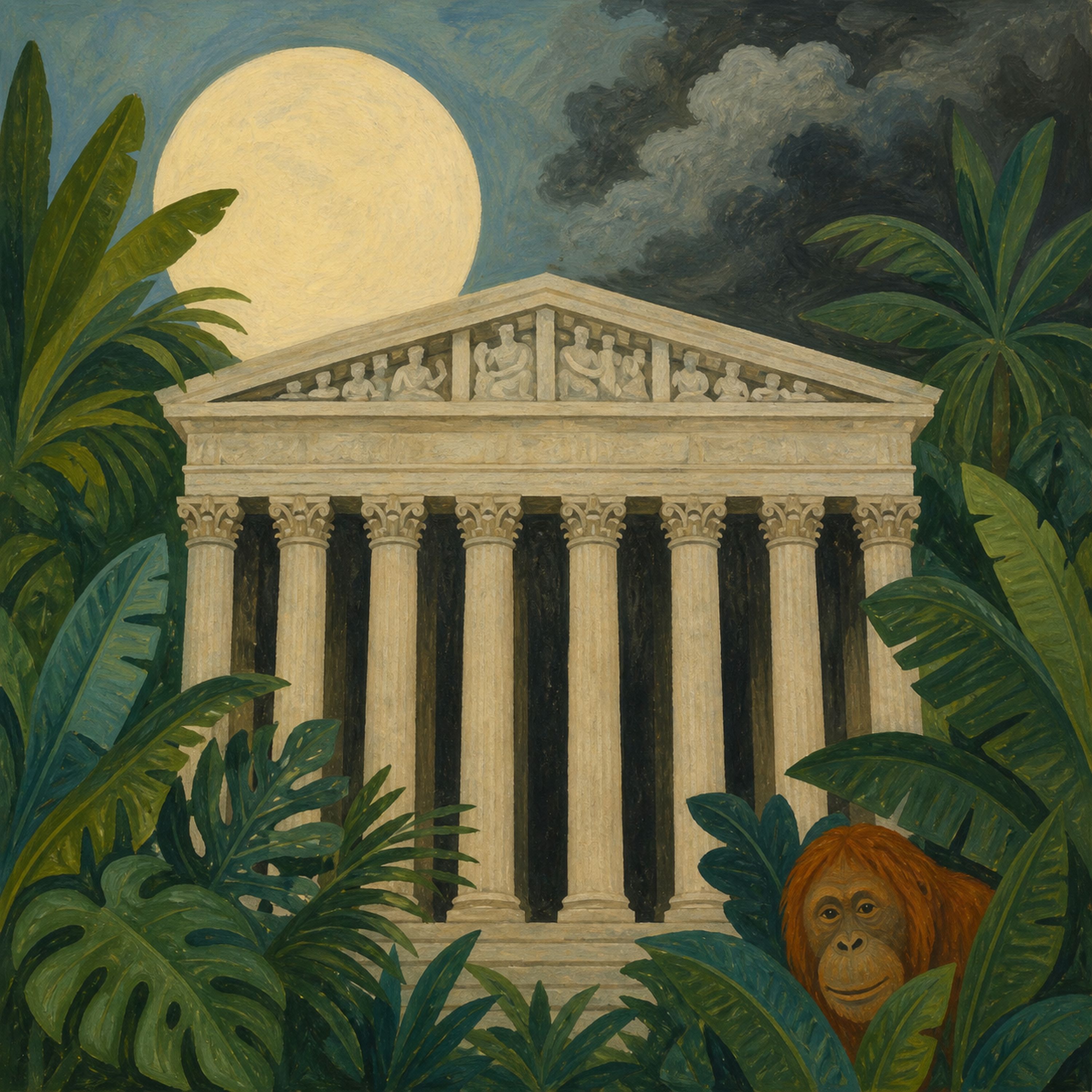
[00:37:51] What definitely counts: race-based sentences, a no-pregnancy condition, sentencing by 12 orangutans.
[00:40:40] Dan logs a scorecard prediction on what the Fifth Circuit does on remand.
[00:43:04] How does an opinion this mushy get 8 votes in 2026? In for a dime, in for a dollar.
[00:45:40] The Gorsuch concurrence comes out swinging against plea bargaining itself — Stuntz and Barkow make the U.S. Reports.
[00:52:50] The Kavanaugh concurrence's high bar, and the 3–3–2 math of who wouldn't take sides.
[00:55:00] The Thomas dissent: no source of law — and no sentencing appeals for most of American history anyway.
[01:00:20] The Barrett concurrence: procedural common law, with citations to Professor Barrett.
[01:08:16] Sign-off: thanks to the Constitutional Law Institute; Dan's predictions may yet be made falsifiable.
Relevant links
Cases
Commentary & articles
"Hunter v. United States — the most important criminal case of the term" — SCOTUSblog opinion analysis
Amy Coney Barrett, "The Supervisory Power of the Supreme Court" — 106 Colum. L. Rev. 324 (2006), cited in the Barrett concurrence
Amy Coney Barrett, "Procedural Common Law" — 94 Va. L. Rev. 813 (2008), the other self-citation
Other
Ice by Magneto — last episode, where the Magneto debate began
Smart Microwave — the Chatrie episode, where the Aurora Tap of Ybarra v. Illinois first came up
Gorsuch Genie — our episode with Rachel Barkow on Justice Abandoned, now cited in the Gorsuch concurrence
View more