Movers Mindset
https://moversmindset.com/feed/podcast/movers-mindset/Episode List
Remodeling with Sean Hannah
What does it take to stop avoiding pain and instead use it as a guide for rebuilding the body? The same movements that caused injury can heal it when performed slowly, partially, and with intention. "What we try to do is get people to understand that if you have pain, if you have a limitation, you don't stop doing the thing that hurt it. You do the thing that hurt it, slow, partial, light, take it down to the baby amount, the tolerable amount, and then start pushing it back up the scale. And by the time you can do it fast and heavy again, you're healed. Congratulations." ~ Sean Hannah (9:19) The conversation explores why most people avoid the slow, deliberate work required to truly rehabilitate injuries rather than just return to basic function. The distinction between physical therapy (designed for baseline recovery) and full joint remodeling (a months-to-years process typically reserved for elite athletes) forms the foundation of the discussion. The key insight is that healing requires doing the same movements that caused injury—but slower, lighter, and more partial—rather than avoiding them entirely. Pain emerges as a multifaceted phenomenon with three distinct layers: actual tissue damage, neuropathic pain (trauma responses encoded in nerves and fascia), and centralized pain (psychological amplification based on beliefs and language). The conversation addresses how someone might present with a knee problem but actually need a full head-to-toe biomechanical remodel, with the knee simply being where the dysfunction surfaces most visibly. The discussion also touches on the origins of the nickname "Seanobi" (an Irish ninja wordplay), the value of intuitive three-dimensional movement versus linear athletic training, and the importance of having something worth playing for as the motivational spark that makes the difficult rehabilitation process possible. Takeaways Remodeling versus physical therapy — Physical therapy aims for basic function, but returning to athletic capability requires a separate, longer process called remodeling that most people don't know exists. The spark — Without something you love doing that's disappearing or already gone, you won't sustain the slow, frustrating work of rehabilitation. Same movements, different parameters — Healing doesn't require new exercises; it uses the same movements that caused injury, performed slower, lighter, and more partially. Three layers of pain — Pain includes actual tissue damage, neuropathic responses stored in nerves and fascia, and psychological amplification based on perception and language. Language affects pain signaling — The words used to describe pain directly influence how much pain is felt; changing the narrative can dampen signaling and allow greater loading. The blowout point — A presenting injury like a knee problem is often just where a full-body biomechanical imbalance surfaces most visibly. Tissue-specific protocols — Pace, load, and angle can be adjusted to target specific tissues: nerve and fascia respond to different parameters than muscle and bone. Guarding responses — Much of chronic pain isn't damage but protective contractions and nerve issues that require precise loading to release. Threading the needle — Effective rehabilitation requires enough stress to trigger healing responses without crossing the threshold into new damage. Intuitive versus linear training — Three-dimensional, intuitive movement serves rehabilitation and durability, while linear athletic training like Olympic lifting builds speed and power for sport. The dial metaphor — Training exists on a spectrum from slow, rehabilitative, three-dimensional work to fast, linear, athletic work, and the dial can be adjusted based on daily capacity. Becoming your own maintenance mechanic — The goal of guided rehabilitation is independence—learning to address pain and maintain the body without ongoing professional help. Resources Monkey Do — "What Moves You?" Sean Hannah's guided mobility and joint remodeling programs. Monkey Do on YouTube — video content related to the mobility and rehabilitation approach. Designing curriculum, teaching seniors, and the mid-range — Sean's previous conversation on Movers Mindset covering related topics. Katy Bowman — mentioned regarding how too much "vitamin flat and level" is a problem. Iron Gump / MIST — a Movers Mindset conversation discussing meditative strength training. Parkour Generations — the organization behind American Rendezvous where Craig and Sean last met in person. (Written with help from Claude.ai) --- Hello👋 I'm Craig Constantine. In the Movers Mindset podcast, I talk with movement enthusiasts to learn who they are, what they do, and why they do it. I'm interested in the nature and philosophy of movement and in exploring themes like independence, self-direction, and human excellence. My interests color each conversation and provide some structure to Movers Mindset. But since I like to take the scenic route, every conversation ends up going somewhere unique. The purpose of Movers Mindset is to create and share great conversations with movement enthusiasts. Each conversation feeds my insatiable curiosity, but I share them to turn on a light for someone else, to inspire them, or to give them their next question. I appreciate your time and attention, and I don’t take it for granted. --- Thank you! Want more? Subscribe to the email list for weekly updates—new episodes and archive highlights delivered to your inbox. I invite you to cultivate a meaningful life—through presence, not pursuit. You can learn more about me and all my projects at, https://craigconstantine.com. If you like what I'm doing through Movers Mindset, learn more about becoming a patron. ɕ
Subtraction with Nima King
What happens when you stop trying so hard and learn to find power through subtraction rather than addition? Wing Chun training in a Hong Kong living room involves hours of standing still with no sparring, forcing practitioners to confront inner demons and abandon Western goal-seeking mentality. "I'll tell you, Craig, this was the hardest thing at that time that I had to go through, both physically and mentally, because […] it's just so difficult, you know, standing still there, not moving. It's just so difficult! All these inner demons start to come up. You start thinking, and you know, there's nowhere to hide." ~ Nima King (5:17) Nima King describes his journey from training as a teenaged bouncer in Sydney, to becoming a student of Grandmaster Chu in Hong Kong, where his expectations of intense sparring and rooftop battles were replaced by hours of standing practice in a small living room. The training focused on empty hand forms rather than fighting techniques, creating a physically and mentally challenging experience where inner demons surfaced and there was nowhere to hide. Grandmaster Chu provided hands-on guidance through tactile cues, manipulating posture and stance to help students release tension points gradually rather than through sudden breakthrough moments. The practice required abandoning the Western mindset of conceptualization and goal-seeking in favor of embodied experience, with Nima's teacher eventually banning him from asking questions to force this transition. The conversation explores how martial arts principles apply to modern life, including parenting and professional goals. Nima discusses the challenge of not trying too hard despite his natural inclination toward the mentality of pushing through pain and injury. The practice teaches that letting go of control represents a powerful act rather than laziness or apathy, and that vulnerability challenges conventional masculine ideals of strength through aggression. Grandmaster Chu exemplified this power through humility, always bowing lower and greeting students with warmth rather than displays of dominance. The art becomes about subtraction rather than accumulation, finding ways to achieve goals with less effort by allowing things to happen rather than forcing them. Takeaways Art of subtraction — The practice centers on removing tension and thinking rather than accumulating more techniques and knowledge. Embodied learning versus intellectual understanding — True martial arts mastery requires moving beyond conceptualization and goal-seeking to direct physical experience. Standing practice — Hours of stationary training in Wing Chun forms create confrontation with inner demons and reveal hidden tension points. Power through vulnerability — Real strength comes from humility and openness rather than aggression and displays of dominance. Letting go of control — Releasing the illusion of control represents a powerful and necessary practice in both martial arts and daily life. Western versus Eastern training approaches — The goal-oriented Western mindset conflicts with traditional Chinese martial arts teaching methods that resist curriculum and structure. Tactile teaching methods — Hands-on guidance through physical manipulation of posture and stance provides direct transmission of knowledge beyond verbal instruction. Marathon not sprint mentality — Sustainable practice requires wisdom about energy management and avoiding burnout despite natural inclinations to go all in. Teacher-student dynamics — A master may ban questions entirely to force students beyond intellectual grasping toward direct experience. Applying practice to parenting — Martial arts lessons about letting go transfer to raising children, finding balance between freedom and structure. Humble mastery — Grandmaster Chu demonstrated true power through kindness, bowing lower than students, and warmth rather than displays of superiority. Not trying too hard — Finding ways to achieve goals with less effort by allowing rather than forcing outcomes. Resources Mindful Wing Chun — Nima King's online training platform offering comprehensive instruction in the Wing Chun system as taught by Grandmaster Chu Shong Tin, featuring hundreds of hours of instructional videos focused on internal power development and mindful practice. Grandmaster Chu Shong Tin — Nima's Wing Chun teacher in Hong Kong, trained in traditional methods and taught in his living room. Grandmaster Jim Fung — Grandmaster Chu's student, who taught Wing Chun to thousands of students across Australia, under whom Nima began training at age 14. (written with help from Claude.ai) --- Hello👋 I'm Craig Constantine. In the Movers Mindset podcast, I talk with movement enthusiasts to learn who they are, what they do, and why they do it. I'm interested in the nature and philosophy of movement and in exploring themes like independence, self-direction, and human excellence. My interests color each conversation and provide some structure to Movers Mindset. But since I like to take the scenic route, every conversation ends up going somewhere unique. The purpose of Movers Mindset is to create and share great conversations with movement enthusiasts. Each conversation feeds my insatiable curiosity, but I share them to turn on a light for someone else, to inspire them, or to give them their next question. I appreciate your time and attention, and I don’t take it for granted. --- Thank you! Want more? Subscribe to the email list for weekly updates—new episodes and archive highlights delivered to your inbox. I invite you to cultivate a meaningful life—through presence, not pursuit. You can learn more about me and all my projects at, https://craigconstantine.com. If you like what I'm doing through Movers Mindset, learn more about becoming a patron. ɕ
«Partage» with Stany Foucher
What new formats and practices best transmit Art du Déplacement’s culture—beyond technique—so practitioners can reflect, connect, and grow together? Art du Déplacement’s culture is deepened through «partage», reflective practice formats, and distinctive training like vision work and night missions. "Still, I had the fear, but I knew where I was, where I was going, [and] how— I knew myself better, basically. So this very strong experience with my friends, and this strong experience of failure— That was really an in between moment for me. […]There is before that training session at the «Dame du Lac» experiencing all this. And then there is me discovering more about my inner self and being very different in the way I approach fear." ~ Stany Foucher (1:33:00) The discussion frames Art du Déplacement as a living culture rather than simply a set of techniques. Stany's recently published, French-language book is highlighted as a deliberate choice, made with the awareness that language shapes who can engage with the ideas. (Craig and Stany hope that an English translation can eventually be created which captures the subtlety and depth of the material.) The strengths of books—slower pacing and deeper digestion—are compared to the reach and immediacy of video. This leads to exploring audio as a practice medium, with the idea of podcast-led movement sessions modeled on audio yoga classes. The conversation also touches on the value of building shared reference points across the community, so practitioners in different places can connect through common experiences. Practice design is a recurring theme. The Movers Mindset Pause project is discussed as a way to help practitioners form a cycle from discovery to reflection to change. Coaching is discussed as more than sets and repetitions, incorporating environment, questioning, and reframing experiences. Public-space QM is described as a way to normalize human movement in busy urban settings, reducing self-consciousness and building autonomy. The pair note the importance of training “vision” as a standalone capacity, distinct from fear management or technical skill. "Maybe one thing that I’m trying to focus on sometimes is this vision element of the discipline. Vision is really a topic by itself. If you just try to be in an analyzing mode, you know, trying to analyze the environment and be— not measuring, but just feeling— not for the sake of techniques, but just vision for vision. Maybe new things can arise." ~ Stany Foucher (58:00) They describe silent, “night missions” where participants select a distant, barely visible endpoint and navigate to it without touching the ground, focusing on presence, creative pathfinding, and trajectory rather than named techniques. Other modalities—lifting, carrying, climbing, and playing on varied terrain—are folded into practice to broaden capacity. Social aspects like shared meals, walks, and storytelling are recognized as essential for transmitting culture, complementing formal training. "But something that I really get, also from those years of training, and maybe you don’t see it is, all the questioning behind it. I cannot think of a training that would not end with a question— [an] open question from—especially from Jann [Hnautra]—just reflecting on what you did. Why were you in that state of mind when we’re doing this movement? Why did you want to stop when you were doing the QM? Lots of questions and reflecting on what you did. I think this is an important piece of the training." ~ Stany Foucher (28:00) Personal philosophy surfaces through parenting analogies—providing environments where children retain innate movement abilities—and a formative story of a major failure that marked a clear “before and after” in approaching fear. The conversation closes with reflections on building community connection despite geographic distance, testing new formats for sharing practice, and maintaining a loop where ideas, movement, and reflection continually reinforce each other. Takeaways Language shapes reach — Choosing French vs. English determines who can read, hear, and benefit. Books slow the pace — A book supports digestion of concepts that video often rushes past. Podcast as training — Audio sessions can guide live movement for listeners who learn by hearing. Build a reflection loop — Journaling and the Pause practice embed discovery to reflection to efficacy. Coaching beyond technique — The value includes questions, environment, and pointing in the right direction. Normalize movement in public — Holding QM sessions in busy spaces reduces self-consciousness and increases autonomy. Train vision explicitly — Treat “vision” as its own topic, not only fear or technique. Use night missions — Silent, goal-directed traversals cultivate presence and creative pathfinding. Mix natural modalities — Lifting, carrying, climbing, and terrain play (rocks, slopes) broaden practice. «Partage» matters — Sharing stories, meals, and walks transmits culture that classes alone can’t. Parenting reframes coaching — Provide safe environments so kids don’t lose what they already have. Failure as inflection point — A hard setback created a clear “before/after” in approach to fear. Resources https://wiseflow.fr/ — Stany Foucher's website for his book, podcast, and more. Art du Déplacement: Au delà de saut — French-language book discussed as framing the culture beyond movement; available as EPUB globally and in print within Europe. Wise Flow — Stany's French-language podcast. craigconstantine.com — Craig's personal web site with links to everything he does. Movers Mindset's Pause — The new Pause publication is a weekly email publication designed for movement professionals—coaches, teachers, gym owners, and practitioners—who want to slow down and reconnect with their deeper why. Stany Boulifard Mallet: Art du Déplacement, the Yamakasi, and motivation — Stany's first appearance, back in 2018, on the Movers Mindset podcast. Art du Déplacement (ADD) — Information about Art du Déplacement in general. Parkour & Art du déplacement: Lessons in practical wisdom – Leçons de sagesse pratique — Vincent Thibault’s 2015 book discussed in this podcast. The book contains both the French and English text. Don’t confuse it with the similarly named, but completely different book, “Parkour and the Art du déplacement: Strength, Dignity, Community”, published in 2014. There is also a second edition, which is French-language only. Out on the Wire — Book by Jessica Abel recommended by Craig as a book about podcasting, presented as a graphic-novel-style work interviewing leading creators. Meditations — Book by Marcus Aurelius (translated by Gregory Hayes) mentioned by Craig as his most-read book. Quadrupedal Movement (QM) — A practice and movement pattern emphasized in this episode and in Art du Déplacement generally. Communication with Vincent Thibault — Vincent Thibault's episode on Movers Mindset. Move NYC — Public event in New York City mentioned by Craig in reference to normalizing human movement in busy spaces. Joan of Arc Garden, in Quebec City — Location and statue mentioned by Craig as a setting for personal reflection. (Written with help from Chat-GPT.) ɕ --- Hello👋 I'm Craig Constantine. In the Movers Mindset podcast, I talk with movement enthusiasts to learn who they are, what they do, and why they do it. I'm interested in the nature and philosophy of movement and in exploring themes like independence, self-direction, and human excellence. My interests color each conversation and provide some structure to Movers Mindset. But since I like to take the scenic route, every conversation ends up going somewhere unique. The purpose of Movers Mindset is to create and share great conversations with movement enthusiasts. Each conversation feeds my insatiable curiosity, but I share them to turn on a light for someone else, to inspire them, or to give them their next question. I appreciate your time and attention, and I don’t take it for granted. --- Thank you! Want more? Subscribe to the email list for weekly updates—new episodes and archive highlights delivered to your inbox. I invite you to cultivate a meaningful life—through presence, not pursuit. You can learn more about me and all my projects at, https://craigconstantine.com. If you like what I'm doing through Movers Mindset, learn more about becoming a patron. ɕ
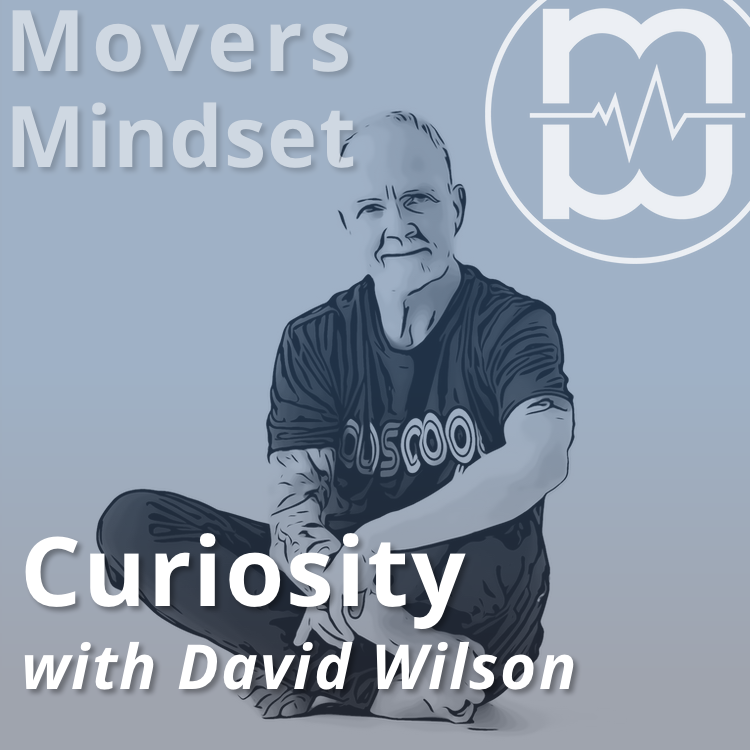
Curiosity with David Wilson
How can older adults reclaim movement as a joyful, empowering part of life despite pervasive cultural narratives about aging? Letting go of perfectionism opens the door to playfulness and self-compassion. "If I can be more compassionate toward myself, I can let go of this addiction to competence and just let myself try, and suck. So yeah, I have come to embrace the idea that if a thing is worth doing, it is worth doing badly and playfully." ~ David Wilson (48:45) This conversation with David Wilson explores how movement intersects with aging, self-perception, and cultural narratives. David begins by addressing how deeply internalized ageist beliefs affect people's willingness to move, take up space, and try new things. The discussion challenges the idea that aging necessitates physical decline, emphasizing instead that variety in movement and awareness of personal stories can lead to growth and transformation at any age. David also critiques societal pressures that promote fear-based motivation, and he encourages a shift toward framing movement as a present-moment gift. The conversation moves through practical barriers and misconceptions that keep people inactive, such as rigid goals, perfectionism, and the belief that certain types of exercise are required. It emphasizes meeting oneself where one is, using personal values rather than fixed goals as guides. The importance of self-compassion, playfulness, and the willingness to "do things badly" is highlighted as a more sustainable path toward movement. There’s also a critique of mainstream fitness messaging, which often excludes older populations by failing to address their actual lived experiences. Takeaways Internalized ageism — Movement hesitancy is often rooted in lifelong exposure to ageist narratives absorbed from a very young age. Misconceptions about aging — Many decline-related assumptions are not due to age itself but to reduced movement and lifestyle limitations. Curiosity over goals — Letting go of rigid, timeline-based goals makes space for exploration and deeper engagement with movement. Compassionate self-awareness — Bringing compassion into one’s personal practice enables growth without harsh self-judgment. Playfulness as practice — Play offers a route to joy and learning, especially valuable when countering addiction to competence. Movement generalism — A broad, varied movement practice supports better adaptability and long-term capability. Fear-based fitness culture — Much mainstream messaging about aging and exercise motivates through fear instead of empowerment. Efficiency of the body — The body conserves resources by shedding unused capabilities, so maintaining movement variety is crucial. Accessible movement — Movement does not require equipment, special clothing, or gym memberships—it can be integrated into daily life. Time as a barrier — A perceived lack of time is the most common excuse for not moving, yet even minutes of activity show measurable benefits. Specificity of training — Effective physical preparation must match the demands of real environments rather than generic or repetitive exercise. Gratitude for the body — Pausing to appreciate the body’s enduring support helps reframe limitations and fosters a more engaged relationship with movement. Imagination of aging — How one envisions growing older strongly influences present decisions about health and movement. Practice as identity — How we treat ourselves in movement mirrors how we show up in the world and in relationships. Resources OldsCoolMoves on Instagram OldsCoolMoves website — David Wilson's web site offering online courses and information. Five Minute Movement — A series of short guided sequences emphasizing movement variety. Ageism Unmasked — Tracy Gendron's book exploring the deep roots and effects of ageism. This Chair Rocks — Ashton Applewhite's book offering another perspective on ageism and cultural narratives about aging. Road Scholar — A nonprofit focused on travel and education for older adults. (Written with help from Chat-GPT.) --- Hello👋 I'm Craig Constantine. In the Movers Mindset podcast, I talk with movement enthusiasts to learn who they are, what they do, and why they do it. I'm interested in the nature and philosophy of movement and in exploring themes like independence, self-direction, and human excellence. My interests color each conversation and provide some structure to Movers Mindset. But since I like to take the scenic route, every conversation ends up going somewhere unique. The purpose of Movers Mindset is to create and share great conversations with movement enthusiasts. Each conversation feeds my insatiable curiosity, but I share them to turn on a light for someone else, to inspire them, or to give them their next question. I appreciate your time and attention, and I don’t take it for granted. --- Thank you! Want more? Subscribe to the email list for weekly updates—new episodes and archive highlights delivered to your inbox. I invite you to cultivate a meaningful life—through presence, not pursuit. You can learn more about me and all my projects at, https://craigconstantine.com. If you like what I'm doing through Movers Mindset, learn more about becoming a patron. ɕ
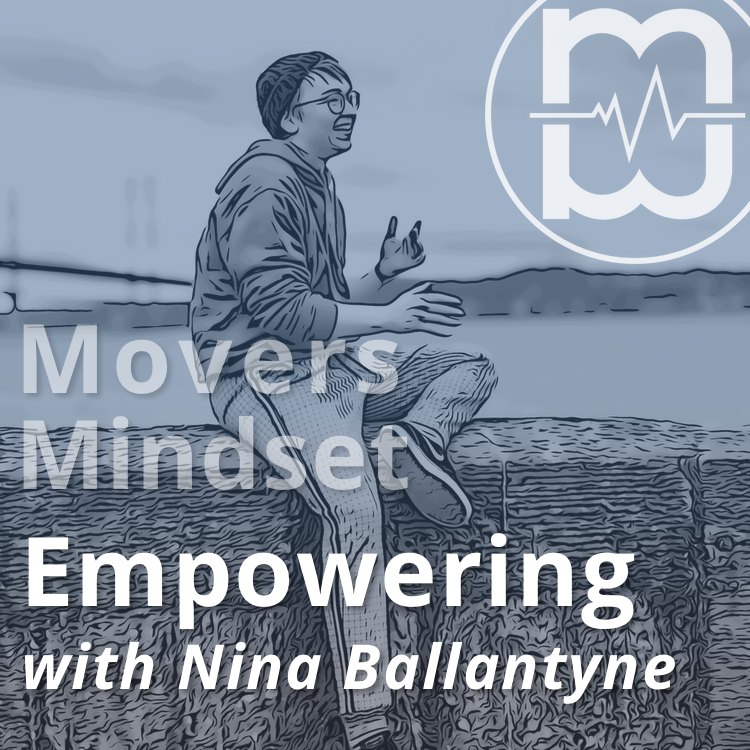
Empowering with Nina Ballantyne
What makes parkour jam spaces unique, and how do they shape the experience of movement, community, and accessibility? A church, a jam space, and a parkour gym—what do they have in common, and why does it matter? "The empowerment, and the kind of liberation to not care what other people think, does have a limit for some folk, I guess. I love it. I think for me, it's been great and really powerful. I really like not caring anymore about being bad at stuff in particular— that's so freeing." ~ Nina Ballantyne (14:00) The conversation explores the concept of parkour jam spaces, emphasizing how they lack defined boundaries, making them more accessible in theory but sometimes intimidating in practice. The discussion touches on the contrast between structured athletic environments and the open, fluid nature of parkour, where new participants must navigate unspoken social norms rather than physical barriers. The conversation also highlights the paradox of accessibility—while jam spaces remove formal entry requirements, social and cultural factors can still create obstacles, especially for marginalized individuals. The discussion transitions into broader themes of public space, inclusivity, and the intersection of parkour with community projects. A significant portion focuses on an initiative to purchase a historic church in Edinburgh and transform it into a community space. The conversation reflects on how physical spaces carry different meanings based on personal and cultural perspectives. The comparison between parkour jam spaces and community-driven spaces like the church highlights the broader theme of reclaiming and redefining public areas for collective benefit. Takeaways Jam spaces and accessibility — The absence of a physical boundary in a jam space doesn’t mean it’s truly open to everyone, as social and psychological barriers still exist. The role of unstructured environments — Unlike traditional sports with defined spaces and rules, parkour operates in public spaces, leading to unique challenges in inclusivity and belonging. Marginalized groups in public spaces — Individuals who are already scrutinized in society, whether due to gender, race, or body type, may experience additional barriers when engaging in parkour. The impact of early experiences — Many practitioners come into parkour without formal athletic backgrounds, which shapes their approach to movement and learning. Cultural norms within parkour — Different communities have their own customs, such as specific greetings or approaches to training, which can be both welcoming and exclusionary. Reclaiming public space — Parkour’s ability to redefine urban spaces extends beyond movement, influencing broader discussions about who has access to and control over public areas. Indoor vs. outdoor training — While some practitioners prefer the spontaneity of outdoor training, indoor spaces provide a structured environment that can be more accessible to beginners or marginalized groups. The intersection of parkour and community work — The discussion about repurposing a church into a community space parallels parkour’s ethos of adapting and reclaiming environments. The perception of churches as public spaces — Depending on cultural background, a church can be seen as either a welcoming community hub or an exclusive, imposing institution. The role of storytelling in community building — Sharing experiences and narratives within parkour fosters a sense of shared culture and belonging. The importance of understanding different motivations — Some practitioners seek challenge, while others prioritize playfulness, relaxation, or self-expression. The limits of parkour’s inclusivity — While parkour prides itself on being an open and adaptable discipline, social realities can still make participation difficult for some individuals. Resources Access Parkour — A parkour organization in Scotland that provides training opportunities and works on community-focused projects. Leith St Andrews Trust — The charitable organization working to purchase and repurpose a church in Edinburgh as a community space. Coach Europe — A parkour coaching conference that brings together practitioners to discuss teaching methodologies and movement philosophy. Richard Marshall — A parkour practitioner and speaker who discusses the importance of play in movement training. (Written with help from Chat-GPT.) --- Hello👋 I'm Craig Constantine. In the Movers Mindset podcast, I talk with movement enthusiasts to learn who they are, what they do, and why they do it. I'm interested in the nature and philosophy of movement and in exploring themes like independence, self-direction, and human excellence. My interests color each conversation and provide some structure to Movers Mindset. But since I like to take the scenic route, every conversation ends up going somewhere unique. The purpose of Movers Mindset is to create and share great conversations with movement enthusiasts. Each conversation feeds my insatiable curiosity, but I share them to turn on a light for someone else, to inspire them, or to give them their next question. I appreciate your time and attention, and I don’t take it for granted. --- Thank you! Want more? Subscribe to the email list for weekly updates—new episodes and archive highlights delivered to your inbox. I invite you to cultivate a meaningful life—through presence, not pursuit. You can learn more about me and all my projects at, https://craigconstantine.com. If you like what I'm doing through Movers Mindset, learn more about becoming a patron. ɕ





Get this podcast on your phone, Free


Create Your Podcast In Minutes
- Full-featured podcast site
- Unlimited storage and bandwidth
- Comprehensive podcast stats
- Distribute to Apple Podcasts, Spotify, and more
- Make money with your podcast