Business for Good Podcast
https://businessforgoodpodcast.libsyn.com/rssEpisode List

Vasectomies, Family Planning, and Environmental Pressure with Dr. Douglas Stein (The Vasectomist)
Episode Summary: What if one of the highest-leverage climate and poverty interventions isn't a new technology, a policy mandate, or a venture-backed breakthrough, but simply making permanent contraception easier for men to choose? In this episode of Businesses For Good, host Paul Shapiro sits down with Dr. Douglas Stein, a Florida physician known as "The Vasectomist," who has performed 45,000+ vasectomies and taken his work internationally, including providing free procedures and (in some cases) small cash offsets for travel and missed wages. Their conversation moves beyond the clinic into systems: fertility rates, infrastructure strain, unintended pregnancies, cultural and religious resistance, and the practical barriers that keep men from sharing the family-planning burden. You'll also hear an honest debate about incentives, the limits of government policy, and the bigger question underneath it all: if we believe human ingenuity can solve hard problems, what would it look like to proactively reduce pressure on the planet through voluntary family planning? Things You Will Learn: Why vasectomy adoption is less about medicine and more about behavior, trust, and access. How Dr. Stein thinks about incentives, and why he frames them as cost offsets. What policy and infrastructure gaps keep family planning from scaling in lower-income regions, even when demand is high. Tools & Frameworks Covered: No-Scalpel Vasectomy Model: a simplified, low-instrument approach that enables portability and scale. Access + Friction Framework: why adoption depends on availability, education, and practical logistics (time, travel, wages). Systems Lens on Population & Biodiversity: connecting fertility trends to infrastructure strain, resource use, and biodiversity outcomes. #BusinessForGood #SustainableBusiness #FutureOfFood #AlternativeProtein #FamilyPlanning
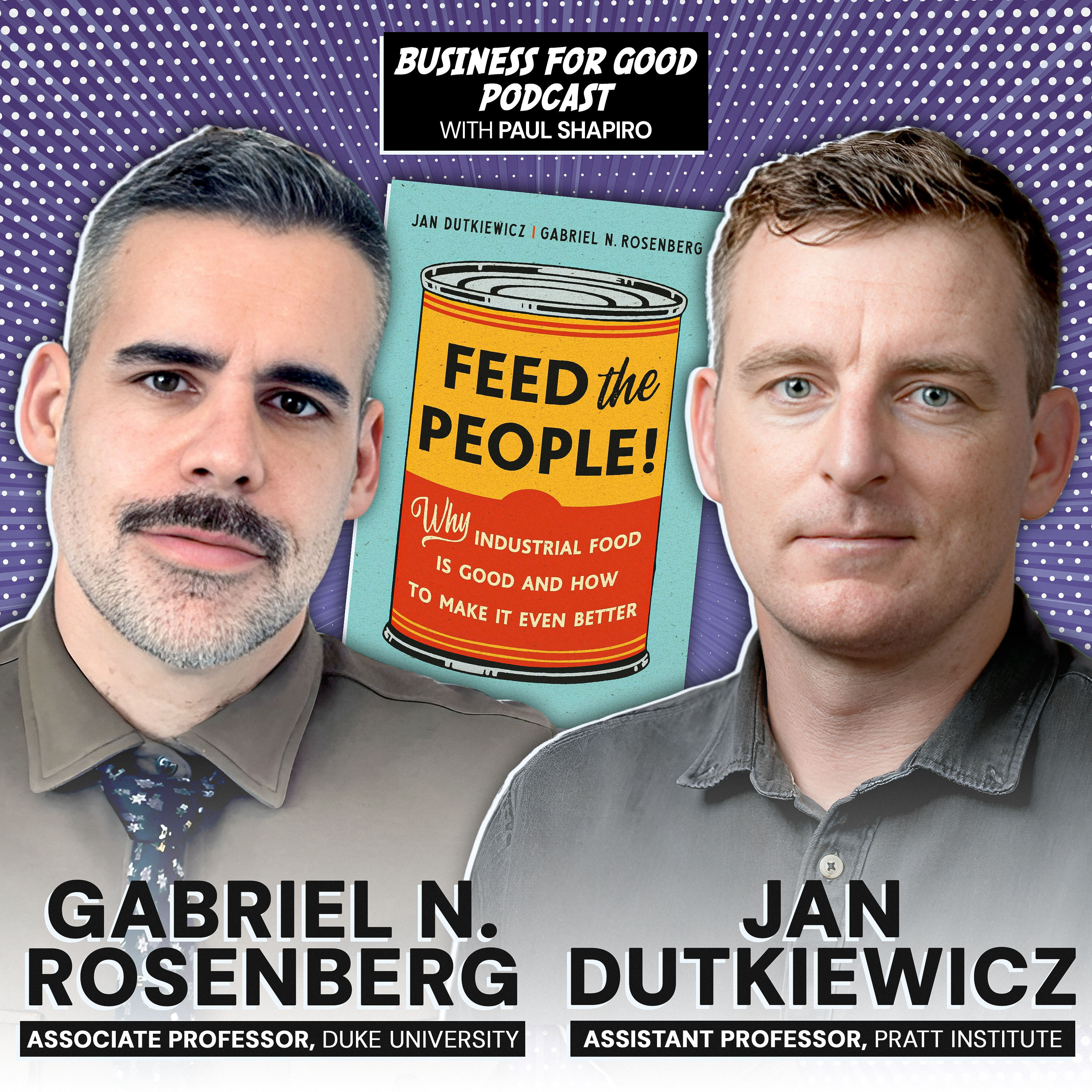
Feed the People Authors on Abundance, Food Policy, and Meat Demand
Episode Summary What if the global food system isn't "broken" in the way sustainability debates usually claim, and treating it that way leads to worse decisions? Paul Shapiro sits down with Jan Dutkiewicz and Gabriel Rosenberg, authors of Feed the People, to unpack how industrial scale and trade created unprecedented food abundance, why "eat local" and small-farm nostalgia collapses at 8 billion people, and what practical policy levers can improve outcomes without fantasy. They explore a clear framework, more food, less feed, no fuel, why animal agriculture remains an inefficient use of land and protein, and how public policy can reshape meat demand by changing incentives instead of accepting forecasts as fate. You'll leave with sharper systems thinking, grounded tradeoffs, and a clearer view of what scalable food system decarbonization can actually look like. Things You Will Learn How to evaluate food system claims using systems logic instead of slogans. Why meat demand rises, and how policy can bend the curve without moralizing. What "more food, less feed, no fuel" implies for land use, emissions, and investment priorities. Tools & Frameworks Covered More food, less feed, no fuel. Prioritizes crops for human food over animal feed and biofuels. Incentives over narratives. Shows how policy choices shape production, prices, and demand. Democratic hedonism. Meets people where they are, then reduces harm at scale. #BusinessForGood #SustainableBusiness #FutureOfFood #AlternativeProtein #FoodSystemDecarbonization
Bruce Friedrich (Good Food Institute) on Taste, Price, and What It Takes to Scale Alternative Meat
Alternative meat looks like it is collapsing. Startups are shutting down, funding is drying up, and headlines are calling the category finished, but that reaction may reflect a misunderstanding of how technological revolutions actually unfold. Bruce Friedrich, President of the Good Food Institute and author of Meat: How the Next Agricultural Revolution Will Transform Humanity's Favorite Food and Our Future, explains why most people will not change behavior for values alone, why price and taste are the real adoption gates, and why "only" $3 billion in cultivated meat funding is far smaller than it sounds when spread across years and companies. Paul and Bruce discuss what it will take to reach taste and price parity, why governments increasingly view alternative protein as food security and national security infrastructure, and why today's failures can be a normal feature of early-stage category formation rather than proof the model will not work. You will leave with a clearer, more evidence-driven view of what is happening now and what progress actually looks like. Things You Will Learn: How taste and price parity shape S-curve adoption in food, regardless of ethics or intent Why $3B in cultivated meat investment may be insufficient relative to comparable industrial innovation cycles How food security, geopolitical risk, and economic competitiveness are driving government interest in alternative protein Tools & Frameworks Covered: S-Curve Adoption – helps evaluate whether setbacks are normal in scaling technologies Eliminating the Green Premium – helps frame what it takes for sustainable products to win at mass-market scale B2B Enablement Strategy – helps identify leverage points that unlock category-wide progress #BusinessForGood #SustainableBusiness #FutureOfFood #AlternativeProtein #PrecisionFermentation

Modern Mill's Chris Guimond on Upcycling Rice Hulls Into Low Maintenance Building Materials
Episode Summary A rice field does not look like the starting point for a scalable building materials company until you understand the economics behind it. In this episode of Business For Good, Paul Shapiro sits down with Chris Guimond, Founder and CEO of Modern Mill, to explore how discarded rice hulls are being transformed into ACRE, a wood like siding, decking, and trim product designed to replace old growth lumber. Chris explains why deforestation is a supply and demand problem, how Modern Mill cracked the manufacturing and adoption challenges that derail most composites, and what it takes to raise significant capital to build real infrastructure in the United States. The conversation covers circular economy manufacturing, competing with billion dollar incumbents, and why climate solutions scale only when they outperform existing systems on cost, durability, and ease of use. Things You Will Learn Why most sustainable materials fail at adoption and how to avoid that trap How supply chain location determines whether upcycling works economically What it takes to scale a hard tech manufacturing business in a legacy industry Tools and Frameworks Covered Supply chain proximity strategy to control logistics costs and reliability Adoption first product design for builders and contractors Capacity planning to scale manufacturing without breaking trust Episode Timestamps 05:10 – Why rice hulls present a hidden opportunity in building materials 08:56 – Cracking the code on turning agricultural waste into scalable products 13:20 – Why most composites fail to replace wood 25:20 – How logistics and location shape upcycling economics 35:10 – Scaling capacity before demand fully arrives #BusinessForGood #SustainableBusiness #CircularEconomy #ClimateSolutions #FutureOfFood
Deep Fission: Using Boreholes to Cut Nuclear Costs and Deliver 24/7 Clean Electricity
What if the fastest path to reliable clean electricity is not a new reactor design, but a new place to put one? In this conversation, Paul Shapiro speaks with Elizabeth Muller, CEO of Deep Fission, about a plan to place a conventional pressurized water reactor roughly a mile underground to use geology, gravity, and groundwater for containment, pressure, and emergency cooling, potentially cutting total nuclear costs by as much as 80%. They unpack how a narrow borehole reactor could serve always-on demand from data centers and industrial users, what "proven tech combined in a new way" really means, how safety and groundwater concerns are handled through regulation and engineering practices, and the practical milestones from pilot to commercial operation so listeners can evaluate what it would take for underground nuclear to scale. Things You Will Learn How putting a conventional reactor in a mile-deep borehole can replace major above-ground systems and cut nuclear cost drivers. How Deep Fission thinks about worst-case scenarios, groundwater protection, and regulatory proof points. What milestones convert LOIs into power purchase agreements, and what timelines look like for early deployment. Tools & Frameworks Covered Geology-as-infrastructure – Uses rock, gravity, and water to replace containment and pressurization systems. Mature-tech recombination – Combines proven reactors, drilling, and geothermal heat transfer to speed time to market. Pilot-to-commercial pathway – Separates "go critical" demonstration from commercial electricity generation milestones. Episode Timestamps 04:55 – Why a mile underground could cut nuclear costs by about 80% 08:47 – Borehole size, reactor dimensions, and how the hardware fits 09:31 – Replacement strategy, sealing, and stacking long-term operations 19:45 – Groundwater and safety concerns, what regulators need to see 21:43 – Timeline to power, DOE pilot program, and moving toward commercialization #BusinessForGood #CleanEnergy #NuclearEnergy #EnergyInnovation #ClimateSolutions
You may also like




Get this podcast on your phone, Free


Create Your Podcast In Minutes
- Full-featured podcast site
- Unlimited storage and bandwidth
- Comprehensive podcast stats
- Distribute to Apple Podcasts, Spotify, and more
- Make money with your podcast