Learn Persian with Podgap
https://www.spreaker.com/show/3513112/episodes/feedEpisode List
Podgap (149) | Persian Idioms and Expressions (B2): Why Do Persians Say “Dog” So Much?
In this episode of Podgap, we explore one of the most colorful corners of spoken Persian: dog-related idioms and expressions.You'll learn 10 common expressions that native speakers use in real conversations, including:🐾 Sag-joon (سگجون) – someone incredibly tough and resilient🐾 Sag-do zadan (سگدو زدن) – working hard with little result🐾 Mahall-e sag nazaashtan (محل سگ نذاشتن) – completely ignoring someone🐾 Sag sahebesh ro nemishnase (سگ صاحبش رو نمیشناسه) – a place that is total chaosBut this episode is more than vocabulary.You'll also discover:🔹 Why animals play such a big role in Persian idioms🔹 How native speakers use these expressions in everyday life🔹 Which expressions are funny, which are offensive, and when NOT to use them🔹 A full dialogue featuring all 10 expressions in contextIf you want to sound more natural, understand Iranian humor, and take your Persian beyond textbooks, this episode is for you.🎧 Listen now and tell us:In your language, what animal is used to describe extreme fear, chaos, or a very dirty place?👇 Leave a comment and share your favorite animal-based expression!📚 Patreon members can download:• Full transcript• Vocabulary list with example and transliteration • Worksheet• Bonus dog expressions that didn't make it into the episodeJoin us at patreon.com/podgapEmail: podgapp@gmail.com
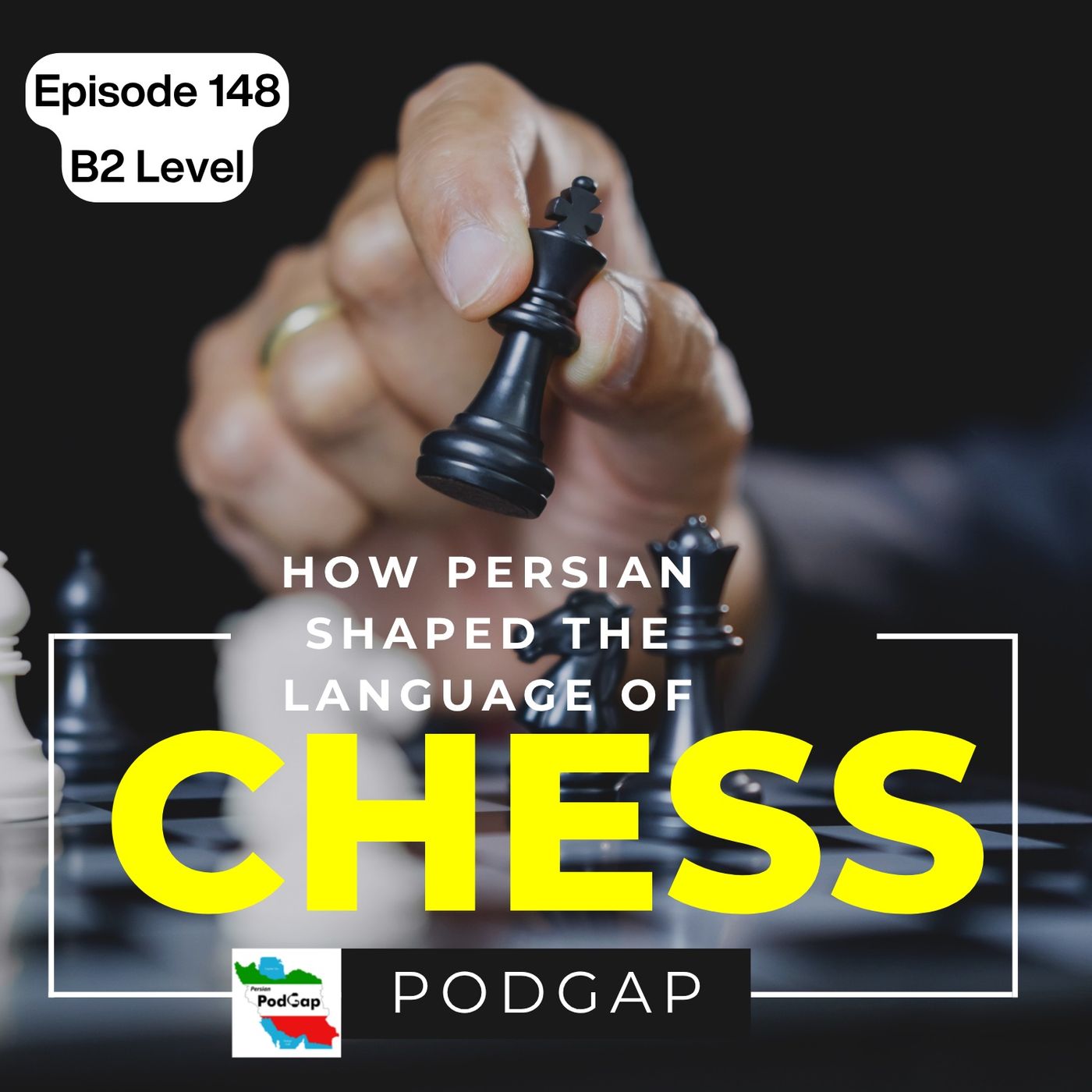
Podgap (148) | Culture & History (B2): How Persian Shaped the Language of Chess
Did you know that “checkmate” comes from the Persian phrase “Shah Mat”?It means the king is helpless — and it’s one of the many ways Persian has left its mark on the world of chess.In this episode of Podgap, we explore the fascinating story of chess: where it began, how it entered Iran during the Sasanian era, and how Persian culture helped shape the game the world knows today.We also talk about the chess pieces in Persian — shah / king, vazir / queen, rokh / rook, fil / bishop, asb / knight, and piyadeh or sarbaz / pawn — and discover which words and expressions traveled from Persian into other languages, including English.Chess is not just a game of strategy. It is a story of language, history, culture, and the journey of words across borders.So, what’s your next move? Listen to the new episode of Podgap and learn Persian through stories, culture, and real conversations.Tell us: Do you play chess? And who taught you your first move?If Podgap makes your Persian learning journey easier and more enjoyable, share it with your friends — it truly means the world to us!We’d also love to hear from you: drop us a message anytime at podgapp@gmail.comWant to dive deeper? By joining us on Patreon.com/podgap
Podgap (147) | Speak Persian Naturally (A-C): Mastering the Sound /q/
Are you struggling with the Persian /q/ sound?You’re not alone! This episode of Podgap focuses on the Persian sound /q/ — one of the most unique and tricky sounds in the language.Join Hanieh and Mohsen for an easy, guided practice that will help you master this Persian sound with confidence.Follow along, repeat with your hosts, and strengthen your pronunciation skills.If Podgap makes your Persian learning journey easier and more enjoyable, share it with your friends — it truly means the world to us!We’d also love to hear from you: drop us a message anytime at podgapp@gmail.comWant to dive deeper? By joining us on Patreon.com/podgap
Podgap (146) | Persian Grammar (A1): Simple Present Conjugation of “Want” and “Come”
Do you know the spoken form of “want” and “come” in the present tense in Persian?In this episode, we break down two of the most essential verbs — khaastan (to want) and aamadan (to come) — and show you how they’re actually used in everyday conversation.Forget the formal textbook versions — you’ll learn the real spoken forms like mikhaam and miyaam, practice them step by step, and hear them in natural dialogues. Perfect for learners who want to sound more natural and understand native speakers with ease.🎁 Bonus: Get your free conjugation poster for these two verbs on our Patreon page.If Podgap makes your Persian learning journey easier and more enjoyable, share it with your friends — it truly means the world to us!We’d also love to hear from you: drop us a message anytime at podgapp@gmail.comWant to dive deeper? By joining us on Patreon.com/podgap
Podgap (145) | Persian Discussion (B2): There's No Place Like Home
In this episode of Podgap, we explore the concept of “home” — not merely as a physical space, but as a source of identity, memory, and emotional connection.While many of us experience a sense of comfort when returning home after a short trip, this feeling takes on deeper meaning for those who have lived abroad for many years.Today, we examine why some individuals choose to return to their homeland even in challenging or uncertain times and what drives this enduring attachment to the place where their roots lie. Through conversation and personal stories, we seek to understand how the idea of home continues to shape our sense of belonging.We host a new Podgap meeting the day after each episode is published. All Patreon members are welcome to join! Even free members can participate. Visit www.patreon.com/podgap to receive the Google Meet details.***If Podgap makes your Persian learning journey easier and more enjoyable, share it with your friends — it truly means the world to us!We’d also love to hear from you: drop us a message anytime at podgapp@gmail.comWant to dive deeper? By joining us on Patreon.com/podgap








Get this podcast on your phone, Free


Create Your Podcast In Minutes
- Full-featured podcast site
- Unlimited storage and bandwidth
- Comprehensive podcast stats
- Distribute to Apple Podcasts, Spotify, and more
- Make money with your podcast
