Episode List

Should You Fight Back If Attacked by a Rapist?
Four women sit around a kitchen table, discussing sandwiches. They are a diverse group. Sophia, 54, is Native and has only been on the street for a year, since her husband died and she couldn’t afford to pay the bills. Juvette, 37, is African American and has been on the street for 12 years, while Lydia, who is white, has been out here for three years. Lastly is Jess, 38, who is Hispanic, has been out here for 15 years. Today they want to talk about serial rapists — those men who prey upon the women on street. These are rapists who attack over and over, counting on the strained relationship between the women and police, knowing that the women are less likely to report an attack to police for fear of being arrested for prostitution and that the police, historically, are less likely to care. In Albuquerque, women who well sex on the street get raped about four times a year and many of the attackers are serial rapists. In fact, there are at least five serial rapists attacking women on the street at any given time. They are men of all ages and backgrounds. We know this because while the women rarely report the attacks to police, they will talk about them to Street Safe volunteers and we keep a list of such men, called the Bad Guy List. On the list at the moment is a bearded white man in his 60s who is known on the street as the Santa Claus rapist. Another is a well-dressed African American man in his 40s who is always described the same way— very nice at first only to change to a monster in an instant. A third is a Latino man in his early 20s who has been on the list since he was a teenager. Because Street Safe keeps a list of such attacks, we also know that almost 15% of these serial rapists specially outfit their cars so they can more easily kidnap the women. They will weld the doors shut, disable the passenger door locks or make sure that once a seatbelt is secured, is can’t be unlocked. That kind of dedication shows that these men are not planning on stopping any time soon. The only ones capable of stopping them are police. Yet, if the men are arrested, the system often fails the women, which is what happened when a serial rapist was arrested this past March.

Discovering you’re a sex trafficking victim
CREATED BY STREET SAFE NEW MEXICO When you work with women on the street, you hear a lot of brutal stories. About addiction. About cruelty. About violence. You try not to let the stories harden you. You hold onto your humanity tightly. You watch over it as if you might lose it at any moment, because that’s the truth. It’s easy to spot the nonprofit worker who’s lost their compassion. They’re the ones who yell at the people they serve and say things to them like, “You should be grateful we’re helping you at all.” But those toxic people probably originally got into service work to help people. Once upon a time they cared about the homeless or the addicted or the trafficked. But over the months or years, the brutal stories or things they witnessed got to them. And the horror got an opening. It proceeded to tease apart their psyche piece by piece until they were burnt out. And once that happens, there is no coming back. So, I’ve learned to protect my humanity like the precious thing it is so I can listen to the next story with compassion and respect. And the next. And the next. After a decade of doing this work, I think I finally figured out the trick — keep yourself in the moment. Don’t dwell on the horror of the story you’re hearing. Instead, focus on the woman telling it to you. Look at her as she is, in the now. And see her as the epic undefeated survivor that she is. But there are certain stories that still break through my best efforts. One that can get through all the security measures I’ve put around my soul. Those are the stories about the moms who sell their kids. They woman who needs money or that next fix so bad, she gives her kids away to strangers for the hour or the night. I’ve met moms like this. Their justifications are like those of all sex abusers. The mom says it doesn’t really hurt the child. Or that youth enjoys it. Or that the teen freely went along because it meant the mom would get what she needed to stop suffering. These types of addicted moms are rare. The vast majority of mothers with addictions would never do such a thing. In fact on the street, if there is a mother selling her child, addicted women — most of whom are mothers — are the first ones to come tell me about it. These women on the street are united in reporting abusive mothers to me knowing that I will tell police and children’s services even though they live in a community where snitching to anyone is forbidden. Thankfully, the police now act on these cases quickly, because selling a child isn’t it just child abuse — it's human sex trafficking. And for the children, they often never realize until decades later that what their parents did to them was trafficking. That is the case for Jessica, who was a teenager in 1999 when her mother first sold her to a man for crack. In this podcast that Jessica learns for the first time that was her mother did was sex trafficking.

When Your Boyfriend Forces You To Sell Sex
When you see a woman who fits your idea of a prostitute walking down the street, what do you think? Do you put blinders on and not think about it all? Do you think, “She’s doing what she has to do to support herself.” Or do you think, like most people, that she’s out there selling sex simply to support drug habit? Do you ever consider another possibility? That maybe she’s out there on that street corner because someone is forcing her to sell sex? Did you know that 90% of women who sell sex on the street are sex trafficking victims or survivors? That they either started selling sex as teenagers or have been forced to sell sex by someone else? Today we are going to talk with one such sex trafficking survivor, who lives in a rundown hotel along the famous Route 66 in Albuquerque, New Mexico. On the street she is called “Vicious.” With her long straight hair and petite build she looks anything but. Yet she would be the first to tell you that as a woman on the street, you have more than a little vicious to survive. MUSIC Loveless1017, "Dangerous World"
How serial killers get away with murder
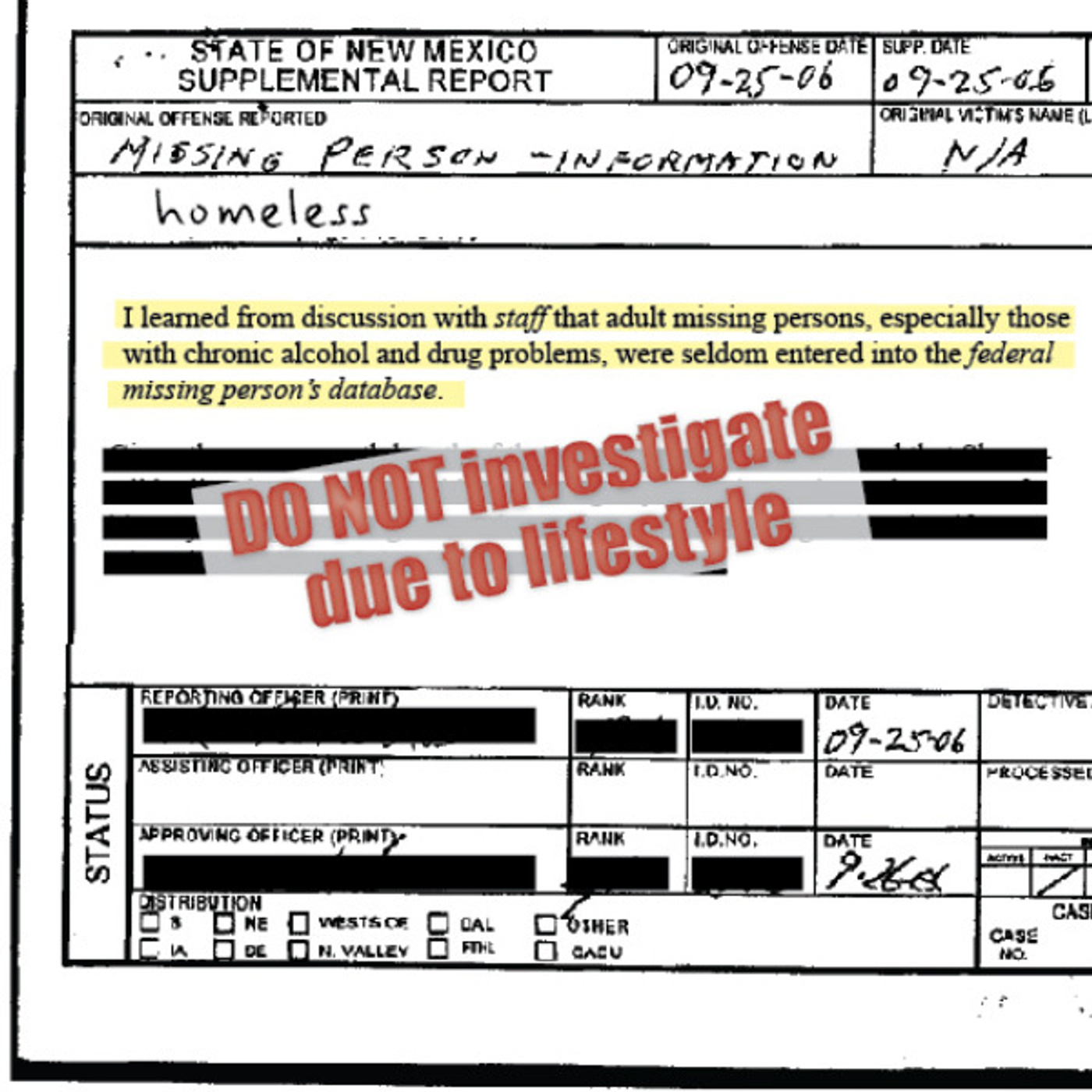
If you are an average American, your chance of being murdered by a serial killer is 0.0004%. That’s three zeros in front of that 4. That’s four ten-thousandths of a percent. But if you are a women selling sex on the street, your chance of being murdered by a serial killer is 7%. That means they are 10,000 times more likely to be targets of a serial killer than most people. Why are women on the street so much more at risk? Law enforcement will tell you it’s because their lifestyle. But what do they mean by that? Do they mean they are more easily located? That they are more visible? That they are easily identifiable? That they will voluntarily get into a suspects car? But the same could be said for women hailing a cab or looking for her Uber ride. They are easily located, outside night clubs or the airport. They are visible as they stand on the street corner and they are easily identifiable as they look eagerly for their ride to come. And will get in without coercion. So that’s not what police are referring to when they say their “lifestyle” puts them at risk. What they are referring to are a group of tendencies they say are shared by women on the street. The tendency to be addicted to drugs or alcohol. The tendency to not stay in one place because they are homeless. The tendency to sell sex to make money. The tendency to be out and about without having to tell another person where they are. To police those tendencies make a lifestyle. And that lifestyle is something serial killers count on. Gary Ridgway, that Green River killer, who killed 48 prostitutes in the 1980s and 90s, said, he picked women on the street because, “I knew they would not be reported missing right away and might never be reported missing. I thought I could kill as many of them as I wanted without getting caught.” And he wasn’t wrong. Several of his victims weren’t reported missing for years and some were never reported missing. Women who live on the street know that if they are taken, it might be weeks or months before anyone comes looking for them. Cindy Jaramillo realized that hard truth when she was kidnapped from the streets of Albuquerque in 1999 by the Toy Box Serial killer. REFERENCES Brewer, D, et al. “Extent, Trends, and Perpetrators of Prostitution-Related Homicide in the United States.” Journal of Forensic Science. 2006. Vol. 51, No. 5 Potterat, J., et al. “Mortality in a Long-term Open Cohort of Prostitute Women.” American Journal of Epidemiology . 2004. Vol. 159, No. 8
One Family. Two Serial Killer Victims.
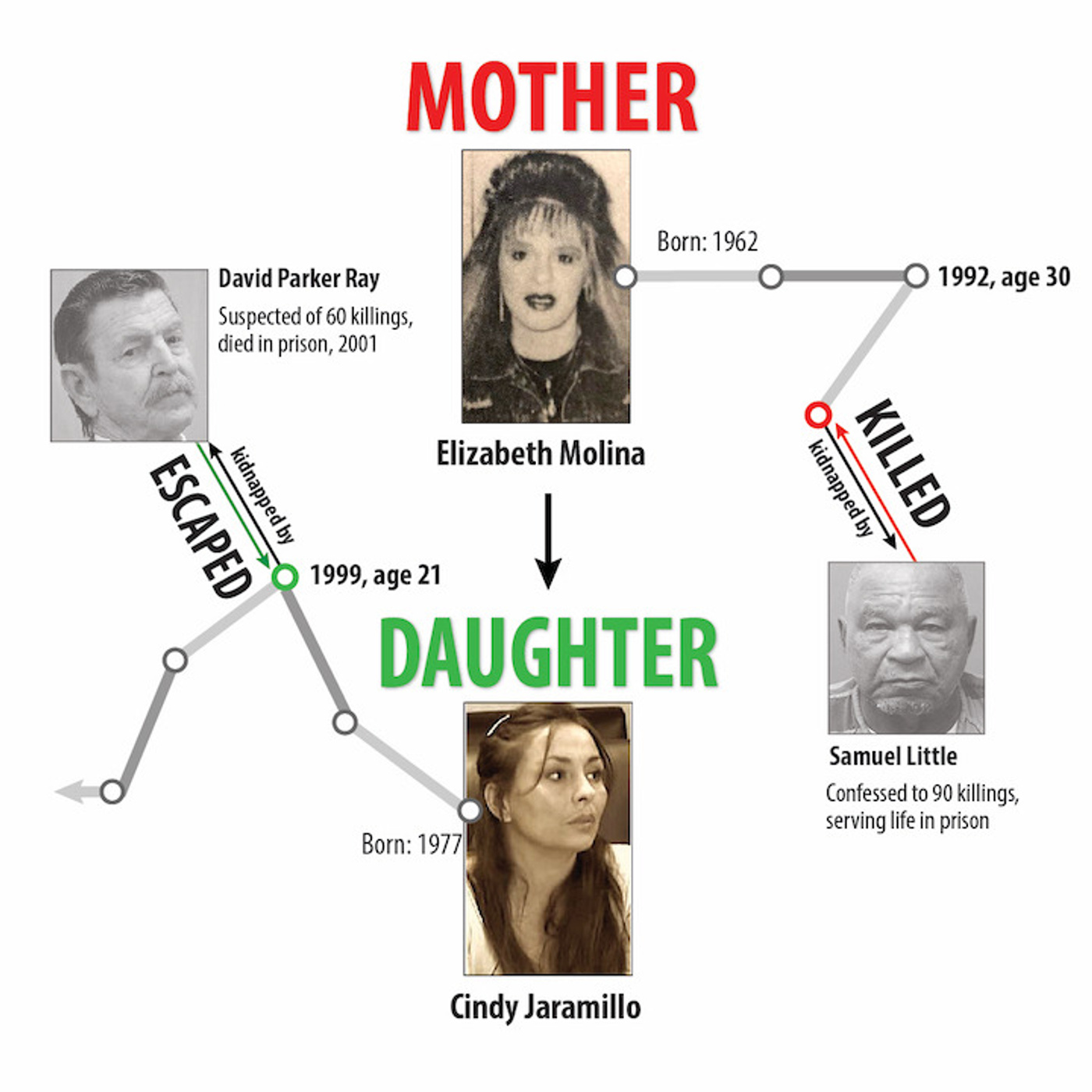
INTRODUCTION: In 1992, when Cindy Jaramillo was 15 her mother died of a drug overdose. Cindy had run away from home by then and was living on the streets of Albuquerque, New Mexico. This was after trying and trying to convince her family that she was being sexually abused by uncle. But no one believed her, except her mother. But all her mom could do was believe her. She was too deep in her own life of partying and drugs to help more. So Cindy ran away and by age 12 she was living on the street and selling drugs. Three years later her mothers death sent even deeper into that world. One morning in March 1999, Cindy was out working when a man in an RV asked for a date. Once inside the RV, he hit her with the sun gun. He kidnapped her and tortured her for three days before she escaped by running to the desert barefoot and naked. Police would later call him the Toy Box serial killer because that was what he called his own personal torture chamber. For most people that experience would mean a lifetime of paralyzing nightmares. But for Cindy it was something to fight against. He was something to fight against. He hadn’t broke her during the torture and he sure as hell wasn't gonna break her life. So she fought. Hard. She got off the street and got clean. She got married and had kids. But that wasn't enough. She wanted to help the women who lived on the streets of Albuquerque as she once did. In 2009 she and I founded Street Safe New Mexico to do just that. The Toy Box serial killer might have died 20 years ago in prison but Cindy still wins every day in her fight against him. But recently it's a completely different serial killer that occupies most of Cindy's thoughts. It's a new development, one that happened only a few months ago. Because that's when that serial killer confessed to killing her mother. MUSIC BY: Luckylittleraven










Get this podcast on your phone, Free


Create Your Podcast In Minutes
- Full-featured podcast site
- Unlimited storage and bandwidth
- Comprehensive podcast stats
- Distribute to Apple Podcasts, Spotify, and more
- Make money with your podcast