
Who Arted: Weekly Art History for All Ages
https://feeds.megaphone.fm/ARML1644080429Episode List
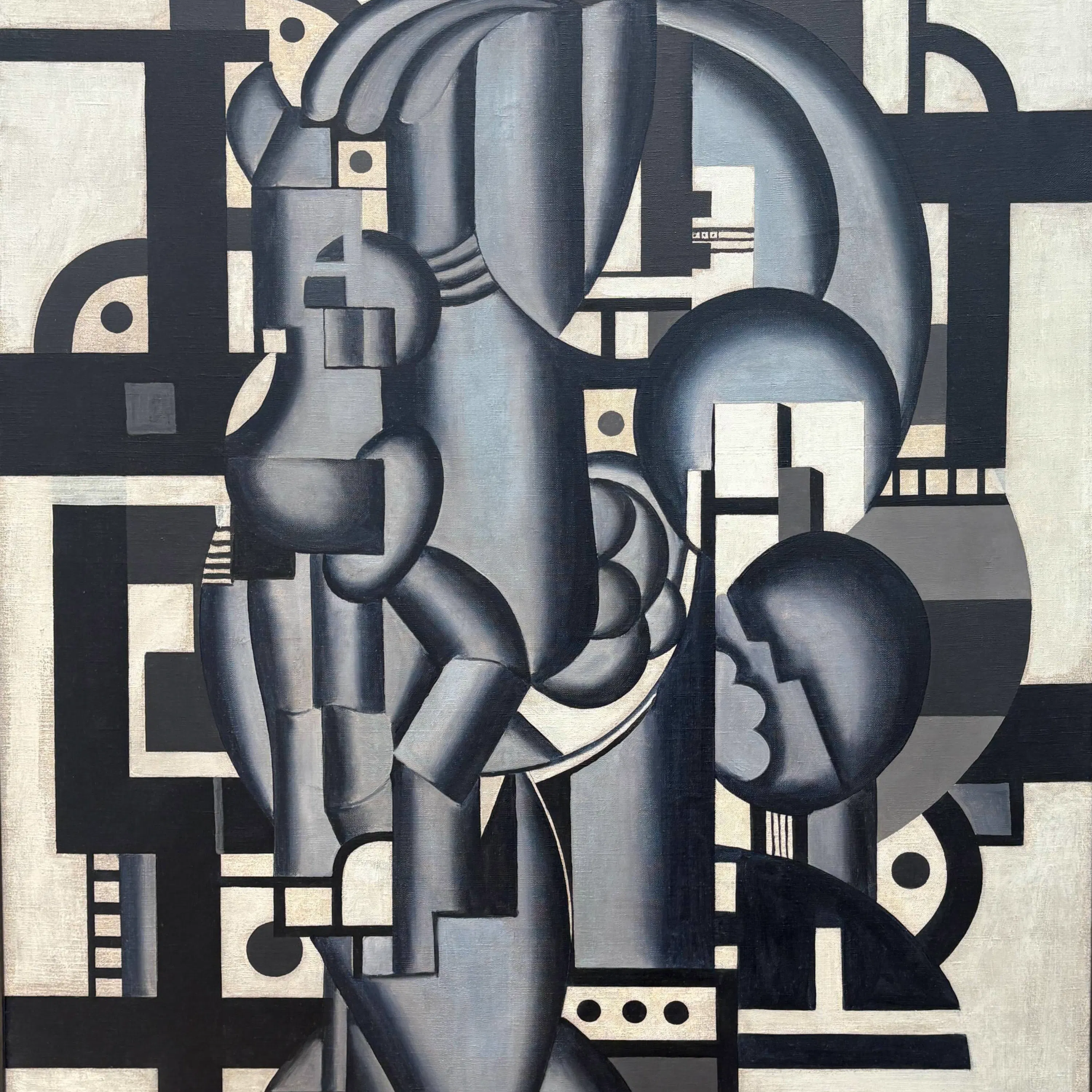
Fernand Léger | Composition in Blue
Fernand Léger was a pioneering French modernist painter whose foundational training as an architectural draftsman profoundly shaped his structured, geometric approach to art. After absorbing the influence of Paul Cézanne and collaborating among avant-garde circles in Paris, Léger developed a distinct variation of Cubism characterized by cylindrical, tubular forms, a style contemporary critics dubbed "Tubism." His military service in World War I, where he survived a gas attack, deepened his fascination with the industrial beauty of modern machinery and inspired his goal to create art accessible to working-class audiences. This perspective catalyzed his "Mechanical Period" during the 1920s, a phase marked by vibrant, machine-like compositions and urban motifs that celebrated industrial progress. Léger's 1921–1927 painting Composition in Blue, housed in the Art Institute of Chicago, exemplifies this mechanical aesthetic and demonstrates rigorous principles of design. Utilizing a limited monochromatic blue palette, hard-edged geometry, and carefully balanced line weights, the piece synthesizes three-dimensional volumetric shapes with flat planes. Beneath its paint layers, conservation analysis reveals a structured grid system that Léger used to systematically map the canvas. By translating machine components into universal abstract harmonies, Léger transformed industrial forms into a lasting modern aesthetic. Listen Ad-Free on Patreon. For just $3 per month, you can get ad-free versions of Fun Facts Daily, Who ARTed and Art Smart. Head over to https://www.patreon.com/cw/FunFactsDailyPod if you are interested. Who ARTed is an Airwave Media Podcast. If you are interested in advertising on this or any other Airwave Media show, email: advertising@airwavemedia.com Learn more about your ad choices. Visit megaphone.fm/adchoices

Stuart Davis | Swing Landscape
Stuart Davis was an influential 20th-century American modernist painter who bridged European abstract movements like Cubism with distinctively American subjects and aesthetics. Born in 1892, Davis studied under Ashcan School leader Robert Henri in New York, where he initially focused on urban realism before finding inspiration in European avant-garde styles at the landmark 1913 Armory Show. Throughout the 1920s and 1930s, he incorporated commercial graphics, consumer packaging, and jazz rhythms into his visual compositions, pioneering an approach that prefigured Pop Art. Active in arts advocacy, Davis worked with the WPA Federal Art Project during the Great Depression and held teaching positions at institutions such as The New School and Yale. One of Davis’s defining works is Swing Landscape (1938), a monumental canvas commissioned by the WPA Federal Art Project for the Williamsburg Houses public housing development in Brooklyn. Taking inspiration from the coastal town of Gloucester, Massachusetts, and the urban energy of New York City, the painting fragmentarily blends industrial, nautical, and architectural motifs into a vibrant arrangement of flattened shapes and bold colors. Named after the swing era of jazz, the composition translates musical syncopation into visual rhythm through sharp geometric shifts and contrasting colors. Although never installed at its intended housing complex site, Swing Landscape stands as a benchmark of American abstract public art and currently resides in the collection of the Indiana University Art Museum. Listen Ad-Free on Patreon. For just $3 per month, you can get ad-free versions of Fun Facts Daily, Who ARTed and Art Smart. Head over to https://www.patreon.com/cw/FunFactsDailyPod if you are interested. Check out my other podcasts Fun Facts Daily | Art Smart | Rainbow Puppy Science Lab Who ARTed is an Airwave Media Podcast. If you are interested in advertising on this or any other Airwave Media show, email: advertising@airwavemedia.com Learn more about your ad choices. Visit megaphone.fm/adchoices

Tamara de Lempicka | Tamara in a Green Bugatti (encore)
Tamara de Lempicka remains the definitive icon of the Art Deco era, blending polished Cubist techniques with the glamorous, high-stakes atmosphere of the Roaring Twenties. From her harrowing escape during the Russian Revolution to her transformation into a Parisian socialite and eventually a Hollywood favorite, her life was a calculated masterpiece of self-invention. Her signature style, characterized by "soft Cubism" and metallic, architectural lighting, captured the spirit of the "New Woman"—independent, liberated, and sophisticated. Known for her relentless self-promotion and a portfolio of portraits that defined modern luxury, she became a favorite of the European aristocracy and the American film elite alike. The legendary self-portrait Tamara in a Green Bugatti serves as a focal point for understanding both the artist and the Art Deco movement. This work embodies the era's obsession with speed, industry, and geometric precision, rejecting the organic curves of Art Nouveau in favor of sleek, machine-age aesthetics. Although she famously curated her public persona even swapping her modest yellow Renault for a high-performance Bugatti on canvas Lempicka’s influence on the world of fashion and fine art remains undeniable. Check out my other podcasts Fun Facts Daily | Art Smart | Rainbow Puppy Science Lab Who ARTed is an Airwave Media Podcast. If you are interested in advertising on this or any other Airwave Media show, email: advertising@airwavemedia.com Learn more about your ad choices. Visit megaphone.fm/adchoices

Artist Interview Emil Wilson | The Nightingales
My guest this week is Emil Wilson, the author and illustrator behind the new graphic novel, The Nightingales. Wilson started his career in advertising before attending art school in his fifties, spurred by the sudden loss of a friend that motivated him to finally take a leap of faith and pursue his true creative passions. We dive into the moving, true story of compassion from 1985 that inspired the book, and he gives us a fantastic behind-the-scenes look at his unique, layered watercolor process. We also chat about why he deliberately avoided reading other comics so he could cultivate his own intimate, authentic, sketchbook-style aesthetic. Find Emil Wilson online: Emil’s website: https://emilwilsonart.com/ Book link: https://www.amazon.com/Nightingales-Emil-Wilson/dp/1668217775 Listen Ad-Free on Patreon. For just $3 per month, you can get ad-free versions of Fun Facts Daily, Who ARTed and Art Smart. Head over to https://www.patreon.com/cw/FunFactsDailyPod if you are interested. Check out my other podcasts Fun Facts Daily | Art Smart | Rainbow Puppy Science Lab Who ARTed is an Airwave Media Podcast. If you are interested in advertising on this or any other Airwave Media show, email: advertising@airwavemedia.com Learn more about your ad choices. Visit megaphone.fm/adchoices

Francisco Goya | The Third of May 1808 (encore)
Francisco Goya (1746-1828) is one of Spain's most important and complex artists. His career bridged the gap between the Old Masters and the modern era. He found success as a court painter for the Spanish monarchy, creating bright, lively tapestry designs for the royal palaces. However, a devastating illness in 1792 that left him completely deaf marked a profound turning point. His art took on a darker, more critical tone, evident in his series of satirical etchings, Los Caprichos, which targeted the follies of Spanish society. The horrors he witnessed during Napoleon's invasion of Spain (1808-1814) were unflinchingly documented in his print series, The Disasters of War. In his final years in Spain, Goya painted his most enigmatic and disturbing works, the "Black Paintings," directly onto the walls of his country home, creating private, nightmarish visions like Saturn Devouring His Son. The Third of May 1808, painted in 1814, is a monumental and revolutionary depiction of war. Breaking from centuries of tradition that glorified battle, Goya focuses on the brutal, systematized execution of captured Spanish civilians by a faceless French firing squad. The painting's power comes from its raw emotion, its dramatic use of light to illuminate the victims, and its central, Christ-like figure whose gesture of martyrdom has become a universal symbol of protest. As one of the first truly modern paintings, The Third of May 1808 stripped war of its romance and its influence resonates through the history of art, most notably in works by Édouard Manet and Pablo Picasso's famous anti-war mural, Guernica. Related episodes: Édouard Manet Pablo Picasso Auguste Rodin Check out my other podcasts Fun Facts Daily | Art Smart | Rainbow Puppy Science Lab Who ARTed is an Airwave Media Podcast. If you are interested in advertising on this or any other Airwave Media show, email: advertising@airwavemedia.com Learn more about your ad choices. Visit megaphone.fm/adchoices








Get this podcast on your phone, Free


Create Your Podcast In Minutes
- Full-featured podcast site
- Unlimited storage and bandwidth
- Comprehensive podcast stats
- Distribute to Apple Podcasts, Spotify, and more
- Make money with your podcast
