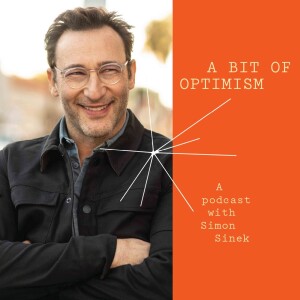
A Bit of Optimism
https://rss2.flightcast.com/mbqbwjr8ssv2vt5jgwcv3w20.xmlEpisode List

How to Say the Hard Thing and Keep the Relationship | A Bit of Optimism: Feelings at Work | PART 5
Every lasting relationship has survived at least a few hard conversations. But most of us would still rather not have them... So we put them off and tell ourselves the tension will fade on its own. Instead it goes underground: into the stories we build about people, the resentments we quietly collect, and the side-texts we send about a colleague we won't talk to directly.But a hard conversation is a short burst of discomfort in exchange for something better on the other side: trust, collaboration, and a relationship strong enough to survive the next one. Feelings at Work is a special five-part series from A Bit of Optimism, where Simon Sinek and Alex Simon, founder of LifeShop, explore the human skills that shape how we work, lead, and build relationships. Together, they unpack the emotional challenges most of us face every day—from people pleasing and listening to giving feedback, taking accountability, and having difficult conversations.In this final episode, Simon and Alex take on hard conversations: why tension is telling us something useful, why the story we build about someone gets harder to undo the longer we wait, and what to actually say when it's time to have the hard conversation.Simon and Alex share tools like how to know when to bring something up so you don't show up hot, how to break the fourth wall and reset a conversation that's already going sideways, and the practice of “Watering Someone’s Flowers.” In this episode you'll learn:➡️ Why tension is a smoke signal telling you to address something ➡️ How conflict is a team sport for mutual understanding➡️ How to move from "you're the problem" to both of you facing it together ➡️ The "resentment gremlin" + why feeding it feels so satisfying ➡️ When to initiate a hard conversation ➡️ Why it’s important to start with a request for grace➡️ “Watering someone's flowers”: the practice that softens any tension➡️ What to do instead of “feedback sandwiches”➡️ How to interrupt, reset, and take something back during a conversation Whether you're leading a team, dreading a review, or rehearsing the same speech in your car for the third week running, learning how to have hard conversations is an essential skill to build. And remember: a hard conversation isn't a sign that something has gone wrong. It's a sign that something matters enough to fix.This... is A Bit of Optimism.+ + +CHAPTERSChapters00:00:00 When Conflict Turns People Into Monsters00:02:16 Reframing Tension: It's a Sign, Not a Problem00:02:43 The Resentment Gremlin: How Waiting Makes It Worse00:03:50 Oh No, Let's Just Skip It: Why Hard Conversations Feel Impossible00:08:01 The Passive Aggressive Company: When Tens of Thousands Avoid Feedback00:10:02 When Passive Aggression Is The Solution to Conflict00:11:15 What Actually Stops Us: Fear, Narrative Building, and Self-Righteousness00:20:38 Conflict Is a Team Sport for Mutual Understanding00:23:04 You're Not the Problem, I'm Not the Problem: The Problem Is the Problem00:25:21 The Interruption Technique That Stops Character Assassination00:26:27 Timing Matters: Not Too Hot, Not Too Cold00:28:31 Setting a Goal: What Do You Actually Want From This?00:29:44 Asking for Grace Grace: "I'm Going to Get This Wrong"00:33:07 How to "Water Someone's Flowers"00:38:02 Try This Instead of Feedback Sandwiches00:40:25 Breaking the Fourth Wall: Pause, Reset, and Start Again00:43:41 The Scaffolding Philosophy: Messy Humans Need Support Structures+ + +Website: http://simonsinek.com/Leaderful: https://simonsinek.com/leaderfulPodcast: http://apple.co/simonsinekInstagram: https://instagram.com/simonsinek/Linkedin: https://linkedin.com/in/simonsinek/Twitter: https://twitter.com/simonsinekFacebook: https://www.facebook.com/simonsinek+ + +About Alex SimonAlex Simon is the founder of Lifeshop, a school for adult emotional education and teaches emotional intelligence at Yale University. She teaches the emotional and communication skills we all should've learned in school—but didn't.She facilitates experiential workshops on how to have hard conversations, stop people pleasing, listen better, navigate major life transitions, and build healthier relationships. Her sessions are practical, deeply connective, and somehow shockingly fun.When she was 27, Alex created The Self & Other: In Theory and Practice, one of Yale's most sought-after courses.In 2025, she founded Lifeshop in New York to bring emotional education beyond the classroom and into everyday life. She also launched The School of Life in New York and leads workshops for organizations around the world.Before dedicating her career to emotional education, Alex worked as a management consultant at Bain and held strategy and operations roles across industries. She has also lived and trained at Plum Village and Esalen and completed dozens of programs in mindfulness, communication, and personal development.

Why Being Right Is Costing You Trust | A Bit of Optimism: Feelings at Work | PART 4
Everyone says they want more accountability at work… yet few of us think we're the ones who need to learn how to be more accountable.Most of us believe we already know how to own a mistake. We've all said sorry and truly meant it. But meaning it and doing it well are two very different things. And when we’re the first to apologize, we model to everyone around us how cathartic accountability can be.Feelings at Work is a special five-part series from A Bit of Optimism, where Simon Sinek and Alex Simon, founder of LifeShop, explore the human skills that shape how we work, lead, and build relationships. Together, they unpack the emotional challenges most of us face every day—from people pleasing and listening to giving feedback, taking accountability, and having difficult conversations.In this episode, Simon and Alex take on accountability: why owning a mistake can feel like losing, why taking credit and dodging blame come from the same place, and what a real repair actually looks like.You'll discover why owning your part doesn't mean admitting you were wrong, why the confidence to say, "I got that wrong," is what actually makes people follow you, and how to repair something in a way that genuinely clears a pathway forward. Simon and Alex share practical tools like the "wheelie bag" rule for separating intent from impact, the two-part formula that turns an empty gesture into apologies people can actually feel, Alex's practice of "micro-accountability" for owning small things before they accumulate, and the one word that quietly cancels everything you said before it.In this episode you'll learn:➡️ Why saying you're sorry doesn't mean you're wrong➡️ The two-part apology formula: what you actually did + the impact it had➡️ How to name someone's hurt + leave room to be corrected➡️ "Micro-accountability": owning the small stuff before it turns into the big stuff➡️ Why people who take too much credit are the same people who dodge blame➡️ What real confidence actually looks like➡️ How to receive an apology and why refusing it is its own kind of failure➡️ Why being uncoachable is the biggest problem at work➡️ How to ask people to build the fix with youWhether you're leading a team, rebuilding trust with a colleague, or still quietly replaying an argument from three years ago, accountability is one of the most healing skills you can develop.And remember: owning your part is a gift you give the other person AND you give yourself.This... is A Bit of Optimism.+ + +CHAPTERSChapters00:00:00 Why Nobody Thinks They Need to Learn How to Apologize00:05:49 The Wheelie Bag Philosophy: What Saying Sorry Actually Means00:08:52 Why People Who Take Too Much Credit Can't Handle Blame00:10:15 Blame Culture: Why Our First Instinct Is Always to Point Fingers00:13:37 The Difference Between Being Wrong and Taking Accountability00:17:34 The Catharsis of Apologizing: Relief for Both Sides00:24:04 The Leader Who Gives All Credit and Takes All Blame00:27:55 The Anatomy of a Real Apology: Recognition Plus Impact00:30:19 When Guessing the Impact Goes Wrong00:33:46 Repair In Real-Time With Micro-Accountability 00:35:17 The Three-Part Apology That Finally Landed00:41:06 How to Receive an Apology Without Twisting the Knife00:43:18 When Sorry Isn't Enough Without Behavioral Change00:46:16 When You Can't Just Fix It: Asking for Help With Repair00:49:57 Why We All Think We Already Know How to Apologize00:51:10 Accountability Is the Gateway to Trust+ + +Website: http://simonsinek.com/Leaderful: https://simonsinek.com/leaderfulPodcast: http://apple.co/simonsinekInstagram: https://instagram.com/simonsinek/Linkedin: https://linkedin.com/in/simonsinek/Twitter: https://twitter.com/simonsinekFacebook: https://www.facebook.com/simonsinek+ + +About Alex SimonAlex Simon is the founder of Lifeshop, a school for adult emotional education and teaches emotional intelligence at Yale University. She teaches the emotional and communication skills we all should've learned in school—but didn't.She facilitates experiential workshops on how to have hard conversations, stop people pleasing, listen better, navigate major life transitions, and build healthier relationships. Her sessions are practical, deeply connective, and somehow shockingly fun.When she was 27, Alex created The Self & Other: In Theory and Practice, one of Yale's most sought-after courses.In 2025, she founded Lifeshop in New York to bring emotional education beyond the classroom and into everyday life. She also launched The School of Life in New York and leads workshops for organizations around the world.Before dedicating her career to emotional education, Alex worked as a management consultant at Bain and held strategy and operations roles across industries. She has also lived and trained at Plum Village and Esalen and completed dozens of programs in mindfulness, communication, and personal development.

What Is Your Team Afraid to Tell You? | A Bit of Optimism: Feelings at Work | PART 3
Giving and receiving feedback is one of the hardest things we do at work and most of us just... avoid it.But avoiding feedback has a cost. Everything you need to grow is already in the room and it's just sitting in your blind spot. Your colleagues can see it. Your boss can see it. And nobody will tell you, unless you learn to ask.Feelings at Work is a special five-part series from A Bit of Optimism, where Simon Sinek and Alex Simon, founder of LifeShop, explore the human skills that shape how we work, lead, and build relationships. Together, they unpack the emotional challenges most of us face every day—from people pleasing and listening to giving feedback, taking accountability, and having difficult conversations. In this episode, Alex and Simon take on feedback: how to give it, how to take it, and how to ask for it. You’ll discover ways to give feedback people can actually hear, receive criticism without taking it personally, and build a feedback culture on any team. Alex and Simon share practical techniques like the one-word ritual Simon borrowed from the Air Force that made his whole company crave critiques, the “FBI” method for delivering hard feedback without blowing up relationships, and questions Alex asks her team to surface everything left unsaid, like "What are you afraid to tell me?"In this episode you'll learn:➡️ Why we avoid giving feedback + what that avoidance quietly costs our teams ➡️ "Spears": the Air Force ritual that turns criticism into something people actually want ➡️ The “FBI” (Feelings, Behavior, Impact) method for giving feedback people can actually hear ➡️ The Army Rangers' peer assessment’s "foxhole question" + what it reveals about character ➡️ How to think of feedback as preventative care and build that muscle➡️ Why everyone receives feedback differently (+ how to give people what they need)➡️ When to give feedback (hint: never the moment you think of it) ➡️ The four-word habit that builds a thick skin: "What can I do better?"Whether you're leading a team, managing up, or just tired of side-texting about a problem no one will name out loud, feedback is one of the most valuable skills you can build. And remember: feedback is kind, even when it’s not nice.This... is A Bit of Optimism.+ + +Chapters00:00:00 The Spinach in Your Teeth Problem: Why Nobody Tells You00:03:48 The Story of Two Failed Feedback Sessions00:06:37 Why Feedback Obsession Changes Everything00:08:05 The Company That Was Too Nice to Give Feedback00:10:35 Army Rangers and the Three-Level Evaluation System00:14:24 Why Giving Feedback Feels So Hard 00:17:16 Spears: The Air Force Technique That Changed Everything00:20:08 All the Information You Need Is in Your Blind Spot00:22:28 FBI: The Three-Part Formula for Feedback That Lands00:25:37 Why Vague Praise Doesn't Help Anyone00:27:16 Credit Is Free: Recognition Languages at Work00:31:05 The Collaboration Meeting: Preventing Problems Before They Start00:42:34 The Air Force Commander Who Cried Every Night for Six Months00:45:08 When to Give Feedback: Not When You Think of It00:47:24 The Virtuous Cycle: What Happens When You Get Feedback Right00:49:08 How to Build the Muscle of Receiving Feedback00:51:43 Generational Difference For Feedback 00:52:57 One Simple Question: What Can I Do Better?00:55:49 Feedback Is Kind Even When It's Not Nice+ + +Website: http://simonsinek.com/Leaderful: https://simonsinek.com/leaderfulPodcast: http://apple.co/simonsinekInstagram: https://instagram.com/simonsinek/Linkedin: https://linkedin.com/in/simonsinek/Twitter: https://twitter.com/simonsinekFacebook: https://www.facebook.com/simonsinek+ + +About Alex SimonAlex Simon is the founder of Lifeshop, a school for adult emotional education and teaches emotional intelligence at Yale University. She teaches the emotional and communication skills we all should've learned in school—but didn't.She facilitates experiential workshops on how to have hard conversations, stop people pleasing, listen better, navigate major life transitions, and build healthier relationships. Her sessions are practical, deeply connective, and somehow shockingly fun.When she was 27, Alex created The Self & Other: In Theory and Practice, one of Yale's most sought-after courses.In 2025, she founded Lifeshop in New York to bring emotional education beyond the classroom and into everyday life. She also launched The School of Life in New York and leads workshops for organizations around the world.Before dedicating her career to emotional education, Alex worked as a management consultant at Bain and held strategy and operations roles across industries. She has also lived and trained at Plum Village and Esalen and completed dozens of programs in mindfulness, communication, and personal development.

The Secret to Better Conversations Isn't Talking | A Bit of Optimism: Feelings at Work | PART 2
The fastest way to improve your relationships isn't talking. It's listening.Most of us hear what's being said. Very few of us know how to make someone feel heard.Feelings at Work is a special five-part series from A Bit of Optimism, where Simon Sinek and Alex Simon, founder of LifeShop, explore the human skills that shape how we work, lead, and build relationships. Together, they unpack the emotional challenges most of us face every day—from people pleasing and listening to giving feedback, taking accountability, and having difficult conversations.In this episode, they explore one of the most important communication skills we can develop: listening.Together, they share practical techniques to improve your listening skills, build trust, navigate difficult conversations, and create better outcomes at work and at home. You'll learn why people often ask for one thing but actually need another, how to stop jumping into fix-it mode, and Alex's simple Four-Second Rule for becoming a better listener.When people feel heard, relationships grow stronger, conflicts become easier to navigate, and conversations become more meaningful.Because better conversations don't require everyone to be a great listener.They only require one.In this episode you'll learn:➡️ Why hearing someone isn't the same as making them feel heard➡️ How to stop jumping into "fix-it mode" and start listening with curiosity➡️ Alex Simon's simple Four-Second Rule for becoming a better listener➡️ Why people often ask for one thing but actually need something else➡️ How better listening builds trust, strengthens relationships, and improves teamwork➡️ How to navigate conversations when power dynamics are involvedWhether you're leading a team, supporting a friend, or navigating a difficult conversation, listening is one of the most valuable skills you can develop.Because when people feel heard, relationships grow stronger, conflict becomes easier to navigate, and better conversations follow.This... is A Bit of Optimism.+ + +Chapters00:00:00 Listening to Understand vs Listening to Be Right00:00:38 Why Most of Us Are Bad Listeners00:02:08 What People Ask For vs What They Actually Want00:02:53 The Four-Second Rule for Better Listening00:04:05 Defining What Listening Is NOT00:05:42 Listening Beyond Words: Tone, Volume, and Subtext00:06:33 The Problem With Knee-Jerk Problem Solving00:07:14 The Real Story: When We Failed to Listen and Lost an Employee00:10:56 Needs vs Strategies: Understanding What's Really Being Asked00:12:28 Being Present: The Social Benefit of Meditation00:15:48 Body Language: Squaring Up and Putting Phones Away00:18:26 Listening With Warm Eyes That Believe in Them00:21:50 When Defensiveness Gets in the Way00:26:46 The Four-Second Rule in Action00:29:28 Is There More? The Buddhist Question That Peels Back Layers00:31:11 Creating Self-Reliance Through Listening00:34:26 Listening and Power Dynamics at Work00:35:16 Creating Safety So People Don't Withhold Information00:36:08 Why People Repeat Themselves Over and Over00:37:45 Reflective Listening: When to Mirror Back What You Hear00:40:11 Be As You Wish to Seem: Authenticity in Listening00:41:42 Listening Up: Understanding What Your Boss Actually Needs00:42:49 The One Degree Off Problem00:45:18 Asking Questions Depersonalizes Criticism00:47:02 Listening Is a Muscle You Can Build+ + +Simon is an unshakable optimist. He believes in a bright future and our ability to build it together.Described as “a visionary thinker with a rare intellect,” Simon has devoted his professional life to help advance a vision of the world that does not yet exist; a world in which the vast majority of people wake up every single morning inspired, feel safe wherever they are and end the day fulfilled by the work that they do.Simon is the author of multiple best-selling books including Start With Why, Leaders Eat Last, Together is Better, and The Infinite Game.+ + +Website: http://simonsinek.com/Leaderful: https://simonsinek.com/leaderfulPodcast: http://apple.co/simonsinekInstagram: https://instagram.com/simonsinek/Linkedin: https://linkedin.com/in/simonsinek/Twitter: https://twitter.com/simonsinekFacebook: https://www.facebook.com/simonsinek+ + +About Alex SimonAlex Simon is the founder of Lifeshop, a school for adult emotional education and teaches emotional intelligence at Yale University. She teaches the emotional and communication skills we all should've learned in school—but didn't.She facilitates experiential workshops on how to have hard conversations, stop people pleasing, listen better, navigate major life transitions, and build healthier relationships. Her sessions are practical, deeply connective, and somehow shockingly fun.When she was 27, Alex created The Self & Other: In Theory and Practice, one of Yale's most sought-after courses.In 2025, she founded Lifeshop in New York to bring emotional education beyond the classroom and into everyday life. She also launched The School of Life in New York and leads workshops for organizations around the world.Before dedicating her career to emotional education, Alex worked as a management consultant at Bain and held strategy and operations roles across industries. She has also lived and trained at Plum Village and Esalen and completed dozens of programs in mindfulness, communication, and personal development.

The Hidden Cost of Always Saying Yes | A Bit of Optimism: Feelings at Work | PART 1
Welcome to Feelings at Work, a special series from A Bit of Optimism with Simon Sinek. Work isn't just about deadlines, meetings, and getting things done. It's also where we experience frustration, excitement, trust, anxiety, belonging, conflict, and joy. If we want to build healthier teams and better workplaces, we have to get better at understanding the emotions that shape how we work together.That's what this series is about.In each episode, Simon Sinek sits down with Yale professor and Lifeshop founder Alex Simon to explore one emotional challenge that affects how we work, lead, and relate to one another. Together, they unpack the emotional skills most of us were never taught—but use every single day.This episode is about saying yes.Have you ever agreed to something... and immediately regretted it?Maybe you didn't want to disappoint someone. Maybe you thought, I'll figure it out somehow. Maybe your calendar is packed, your to-do list never gets shorter, and somehow you're still worried you're letting people down.Most of us don't think of ourselves as "people pleasers."We just want to be helpful. We want to be dependable. We want to be someone others can count on.But what if constantly saying yes is actually making things harder—for you and everyone around you?Together, Simon and Alex explore why so many thoughtful, capable people take on more than they can realistically handle. They unpack the hidden patterns that lead to overwhelm, resentment, and burnout—and why trying to keep everyone happy can quietly make us less reliable.The good news? This is a skill we can learn.In this conversation, you'll discover practical ways to communicate more honestly, set healthier boundaries, and build stronger relationships—without feeling selfish or letting people down.In this episode you'll learn: ➡️ Why saying yes too often can actually make you less reliable➡️ The hidden connection between overwhelm, burnout, and self-betrayal➡️ The simple phrase that creates space before committing ➡️ A better alternative to saying yes or no: how to "share the dilemma"➡️ What leaders can do to create teams where people feel safe telling the truth➡️ Why healthy boundaries strengthen relationships instead of hurting themWhether you call it people pleasing or simply trying to keep up with everyone else's expectations, this conversation is a reminder that taking care of yourself isn't selfish.It's one of the best ways to show up for the people who matter.This... is A Bit of Optimism.+ + +ChaptersChapters00:00:00 Why We Need to Talk About Feelings at Work00:02:00 What People Pleasing Actually Looks Like00:04:20 Why People Pleasing Hurts You and Your Team00:07:00 Why We Say Yes When We Mean No00:10:00 Different Types of People Pleasing00:13:00 Why Approval Can Become Addictive00:15:00 How People Pleasing Leads to Burnout00:18:00 The Hidden Cost of Being "Hyper Competent"00:21:00 Why People Pleasing Doesn't Actually Help People00:27:30 Simon's Experience With Saying Yes to Too Much00:31:00 How Leaders Can Help People Pleasers00:38:20 The Power of "Let Me Get Back to You"00:40:00 How to "Share the Dilemma"00:44:00 The Difference Between Being Reliable and Being Available00:47:00 Building Healthier Boundaries at Work+ + +Website: http://simonsinek.com/Leaderful: https://simonsinek.com/leaderfulPodcast: http://apple.co/simonsinekInstagram: https://instagram.com/simonsinek/Linkedin: https://linkedin.com/in/simonsinek/Twitter: https://twitter.com/simonsinekFacebook: https://www.facebook.com/simonsinek+ + +About Alex SimonAlex Simon is a Yale professor and the founder of Lifeshop, a school for adult emotional education. She teaches the emotional and communication skills we all should've learned in school—but didn't.She facilitates experiential workshops on how to have hard conversations, stop people pleasing, listen better, navigate major life transitions, and build healthier relationships. Her sessions are practical, deeply connective, and somehow shockingly fun.When she was 27, Alex created The Self & Other: In Theory and Practice, one of Yale's most sought-after courses.In 2025, she founded Lifeshop in New York to bring emotional education beyond the classroom and into everyday life. She also launched The School of Life in New York and leads workshops for organizations around the world.Before dedicating her career to emotional education, Alex worked as a management consultant at Bain and held strategy and operations roles across industries. She has also lived and trained at Plum Village and Esalen and completed dozens of programs in mindfulness, communication, and personal development.







Get this podcast on your phone, Free


Create Your Podcast In Minutes
- Full-featured podcast site
- Unlimited storage and bandwidth
- Comprehensive podcast stats
- Distribute to Apple Podcasts, Spotify, and more
- Make money with your podcast
