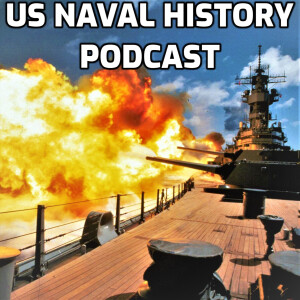
US Naval History Podcast
https://anchor.fm/s/37166b24/podcast/rssEpisode List
Booty, Blockades, and Prizes with Andrew Claphan
Traditionally war came with loot. This loot took a lot of forms, ranging from slaves (definitely not allowed today), to enemy military equipment, and whatever you could plunder from the enemies cities and countryside. We still have a few vestiges of these sorts of takings that are "legal" in warfare today. Andrew Clapham argues that we should almost completely ban these sorts of prize-taking, along with blockades and other tools of warfare. I'd actually argue that they are not all bad, and we have a pretty good debate about the topic on this podcast. Financially support the show here: https://www.usnavalhistory.com/#/portal/signup Please support the show if you are able. I greatly appreciate everyone who does so. Email me at: usnavalhistorypodcast@gmail.com
The Perils of Interpreting (The Opium War)
When the biggest country in the world and the most powerful country in the world can't even talk to each other, how can they possibly avoid war? Well, in the case of the Chinese and British in the early 19th Century... they didn't! In this episode of the U.S. Naval History Podcast, I interview Professor Henrietta Harrison on the leadup to war that in some ways parallels our world today. We discuss: - The difficulty in getting the right information to the country's leaders and the dangers when this does not happen well - How difficult it is to translate not only languages, but cultures and worldview between Anglo-American English and Chinese - How just being close enough to do the direct translation in often seen. as inherently suspicious - The not-so-great fates of the two key interpreters between England and China - The First Opium War Subscribe to support the show ($3/month): https://www.usnavalhistory.com/#/portal/signup Email me at: usnavalhistorypodcast@gmail.com
Diplomacy by Other Means
Why did the United States fight the Barbary Wars? How did early American diplomacy, economics, and naval power converge to confront North Africa's Barbary states? In this episode of the U.S. Naval History Podcast, Chase Dalton interviews Professor Abby Mullen from the United States Naval Academy, author of To Fix a National Character: The United States in the First Barbary War, 1800-1805. Together, they explore the Barbary Wars through the lens of diplomacy, economic strategy, and naval action. We discuss: - The diplomatic landscape between the United States, Barbary states, and European powers, - The importance of trade routes and the Mediterranean post-Independence, - How American naval captains operated under minimal guidance, acting as both diplomats and warriors, - The ideological motivations driving early U.S. foreign policy, and - The role of European powers and international relations in shaping the outcome of the Barbary Wars. We also dive into how the U.S. Navy developed through these conflicts and the lessons learned for future engagements. Subscribe to support the show ($3/month): https://www.usnavalhistory.com/#/portal/signup Email me at: usnavalhistorypodcast@gmail.com Buy To Fix A National Character here! (https://www.amazon.com/Fix-National-Character-Barbary-1800-1805/dp/1421449269)
Accidental Exporters: How Britain Taught America to Guard Its Tech Secrets
In this episode I talk with Kate Epstein about her new book "Analog Superpowers: How a 20th Century Technology Theft Built the National Security State." Key points: - The book focuses on the development of fire control technology for battleships in Britain and how the U.S. essentially stole this technology. - The challenges of protecting military inventions through patents while maintaining secrecy. - The concept of "technology laundering" and how nations rewrite history to appear more innovative. - Parallels are drawn between UK-US tech transfers in the early 20th century, US-Soviet dynamics during the Cold War, and current US-China tensions. - The evolution of export control laws is discussed, tracing their origins from British influence to modern-day semiconductor restrictions. Financially support the show here: https://www.usnavalhistory.com/#/portal/signup Please support the show if you are able. I greatly appreciate everyone who does so. Email me at: usnavalhistorypodcast@gmail.com
Early Military-Industrial Complex
How did the military-industrial complex get it's start? How did it affect our early wars? Financially support the show here: https://www.usnavalhistory.com/#/portal/signup Please support the show if you are able. I greatly appreciate everyone who does so. Email me at: usnavalhistorypodcast@gmail.com


Get this podcast on your phone, Free


Create Your Podcast In Minutes
- Full-featured podcast site
- Unlimited storage and bandwidth
- Comprehensive podcast stats
- Distribute to Apple Podcasts, Spotify, and more
- Make money with your podcast