Episode List

A WIN for Middle Housing
https://legislature.maine.gov/committee/#Committees/HED
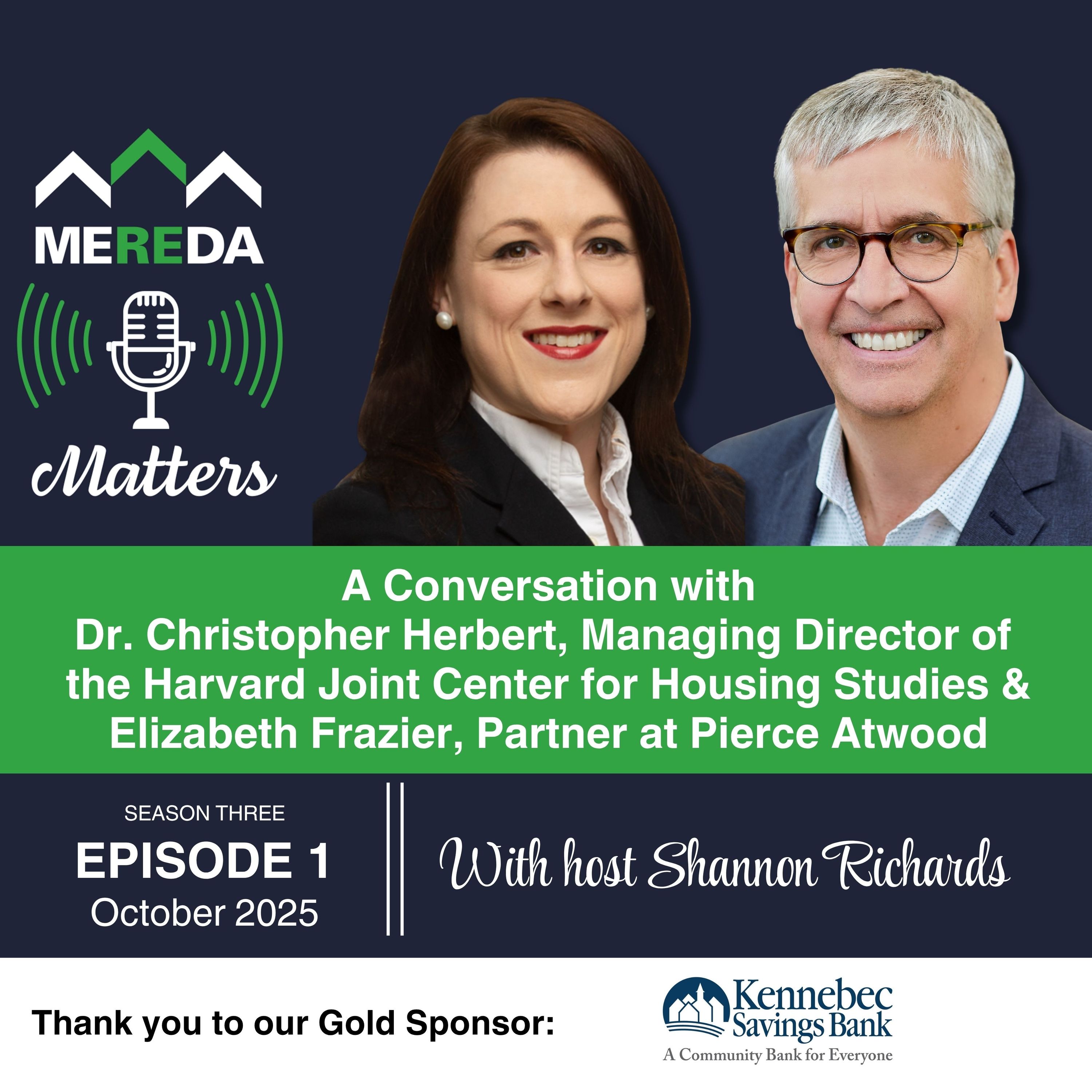
Conversation with Chris Herbert and Elizabeth Frazier
Maine is in the midst of a housing affordability crisis, but the issue is far more complex than rising prices. In this episode of MEREDA Matters, Dr. Chris Herbert of Harvard’s Joint Center for Housing Studies and Elizabeth Frazier, Partner at Pierce Atwood sit down with MEREDA President, Shannon Richards to unpack why the system is strained, where the bottlenecks really sit, and what it will take to build our way to something more sustainable. From the cost pressures baked into construction and land markets to the promise (and limitations) of zoning reform, small-scale infill, ADUs, and new industrialized building technologies, this discussion connects national research to Maine’s on-the-ground reality. The takeaway? There is no single fix, but there is a path forward. If you care about the future of Maine’s communities, workforce, and neighborhoods, this is a conversation worth leaning into.
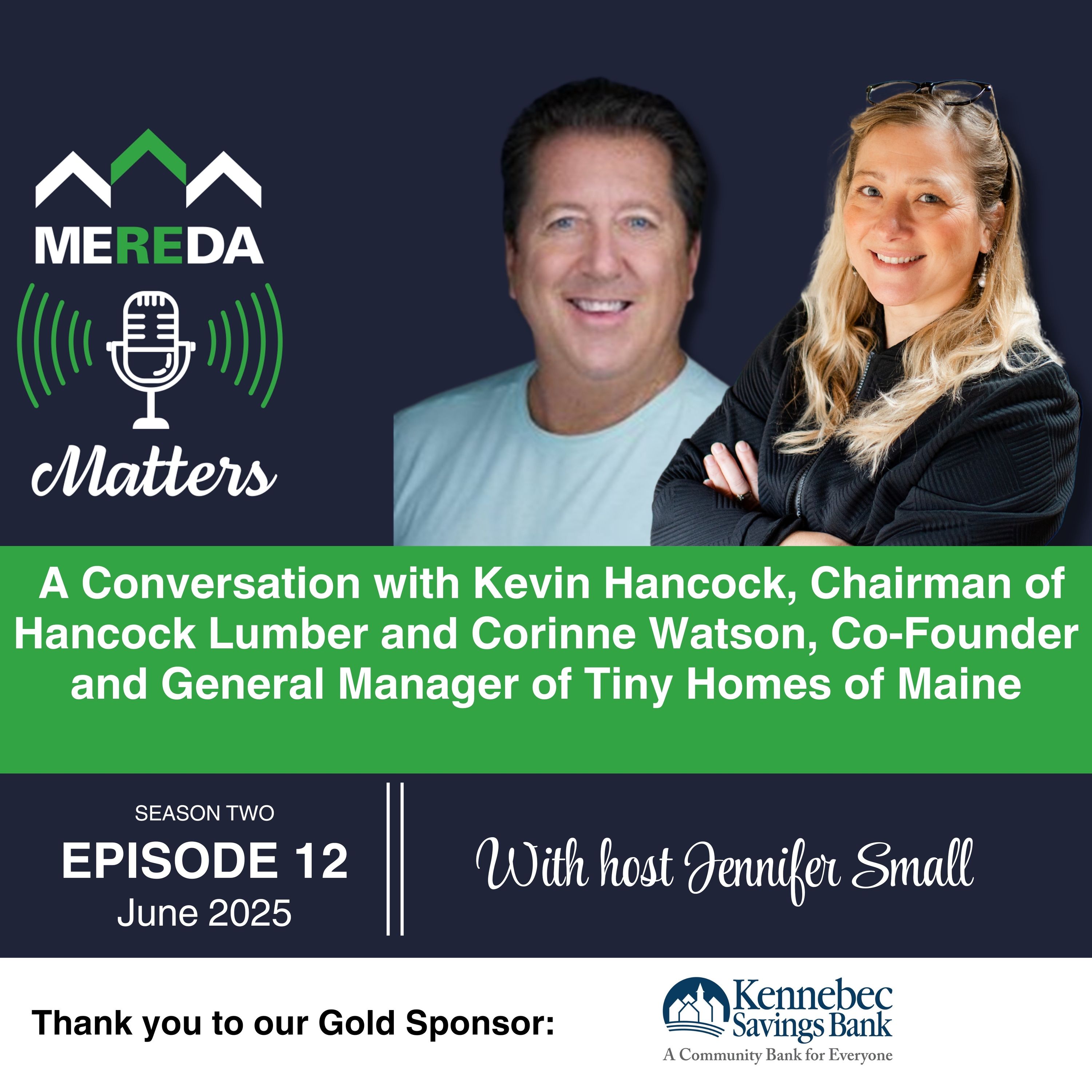
A Conversation with Kevin Hancock and Corinne Watson
Corinne Watson, Co-Founder of Tiny Homes of Maine, and Kevin Hancock, Managing Owner of Hancock Lumber, sit down with MEREDA Vice President Jenn Small for MEREDA Matters - the podcast that lets you listen in on conversations with the people driving responsible development in Maine. In this episode, Watson and Hancock talk about their partnership and plans for scaling Tiny Homes of Maine. Now located in Dyer Brook, Maine, Watson founded the company with her husband to support their belief that everyone deserves a home. After a fire burned down their facility in 2023, Hancock reached out to Watson to help. Aligned in what they cared about and their vision for scaling up the operation, the two forged a new partnership with their two businesses. Their conversation goes on to explore the process for buying a tiny home, and the two pieces of legislation – LD-1981 and LD-1530 – that Watson facilitated which helped open the floodgates for more tiny homes in Maine. The group also discusses commercial uses of tiny homes, how Tiny Homes of Maine are unique products – made in Maine with Maine materials – and how Watson developed a Lean Manufacturing Process to reduce the cost and production timeline. Listen to the episode to learn more!
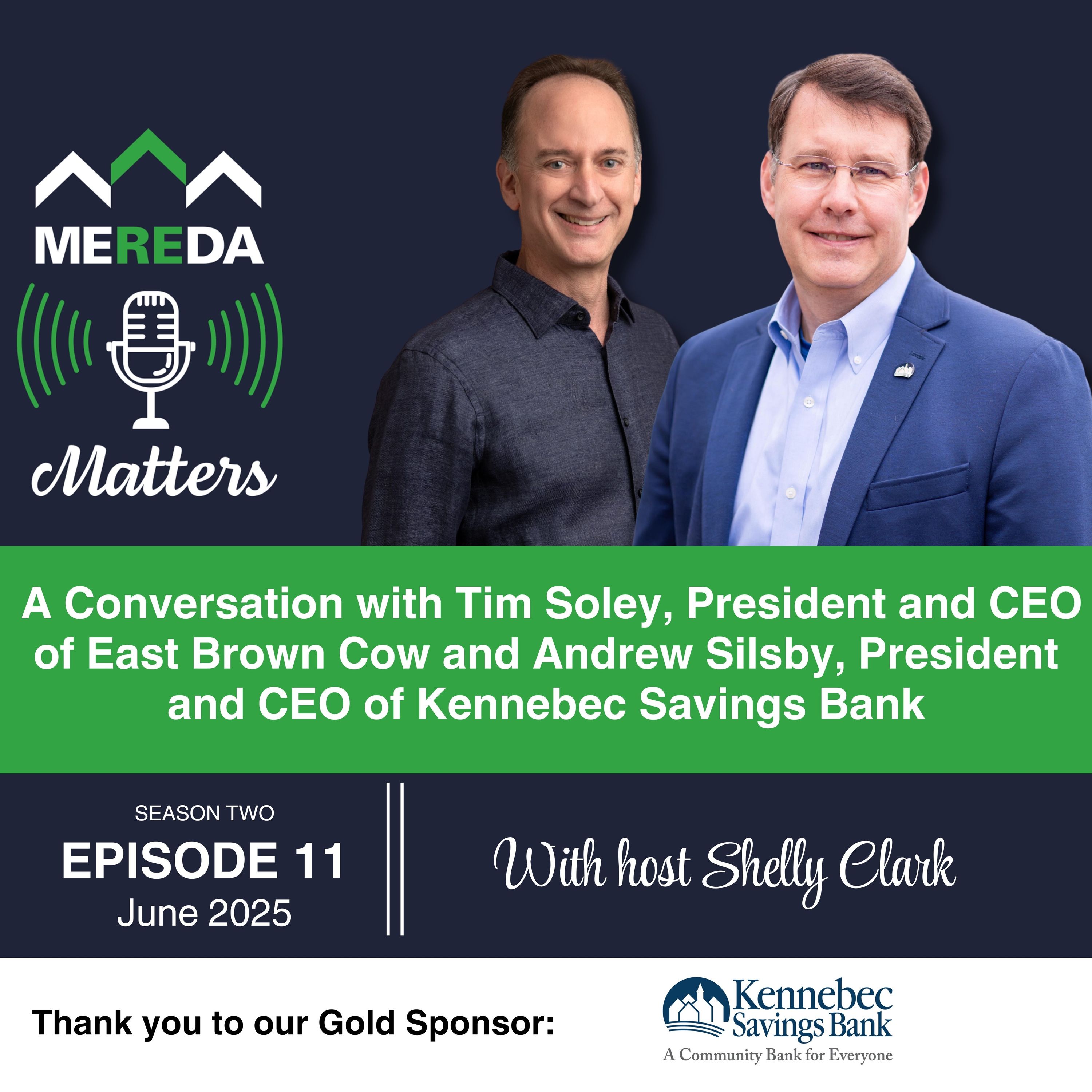
A Conversation with Tim Soley and Andrew Silsby
Andrew Silsby, President and CEO of Kennebec Savings Bank, and Tim Soley, President and CEO of East Brown Cow, sit down for MEREDA Matters - the podcast that lets you listen in on conversations with the people driving responsible development in Maine. In this episode Silsby sits in the interviewer chair and asks Soley about his path to real estate development and his passion and drive for the work. Solely goes on to discuss why he likes working with community banks for financing projects because of their long-term focus, as well as how he builds and maintains relationships with banks. The conversation continues with an exploration of East Brown Cow’s Old Port Square Project and vision for community development in Portland, their commitment to sustainability and drive for preserving the historic character of the Old Port, as well as how Soley navigates the different economic cycles as a developer. Solely also shares some advice for up-and-coming developers and his view on making mistakes and being a contrarian. Listen to the episode to learn more!

A Conversation on Bangor and Development with Bob Montgomery-Rice and Matthew Lewis
Bob Montgomery-Rice, President and CEO of Bangor Savings Bank, and Matthew Lewis, Director of Four Directions Development Corporation, sit down with MEREDA President Shannon Richards for MEREDA Matters - the podcast that lets you listen in on conversations with the people driving responsible development in Maine. In this episode, Montgomery-Rice and Lewis share their insight on the development landscape in the Bangor area. Lewis, a member of the Passamaquoddy Tribe, provides an overview of his non-profit, which is a Community Development Corporation (CDC) and Community Development Financial Institution (CDFI), enabling them to provide capital and resources in areas that are difficult for banks to access. Lewis goes on to share how historically Tribal communities have faced barriers to accessing capital, and how Four Directions pioneered a program for home ownership in Tribal Nations. The group goes on to discuss the need for creativity and collaboration in finding solutions to difficult problems like the housing crisis. Montgomery-Rice highlights a success story in Bangor – the Cedar Falls Mobile Home Park – as an example of the opportunities for innovative solutions. The group also delves into the current legislative session; how their work helps provide people access to owning property, which is crucial for wealth-building; and how the Bangor area has development opportunities at a lower price-point than the Portland market. Listen to the episode to learn more!
You may also like




Get this podcast on your phone, Free


Create Your Podcast In Minutes
- Full-featured podcast site
- Unlimited storage and bandwidth
- Comprehensive podcast stats
- Distribute to Apple Podcasts, Spotify, and more
- Make money with your podcast