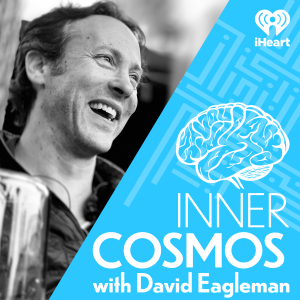
Episode List
Ep167 "What Happens With Stone Age Brains + Godlike Tools?" with Steven Kotler
What happens when old brain circuitry collides with modern tech? Are we heading into an age of abundance, and can abundance create its own psychological problems? Do we need friction in our lives to become better humans? Could curiosity become the most important survival skill of the twenty-first century? What happens to your biological neural networks when artificial neural networks do your thinking for you? Eagleman sits down with author and researcher Steven Kotler to discuss his new book, We Are As Gods.
Ep166 "Could the Next Brain Interface Get Sprayed Up Your Nose?" with Tetiana Aleksandrova & Scott Meek
A brain computer interface (BCI) is any technology that allows you to connect your 3 pounds of wetware to a computer. But instead of implanting electrodes via neurosurgery, might the next revolution in BCIs come from something very small, like nanoparticles? Would this allow us to spy on millions (or billions) of neurons talking at once -- and could we do so without opening the skull? Will this allow BCI tech to become as common as smartphones? Join Eagleman as he talks with the company Subsense about why the next brain-computer interface might come from thinking small.
Ep165 "What's a Doom Loop & How Do You Escape It?" with Jonathan Downar
Have you ever spent hours with a thought cycling around in your head? What happens when the brain continuously worries, craves, or replays something without finding the exit? Where does the feeling of being “done” come from? Might depression, addiction, OCD, and PTSD all share the same problem? Is mental freedom just the ability to change states? Join Eagleman with neuroscientist and psychiatrist Jonathan Downar to talk about doom loops and how we might break them.
Ep164 "Why Do We Act Differently Around Different People?" With Claude Steele
Does your identity and performance change in different situations? What does this have to do with wondering how you’re being judged? What if polarization grows from uncertainty more than hatred? Might social uncertainty be more common than prejudice? Why do strangers become enemies so easily? Can we engineer more trust into society? Today Eagleman sits down with Stanford social psychologist Claude Steele to explore the hidden psychological forces that shape who we become whenever we wonder how other people see us.
Ep163 "How Quickly Does AI Become Smarter Than Humanity?" with Ben Goertzel
What is artificial general intelligence (AGI) and how close are we to getting there? What defines the next step, called artificial superintelligence (ASI), and why might the gap between those two be so dangerous? When machines become smarter than us, what roles are left for humanity? Should we think of AI as software, or as something we’re raising like a child? Will tomorrow’s AI destroy us, ignore us, or protect us? This week Eagleman talks with computer scientist & AI researcher Ben Goertzel.




Get this podcast on your phone, Free


Create Your Podcast In Minutes
- Full-featured podcast site
- Unlimited storage and bandwidth
- Comprehensive podcast stats
- Distribute to Apple Podcasts, Spotify, and more
- Make money with your podcast
