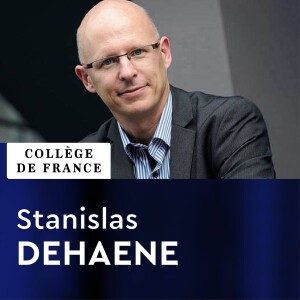
Psychologie cognitive expérimentale - Stanislas Dehaene
https://podcast.college-de-france.fr/xml2/cdf3-5.xmlEpisode List
Colloque - Stanislas Dehaene : Concluding Remarks
Stanislas DehaeneChaire Psychologie cognitive expérimentaleAnnée 2025-2026Collège de FranceColloque : Seeing the Mind, Educating the BrainConcluding RemarksColloque - Stanislas Dehaene : Concluding RemarksStanislas Dehaene
Colloque - Josh Tenenbaum : Scaling Intelligence the Human Way
Stanislas DehaeneChaire Psychologie cognitive expérimentaleAnnée 2025-2026Collège de FranceColloque : Seeing the Mind, Educating the BrainTheme: Human SingularityScaling Intelligence the Human Way Colloque - Josh Tenenbaum : Scaling Intelligence the Human Way Josh Tenenbaum
Colloque - Valentin Wyart : The What?, How? And Why? Of Behavior: Using Cognitive Computational Models to Answer Distinct Questions about Human Cognition
Stanislas DehaeneChaire Psychologie cognitive expérimentaleAnnée 2025-2026Collège de FranceColloque : Seeing the Mind, Educating the BrainTheme: Human SingularityThe What?, How? And Why? Of Behavior: Using Cognitive Computational Models to Answer Distinct Questions about Human CognitionColloque - Valentin Wyart : The What?, How? And Why? Of Behavior: Using Cognitive Computational Models to Answer Distinct Questions about Human CognitionValentin WyartRésuméQuantitative modeling approaches are routinely used in cognitive science to make sense of behavior. Statistical models are designed to test *what* specific patterns are present in behavior, whereas cognitive computational models are developed to describe *how* specific behavioral patterns may emerge from latent cognitive processes. These two types of modeling approaches have successfully identified characteristic (and sometimes suboptimal) features of human learning and decision-making under uncertainty. In this talk, I will argue that cognitive computational models can be used to answer the distinct question of *why* these characteristic features are there. I will use recent studies that rely on different classes of models (low-dimensional algorithmic models, high-dimensional neural networks) to explain characteristic features of human cognition in terms of latent objectives and constraints.
Colloque - Mathias Sablé-Meyer : Dissecting the Language of Thought Hypothesis across Marr's Levels
Stanislas DehaeneChaire Psychologie cognitive expérimentaleAnnée 2025-2026Collège de FranceColloque : Seeing the Mind, Educating the BrainTheme: Human SingularityDissecting the Language of Thought Hypothesis across Marr's LevelsColloque - Mathias Sablé-Meyer : Dissecting the Language of Thought Hypothesis across Marr's LevelsMathias Sablé-MeyerRésuméThe Language of Thought (LoT) hypothesis posits that mental representations are best understood as programme-like objects; indeed, "thoughts" share properties such as productivity and systematicity with programming languages. I tackle questions that arise from taking this hypothesis at face value and unfolding its predictions, from computational accounts to mechanistic implementation. First, zooming on humans' cognition of geometric shapes, I show that in all human groups tested (adults, children, congenitally blind), the perception of shapes is heavily influenced by geometric features. Then, I show using MEG and fMRI that the neural signature of these exact geometric properties is separate both in timing and localisation from typical visual processes. To generalise beyond quadrilaterals, I commit to a proposition for a generative language of shapes to account for the complexity of geometric shapes in humans, while implementing an algorithm for perception-as-program-inference. Finally, building on recent results in rodent neuroscience, I sketch a research programme and give preliminary results on a mechanistic understanding of how program-like representations might be implemented by populations of neurons.
Colloque - Floris de Lange : Uniquely Human Prediction?
Stanislas DehaeneChaire Psychologie cognitive expérimentaleAnnée 2025-2026Collège de FranceColloque : Seeing the Mind, Educating the BrainTheme: Human SingularityUniquely Human Prediction?Colloque - Floris de Lange : Uniquely Human Prediction?Floris de LangeRésuméThe brain is fundamentally a predictive organ that uses internal models to extrapolate future events from current inputs. While this predictive capacity exists across species, what may be uniquely human are the specific internal models we employ. Using AI tools to quantify predictability in naturalistic environments, we can examine prediction at multiple levels of abstraction. In my talk I will highlight recent work from the domain of language, music and visual perception, elucidating how uniquely human experiences and capabilities shape our predictive models of the world.
You may also like







Get this podcast on your phone, Free


Create Your Podcast In Minutes
- Full-featured podcast site
- Unlimited storage and bandwidth
- Comprehensive podcast stats
- Distribute to Apple Podcasts, Spotify, and more
- Make money with your podcast