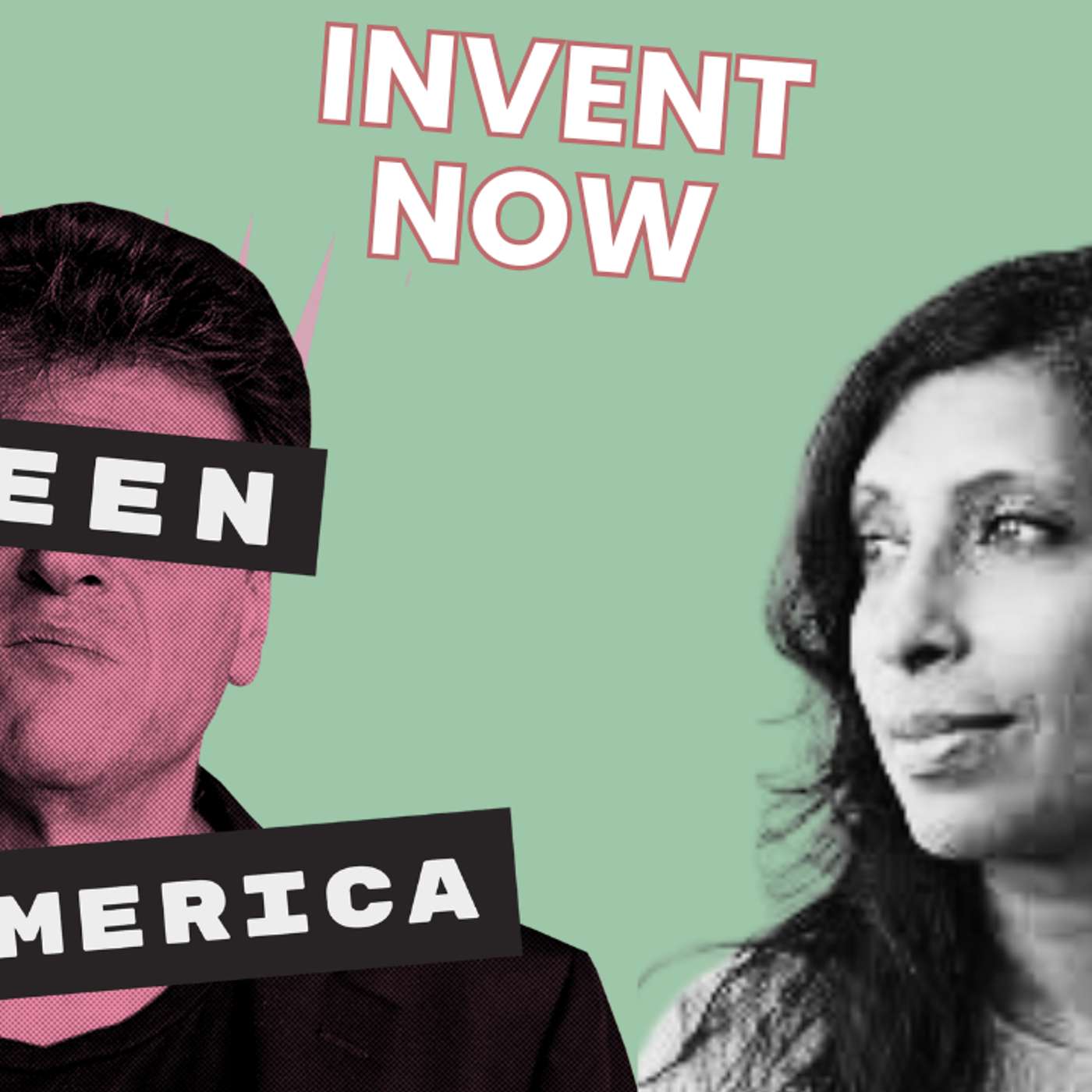
“If we continue to build for people and not with people, we won’t have a say in what this technology will look like or do in ten or twenty years.” — Salima Bhimani Finally some inventive news in our summer of Luddite discontent. Salima Bhimani spent six and a half years at Google X’s moonshot factory as its first Chief Strategist for Responsible Tech. So thank her for the (responsible) magic of Alphabet’s Waymo, Wing, and DeepMind. In her new book, Invent Now, Bhimani prov...
“If we continue to build for people and not with people, we won’t have a say in what this technology will look like or do in ten or twenty years.” — Salima Bhimani
Finally some inventive news in our summer of Luddite discontent. Salima Bhimani spent six and a half years at Google X’s moonshot factory as its first Chief Strategist for Responsible Tech. So thank her for the (responsible) magic of Alphabet’s Waymo, Wing, and DeepMind. In her new book, Invent Now, Bhimani provides a map for the next wave of moonshots. No, she speculates, they probably won’t come out of Silicon Valley. But, yes, they will come from somewhere.
Her invention was formed long before Silicon Valley. She remembers staring at the Toronto subway from her father’s magazine stall and wondering not where the trains went but “what is our relationship to this tube?” An ethnographer by training, Bhimani arrived at Google X from a world of government and nonprofits where “constraint was bread and butter.” At Alphabet, of course, she was spoilt with endless money and runway. Although that didn’t always guarantee moonshot success.
Moonshots fail, she explains, because they are always more than technologies. They are ecosystems, and they need the approval of regulators, communities, and consumers. Take, for example, the abortive Sidewalk Labs, Alphabet’s smart-city bet in her hometown of Toronto, which failed to recognize the practical realities of utopian city-planning.
So what will be the most dramatic moonshot of the twenty-first century? No, she says, it probably won’t be consumer rocketships to Mars or a cure for cancer. Instead, it will be about a post-labor society. What is human purpose when it’s not work? No wonder such an outrageous idea probably won’t come out of work-obsessed Silicon Valley.
Five Takeaways
• A Nuanced Optimist. Bhimani isn’t surprised by the Luddite lurch: people feel “compressed by things they can’t control,” surrounded by technology doing things they don’t understand — and it’s hot out. But against thirty years of Silicon Valley boosterism she offers neither cheerleading nor despair: hold the tension. Technology surveils, and drones make war; technology also lets more people solve problems that were previously unsolvable. She refuses the binary of the moment — the abundance gospel of the Andreessens versus the scarcity warnings of James Crawford — predicting instead “abundance in some areas and scarcity in others”: your spreadsheet skills may become worthless precisely as your capacity to build becomes unprecedented. The task is holding both truths with what she calls a discerning eye, treating technology as a co-partner in a relationship where the friction stays alive.
• From the Toronto Subway to the Moonshot Factory. Her father ran a magazine stall in the Toronto subway, and young Salima stared at the trains asking an ethnographer’s question: not where are the people going, but “what is our relationship to this tube?” She came to Alphabet from government and nonprofits, where “constraint was bread and butter” — and met the opposite: endless money, endless runway, and audacity as the house style. As Alphabet’s first Chief Strategist for Responsible Tech, she sat with the CEOs of the Other Bets asking about trade-offs: “Are you willing to take on the potential that your drone could be used in nefarious ways — and how are you gonna ensure that doesn’t happen?” Now on her own — no Google badge to fly doors open — she finds leaving “opens up the aperture”: fifty-one years of experience, and both worlds, constraint and abundance, informing everything she builds.
• She Folded Her Own Moonshot. The episode’s quiet bombshell: after leaving Alphabet, Bhimani co-founded a drone-detection company — and discovered what it feels like when the awkward questions are aimed at you. The full-stack solution she was building could genuinely help cities and communities; it could also be used for “all kinds of nefarious things.” Intention, she warns, is “pie in the sky when people actually are impacted”: the moment to map the worst case is now, not five years after your technology is loose in the world — because you will have to live with the choices you make. Some people can live with the range of implications; she and her co-founders decided they couldn’t: “We folded our drone company because the implications are not something that any of us could have lived with.” Responsible tech, practiced on herself.
• Moonshots Are Ecosystems (Ask Sidewalk). The factory’s deepest lesson: a moonshot is never just a technology. Wing isn’t drones — it’s regulators, safety, and whether communities want packages falling on their porches; the ecosystem must come first, not at the last mile. Sidewalk Labs — Alphabet’s smart-city bet in her own Toronto — consulted widely, meant well, and died anyway on public distrust of big tech’s data appetite: an early tremor, Andrew suggests, of today’s earthquake against data centers, and evidence of a “massive gap” between society and technology that still hasn’t closed. Google fumbling Geoffrey Hinton’s generative breakthrough shows the other constraint: inside a company the size of a country, innovation must also become the next billion-dollar business. The counterexample is Waymo — sixteen years of perseverance toward John Krafcik’s bigger mandate (self-driving technology, cars merely one expression) — and perhaps Demis Hassabis, whom the latest reshuffle might just free “to be Demis.”
• Step In, Not Stepped Out. AI wasn’t born yesterday — it spent thirty or forty years in labs, integrated into our lives in the background — and that incubation is precisely her warning: “If we continue to build for people and not with people, we won’t have a say in what this technology will look like or do in ten or twenty years.” The large language models belong to “the Googles and the Anthropics,” and most of us aren’t inside those companies. Her flip: if such powerful things were built in incubated spaces, imagine what could be built in unincubated ones — collective intelligence as our superpower, moonshots born from the convergence of places, people, and contexts rather than from Silicon Valley’s playbook. The century’s biggest moonshot, she suspects, is labor itself: what is human purpose when it’s not work? Her closing instruction, and the episode’s stamp: “We gotta step in and not be stepped out.”
About the Guest
Salima Bhimani, PhD, was Alphabet’s first Chief Strategist for Responsible Tech, Business, and Leaders, working for six and a half years with moonshot companies including Waymo, Wing, DeepMind, and Google X. An ethnographer by training who came to Silicon Valley from government and nonprofits, she is now CEO of 10X Responsible Tech and a senior fellow at AI 2030. Invent Now: The Next Leap in Moonshots (John Wiley & Sons, 2026), her first book, introduces the Third Space — a new lens for building moonshots from the convergence of technolog...