Season 3, Episode 1 - The TEACHING CONTENT Podcast "The Angels of Learning Beckon: Seeing Beyond Current Systems of Education" By Robb Scott, Host & Author Alt text = https://drive.google.com/file/d/1OnbbmgNW6pAlUqihMqk5Kp9GfK5soUtf/view?usp=sharing SHOW NOTES / May 1, 2024 New context for today's podcast episode: "A Phenomenology for Women of Color Merleau-Ponty and Identity-in-Difference" (Lee, Emily S., 2024), featured also on the podcast "New Books in Philosophy, at:...
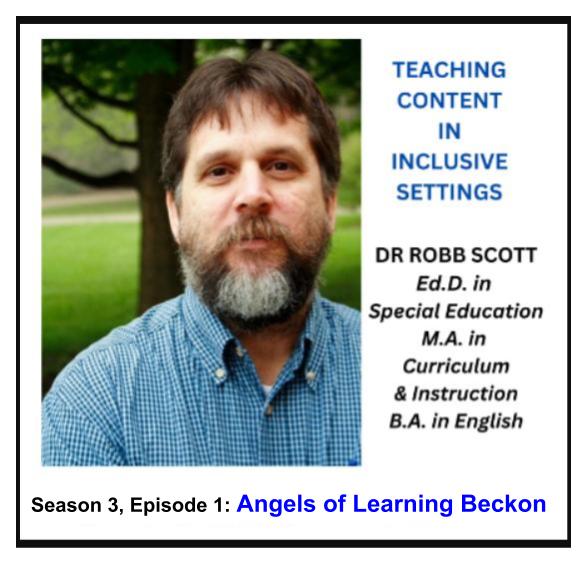
Season 3, Episode 1 - The TEACHING CONTENT Podcast
"The Angels of Learning Beckon: Seeing Beyond Current Systems of Education"
By Robb Scott, Host & Author
Alt text = https://drive.google.com/file/d/1OnbbmgNW6pAlUqihMqk5Kp9GfK5soUtf/view?usp=sharing
SHOW NOTES / May 1, 2024
New context for today's podcast episode:
"A Phenomenology for Women of Color
Merleau-Ponty and Identity-in-Difference"
(Lee, Emily S., 2024), featured also on
the podcast "New Books in Philosophy, at:
https://podcasts.apple.com/us/podcast/emily-s-lee-a-phenomenology-for-women-of-color/id426208821?i=1000653046554
&
"American Educator, Activist, and Advocate
Eleanor Rebecca Powell Archer"
(Taylor, Kay Ann, 2024), at:
https://rowman.com/ISBN/9781666920574/American-Educator-Activist-and-Advocate-Eleanor-Rebecca-Powell-Archer
SHOW NOTES, continued
Today's podcast episode was originally composed by Robb Scott as a paper in philosophy of education, assigned by Professor Kay Ann Taylor, in 2007.
The full paper is available at
https://drive.google.com/file/d/1OnbbmgNW6pAlUqihMqk5Kp9GfK5soUtf/view?usp=sharing
Comparing Booker T. Washington's "The Awakening of the Negro" (1896) to W.E.B. Du Bois's "Of the Training of Black Men" (1903), focusing on a tension between these two authors regarding the purpose of education and schooling for Blacks in America
Historical Contexts:
Plessy v Ferguson (1896)
Brown v Topeka Board of Education (1954)
"The Great Migration" (1890 to 1910)
American involvement in the Philippines
"Anti-imperialist" presidential candidate William Jennings Bryan (1900)
What is the purpose of education and schooling?
Booker T. Washington's answer is framed within a materialistic perspective and his philosophical approach to education is atomistic, that is, the teacher is a trainer who presents information and techniques which enable the learner to demonstrate certain valued behaviors.
W.E.B. Du Bois is operatig within a problematic mode of thinking, in which the teacher is a mediator of inquiry and the curriculum is based on problem-solving, and the outcomes for learners are expressed in the arts, sciences and history. Du Bois's mode of thought may also be considered akin to perspectival thinking, due to his creative vision for the future of American democracy.
Related anecdote, remembering a cherished member of the Kansas State University community, Elfrieda Nafziger, who passed away in early September of 2007, at the age of 69.
Back to the comparison between Washington and Du Bois:
Washington emphasizes self-sufficiency through labor,
whereas
Du Bois emphasizes self-realization through transformative vision.
Du Bois warns that Washington's Tuskegee Institute may have been preparing blacks to fit into and
support a system of racial segregation and white privilege.
Perhaps Du Bois's warning was a precursor for today's Critical Race Theory (Ladson-Billings, 1999).
Perhaps the late educational philosopher bell hooks can be seen as the intellectual and spiritual reincarnation of Du Bois, with her emphasis on learning to be free via an "engaged pedagogy."
Closing notes re Paolo Freire and T.H. Huxley.
Thank you for listening to the TEACHING CONTENT podcast today.https://www.amazon.com/dp/B0B47QDNRH
Visit the podcast archives at https://drrobbscott.libsyn.com/site
Robb Scott, Host and Author
Note: The book "Teaching Content: Skill-Building in Inclusive Settings" is at: https://www.amazon.com/dp/B0B47QDNRH