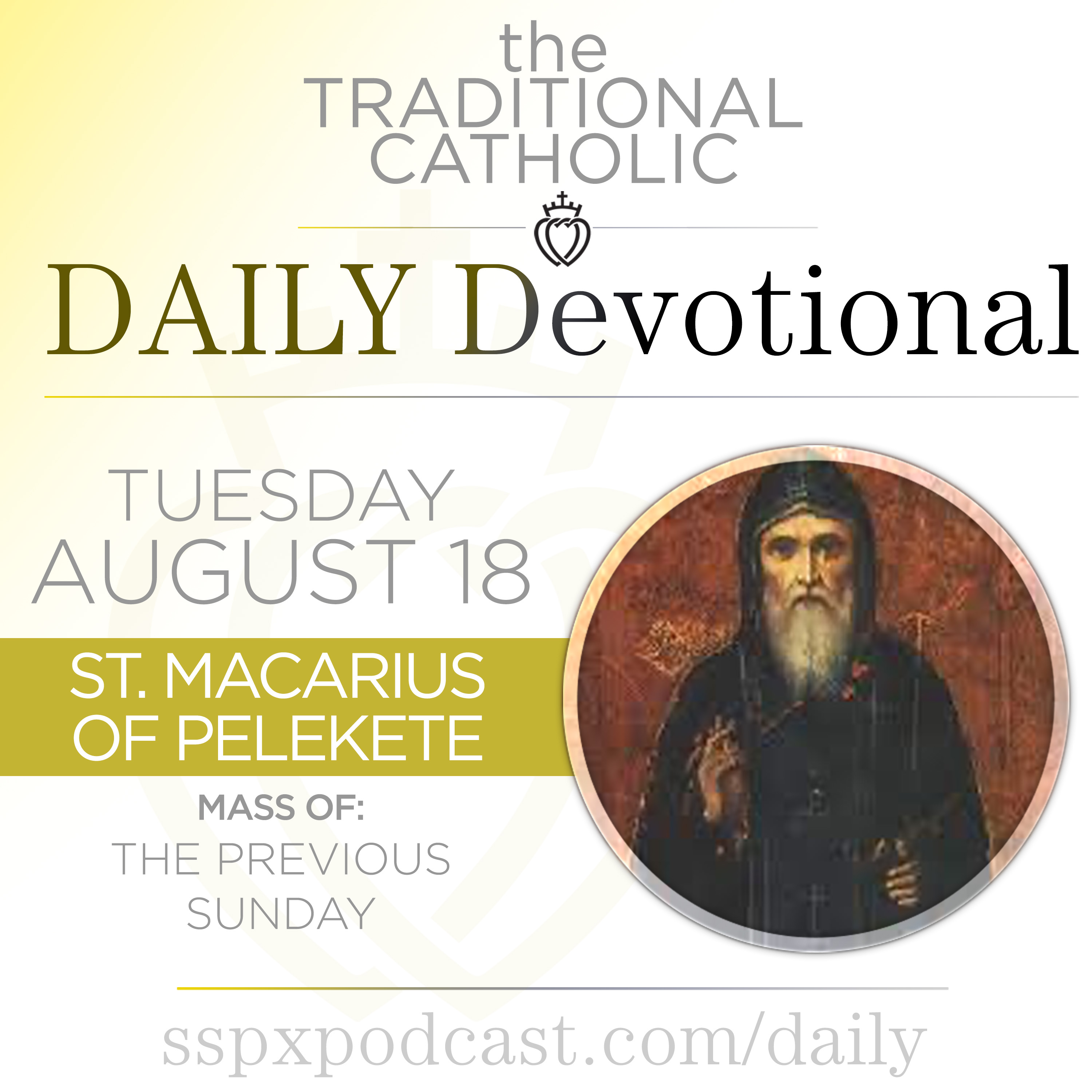
It's a Feria, 4th Class, with the color of Green. In this episode: the meditation: "The Extent of Charity", today's news from the Church: "Read About God's Love for Us", a preview of this week's episode of The SSPX Podcast: "Audiobook Chapter 13: Herald of Christ the King", and today's thought from the Archbishop Marcel Lefebvre.
Have feedback or questions about the DD or our other shows? podcast@sspx.org
Sources Used Today:
"The Extent of Charity" — From Trinity Sunday to the A...
It's a
Feria,
4th Class, with the color of
Green. In this episode: the meditation: "The Extent of Charity", today's news from the Church: "Read About God's Love for Us", a preview of this week's episode of The SSPX Podcast: "Audiobook Chapter 13: Herald of Christ the King", and today's thought from the Archbishop Marcel Lefebvre.
Have feedback or questions about the DD or our other shows?
podcast@sspx.org
Sources Used Today:
- "The Extent of Charity" — From Trinity Sunday to the Assumption
- https://angeluspress.org/products/from-trinity-sunday-to-the-assumption
- "Read About God's Love for Us" (FSSPX.news)
- https://fsspx.news/en/news/read-about-gods-love-us-60522
- The SSPX Podcast: "Audiobook Chapter 13: Herald of Christ the King" (SSPX Podcast)
- View on YouTube
- Listen & Subscribe on SSPXpodcast.com
- The Spiritual Life — Archbishop Marcel Lefebvre (Angelus Press)
- https://angeluspress.org/products/spiritual-life-archbishop
Please support our new project, the Archbishop Lefebvre Biography Audiobook:
- Learn more:https://www.youtube.com/watch?v=Y-Wp4MQdK2o
- Donate:https://sspx.gifts/audiobook
Saint Macarius of Pelekete lived during one of those periods of Church history when possessing a religious image could actually get you arrested.
He was born in the eighth century in the Byzantine Empire and was originally named Christopher. As a young man, he entered monastic life, received the name Macarius, and eventually became abbot of the monastery of Pelekete, near the Sea of Marmara in what is now Turkey.
This was the age of Iconoclasm.
Several Byzantine emperors had decided that sacred images of Christ, Our Lady, and the saints encouraged idolatry. Icons were removed from churches, destroyed, or burned. Monks were particularly troublesome to the government because many of them refused to cooperate.
Macarius was one of them.
To understand why he cared so much, it's important to remember that Christians weren't worshipping pieces of wood and paint. The controversy touched something much deeper. If Christ truly became man, then He really possessed a human face. Christians believed that depicting that face was a way of defending the reality of the Incarnation.
So Macarius refused to surrender the icons.
And it cost him.
Under Emperor Leo V, the persecution became especially severe. Macarius was arrested and pressured to accept the emperor's religious policy. When he refused, he was imprisoned and tortured.
Then something unusual happened.
The emperor died.
For a moment, it looked as though Macarius might finally be free. The new emperor, Michael II, released a number of imprisoned monks and churchmen. Macarius was brought before him and again encouraged to compromise.
He still wouldn't do it.
This time he was exiled to the island of Aphousia in the Sea of Marmara. After years of imprisonment, beatings, and hardship, Macarius died there around the year 830.
His monastery has an interesting archaeological story of its own. Pelekete was one of several important monastic communities clustered along the southern shore of the Sea of Marmara, a region filled with Byzantine monasteries before many disappeared through war, earthquakes, and centuries of political change. Ruins traditionally associated with the monastery survive near modern Tirilye in Turkey, giving us a tangible connection to the world Macarius knew.
What makes Macarius especially interesting is that he died before the controversy was finally settled. He never lived to see the great restoration of sacred images in 843, when icons were solemnly returned to the churches of Constantinople.
He fought for something he would never personally see restored.
And yet, every time we enter a Catholic church and see a crucifix, statue, painting, or stained-glass image of a saint, we're enjoying a Christian inheritance that men like Macarius suffered to preserve.
Saint Macarius of Pelekete, courageous defender of sacred images and steadfast monk of Christ, pray for us.
Please Support this Apostolate with 1-time or Monthly Donation >>
- - - - - -
Explore more:
- Subscribe to the email version of this Devotional- it's a perfect companion!
- Subscribe to this Podcastto receive this and all our audio episodes
- Subscribe to the SSPX YouTube channelfor video versions of our podcast series and Sermons
- FSSPX News Website:https://fsspx.news
- Visit the US District website:https://sspx.org/
What is the SSPX Podcast?
The SSPX Podcast is produced by Angelus Press, which has as its mission the fortification of traditional Catholics so that they can defend the Faith, and reaching out to those who have not yet found Tradition.
What is the SSPX?
The main goal of the Society of Saint Pius X is to preserve the Catholic Faith in its fullness and purity, to teach its truths, and to diffuse its virtues, especially through the Roman Catholic priesthood.
Authentic spiritual life, the sacraments, and the traditional liturgy are its primary means of bringing this life of grace to souls.
Although the traditional Latin Mass is the most visible and public expression of the work of the Society, we are committed to defending Catholic Tradition in its entirety: all of Catholic doctrine and morals as the Church has always defended them. What people need is the Catholic Faith, without compromise, with all the truth and beauty which accompanies it.
https://sspx.org