In a recent podcast, Taylor brought forth a number of objections about the recent consecrations and the present SSPX as such, and I have gone through his arguments and they can be broken down into twelve points, which will be addressed after an introduction.The Obligation of Christian CharityTaylor and I have been friends for years, so, I have to say plainly, that I really hate this situation. I also want to make it clear that it is disrespectful for anyone to impugn motives to...
In a recent podcast, Taylor brought forth a number of objections about the recent consecrations and the present SSPX as such, and I have gone through his arguments and they can be broken down into twelve points, which will be addressed after an introduction.
The Obligation of Christian Charity
Taylor and I have been friends for years, so, I have to say plainly, that I really hate this situation. I also want to make it clear that it is disrespectful for anyone to impugn motives to Taylor that he hasn’t expressed or made clear. Taylor is a noble man. He is a top-notch husband and father. His wife adores him, and his children respect him, and his children are faithful Catholics. He is a man of great courage and he has done, and will continue to do, a lot of good for the Church. While men of principle will have disagreements, it is unconscionable, as far as I am concerned, to resort to some sort of tabloid-style speculation about a man’s reasoning for changing his mind.
Taylor has, for years, been a supporter and defender of the SSPX, and I even sat with him and prayed with him in St. Mary’s, Kansas at the consecration of the Immaculata. His reasons for changing his tune on the Society in recent months are his own, and Taylor is not easily coerced or manipulated. He is, in a true sense, a real Texan, and because of that he is largely self-reliant and not easily intimidated. So, I reject any speculation that he has been “compromised” or whatever else certain commentators have been opining about online.
If you will allow me, I will bring up Michael Davies as an analogous situation. Davies was a massively important defender of Archbishop Lefebvre and the Society from the very start. However, Davies believed that the ’88 consecrations were a step too far, and he expressed those beliefs to the Archbishop, and to the public after the fact. For a number of years, Davies continued in that belief, however, eventually he changed his mind and resumed his leonine defence of Lefebvre and his associates. It would have been wrong to impugn any ulterior motives on Davies during that period, and, whether Taylor is planning to stay fixed in his positions as they stand, will be known to history as it unfolds. But, Taylor is a humble man and he does not express his beliefs for mere personal gain, so if he wants to change his mind, he will. He is a good Catholic and should be treated as such.
Also, it should be noted that he does not, at least as far as I can tell, believe you are a schismatic if you attend the SSPX, and, he mentioned me by name in the show, expressing his understanding of my situation, which is common to so many, wherein it is a choice between the SSPX or Modernism. He seems to believe that the right choice in a situation like that is to go with the SSPX. So, as a Thomist, he must believe that the SSPX is not in schism, because a Thomist would never make a consequentialist argument.
Thanks for reading Mere Tradition with Kennedy Hall! This post is public so feel free to share it.
The Twelve Arguments
1. Order/jurisdiction critique of Fr. Pagliarani’s authority
Marshall’s central procedural objection: Pagliarani is a priest of ~20 years standing at the head of six consecrated bishops. He invokes the religious-order analogy (Dominicans, Franciscans, Jesuits) to argue that once a member of an order is raised to the episcopate, he’s no longer under his order’s superior — implying the SSPX’s structure, where a priest-superior directs bishops, is anomalous and disordered.
2. Tone/rhetoric of Pagliarani’s letter to the Pope
He treats the “bread/stone, fish/serpent, egg/scorpion” language as effectively accusing the Pope of bad faith or malice, and reads this as prideful — contrasted pointedly against what he reads as the conciliatory, paternal tone of Leo’s letter.
3. The “fake apostolic mandate” — the dissimulation charge
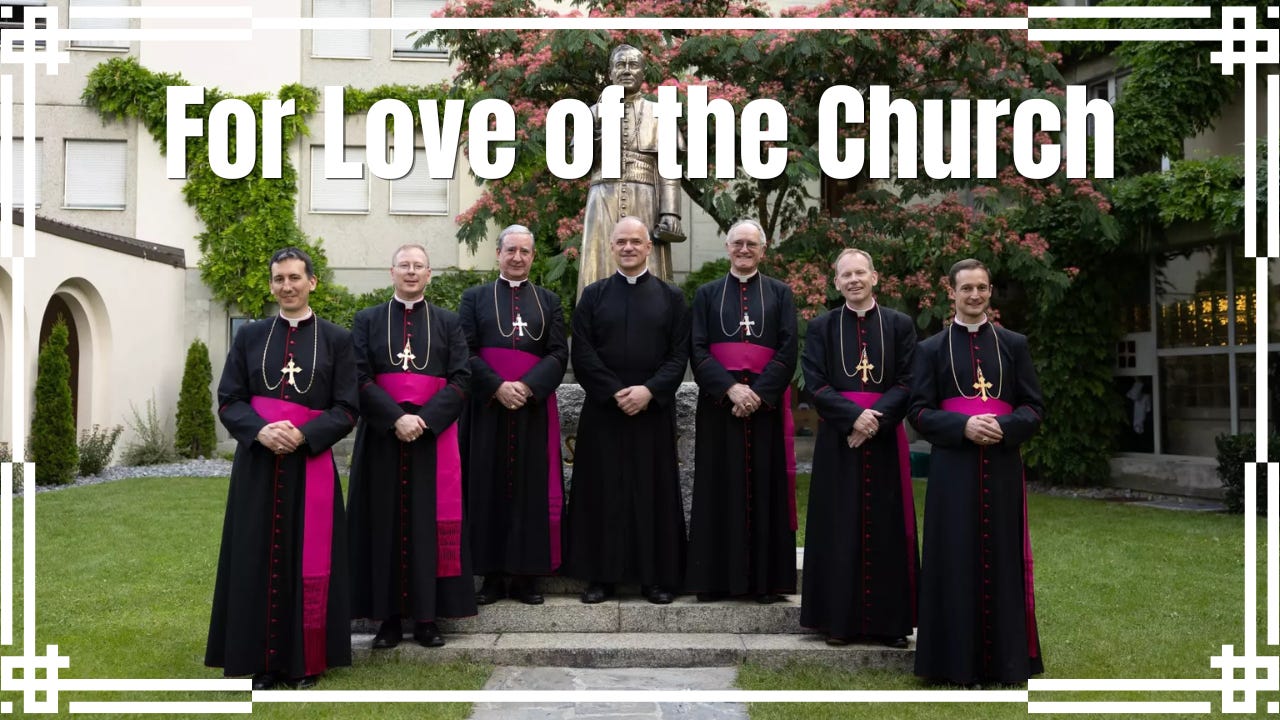
This is his most repeated point: the liturgy asks “do you have the apostolic mandate,” and he characterizes the SSPX’s response (reading a rolled parchment with a red ribbon, in French, calling the new bishops “auxiliary bishops,” then having them swear obedience to Leo XIV) as three separate untruths/theatrical deceptions rather than a straightforward “we don’t have one and don’t believe we need one.”
4. Arbitrariness of the July 1 deadline
He argues no one has shown why consecration had to happen on that specific date rather than allowing further negotiation — framing Pagliarani’s inflexibility (announced Feb 2, no budging) as itself a choice, not a necessity.
5. 1988 vs. 2026 disanalogy
Central to undercutting the “state of necessity” argument: in 1988 there were few TLM options; in 2026 there’s FSSP, ICKSP, Institute of the Good Shepherd, etc. He argues the necessity claim that justified Lefebvre’s actions doesn’t hold the same force today.
6. Ecclesiological/papal-primacy argument
An appeal to the authority of the Pope to judge who is in schism, and the framing that historically all Church crises were resolved through the papacy, never through a body acting independently of it — the papacy as “the immune system,” distancing from it is self-harming even if not formal schism.
7. St. Francis contrast
Used as a positive model of humility/obedience under difficult treatment from Rome, versus what he frames as Pagliarani’s defiance.
8. Internal-unity/schism-risk argument
Points to Williamson’s break as precedent — worries that without submission to the Holy See and canon law, a larger group of SSPX bishops (6 now) is structurally prone to further splintering.
9. Sedevacantist-harboring concern
Argues part of the SSPX’s lay base includes people who reject Leo XIV’s legitimacy outright, and that this is a distinct pastoral problem from the mainstream SSPX position.
10. Procedural/diplomatic complaint
The submission of a lengthy document to the Pope days before the consecration is characterized as poorly timed and undiplomatic regardless of its content.
11. Distinction from the Chinese Patriotic Church comparison
He preempts a “why not treat SSPX like Chinese state-appointed bishops” objection by arguing the SSPX bishops operate trans-diocesan/universally (not tied to a single contested see), which he says is a different canonical problem from Rome’s vantage point.
12. General obedience argument
Christ’s obedience unto death as the governing paradigm; obedience owed to the Pope except where he commands sin.
The arguments or opinions that he presents are of three cateogories; on the one hand there are arguments made about the general coherence of the Society’s actions from a canonical/juridical perspective; on the other hand, he expresses his opinion about how he believes the leadership of the Society did not act rightly and that it could have acted better; and, on the third hand, he expresses the belief that the Society framework has great risks of defects inherent therein, characterized by a possible schismatic spirit, a sedevacantist mindset, and a disobedient spirit.
For the sake of this essay, I will consider two substantive arguments that pertain to canonical/juridical considerations, which are
1. The “fake apostolic mandate” charge.
2. Order/jurisdiction analogy
In subsequent essays, I will address the other arguments. The present arguments take longer to address, so in subsequent essays, there will be more points addressed therein.
Mere Tradition with Kennedy Hall is a reader-supported publication. To receive new posts and support my work, consider becoming a free or paid subscriber.
The “Fake Apostolic Mandate”
About the Mandate — or lack thereof — Marshall’s arguments can be broken down as such:
1. What the mandate is, in his framing
He explains that during the consecration liturgy, there’s a formal moment where the liturgy asks whether the celebrant has the “apostolic mandate” — which he defines as papal permission to proceed with consecrating a bishop. He states plainly: they don’t have it, and everyone involved knows they don’t have it — SSPX knows, Pagliarani knows.
In essence, it is Taylor’s opinion that, since they don’t have a mandate, which the Society clearly acknowledges, then they should basically skip this part or reframe that moment in the liturgy.
2. What he says they should have done
His position is that the honest move was to simply say “we don’t have it, and we don’t believe we need it” and move on.
Well, I am unsure of whether something has been missed here, because the text from the Mandate reads:
“It is the Catholic and Roman Church, always faithful to the holy traditions received from the Apostles, who, in entirely exceptional circumstances, demands that we provide for the upholding of these holy traditions – that is, the deposit of faith – and that we take the means necessary to transmit them faithfully to all men for the salvation of their souls.
From the Second Vatican Council up to the present day, the authorities in the Church have been animated by a spirit that is contrary to that of the Faith, and have been acting against holy Tradition – “they will no longer endure sound doctrine, turning away their hearing from the truth, and turning towards fables,” as St. Paul says to Timothy in his second epistle (4:3-5). Therefore, before God, we consider it a sacred duty towards Holy Church and towards souls to proceed with the consecration of bishops who are entirely faithful to her holy Tradition and to her constant Magisterium.
Moreover, everywhere in the world, we hear souls beseeching us that, by the preaching of the Truth and the administration of the sacraments, the Bread of Life which is Christ might be given to them. That is why, out of compassion for this multitude, we have the most serious duty to transmit the grace of the episcopate to these dear priests, so that they themselves might confer the grace of the priesthood on many clerics formed according to the holy traditions of the Catholic Church. And we consider that every punishment and censure brought to bear against this step will have no validity.
Following this pressing demand of the always faithful Roman and Catholic Church, we choose these four priests here present as auxiliary bishops of the Priestly Society of St. Pius X, with the one and only purpose of serving the Holy Roman Church.”
The text read in 2026 is substantially the same as in 1988. There are slight differences, when compared to the text published in the official biography of Marcel Lefebvre, but the differences do not change the meaning.
Explaining the meaning of the text, Lefebvre said during the ’88 ceremony:
“…I am simply a bishop of the Catholic Church who is continuing to transmit Catholic doctrine. I think, and this will certainly not be too far off, that you will be able to engrave on my tombstone these words of St. Paul: ‘Tradidi quod et accepi—I have transmitted to you what I have received,’ nothing else….
It seems to me, my dear brethren, that I hear the voices of all these Popes—Gregory XVI, Pius IX, Leo XIII, St. Pius X, Benedict XV, Pius XI, Pius XII—telling us: ‘Please, we beseech you, what are you going to do with our teachings, with our preaching, with the Catholic Faith? Are you going to abandon it? Are you going to let it disappear from this earth? Please, please, continue to keep this treasure which we have given you. Do not abandon the faithful, do not abandon the Church. Continue the Church! Indeed, since the Council, what we formerly condemned the present Roman authorities have embraced and are professing.’” (Marcel Lefebvre: The Biography, 563)
Now, I know Taylor has great affection for Lefebvre, and that he has read the biography, so he must know this. In his show, he expressed his opinion that he (Taylor) was not changing his opinion on the Society, but that the SSPX had changed. “I didn’t change, guys. I’m the same Taylor Marshall. You know what changed? Y’all rolled out a parchment with a red ribbon on it and pretended it was an apostolic mandate.”
I am struggling to understand how the Society has changed when it does the same thing it did in 1988, which, Taylor, apparently supports.
Furthermore, Don Pagliarani spoke of the state of necessity numerous times in his sermon, at one point saying very clearly:
“If we truly love Our Lord, we have the duty to share these goods which come to us first of all through the Faith. For he who does not have this desire to transmit the Faith, it is a sign that he himself no longer lives by the Faith. The more the Faith is attacked, the more it disappears, the more this duty becomes urgent, because, without the Faith, it is impossible to please God, it is impossible to live well, it is impossible to be saved. And today we are taking exceptional measures, proportionate to this necessity.”
Now, if Taylor believes that it is wrong, or even sinful, to read a mandate that is not strictly from the Pope, then that is another matter. However, it seems that he still believes ’88 was justified, and, again, the same thing happened, so I am not sure how he could make that argument. Perhaps in another essay I can consider the extraordinary mandate question in detail, but for the sake of this piece, let us consider the following:
* The Rite of Consecration has been established by the Church and it has been received
* The Society is in no position to fundamentally change the rite
* However, the Society believes that extraordinary measures are necessary due to Necessity
* Therefore, a Mandate is read that both reflects the liturgical requirement for the Rite, but also the logic behind the extraordinary action
* So, the continuity of the rite is upheld, and the slight modification in text is meant only to reflect the very circumstances that validate the extraordinary action, which, in this case, is the consecration of bishops without a Mandate
Mere Tradition with Kennedy Hall is a reader-supported publication. To receive new posts and support my work, consider becoming a free or paid subscriber.
3. What he says they actually did — his three-part “dissimulation” charge
He breaks this into three specific moments that, together, form his accusation of dishonesty:
The parchment itself: He describes a notary reading from a rolled document tied with a red ribbon that visually resembles a papal document, at the exact point in the liturgy where the mandate would normally be produced. His claim is that the physical presentation was staged to look like an apostolic mandate to onlookers/the faithful present, even though it structurally cannot be one since Rome didn’t issue it.
The content — “auxiliary bishops”: He says the document (per the ceremony’s printed bulletin/handout, which he says he reviewed) refers to the four men as “auxiliary bishops.” He states flatly this is inaccurate — they are not auxiliary bishops in the canonical sense, since auxiliaries are appointed by the pope to assist a diocesan bishop within a specific see, which doesn’t describe their situation at all.
The oath of obedience: He notes that after consecration, the four new bishops swore a personal oath of obedience to Pope Leo XIV by name — which he finds contradictory given that this happened within 48 hours of the Pope directly asking them, in writing, to desist from the very act they’d just completed. His point isn’t that swearing obedience is wrong in itself, but that swearing it immediately after defying an explicit papal request reads as either incoherent or performative.
Parchment Gate
Regarding the parchment scroll, well, it is customary to read from a scroll of that sort, even if it is not absolutely required (I am not sure if New Rite consecrations use scrolls in all cases). And, as was explained above by Archbishop Lefebvre, and Don Pagliarani, the extraodrinary act is done with the intention of serving the Church. Therefore, the ceremonial dignity of a parchment scroll is used to help visualize the dignity of episcopacy. Ultimately, it is a symbolic presentation of a document — nobody uses parchment scrolls anymore — and the intention of the Society is to demonstrate that they are doing this for the Papacy, and not against it.
Alas, I think that there is no way the Society could perform this action without someone finding something to criticize, even from a Traditional perspective. If they left out the Mandate, then they could be accused of not even attempting to justify their actions; if they used a different form of paper for the scroll, or no scroll at all, then the “smells and bells” purists would find something wrong with that, too.
Ultimately, the question is not whether the parchment itself is somehow symbolic of the usurpation of the authority of the Pope, because the whole ceremony is done in an extraordinary manner that is without the blessing of the Pope! If I may, this sort of nitpicking seems pedantic.
It is Taylor’s claim that the Society, and Don Pagliarani have been dishonest — thus the term dissimulation is used — but dishonesty would require hiding motives, or misleading someone.
The motives have not been hidden, and were not hidden in the ceremony. And, if one were to pay attention to the full ceremony, and everything that was said, then it would be clear that no lies have been told.
Nevertheless, he repeatedly calls it “dissimulation,” says he had “a sense of deep dread” watching it in real time, and constructs an analogy to a wedding where a groom, lacking a marriage license, reads a different document aloud and claims it counts — explicitly to make the point that a valid form (mandate/license) can’t be substituted with a stand-in document while implying to observers that the requirement was satisfied. Well, this analogy fails, even by the standards of the current Code of Canon Law, which states:
“If one who, in accordance with the law, is competent to assist, cannot be present or be approached without grave inconvenience, those who intend to enter a true marriage can validly and lawfully contract in the presence of witnesses only… apart from danger of death, provided it is prudently foreseen that this state of affairs will continue for a month…” Canon 1116
So, even the Code recognizes that a marriage can be valid without priests or proper permission, for reasons of necessity. Whether or not the State recognizes the marriage is irrelevant for the validity of the marriage. For reasons of necessity, both physical and moral (this is the logic of necessity in the Code), a couple could hypothetically get married in the forest with witnesses only if the situation warranted it, and they would have no official marriage license to read or sign, but they would be married. And, in a situation like that, they should then present themselves to a priest who can help them when it is possible, and the marriage will be officially recognized by the competent authority.
This is, quite frankly, almost identical to the logic of the SSPX consecrations, as Archbishop Lefebvre stated:
“And the day the truth of the Church of all time comes back to Rome, these bishops will put their episcopal dignity into the hands of the Pope and say to him: “Here we are. What will you do with us? If you wish, we will live now as simple priests; if you want to make use of us, you can do so.” (Bio, 545)
Auxiliary Bishops
Regarding Marshall’s argument that the term “Auxiliary Bishops” is misleading, I will cite from another author who has written on this better than I could.
She writes:
“… Marshall is right about their claim that SSPX bishops are not auxiliary bishops in the strict canonical sense of canon 403. They are validly consecrated bishops without ordinary diocesan jurisdiction, exercising episcopal ministry within an irregular canonical situation and, as the SSPX has unequivocally declared, under the claim of supplied jurisdiction in a state of necessity.
But Marshall’s positive analogy is shaky, because SSPX bishops do not canonically function as Cardinal bishops [Taylor had been arguing on X that they were functionally Cardinal bishops]. This is imprecise and misleading, because Marshall begins with the subject (the SSPX) and shifts the discussion to an insignificant comparison (even if technically and canonically accurate) as it keeps the inquiry at the level of classification, administration, and institutional function. The question shifts from the pertinent question of why the SSPX bishops exist to what ecclesiastical category they most resemble.
It is like standing on the deck of a sinking ship and arguing over whether the lifeboats have been properly categorized (rescue vessel, an emergency craft, or a temporary transport) while ignoring the breach in the hull that made them necessary. The classification may be technically correct, but it is radically disproportionate to the situation. The more urgent question is why the vessel continues taking on water and why the lifeboats had to be launched in the first place.
In this particular crisis, merely applying a canonical label is misleading if the label hides the actual ecclesial reality, because the issue is not only whether the word auxiliary technically fits, but the real function of the SSPX bishops in the present crisis. So while Marshall is technically correct that they are not auxiliary bishops under canon 403, it is a purely legalistic flattening of the discussion. Marshall obscures the fact they are bishops consecrated for the preservation and continuation of traditional priestly formation, confirmations, ordinations, sacramental continuity, and apostolic succession under circumstances the Society has consistently described as extraordinary the sate of necessity.”
It is not clear what the proper term would be for the SSPX bishops, because the terms used pertain to strict canonical proceedings, which are strained in the case of the SSPX, and which they do not deny. Lefebvre used the term that was recognized by Rome during their discussions. Cardinal Ratzinger wrote to him, “The Holy See cannot grant the Society of Saint Pius X auxiliaries without the Society being given an adequate juridical structure.” (Bio, 548)
Of course, that structure was never realized, nonetheless, if it were to be realized, it was the opinion of the Holy See that the bishops would be called auxiliaries. So, what other term should be used to express their function, even if the paperwork is absent?
Certainly, not the pejorative term episcopi vagantes, because, that term refers to bishops who have no attachment to the Church, and whose flocks seek to serve the bishops, rather than the bishops to serve the flock. Furthermore, the bishops of the Society have no established flock because they claim no territory or juridical power over any group.
The Oath of Obedience
To answer the claim that the Oath of Obedience uttered by the new bishops is self-defeating, due to the extraordinary nature of the consecrations without a mandate, I will quote a recent article at length, published by the Society, so far only in French, which is translated here (I speak French and attest to the translation):
In Catholic doctrine, obedience is not an absolute. Not even obedience to the Sovereign Pontiff.
As St. Thomas Aquinas teaches: “The abuse of authority can occur […] when what is commanded by the superior is contrary to the end for which the authority was instituted, for example, when he orders an evil act, contrary to the virtue that this authority is intended to promote and protect. In this case, not only is one not obliged to obey the superior, but one is even obliged not to obey him, as the holy martyrs faced death rather than obey the impious orders of tyrants.”
The same teaching can be found in Leo XIII’s encyclical Diuturnum illud (June 29, 1881).
Moreover, if the unjust order of the superior constitutes a danger to the faith, the disobedience itself must be public.
It is again Saint Thomas who affirms this: “When there is an imminent danger to the faith, the prelates themselves must be publicly rebuked by their subjects. This is why Saint Paul, who was subject to Saint Peter, publicly rebuked him because of the imminent danger of scandal concerning the faith. And, as the Gloss says, quoting Saint Augustine, regarding Chapter II of the Epistle to the Galatians, ‘Peter himself thus gave superiors an example: if ever they should stray from the right path, they should not refuse to be corrected even by their inferiors.’”
The great Dominican theologian Juan de Torquemada (1388-1468) summarizes all the above in these terms: “If the Roman Pontiff commands something that is evil in itself, that is, contrary to divine law, to the faith, or to the salvation of souls, in such a case, separating oneself from the Roman Pontiff by disobedience is not illicit and, consequently, should not be called schism.”
One could not be clearer. And, let us repeat, this is not the isolated opinion of a theologian, but the unanimous teaching of the entire theological tradition.
I cannot say it any better: one can profess obedience, even if at times, certain commands must be resisted. The current decision of the Holy See to condemn the SSPX certainly fits Torquemada’s insistence that the Pope can be resisted when the Pope commands something (in this case, don’t consecrate) that is contrary to “the salvation of souls.”
Order/jurisdiction critique of Fr. Pagliarani’s authority
In essence, Taylor argues that since Don Davide Pagliarani is a mere priest, he cannot have authority over bishops. And, since the bishops are members of the Society, they must be under Don Pagliarani’s authority since he is the superior. Marshall alludes to examples of other religious orders where members are made bishops, and rightly asserts that they remain members of the orders, and, that they are no longer subject to the superior of the Order once they are made a bishop. His contention is that it is disordered for the bishops of the Society to still be under Don Pagliarani as a superior. However, Marshall seems to assert that this norm for Religious Orders is the same for societies of priests, which, I imagine is meant to include the sort of organization that the SSPX is, which was founded as a Society of Apostolic Life.
Canon 705 explains what Marshall is getting at: “A religious who is raised to the episcopate remains a member of his institute, but is subject only to the Roman Pontiff by his vow of obedience. He is not bound by obligations which he prudently judges are not compatible with his condition.”
Now, this canon refers to the vow of obedience, which must be made to the Pope once a priest is elevated, and, the subsequent canon, 706, addresses the vow of poverty and how that would be understood in the case of a bishop, who must dispose of various goods and oversee property.
In any event, the Society of Saint Pius X is not a Religious Order like the Dominicans, etc, and the members take no vows of obedience.
Marshall takes great offence at the notion that a mere priest like Don Pagliarani, could have some sort of jurisdiction over bishops. However, that isn’t what is happening in the SSPX.
Since they take no vows, they are not professed to be bound to the Superior, and he does not “command” them as if he has authority over them. Instead, the bishops have accepted a call to serve the faithful and seminarians who require sacramental functions that only bishops can perform.
Father Paul Robinsion said in a recent interview when asked what will happen with the new bishops:
“So we do not assign bishops to a certain part of the world as such, because of the fact that our bishops do not possess jurisdiction. We do not want to pretend that they are diocesan bishops and take care of a certain area. So what we do, for instance — if we have an ordination ceremony at Écône every year, we usually rotate the bishops. The bishops will be staying in the same place they were before they were consecrated. In fact, three of them are in the seminary in the United States. One of them is the superior of Benelux. So they will remain in their position, but they will also have some assignments, no doubt from the superiors, to do confirmations or ordinations, or like on Holy Thursday…”
Now, undoubtedly one could take issue with the statement that there will be “assignments, no doubt from the superiors,” if he chooses. However, they are not commanded under obedience to do so, and by agreeing to serve the Society and the faithful, they are simply fulfilling that agreement.
Furthermore, even if the Society were a Religious Order, the bishops who come from those orders still do obey the superiors as far as their dominative power (potestas dominativa) is concerned. This means that the decisions of the superior of an order are followed, even by the bishops who are members, as they pertain to the way of life, etc. For example, if a superior approves statutes that require members to go on a retreat once a year, then the member-bishop will do that, all things being equal. He will, in fact, obey the approved norms of the superior, who is a priest. However, the bishops who come from the order are not bound to follow directions that get in the way of their duties.
In any event, the Society is not a religious order, and there are not direct parallels to be found in Canon Law that apply the same reasoning to Societies of Apostolic Life. So, the analogy from Marshall fails, and the logic does not apply.
Don Pagliarani is the General Superior, and the men who have been made bishops are still members of the Society, and they will continue in their roles that they presently have. The Society will communicate to the bishops what they need from them for the sake of souls, liturgical functions, and the ordinations of priests, but they will not be ordered to do anything under a vow of obedience, or given any jurisdictional role by a mere priest, or by anyone from the Society because jurisdiction is not claimed or asserted.
Lastly we would do well to explain how mere priests can, in fact, operate with jurisdiction, even over other bishops. Of course, this is not happening in the same way in the Society, but it speaks to the difficulty with Taylor’s claims that it woud somehow be unconscionable for a mere priest to tell a bishop what to do.
The Catholic tradition recognizes a clear distinction between the sacrament of holy orders and the canonical grant of jurisdiction — the two are related but not identical, and history and current law both confirm that jurisdiction, even jurisdiction reaching bishops, can be held by a man who is only a priest.
The sharpest example is the papacy itself: a man elected pope obtains full and supreme jurisdiction over the universal Church, including every bishop on earth, the instant he validly accepts election, even if he has not yet been consecrated a bishop (c. 332 §1). History records several men who exercised complete papal jurisdiction over the whole episcopate while still only priests, prior to their later consecration.
A second example is the diocesan administrator, or vicar capitular, who governs a vacant diocese: this office is very often filled by a priest, who then holds nearly the full ordinary power of a bishop over that diocese — including binding authority over any auxiliary bishop still resident there, since auxiliaries possess no jurisdiction of their own apart from delegation.
A third example is the territorial abbot (abbatia nullius), who governs a jurisdiction entirely separated from any diocese; historically, not every man holding this office was himself a consecrated bishop, yet he still held full ordinary governing jurisdiction over the clergy and faithful within his abbey’s territory.
A fourth is the prefect apostolic, typically a priest, who is granted ordinary governing jurisdiction over a mission territory not yet raised to the level of a diocese, functioning administratively much as a bishop would.
A fifth is the cardinal-priest historically appointed to head a Roman dicastery: exercising real governing authority — delegated from the pope, not from his own priestly orders — that can reach into the affairs of diocesan bishops worldwide.
Finally, the priest-superior of a clerical religious institute can hold genuine governing authority, under canon 596 and related law, extending even to a bishop who remains a professed or incorporated member of that institute, in matters proper to the institute’s internal governance. Taken together, these examples confirm the classical distinction — traceable through theologians like Suárez — that jurisdiction is fundamentally an office and mission-based grant, separable in principle from the sacrament of orders itself. The pope-before-consecration case is the clearest possible proof that priestly jurisdiction reaching bishops is not inherently disordered; the only real question in any given case is whether the specific grant or structure of authority in question was validly constituted — not whether a priest holding authority over a bishop is, as such, a contradiction in terms.
In the next essay, we will discuss the comparison between 1988 and 2026, and the controversy of strained relations between the Holy See and the SSPX as it pertains to the Crisis in the Church and a desired solution.
Kyrie Eleison
Mere Tradition with Kennedy Hall is a reader-supported publication. To receive new posts and support my work, consider becoming a free or paid subscriber.
This is a public episode. If you'd like to discuss this with other subscribers or get access to bonus episodes, visit meretradition.substack.com/subscribe