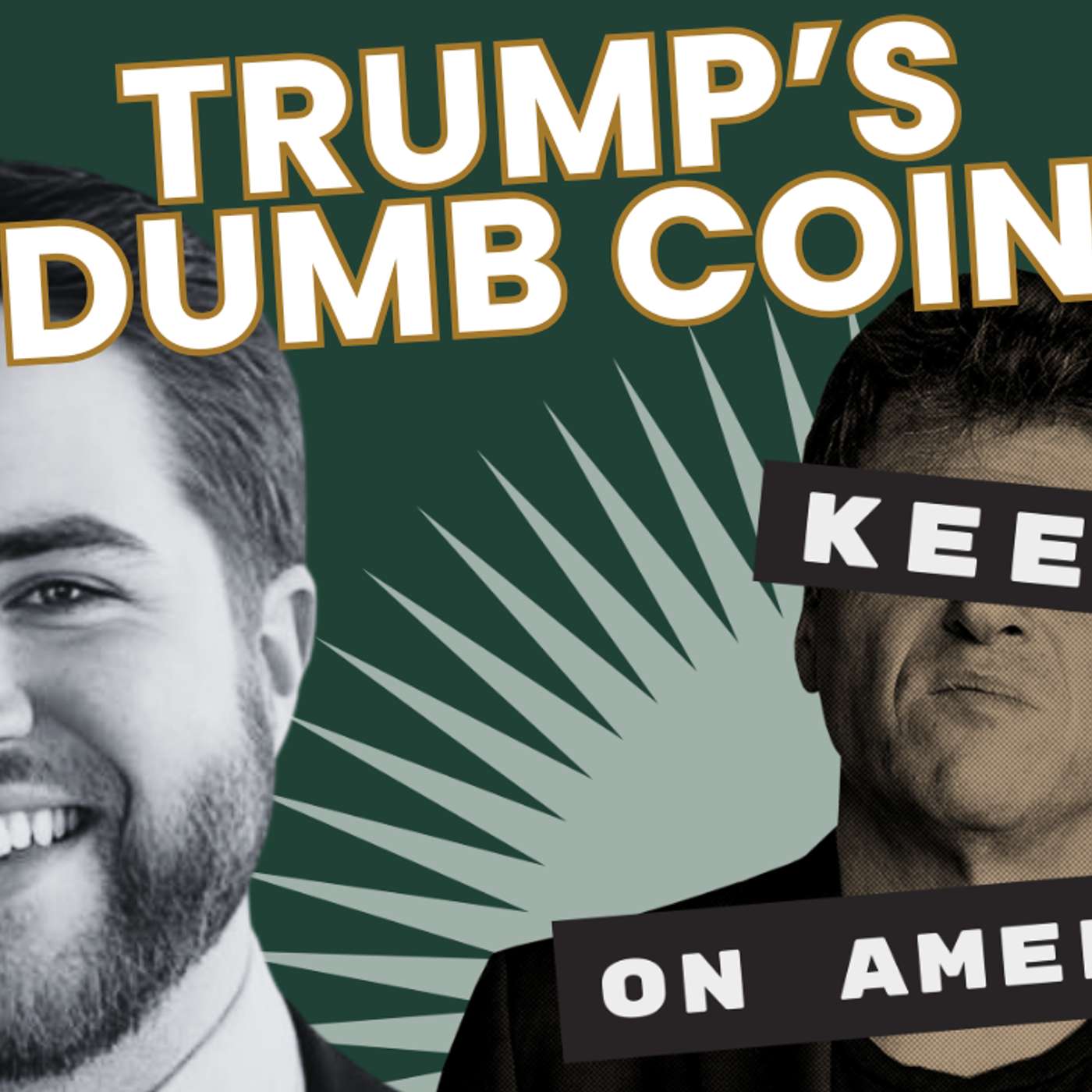
“Just because I think something is dumb doesn’t mean I think it should be illegal.” — Nicholas Anthony on meme coins Earlier this month, Elizabeth Warren called for an SEC investigation of Donald Trump’s meme coin. Is the Pope Catholic? No surprise there. More revealing are other critics of the “presidential” token which netted our Grifter-in-Chief $636 million last year. Take, for example, Nicholas Anthony, an expert on crypto at the Cato Institute and author of Digital Currency or Di...
“Just because I think something is dumb doesn’t mean I think it should be illegal.” — Nicholas Anthony on meme coins
Earlier this month, Elizabeth Warren called for an SEC investigation of Donald Trump’s meme coin. Is the Pope Catholic? No surprise there. More revealing are other critics of the “presidential” token which netted our Grifter-in-Chief $636 million last year. Take, for example, Nicholas Anthony, an expert on crypto at the Cato Institute and author of Digital Currency or Digital Control? It’s news when an unashamed libertarian from Washington’s own temple of free markets calls the president’s crypto adventure “completely unnecessary.” Maybe the Pope isn’t Catholic. Or maybe Elizabeth Warren should join the Cato Institute.
Anthony’s verdict is withering because, under his libertarian shell, he’s a crypto bro. The meme coin “has been a problem for everyone but Trump,” he argues, because it has held up legislation, invited investigations, and weaponized ethics concerns about crypto.
“We have no one to blame except Trump…” Anthony concludes bleakly. “He knew better than to do it, but he saw the opportunity and ran with it.”
When I accused Anthony of sounding like Elizabeth Warren, he was more amused than offended. Unlike the Warren crowd, however, he doesn’t want to ban crypto. “Just because I think something is dumb,” he says, “doesn’t mean I think it should be illegal.” So while Trump-style meme coins are a natural habitat for what he calls “rug pulls,” that shouldn’t be an excuse for lawmakers to pull the rug from the entire industry. Crypto can still revolutionize finance, Anthony believes. It can democratize centralized banking. It can make money fairer. Just don’t confuse that with a Melania meme coin.
Five Takeaways
• A Hard No from Cato. The week’s most surprising critic of Trump’s meme coin isn’t a Democrat — it’s a Cato libertarian. Anthony’s verdict: “completely unnecessary,” legally gray but ethically indefensible, and “a problem for everyone but Trump” — stalling the crypto legislation the industry actually wants, inviting investigations, and handing opponents a weapon. The explanation is pure self-interest: the first-term Trump attacked crypto as competition to the dollar and pushed policies hostile to the space; the second-term convert was swayed by industry lobbying and campaign money, the opportunity for personal enrichment, and crypto’s libertarian-conservative DNA. “We have no one to blame except for Trump… He knew better than to do it, but he saw the opportunity and ran with it.”
• Dumb, But Not Illegal. The libertarian line in one sentence: “Just because I think something is dumb doesn’t mean I think it should be illegal.” Meme coins are “a trading card of sorts” — their value is the person behind them, held up only as long as people stay amused — and a natural habitat for rug pulls, where insiders manufacture interest and vanish with the proceeds. Anthony opposes bans; he demands disclosure, and insists fraud be prosecuted whether it’s snake oil from a cart or a token from a president. Hence the kicker: a Warren-style investigation of the sitting president is “perfectly reasonable,” and “if it turns out he was doing something behind the scenes, then I think he should be prosecuted for it.” From what he’s seen, the fans knew what they were buying — but the line between brilliantly marketed and fraudulently sold is exactly what investigations exist to draw.
• The Dollar Launders Better. Isn’t crypto the ideal vehicle for laundering money? “Not so much. The US dollar is definitely the ideal vehicle” — and remains the currency of choice for criminals worldwide. The numbers: roughly one percent of cryptocurrency activity has been identified as illegal, against about five percent of US dollar usage — because the dollar is accepted everywhere, even in criminal circles, and cash, once it leaves your hand, is gone. Most cryptocurrencies, by contrast, run on public blockchains: permanent, searchable records that forensic accounting firms mine daily, and that keep catching criminals who never understood that the ledger remembers everything. The moral panic, Anthony suggests, is aimed at the wrong instrument.
• Free Banking’s Revenge. The deeper Cato case: cryptocurrency — born of cypherpunk and libertarian ideas after the 2008 crisis — is “for the first time in over a hundred years, the challenge to the idea that central banks have complete and total ownership of what is money.” Its ancestors are Scottish free banking and the note-issuing American banks that cleared payments for decades before the Federal Reserve existed. The prosecution’s exhibits against central banking: Zimbabwe’s hyperinflation queues, where friends of Anthony’s watched food become unaffordable while they waited in line, and the slower American version — $10,000 bought two Corvettes in 1970 and needs to be $80,000 today. No utopias: Bitcoin won’t erase the debt. But competition would supply the missing incentive for governments to be “better stewards of currency” — and the practice already exists, from Argentina and Lebanon to the crypto hubs of Nigeria, South Africa, and Kenya.
• Swept Up by Trump. The sadder confession concerns his own side: “Sadly, many conservatives have been swept up by Trump… the president can do no wrong” — Ted Cruz and Mike Lee among the obsequious, blocking the ethics language Democrats want attached to crypto legislation. The principled exception is Wyoming’s Cynthia Lummis: pro-Trump, yes, but one of the rare members of Congress who has done the technical and philosophical homework. The industry itself — Coinbase included — walks a careful line around the man who will sign its rules into law, seeing the damage but saying little. Anthony acknowledges his privilege: “Here at the Cato Institute, I can call balls and strikes.” As for the wider economy: a storm in a teacup for now — while crypto’s speculative fever has migrated to AI, whose models are quietly integrating the coins as their payment rails. It’s not what Satoshi envisioned; the cypherpunks and the bankers will split the inheritance.
About the Guest
Nicholas Anthony is a research fellow at the Cato Institute’s Center for Monetary and Financial Alternatives, a fellow at the Human Rights Foundation, and a member of the Economic Inclusion Group’s Advisory Board. His research covers central bank digital currencies, financial privacy, cryptocurrency, and the use of money in society. The author of Digital Currency or Digital Control? Decoding CBDC and the Future of Money, he has testified before Congress, maintains the Human Rights Foundation’s CBDC Tracker, and has been published in the Wall Street Journal, MarketWatch, and Business Insider. Originally from Baltimore, he holds an MA in economics from George Mason University.
References:
• Digital Currency or Digital Control? Decoding CBDC and the Future of Money by Nicholas Anthony (Cato Institute).
• Senator Elizabeth Warr...