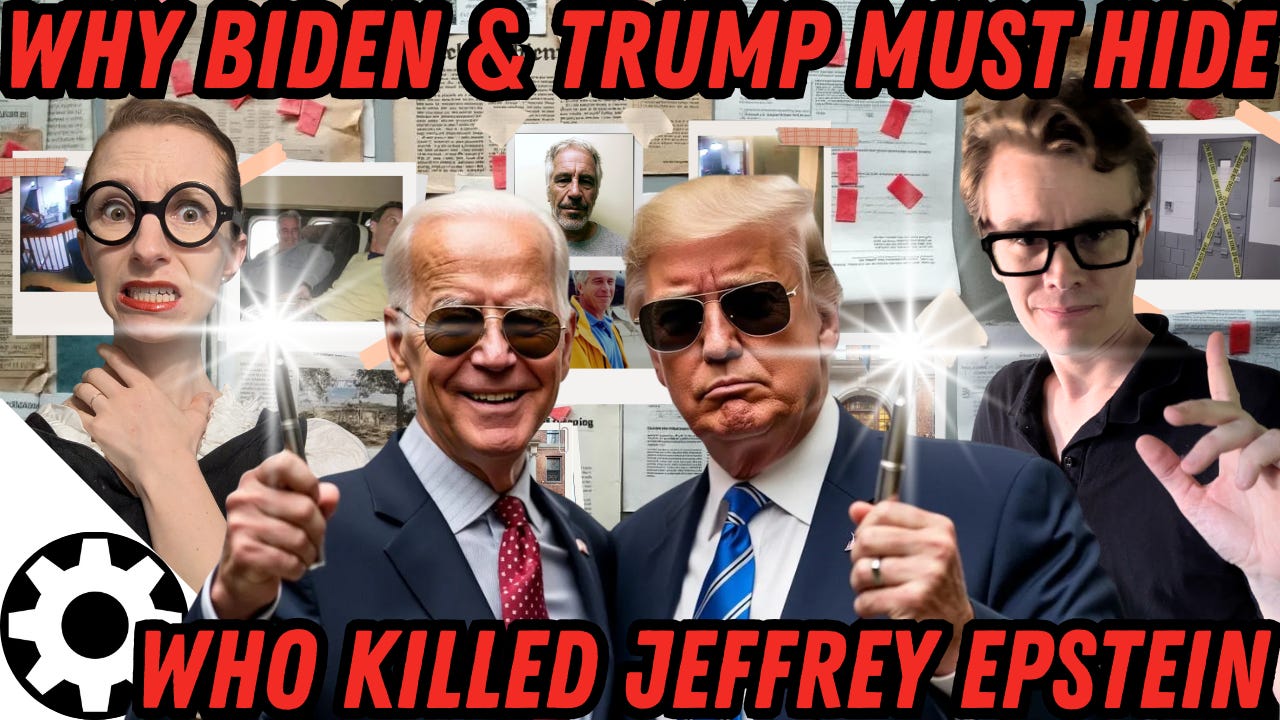
In this episode, Malcolm and Simone delve deep into the complexities and controversies surrounding Jeffrey Epstein's infamous case. They explore the lack of logical investigation, the political maneuvering, and the possible cover-ups. The conversation touches upon the role of intelligence agencies, Trump's shift in stance on releasing Epstein files, and how different powerful forces might have influenced the course of events. They dissect the new pieces of evidence, including inconsistencies in the guard logs, camera footage, and suspicious injuries. The episode aims to shed light on the probable reasons why key information is being withheld by the government, proposing plausible theories involving foreign nations and intelligence operatives.
[00:00:00]
Malcolm Collins: Hello Simone. I'm excited to be here with you today. Today we are gonna be talking about a spicy topic, which is Epstein. Oh boy. And the reason we're gonna be talking about Epstein is I have long wondered what actually happened. Because so many people when they talk about the Epstein list or they talk about his death they use it as just a tool to attempt to score political points on their opponents in ways that don't make a lot of sense if you apply logic to them.
And I had seen very little actual investigation trying to understand what actually happened and why, if there is a coverup, is there a coverup? And I think that recently we have received a giant piece of evidence as to what may have happened and who may have been involved that might blow the case open.
Ooh. But what's interesting is a lot of people are completely overlooking this new source of evidence. Yeah. They're just [00:01:00] complaining about it. They're just complaining about the redactions and everything else. Yeah. Well, no, no, no, no. What they miss is they see Trump administration, you know, they're running for office.
You have somebody like JD Vance in 2021, he, he tweeted quote. What possible interest would the US government have in keeping Epstein's client secret? Oh, do, do dot. And then later he said, if you're a journalist and you're not asking questions about this case, you should be ashamed of yourself. What purpose do you even serve?
I'm sure there's a middle class teenager somewhere who could use some harassment. Not right now, but maybe try to do your job once in a while. I mean, then there's a quote that we'll go into of Trump leading up to the election where he was super gung ho on this. And what people are missing is a crucial piece of evidence that has been revealed is that Trump's administration hasn't revealed significant evidence That tells you something.
Okay. It tells you that when you get a full picture of the case. Hmm. Even if you are Trump's [00:02:00] administration, even if you are a Republican administration, I. You believe it isnt in your best interest to cover this case up?
Simone Collins: Hmm. Interesting.
Malcolm Collins: Or the, the official narrative that he un alive himself is actually true.
And I will go into copious evidence that I do not believe that is true, that we will get to. Oh, really?
Simone Collins: Okay. Yeah. And I, Malcolm and I have been talking, by the way, offline about some, I read this really detailed substack post presenting all the evidence as to like, why basically the preponderance of evidence favors that he did indeed die, as people have said, he died in prison as, at least as a government official, said he died in prison with no foul play.
And yet I can't find it. Which also kind of to me suggests that whoever made that post found out something that kind of undid their argument and they took it down. So, yeah,
Malcolm Collins: that, that's my assertion. Well, because I, I did a deep dive on all of the evidence. And [00:03:00] my read, and I can, I can give you guys like the end state answer here and we'll work to it because I don't like leaving people hanging on, on theories.
People are busy. Yeah. My read from the majority of the evidence right now is, and I don't want to call out names, was one of these groups because I don't wanna put my own life at risk. But it was either a wealthy Muslim within Saudi Arabia who the US had strong reason to keep happy, both Republicans and Democrats.
Mm-hmm. And who has a history of doing this sort of thing. Mm-hmm. Or he worked for Mossad and or Jeffrey
Simone Collins: Epstein worked for Mossad.
Malcolm Collins: Jeffrey Epstein was a Mossad agent, and I'm not saying that Mossad necessarily installed him. Actually, it would be almost a little insane if various intelligence agencies didn't go out to him.
Yeah, because if you build a network, so people who don't know how intelligent agencies recruit assets, I should probably just go into this before we go further, because my dad was recruited as an intelligence agency asset. The CIA tried to recruit [00:04:00] him.
Simone Collins: Oh, so basically once you reach a certain level of connection and profile, you're probably gonna be contacted by some groups because
Malcolm Collins: yeah, they're, they're like, oh, you got invited to X event with a bunch of Russian dignitaries.
You know, you're very patriotic. He was a congressman's son. He was, you know, a known like very patriotic individual. And so they'd be like, Hey. Here's something you can do for your country. For, from Jeffrey Epstein's perspective. You know, he was born Jewish so they would've thought that they could have some leverage on him, and he had a lot of powerful people sort of in his debt to some extent which would.
Highly motivate. I, in fact, I would be surprised if, if he wasn't Mossad, that at no point did Mossad contact him. And, and I'd also point out here, I wouldn't say just a Mossad thing. I would also guess that Russian intelligence contacted him at some point. And I bet that the CIA contacted him at some point, he may have been working for various intelligence agencies.
Like if, if, if you build yourself into a position of power by blackmailing lots of famous people, and it's obvious and there is a paper trail [00:05:00] you are very desirable from the perspective of as, as an asset, you the hottest girl in the club. Yeah. The hottest girl in the club, right? Yeah. So what I'm saying here isn't insane.
I'm not saying that they like implanted him and built his career and everything like that. I like this way of
Simone Collins: looking at it though. What you're looking at is where are the incentives aligned? And, and who's going to come out of the woodwork for certain things. You know, like if you. Like put a pile of food in a field.
You know what bugs are gonna come flocking to it, you know? Well, yes. And if it
Malcolm Collins: was either of these groups, it would 100% explain why neither the Democrats or the Republicans want released. Because both the Democrats and the Republicans both want the Saudis and I I Israel to stay our friends. Yeah. Um, And that matters much more.
The, the stupid answer I keep hearing from people is, oh, Trump is on the list. And this answer just shows an inability at rational thought. Because if Trump, like if there was concrete evidence not just Trump on flight records or some picture of Trump, but that tied Trump, [00:06:00] Trump to Jeffrey Epstein in a nefarious context, the Biden administration, 100% would've released it.
Whoever it is. That's a good point that people are attempting to protect, is somebody who cannot be used to undermine either the Democrats or the Republicans. Hmm. If it was a mainstream Democrat. The Trump administration would be releasing it. If they had hardcore stuff on this, it was a mainstream Republican, the Democrats would be releasing it.
And you can be like, well, maybe there's people on both sides on the list. Then they would've released a redacted list.
Simone Collins: Yeah, yeah, you're right. I mean, there's, there's, it is just too tempting. And the fact that the Biden administration was sitting on this and could have done this is very compelling to me.
You make a great point. Some, yeah.
Malcolm Collins: Something at the core of this is, and, and, and I mean core in that you couldn't just give simple, redacted lists is preventing both sides from releasing it. And I note another interesting thing about it is it the Trump administration, early in the administration, they [00:07:00] signaled that they plan to release this information.
Simone Collins: Yeah.
Malcolm Collins: And that appears before they did a deep dive into the information. So, it may have been somebody that, you know, you get contacted not in months one when you're president. But month three or four when you're president and they're like, by the way, I hope we have an understanding over this Epstein thing.
Mm-hmm.
And that, that would make sense. Honestly, that one leads me more to believe the Saudis, because I think the Israelis would've immediately told him to tove this. Oh
Simone Collins: no, they're way too organized. Mossad is too organized to let that slip. Yeah. Whereas the
Malcolm Collins: Saudis, I could see them thinking it was more appropriate to you know, have a, a personal conversation with him.
Yeah. Let's socialize
Simone Collins: a little bit. First, let's have you visit a little bit first. Let's, you know, because you don't necessarily have to reach out right away because the, the administration was pretty busy flooding the zone in its first few weeks to do anything about the Jeffrey Epstein stuff anyway.
Right. So that makes sense.
Malcolm Collins: And so I'm gonna jump right into one of the biggest pieces of evidence around this that I [00:08:00] think a lot of people sleep on. And so we're gonna go into Alexandra Acosta, who claimed that Jeffrey Epstein was intelligence and was quote unquote above his pay grade in terms of charging him with specific things early in the investigative cycle.
And I think that this is actually a really important quote when you get an understanding of who this individual is who made these claims.
Simone Collins: Okay.
Malcolm Collins: So who is, who is he? Alexander Acosta is an American attorney and former politician who served as the US attorney for the Southern District of Florida, 2060 2009, and later the 27th, US Secretary of Labor, 2017 2019 under President Trump.
Hmm. A Miami nata and son of Cuban immigrants. Acosta graduated from Harvard College and Harvard Law still clerked for j Samuel Alida and held roles like Assistant Attorney General for Civil rights and Dean of Florida International College Law. And, and, and so what I'm pointing out here is this is not a fly by night guy.
This is not somebody, this is [00:09:00] not some
Simone Collins: YouTube conspiracy theorist. This is
Malcolm Collins: randomly appointed to a position of power, right? This is somebody who was, was, you know, structurally like a big deal individual, but also not like a swamp creature like team Trump, everything like that. Okay? So, as US Attorney Acosta oversaw the 2007 to 2008 non-prosecution agreement, NPA was Epstein allowing him to plead guilty to two state level prostitution charges.
Serving 13 warrant was work release despite a 53 page federal indictment for fornication trafficking. This lenient deal later ruled illegal for violating the crime victim's sparked controversy. The claim in 2017 during the vetting for his labor secretary role.
So, you know, he is under oath. He's, he is doing a vetting for labor secretary role. Acosta reportedly told Trump transition officials that he approved the 2008 NPA because he was told Epstein, quote unquote, belonged to [00:10:00] intelligence and that the issue was quote unquote above his pay grade. So he was instructed to quote unquote, leave it alone.
Oh, this was reported in the Daily Beast July, 2019. So Acosta made this statement to explain why he didn't pursue a stronger federal case against Epstein. Despite FBI evidence for dozens of victims the claim surfaced after Epstein's 2019 arrest, feeling speculation that Epstein was an intelligent asset.
And note if he was moad, this claim would apply to him.
Simone Collins: Yes, that's true. Okay.
Malcolm Collins: Acosta's response at a 2019 press conference. So he was later pressed on this later, right? Like they tried to pin him down on this in public. I guess he didn't know that this would leak, that he said this at this hearing.
When asked if Epstein was an intelligence asset, Acosta declined to confirm citing Justice Department regulations and said quote, I would hesitate to take this reporting as fact calling such [00:11:00] claims rabbit holes. He emphasized his office acted based on quote unquote facts, not external pressures. If you are wondering, by the way, that is exactly what I would say.
If I knew that I was told not to talk about this and then it leaked and then the press approached me and we often have to talk around you know, people who we know or whatever in press articles. So I'm very familiar with the language you have to use. To not lie you know, but to also not you know, 100% confirm this, but yeah,
Simone Collins: to, to answer a question without answering the question
Malcolm Collins: to me, there is no reason that somebody, you know, especially while being grilled for an appointment with the Trump administration was this level of history, would have said something like this, unless it was true.
It is such a, it's just he's not the type of guy who would make this up from, from his backstory. Well, to
Simone Collins: both make it up in a hearing, but then not repeat it [00:12:00] to journalists. It also would be weird.
Malcolm Collins: Yes. It also explains very odd behavior on his part. Why did he build this giant 53 page dossier with dozens of victims and then not attempt to prosecute it?
Why would you do that? Why would you have your office do that unless you had built it? And then not just that, what's really important about this coming out of him is that he is the person that if Epstein was an intelligence asset that would've been notified, don't continue to pursue this. It, in fact, it's very likely that he did even explain to his subordinates why they had to stop pursuing it.
But, but out of everyone, we happen to get the one person who we know for a fact would've been pulled aside and said, this is an intelligent asset. You need to stop this case. Yeah. So it, it checks out. It makes sense in context and I can't understand why he'd makes this up.
Simone Collins: That's a really good point.
Yeah. [00:13:00] Huh. Okay.
Malcolm Collins: And, and he had his office drafted a 60 count indictment and and received an 82 page prosecution memo from the assistant us Marie Ena in 2007 detailing Epstein's fornication trafficking his decision to shelves. He would've had a, a strong reason to move ahead with it.
So, let's now go into another interesting thing here that's often talked about in regards to this. And note I'm gonna, I'm gonna blow up some stuff that people think is evidence of fpe. Like the fact that originally it was said that there were no tapes of what happened, and now we have tapes of what happened.
That's actually not a particularly bad smoking gun. But I will go to a second smoking gun that a lot of people sweep under the table as being less of a smoking gun than it actually is. So, on August 9th to 10th, 2019, MCC Guard, so this is where Epstein, when he unli was being held Tova Noel and Michael Thomas were responsible for [00:14:00] monitoring Epstein in special housing unit, the SHU.
They falsified log entries, so two log entries in a row. Roe claiming to have conducted the required checks at 12:00 AM and 3:00 AM and 5:00 AM sorry, three log entries in a row. So two people were involved in this and it was the falsification of three entries.
Simone Collins: That's pretty bad. But also, how pervasive is that in the prison system, he was
Malcolm Collins: found dead at 6:30 AM officially by Unli via partial hanging.
The 2023 OIG G report attributed this to negligence, noting the guards were distracted. EG online shopping and napping online shopping. Okay. This, this is, yeah. A lot of people, they're like, oh. Well, there's actually been findings that like 20% of staff within this facility have so, so to give context, a 2018 presenters, BOP audit by the Washington Post reported widespread falsification at the MCC due to overwork staff cutting [00:15:00] corners.
For example, guards, often logged checks was out physically conducting them a practice. Not unique to Noelle and Thomas. Yeah, the OIG noted that nine out of 11. SHU officers on duty that night failed to complete rounds properly, though only Noel and Thomas fail faced charges due to their direct responsibility for Epstein.
So nine out of the 11 guards in some way faked this. Yeah. But here's the important thing, the faking of it, and there are specific instances in which they faked of it overlap with the period where Epstein Unli. Yeah. That's uniquely inconvenient. Also, like wouldn't you check on the celebrity that. Then we're dealing the celebrity who might unlive themselves.
And a lot of people had said, oh yeah, he was on watch,
Simone Collins: wasn't he?
Malcolm Collins: Yeah. He not only was he on watch, but like a huge number of people had a reason to want him dead, right? Yeah. Like everybody knew this, right? Because he had blackmail information on [00:16:00] tons and tons of individuals. And so, there was a reason to check, but where this gets really interesting is in the prosecution of these two individuals.
Hmm. So it says, oh, nine out of the 11 people on staff that night didn't properly do their rounds. However, there was no prosecution for any of these other individuals. In addition, when these two individuals were prosecuted, the prosecution was only for skipping on those specific periods and not for any past skipping.
If this had been a ongoing issue with these individuals, presumably during the prosecution of them, there would've been a motivation even just to show, Hey, this is not like it was actually just negligence that this had been an ongoing behavioral issue and yet that didn't happen. Huh? That is, which to me is a huge red flag.
Why was nobody else prosecuted? If this is a major issue for this facility and it led to such a high [00:17:00] profile screw up, why did they not go back and check the older logs to prove that these individuals had been skipping regularly? If. There was an assassin and somebody had paid them or done something for a family member or threatened a family member or in some other way motivated them, Hey, he's a bad guy.
Let me, like the ways that intelligence agencies get people to do things. There's a myriad of ways that they get people to do things, maybe get some blackmail on them or something. Hey, just don't show up to these two specific shifts. Right. They may not even know what was gonna happen. Right. It's just don't show up to these shifts.
Yeah. That is exactly the way intelligence agencies work when they're pulling something like this off. And it wouldn't have been hard for them to do. Is the other thing, right? Like people act like this is some big complicated operation when it's like, not necessarily. It would also explain how the individuals were able to get on to a facility like [00:18:00] this.
It would also explain why the cameras that directly looked at his cells were not operational. Because when they said they released camera footage, it was of a surrounding area. And we'll get to the, the weird camera footage story in a second, which also I'm so curious
Simone Collins: about that.
Malcolm Collins: Yeah, yeah. But I, I, I personally found that really, really fascinating.
Okay. I also want to just before we go further, go over the larger case because something that I was trying to dig into is, was Epstein just a rich playboy with hemophilia, you know, liking underage but not minor girls?
Mm-hmm.
Or, and, and who like liked drawing other people into this? Or did he have an operation where and this by the way, is my reconstruction of events with Jeffrey Epstein.
He started as an individual who found ways to blackmail other individuals and worked really intently to draw other individuals into situations of blackmail to get '[00:19:00]
Simone Collins: em implicated. Yeah.
Malcolm Collins: Yes, but never, I don't get, I get that he actually had fond relations with the people he was quote unquote blackmailing, where they just sort of knew he had info on them.
And so they did him favors or things. Yeah. This is how
Simone Collins: trust networks used to work. You just knew that you had embarrassing stuff on your friends and so you were less likely to, you know, when it became less convenient to. Back then you were still,
Malcolm Collins: and, and I believe that he became a an intelligence asset later.
But the reason I was looking into this, I was trying to determine, well, was he actually blackmailing people? Because there isn't hard evidence of him blackmailing anyone.
Simone Collins: No. I think he just had dirt on a lot of people. And that gave him leverage.
Malcolm Collins: Yes. Well, and we are aware of an instance of how he did this.
So sort of how he operated is he would send girls, like, he would go hang out with like wealthy or powerful individuals, and then he would send girls to meet with them.
Simone Collins: Mm-hmm.
Malcolm Collins: And, and the, the individual who we know who he did this to basically open the door and was like, what the f**k are you doing here?
[00:20:00] Leave. And then close the door. But that was that to me. Implies he's not just a playboy, he's intentionally trying to get people like dirt on individuals. Yeah.
Simone Collins: Well, and this is, I think this happens a lot, for example, with like drug dealing, like you give you, you know, some free samples too, like that could be part of it as well.
I.
Malcolm Collins: Yeah. So let's, let's go into where I get this from the scale of the operation. Epstein's Trafficking Network was highly organized involving recruiters, Gillian Maxwell, payment to girls, 200 to a thousand per session, and steady supply of victims across multiple properties. This level of coordination documented in the 2019 indictment suggests more than personal indulgent, hinting at a broader purpose, surveillance equipment.
His properties were equipped with cameras per the New York Times 2019, and victim accounts raising questions about the recording purposes beyond personal use such as blackmail intelligence ties. Alexander Acosta claims that Epstein unquote belong to intelligence strongly suggest this goes beyond [00:21:00] hedonism as well.
Un prosecuted crimes. Epstein's escaped from charges in the 2094 towers. Financial Ponzi scheme, which we'll go over later. Mm-hmm. In lenient 2008 plea deal suggests protection. Mm-hmm. Possibly from leveraging compromising material, not just to playboy lifestyle. I actually don't think that that death was happening.
I'll go over the timeline. I think that those charges for the Ponzi scheme is when he was recruited. And I think that this indicates that he was working for the CIA potentially as well as Mossad. If you could say, well, if he was working for the CIA, why don't you think the CCIA a did it? And I think it's because I don't, I don't think they're comp competent.
I don't think they're competent enough. I don't, I don't think that they would or, or would think in the modern age to do something like that, even if one of their assets was in jail. Whereas I think that Mossad, if you look at like the pager thing and, and other ops they've run recently absolutely had the capabilities and the desire to do something like this.
Simone Collins: Hmm.
Malcolm Collins: Surveillance systems, Epstein's Manhattan townhouse. So in terms of where the cameras were, they had hidden cameras in the [00:22:00] bedrooms and bathrooms per victim accounts. And FBI searches. Guffey alleged in her 2005 lawsuit that Gillian instructed her to gather, quote, unquote embarrassing information on powerful men.
So he, he was directly directing people to do this. And the 2019 raid on Epstein's Manhattan Home found CDs labeled with names of individuals alongside miscellaneous nudes or girl pics suggesting compromising material.
Simone Collins: Oh my goodness.
Malcolm Collins: Hard drives. Were also seen, though their content remains unreleased, and this gets really interesting.
So we know they have the CDs. We don't know whose names was on them. We know, we know that there were names on them. We don't know whose, we know that there were hard drives that they seized. And so you have people say, oh, they didn't get the information. Oh, they didn't get the, and we're like, we know for a fact that's not true.
Right. They have the dirt.
Simone Collins: He
Malcolm Collins: didn't, he didn't have a list. Could we at least get a list of the names on the CDs? Like that's a, that's an important list, right. I wonder [00:23:00] though,
Simone Collins: I mean, is there, are you gonna argue that also the argument, sorry, that the government benefits from having these lists themselves.
Now they just have all the benefits that Epstein did and they can call these people and be like, yeah. So I have a picture of you right here with you know, in, in certain embarrassing scenario. So you wanna tell me about X? 'cause I think that there are many scenarios in which government intelligence agencies or just agencies in general would love to be able to call someone up and be like, Hmm, embarrassing picture here.
Shame if it got published tomorrow. And then instantly get answers. Is that part of the issue here is that if they released everything suddenly, it'd be a lot harder for them to get answers and leverage from people.
Malcolm Collins: No. No, that's it. Okay. Why? I don't, I don't think that's it. And I'll note here that for one of the theories that I'm gonna come up with of what could have led to this,
Simone Collins: yeah.
The
Malcolm Collins: fact that he labeled some CDs was Girl picks imply something. It implies that he had multiple categories of picks uhoh, including a Guy picks category of pick. No, no one
Simone Collins: talks [00:24:00] about that. Oh, no One talks about the, the Epstein Boys.
Malcolm Collins: Well, the reason why this is important to one of my series is if you're talking about someone was in Saudi Arabia who was wealthy, who.
Them sleeping around with girls on a trip wouldn't be that big. Yeah. That is not scandalous. Them sleeping around with men would be execution. And so in a very big deal under law. And so, this, this is why I suspect that that could be what's upstream of all this Ahuh. Okay. And there's actually a lot of evidence for that, which we'll dig into really, because
Simone Collins: no one, everyone talks about all these young girls that got looped into Epstein's nightmarish scenarios and creepy uncomfortable whatevers.
And then I. Yeah. No boys. No boys, no, no boys are coming forward.
Malcolm Collins: Why they're not me doing this. Girls come forward. The reason is, is because if you know the people involved in this, and you were one of these guys you know, very much how, how extremely dead you'd be if you [00:25:00] came forward.
And,
and Epstein likely knew how extremely dead he'd be if he came forwards.
Okay. But before people were at, because we're gonna go over flight logs and stuff like that we're they, they get pretty interesting on this point.
Simone Collins: And I, and I wanna be
Malcolm Collins: clear in what I'm saying here. I am in no way saying, anything about the royal family in Saudi Arabia? I'm just saying powerful interests within Saudi Arabia is, is is what we'll be going over.
I I don't wanna make any claims about that. That is not what I'm saying. Yeah. But I, I'd say that that's, that's why the, the men who are involved in this aren't coming over. And you'd be like, wait, why would the men only be involved with high profile Muslims? Whereas the underage women would've been involved with, well, because one.
You people in a lot of Muslim countries just aren't gonna care. You haven't actually gotten dirt on them if you've gotten them to sleep with a 16-year-old woman, right? Like, that's not real dirt from the perspective of these countries. And if you're an American sleeping with men, especially if they're not underage, is just not dirt.
That's, that's not something you [00:26:00] could hold over. Most American politicians or something like that, they'd just be like, oh, now I look sexually adventurous, you know, whatever. Whereas, you know, it's like, know your audience, know the context. Victim testimony. So, GE Gere claimed that Epstein and Maxwell directed her to have sex with specific high profile figures like Prince Andrew to collect information per her 2015 disposition.
Another victim, Sarah Ranson, alleged that in 2016 that Epstein recorded sex tapes of prominent men, though she later admitted to fabricating some of the claims. Leslie Wexner accused Epstein of misappropriated 46 million per a 2019 letter to his foundation, but he didn't report it until after Epstein's arrest.
This delay could suggest that Epstein held leverage over Wexner possibly compromising material. No to, no direct evidence confirms this. So basically this one guy will get into this Epstein managed all his money. After Epstein's arrest for this stuff. This guy said he stole 46 million, $46 million from me.
[00:27:00] He allowed Epstein to continue managing his money. Why did he do that if Epstein didn't have blackmail material on him? That, to me suggests a black male operation. I'd be stoked
Simone Collins: if I were that guy in Epstein didn't exist anymore.
Malcolm Collins: And then we had flight logs. The, the list of individuals like Clinton, 27 flights Trump seven flights and Arab.
Barack, which we'll get to in a bit indicating Epstein specifically had a lot of powerful men go to his stuff. Now we're gonna go to next piece of evidence that this was probably not arriving. Okay.
But I, I do like that we're getting true crimey in this episode. Like, yeah,
Simone Collins: I'm enjoying this thoroughly.
Yes.
Malcolm Collins: So the details of Epstein's neck injuries, I don't know, did you hear about this?
Simone Collins: So, and this had to do with the partial hanging.
Malcolm Collins: Yes. Okay. So an autopsy conducted by New York City's Chief Medical Examiner, Dr. Barbara Sampson, found specific injuries to Epstein's Neck that raised questions about [00:28:00] the manner of death.
Here is a detailed breakdown. Hmm. Injuries observed hyoid bone fracture. Epstein had a fractured hyoid bone, a small U-shaped bone in the neck below the jaw, which supports the tongue. The Washington Post 2019 reported that this injury was noted in the autopsy, thyroid cartilage damage. The autopsy also identified fractures in the thyroid ridge.
Adam's apple, another structure in the neck, Perrin pathologist report cited in the same article. Other findings, the autopsy noted ligature mark, consistent with a bedsheet used as a noose tied to the top bunk of his cell. Epstein was found with the sheet around his neck kneeling or leaning forwards in a quote unquote partial hanging position as he didn't jump from a height.
And the this, this is, how could that. Hold on. This is really important what I'm about to get to here. Okay, go ahead. Yeah. Epstein was in a small single occupant cell in these special housing unit that was approximately eight by 10 feet. It was a bunk bed, toilet and sink. The bunk bed was [00:29:00] about five to six feet high, insufficient full, a full body drop, typical of hangings.
The height meant that Epstein's hanging was likely a low force partial suspension, where his body weight applied pressure to his neck while kneeling or sitting. A common method was in prison and alives. Now why is this important? Because the type of injury that he had to his neck, which we'll get to in a second.
Okay. Very rarely happens on hanging suicides even when the individual has jumped from a height. And so the fact that he was able to obtain these injuries in a cell that was only eight by 10 feet, right? He didn't, there's not enough torque. He lacked the torque. He lacked the torque to create these injuries, which we'll get to, and we'll get to their frequency and we'll get to studies on their frequency right.
Now. Can you because I'm gonna give you, I'm gonna make this episode even for you, Simone, the deepest you've ever heard somebody go on this case. I
Simone Collins: really appreciate this because I've been watching coverage out of interest and yeah, man.
Malcolm Collins: The [00:30:00] rarity of hyoid bone and thyroid cartilage fractures in suicidal hangings, especially partial hangings, is central to the debate.
Here's what the forensic evidence suggests. Hyoid bone fractures general prevalence studies in forensic pathology. The Journal of Forensic Sciences 2005 indicated that hyoid bone fractures occur in 20% to 30% of hanging un alives, more commonly in older individuals. Now, keep in mind, Epstein was 66, which provides some.
Wiggle room here. Yeah. Due to bone brittleness in strangulation, totally homicidal or accidental hiro. Bone fractures are more frequent occurring in 50 to 70% of cases as the neck is compressed with greater force. Okay. So, and, and, and compressed asymmetrically. So you get it in 50 to 70%, not even all.
So you need quite a violent strangulation to cause this in most cases.
Simone Collins: Wow.
Malcolm Collins: Now but you're
Simone Collins: trying to argue that maybe plausibly it's because he was older and therefore frail.
Malcolm Collins: So in partial hangings. This is Epstein, which is why he had Ky bone fractures are even less [00:31:00] common, only occurring in 10 to 20% of, of, of cases compared to drop hangings.
Mm-hmm. So you would only expect it's in 10 to 20% of cans. Now, the thyroid cartilage fractures prevalent. Thyroid cartilage fractures are also less common in, in partial hangings, 10 to 20% compared to strangulation. 40 to 60% per forensic studies. American Journal of Forensic Medicine and Pathology 2010.
The cartilage is more flexible in younger individuals, but bri in older ones increasing Epstein's risk. So on the other side, he was older. Multiple fractures, Hy and thyroid in a single case are rarer, still occurring in less than 10% of hangings and un alives according to Dr. Cyral Rech, another pathologist cited in the Washington Post.
So the, this
Simone Collins: comb exogenous, yanking evidence is, is growing here.
Malcolm Collins: Yeah, this combination is more typical in strangulation where the manual literature force targets multiple neck structures.
Simone Collins: He was going, [00:32:00] someone going down. So
Malcolm Collins: individual thyroid fractures occur in a minority of hanging suicides, especially partial ones, but are not impossible.
The 10 to 30% range. However, the combination of both fractures is extremely rare. And so, this heavily implies that he was strangled and quite violently, which was somebody who wanted to strangle him quickly.
Simone Collins: Mm-hmm.
Malcolm Collins: Which would be the case if you were going into a prison and then having to leave and then setting, had a rush
Simone Collins: and you had a 92nd interval to make it in and out of the cell while the camera was turned off in the hallway.
Maybe,
Malcolm Collins: I don't, I don't know if I don't buy as much from this camera, but there is some evidence of the camera, so let's talk about the camera right now.
Simone Collins: Yeah, let's
Malcolm Collins: please.
Now I want to note here. If you come to me and you say, well, this could be a coincidence, Malcolm, when you have a lot of people who have a motive to kill someone and that individual dies and there are a large number of coincidences around that, you have to calculate the [00:33:00] probability of that many coincidences happening in a row, and you can get a number where it becomes.
Wilder and and actually significantly wilder to assume they are coincidences than just assume the people with motive means, and opportunity took that motive, means, and opportunity. Specifically here what I'm talking about is the guards falsifying the logs during the window of death. The camera malfunction in that specific area and timeframe, the rare bone fracture patterns for partial hanging.
Previous cases dropped with prosecutor citing, quote unquote, intelligence concerns the consistent pattern of officials changing their stance. After reviewing classified materials and the timing of the routine reset camera gap, each individual event might have a, let's say, 10 to 20% chance of. Being a coincident, but when you multiply these probabilities together, you get something like 0.1 times, 0.2 times 0.1, five times 0.1 times 0.05, and you get a number that's like 0.0 0 0 0 0 0 [00:34:00] 1 5, or about a one in 600,000 chance that is coincidental.
Well, first, why, why, why? Did they say that there wasn't a camera there to begin with and then all of a sudden we have camera footage, right?
Yeah. Okay. Septic investigations revealed that some video footage from the MC did exist, though it was limited, the DOJ and FBI clarified that while cameras in the hallway captured certain areas, they did not have a direct view into Epstein's cell to to the camera. Placement and design of the facility footage from the night of Epstein's death was later reviewed as part of the investigation, but officials noted it was incomplete or lacked.
Critical details due to issues like camera angles, record collapse, and system malfunctions. The DOJ office and the inspector General OIG released a report in 2023 detailing the circumstances of Epstein's death. It confirmed multiple failures at the MTC, including staffing sources, digs, procedural violations, EEG [00:35:00] guards failing to conduct required checks and issues with surveillance systems.
The report noted that while some cameras were operational, the footage did not provide conclusive evidence about the events inside Epstein cells. As the cameras only covered the hallway. The OIG attributed the initial confusion about cameras to poor communication and management within the facility,
Simone Collins: which again, I mean these prisons are not known for being run incredibly well.
Okay. What happened here? So the camera was sus but the entire prison? No, no, no. The point here
Malcolm Collins: being is it does appear that some cameras were down at the facility. The cameras was the best views of the cell were down at the facility. The camera footage that we have footage is not one of the best views of the cell.
It just covers like the entrance to the past that would've gone to the cell. Well, and this is your
Simone Collins: point, whether they weren't wrong about the cameras being down, the footage that we received where they're, like you said, there was no footage, was from a totally different camera, which before they basically didn't count.
'cause you don't see anything.
Malcolm Collins: Right. And I think that everybody's focused on like this, oh, this one minute gap in the, in the video or [00:36:00] something where I'm like. Given the length of time between now and this, in this case, you could have swapped out that footage for any other footage of any other night, right?
Like, there's no reason for us to suspect that this is the actual footage from that night. I, I, I personally do not believe that what happened was that they cut out the one minute of footage when somebody went in there. I just think they swapped out the nights. Hmm. But we'll get to why I think that in a second.
But also the, the one minute of footage is like way more suss than it initially appears when you look at the excuse for it.
So official explanations for the missing minute, the Department of Justice, DOJ and the FBI released approximately 11 hours of surveillance footage from the M CCC Special Housing Unit SHU on July 7th, 2025, covering a period from 7:30 PM on August 9th, 2019 to 6:40 AM on August 10th, 2019 when Epstein was found dead.
The footage [00:37:00] intended to confirm the official conclusion of an alive contains a noticeable gap when the time step jumps from 1150 8:58 PM. To 12:00 AM resulting in the missing minute and two seconds.
Simone Collins: God, attorney
Malcolm Collins: General Pam Bondy addressed this gap during the White House cabinet meeting on July 8th, 2025, explaining that the missing minute was due to a routine nightly reset of the MCCs outdated video surveillance system, which she claimed occurred every night at midnight.
Blondie stated that this reset caused a consistent one minute gap in recordings across all nights, not just the night of Epstein's death, and that the DOJ was working together all additional footage from other days to demonstrate this pattern.
Simone Collins: This sounds like one of those things in caper films where there like where there's one flaw in the security system and we have this 62nd period where we have to sneak through while the camera system's down, but that just seems like such an implausible thing.
Like I never take that trope seriously, because who would've a camera system that's [00:38:00] consistently down for one minute every night? Yes, I would
Malcolm Collins: exactly one time. But here's here's the problem. They, they made the claim that they were gonna do this quite a while ago and they haven't released any other footage showing that this happens on other nights.
Oh,
Simone Collins: okay.
Malcolm Collins: We're gathering it. We'll come to you. I can very much imagine that she believed this. Somebody told her this. She then goes Yeah. And they were like, mm. Actually we tried collecting it and we're not finding it in other nights. Yeah. And then she's like, oh, like, I don't think like necessarily she's involved in a coverup.
I think she's just doing what other people are like, Hey, yeah, I think she
Simone Collins: in the middle of this or that. You know? She, 'cause she originally was extremely bullish, right. She was like, it's on my desk. Yeah. Like, this is coming out. And then I feel like other people have been like, y. Yeah, you're gonna have to change your stance on this.
Yeah. This
Malcolm Collins: is above your grade above your pay grade that somebody else said this is above your pay grade. Right? Yeah. I don't,
Simone Collins: I don't wanna be her right now 'cause she's getting so much hate that I, yeah. I I don't think this was in her [00:39:00] control because I think it was on her desk. I do think she saw it and I think she was ready for it to go.
Malcolm Collins: Yeah. Yeah. But to continue here the 2020 CDOJ Office of Inspector General's report, the OIG report for Epstein's desk does not mention a routine nightly reset causing a one minute gap. But does document systemic issues with the MC surveillance system, including a malfunction on July 29th, 2019.
That caused recordings to be made for only about half of the cameras. I'd also note here that the malfunction happened on that specific day which again is incredibly suss if you have somebody doing an assassination.
Simone Collins: Yeah. This is another one of those like caper film things of like. The camera system went down.
Yeah. Oh no. The cameras are scrambled. What happened? Do, do, do.
Malcolm Collins: Yeah. I also if you're watching this and you're like, okay, there was a one minute gap, but was that one minute gap even around a time that was relevant to mm-hmm. Epstein dying. The, the missing minute 1158 to [00:40:00] 12:00 AM occurs within the critical overnight period where Epstein was alone in his cell.
The DOJ memo and footage indicate that Epstein was last seen as being alive in his cell around 7:49 PM with a guard visit less visible in the area. At 10:51 PM no one was seen approaching his cell door until the guards discovered him unresponsive at 6:30 AM on August 10th, 2019. So, if we're looking at the, official timetable. The the, the unli happened between 10:40 PM and 6:30 AM which is, was in the window of the jump in the footage.
Simone Collins: Mm-hmm. Mm-hmm.
Malcolm Collins: And then we have the three guard checks that didn't happen in a row, and we have the cameras that went down. Yeah. That is, that is too many things happening at once.
It's like any one of these things individually, I could be like, okay, yeah, fine.
Simone Collins: Okay. Totally.
Malcolm Collins: But it's not just that you have all these things happening at once. You have all these things happening at once to an individual that [00:41:00] other people had said was involved with high level intelligence. And like, like when I say other pe I mean people who were managing his case and dropped it out of the blue and then had to explain why they dropped it out of the blue.
I'm not talking about like a reporter or a muckraker or anything like that. It was people with a vested interest to not say something like that. As we can see by what he said when he was asked directly by a reporter. Mm-hmm. To me, I'm just like, okay, so we have a, a, a motive, a means, an opportunity, and like.
Five or six, really, really unlikely coinciding coincidences.
Simone Collins: And some of the excuses that I would make for guard based negligence don't work here. Like, oh, they're underpaid. But if I were an underpaid guard, then what I would be doing is going in to check on Epstein all the time so that I could get dirt that I could sell to tabloids.
Malcolm Collins: Yes. That's actually a very good point.
Simone Collins: Check on him more. One, because you're bored and underpaid and you'd rather check on him than other people who like are violent [00:42:00] and annoying and two. Yeah, it's, it's lucrative to check on him.
Malcolm Collins: All right. Now we're gonna go into Trump Epstein relationship timeline for people who think that Trump was actually involved in any of this.
I do not think he was. And I think we actually have fairly strong evidence that he wasn't. What we do know is that early two thousands Trump and Epstein were very friendly before Epstein's criminal activities became widely public. And note Trump termed on him very early in the criminal investigation, which we'll get to, trump spoke positively about him emphasizing their social connection and shared interests. This was during a period where Epstein was a known as a wealthy financier and social elite, and their interactions were documented at events like those at Mar-a-Lago. A quote in 2002 by Trump said, I've known Jess Epstein for 15 years.
Terrific guy. He's a lot of fun to be with. It is even said that he likes beautiful women as much as I do, and many of them are on the younger side. No doubt about that. Jeffrey Epstein enjoys his social life. Now. I'd also note [00:43:00] what he's saying here because I think that people misread this a little. Yeah, they say that, oh, this is proofs that Trump knew.
This to me is a little side eye from Trump about what shouldn be doing this. Also because it's
Simone Collins: not his type like, phenotypically young looking or underage looking women clearly are not Trump's type. He has a type he and yeah. I, I really think it's more like him being like, yeah, this guy is a little weird, you know, not my taste, but he has fun.
Malcolm Collins: Yeah. Well, I mean, except for his daughter, the, the jokes there from the Yeah. But
Simone Collins: that's, no, she, when when he said all the things about her though, it's her as an adult who does not Yeah. She's already an adult. Like a, she does not look like a teen at all. Yeah.
Malcolm Collins: At all. Yeah. So my read is I've seen no instance that, that Trump is interested in this stuff.
And I have seen Trump like reveal things like the, for example, the way he acts towards his daughter is genuinely kind of creepy and outside of normal [00:44:00] sexual norms. Yeah. So it's not that Trump is like super good at, at covered. He doesn't,
Simone Collins: no, he, he, he does not hide. His issues.
Malcolm Collins: He's also bragged about sleeping with friends wives Yeah.
And stuff like this and recording it. It's,
Simone Collins: and this is another reason why he succeeds, is because there are no secrets. He's hiding. Yeah. He, he talks about all his virtues and vices are 100% public friends Grab em by
Malcolm Collins: the P word. He, he, he, he talks about going into women's locker rooms at like the, the beauty pageants and stuff like that.
He is not afraid of breaking sexual taboos. He apparently looks down on people as I get from this comment, who break this sexual taboo.
Simone Collins: Mm-hmm.
Malcolm Collins: He sees this as crossing a line, which is what I, I, I take from that comment. Yeah. And we actually see this because Trump actually sort of, flipped on Epstein very early.
So let's get into this. Mm. As well as the timeline of this. So Epstein's first major legal troubles began in 2005 or 2006 when the poem. The police investigation investigated ma major allegations of [00:45:00] sexual misconduct with minors leading to his 2007 plea deal in 2008. Conviction for soliciting wait, what, what do I say?
Paid for indication from a minor. The reported Mar-a-Lago ban is said to have occurred around 2007 before the conviction, but during the period where his behavior is under scrutiny. So, I will note that we're gonna get into. Trump banned Epstein from Mar-a-Lago. They had that much of a falling out.
And this happened before the conviction and before a lot of Epstein's problems around this stuff were made public. And it was for something fairly minor, if I understand correctly, like allegedly Epstein. We're gonna go into it. We're gonna go into it. Okay.
Simone Collins: Yeah.
Malcolm Collins: So according to the book, the Grifters Club 2020, a book by Miami Harald, journalist Sarah Blaske, Nicholas and NoJa and Kaitlyn Ostroff.
Trump banned Epstein from Mar-a-Lago after an incident involving Epstein's inappropriate behavior towards the teenage daughter of a club member. The book cites sources claiming Epstein made advances towards the underage girl prompting Trump to bar him from the [00:46:00] property. A 2019 Washington Post article corroborates this reporting that Trump's decision came after Epstein's behavior and Mar-a-Lago raised concern, specifically citing an incident with a member's daughter.
So specifically a member came to Trump and asked if his daughter could have a job at the establishment. Mm-hmm. Trump gave his daughter a job. And, and then Epstein attempted to aggressively hit on this girl. And Trump was apparently, which I can really understand, you're doing a favor for a friend.
You're trying to, you know, help their daughter. And then this daughter of, of a friend of yours comes to you and is like, dude, like I'm X Age. And this guy was aggressively hitting on me. And, and Trump then banned him. Now I know if Epstein had a bunch of stuff on Trump. I don't think Trump's gonna ban him from his establishment, especially
Simone Collins: given that other people have apparently lost millions of dollars due to 'cause of
Malcolm Collins: stuff Epstein had on them.
Yeah. And then
Simone Collins: continued to work with
Malcolm Collins: Epstein.
Simone Collins: Yeah.
Malcolm Collins: That to me indicates yeah, [00:47:00] Epstein definitely, no. Yeah. Another guy had $43 million stolen from him and was able to do nothing. Because of the stuff that Epstein had on him. Trump felt comfortable just banning him from the property.
Simone Collins: Yeah.
That's big. And,
Malcolm Collins: and I note here your initial thought was that maybe Epstein had something on somebody who Trump cares about. 'cause Trump would do a lot, for example, to protect his family For sure. Like, would, would Epstein target Trump's kids? Potentially, yes, they're exactly the type of people he would target.
However if he had successfully gotten dirt on them and there was confirmation of it, I think the Democrats would've leased, leaked it during the campaign cycle. Yeah. And I hadn't considered
Simone Collins: that. 'cause that would just be so tempting. Their own Well, they've seen it perfect revenge
Malcolm Collins: for the Hunter Biden stuff.
Exactly. Yeah. So, I, and I I'd also note here, bradley LERs, an attorney for Epstein's victims also stated in his book, relentless Pursuits in 2020 that Trump banned Epstein after the incident based on information from Mar-a-Lago source. And Edwards, this is not somebody who's like a [00:48:00] big Trump fan or anything like that, noted that Trump was one of the first high profile figures to take such action.
Simone Collins: Hmm.
Malcolm Collins: So Trump was the first high profile figure to go against Epstein. That would, that, that even, even by you know, the, the very lawyer that represented Epstein victims, like, he's like, and Trump was a good guy in all of this. So, you know, keep that in mind as well. Right? Yeah. Like this to me indicates as well, if it had been one of Trump's kids or somebody who Trump had as like a major donor, I suspect they would've told him when he was making all these claims about releasing this information or earlier in his administration.
Simone Collins: Yeah. Yeah. He, yeah. Well, and I even think that before that he probably would've known like. Let's say it was one of his kids, one of his kids might have approached him and been like, Hey, can you maybe like stop talking about releasing the Epstein files because I have to tell you something and you're not gonna like it.
And yeah. And yet he was very consistent and very enthusiastic about this in general about releasing the Epstein
Malcolm Collins: files. Yeah, exactly. This is why I think it was another nation [00:49:00] that both the Democrats and the Republicans wanna stay friends with rather than an individual.
Simone Collins: Mm-hmm.
Malcolm Collins: Again, just logic, people try to piece this together in your heads and, and, and to the other nation saying absolutely 100% if he was a Mossad agent and this was a Mossad operation, or if it was an operation, was any ties to powerful Saudi individuals.
In both instances Trump 1000% would've covered it up. No doubt in my mind that he would've covered this up. And, and so would Biden. Yeah, which would perfectly explain both instances despite all of the smoking guns and public hurrah he could get from revealing this. So let's go to Trump's changing attitude on Epstein quote 2019.
Reflecting on earlier events, quote, I had a falling out with him a long time ago. I don't think I've spoken to him in 15 years. I wasn't a fan end quote. And this was in 2019. And he, and he genuinely doesn't it, he, he appears to [00:50:00] have thought the guy was a creep, from what I can tell.
Simone Collins: Hmm.
Malcolm Collins: And that the earlier stuff, given that he gave a little shade to Epstein, even in the positive early quotes, implies to me that this was when he was rising to power and he thought he needed to play with by Epstein's rules because Epstein was a bigger power player than he was, was in those circles.
Mm-hmm. Especially was in the New York Social Elite, which Trump really wanted to be accepted by. Absolutely. And if you wanna get an idea of how insecure Trump was during that period, keep in mind there's the famous call, which has always been to me, one of my favorite things ever that we have. This is a piece of historic evidence of.
The there was this competition for like the wealthiest person in New York. And Trump wanted to get his name on the list, but he actually didn't qualify. He lied about how much wealth he had to get on the list. And we, this is also who he got loans. This a long story. We're not gonna go into this but, he called up the organization because of course then he was not a big deal. People didn't know the sound of his voice, pretending to be his publicist talking himself up. And if [00:51:00] you are a human today and you listen to this recording, you're like, that is what a hundred percent Trump. But yeah. Well, did he, he
Simone Collins: didn't try to change his voice or
Malcolm Collins: anything, he just kept all his personal mannerisms.
No, he's like, Trump is like the greatest and the wealthiest man to ever exist. You should see all of the nice things he owns. The clip is the best. It's, it's great. They're also beautiful and shiny. It's the best. But the reason I like this call as a fan of Trump is because it shows the amount of hustle and fake it till you make it that Trump represented during this period of his life
Simone Collins: and his
Malcolm Collins: personal hustle, he was doing this to get on the most wealthy list.
Rather than hiring a publicist, what you would do if you were actually wealthy. He faked being his own publicist to try to get a position on that list. Like what a what a what a hustler you have to be to [00:52:00] do something that insane. Oh, perfect. That, that, that boast bold and, and you know, as we always say, to get grandeur, you need dilution of grandeur because he achieved a lot of that later, right?
Like he did achieve a great deal of wealth later. But during this time when he wasn't like willing to publicly do anything other than like shade Epstein under the table, I get the impression he knew he wanted to do more, but he didn't feel that he had the the power to do anything. And he was very insecure.
Which you see a lot of in Trump's earlier stuff is just a very insecure person which I think. He also significantly changed between the two election cycles. I think he was still pretty insecure in his first election cycle, and I think within this election cycle, he's, he's become incredibly secure.
Oh yeah. And he doesn't really care what other people think of him anymore. Not care anymore. Yeah. In 2019 further, further details he did get scrutinized by saying of Gillian Maxwell in Jo June, 2020, after Epstein's death. He said I wish her well. Frankly, I've met her numerous [00:53:00] times over the year, especially since I lived in Palm Beach, and I guess they lived in Palm Beach, but I wish her well, whatever.
It's, and people were like, oh, mad. Oh, how could you wish her well? And I'm like, bro, like, is this somebody who is like in similar social circles to you? Of course you're going to. Like, what does he need to dehumanize everyone? Like, is that like, you know, a a friend of hers just died horribly in prison and she is undergoing trial and likely gonna spend a lot of the rest of her life in prison and disgraced.
Does he need to be like that horrible person gotten, like what a, what a inappropriate thing to say that they expected from him. But if we're talking about this election cycle in 2024 on the Lex Freeman podcast what's Trump doing on Lex Freeman's podcast and not ours? Lex Freeman's podcast is boring.
And I, I've met Lex Freeman and he didn't have me on his podcast as well, so I've got beef with him. Mm-hmm. He, he, she, well, every everyone else has this, so why not Lex Freeman thinks he's too good for us? That's, that's what this is. I think he has trouble
Simone Collins: just keeping up with his inbox, like all too many people.
Malcolm Collins: No. [00:54:00] Well quote, I'm going to release everything we have on Epstein, the files, the records, everything people want to know, and we're not going to hide it. So this was a campaign promise. This is something JD Vance had said historically. And, and Trump has made
Simone Collins: a lot of sacrifices to keep true to his, his campaign promises.
So like if he doesn't, if he breaks a promise, it's, I. Probably for a really good reason.
Malcolm Collins: And then things begin to change, right? So as of April 22nd, 2025, he said, I don't know, I'll speak to the attorney general about that in quote,
Simone Collins: Oh.
Malcolm Collins: Like, and then there's the time when hes, he snapped at somebody during a meeting.
This is very recently, July 8th, 2025. So yesterday are you still talking about Jeffrey Epstein? This guy's been talked about for years. You're asking, we have Texas, we have all this, all the great things that we've done. All the people. Oh my God. And we're still talking about this guy, this crazy, this is like a parent and promises.[00:55:00]
Simone Collins: A trip to Disneyland to their kids. Yeah. And it's like, I promise, we're definitely gonna go to Disneyland this year. And then it's like, why? You're always talking about Disneyland. You went to Disneyland two years
Malcolm Collins: ago. Why do you Yeah. I mean, I can't believe you're asking questions on Epstein at a time like this when we're having some of the greatest successes.
And also tragedy was what happened in Texas. I just took you a Chucky cheese and you're asking him to go to Disneyland. What's wrong with you? Yeah. The, the person he was mad about was Pam Bondy. And, and like this to me suggests a level of emotional charge i
More Episodes
All Episodes>>






Get this podcast on your phone, Free


Create Your Podcast In Minutes
- Full-featured podcast site
- Unlimited storage and bandwidth
- Comprehensive podcast stats
- Distribute to Apple Podcasts, Spotify, and more
- Make money with your podcast