Episode List

Best of Stanford Legal: Suing DOGE
A coalition of privacy defenders led by Lex Lumina and the Electronic Frontier Foundation filed a lawsuit on February 11 asking a federal court to stop the U.S. Office of Personnel Management (OPM) from disclosing millions of Americans’ private, sensitive information to Elon Musk and his “Department of Government Efficiency” (DOGE). As the federal government is the nation’s largest employer, the records held by OPM represent one of the largest collections of sensitive personal data in the country.Is this a big deal? Should we care? Joining Pam today is Stanford Law Professor Mark Lemley, an expert in intellectual property, patent law, trademark law, antitrust, the law of robotics and AI, video game law, and remedies. Lemley is of counsel with the law firm Lex Lumina and closely involved in the DOGE case. In this episode, Lemley overviews urgent privacy concerns that led to this lawsuit, laws such as the Privacy Act, and legal next steps for this case. The conversation shifts to the current political landscape, highlighting the unprecedented influence of Silicon Valley, particularly under the Musk administration. Lemley contrasts the agile, authoritative management style of Silicon Valley billionaires with the traditionally slow-moving federal bureaucracy, raising concerns about legality and procedural adherence. The conversation also touches on the demise of the Chevron doctrine and the possible rise of an imperial presidency, drawing parallels between the Supreme Court's and the executive branch's power grabs—and how Lemley's 2022 paper, "The Imperial Supreme Court," predicted the Court's trend towards consolidating power. This episode offers a compelling examination of how technological and corporate ideologies are influencing American law.Links:Mark Lemley >>> Stanford Law page“The Imperial Supreme Court” >>> Stanford Law publication pageConnect:Episode Transcripts >>> Stanford Legal Podcast WebsiteStanford Legal Podcast >>> LinkedIn PageRich Ford >>> Twitter/XPam Karlan >>> Stanford Law School PageStanford Law School >>> Twitter/XStanford Lawyer Magazine >>> Twitter/X(00:00:00) The Rise of Executive Power(00:07:22) Concerns About Data Handling and Privacy(00:08:41) The Impact of Silicon Valley's Ethos on Government(00:14:01) The Musk Administration's Approach(00:18:01) The Role of the Supreme Court(00:24:43) Silicon Valley's Influence on Washington Hosted by Simplecast, an AdsWizz company. See pcm.adswizz.com for information about our collection and use of personal data for advertising.
Nationwide Injunctions After CASA
When a single federal judge can freeze a president’s policy nationwide, it raises big questions about checks and balances and democratic accountability. That’s one reason nationwide injunctions have become central to some of today’s most consequential legal battles—and why the Supreme Court’s recent decision in Trump v. CASA matters.At a live recording, Stanford Legal host Diego Zambrano sat down with Professor Mila Sohoni, one of the country’s leading scholars on federal courts and administrative law, for a conversation that moved from President Trump’s day-one birthright-citizenship order to the Court’s ruling in CASA, including how lower courts are now navigating the decision’s new, but murky, constraints on nationwide injunctions.Sohoni breaks the protection these injunctions can offer when sweeping executive actions threaten millions, the risks of empowering individual judges to halt national policy, and the incentives for strategic forum shopping in a polarized era. She also explains how CASA reins in—but doesn’t eliminate—the nationwide injunction, leaving room for broad relief through class actions, universal vacatur, and “complete relief” findings. The discussion sheds light on how the legal landscape is shifting after CASA, and why nationwide injunctions continue to shape major clashes between the courts and the executive branch.Links:Mila Sohoni >>> Stanford Law page“The Puzzle of Procedural Originalism” >>> Stanford Law pageConnect:Episode Transcripts >>> Stanford Legal Podcast WebsiteStanford Legal Podcast >>> LinkedIn PageRich Ford >>> Twitter/XPam Karlan >>> Stanford Law School PageDiego Zambrano >>> Stanford Law School PageStanford Law School >>> Twitter/XStanford Lawyer Magazine >>> Twitter/X (00:00:00) The Scope of Nationwide Injunctions(00:12:01) Epistemic and Democratic Arguments Against Nationwide Injunctions(00:28:54) The CASA Decision(00:29:37) Legal Basis and Impact of Executive Orders(00:38:20) Conclusion and Audience Questions Hosted by Simplecast, an AdsWizz company. See pcm.adswizz.com for information about our collection and use of personal data for advertising.
Crime, Justice, and Trump’s DOJ
Over a 35-year career at the Department of Justice, Jonathan Wroblewski, JD ’86, watched the country’s stance on criminal sentencing harden, soften, recalibrate, and shift again. One of his early cases at the DOJ, which involved a cross-burning in rural Georgia, sparked a fascination with sentencing policy that shaped the rest of his career. Today, he is one of the country’s leading experts on sentencing law and policy.In this episode of Stanford Legal, host Professor Pamela Karlan talks with Wroblewski about crime and punishment, including the evolution of modern sentencing policies. Wroblewski, who has been serving as a visiting instructor at Stanford Law teaching courses on sentencing and AI in criminal justice, also offers a look inside his long career at the DOJ, where Karlan also served two separate stints as a political appointee.The conversation moves between how crime waves shape public attitudes, why some sentencing reforms take hold while others stall, and what happens inside the DOJ when long-standing norms begin to erode. Wroblewski’s stories, drawn from decades of work across administrations, bring those shifts into sharper focus.Links:Jonathan Wroblewski >>> Stanford Law pageConnect:Episode Transcripts >>> Stanford Legal Podcast WebsiteStanford Legal Podcast >>> LinkedIn PageRich Ford >>> Twitter/XPam Karlan >>> Stanford Law School PageDiego Zambrano >>> Stanford Law School PageStanford Law School >>> Twitter/XStanford Lawyer Magazine >>> Twitter/X(00:00) Intro to Jonathan Wroblewski’s Career (05:01) Evolution of Sentencing Policies (15:01) Shifts in Sentencing Philosophies (25:01) Public Perception and Crime Rates (35:01) Future Perspectives for Fair and Effective Legal Practices Hosted by Simplecast, an AdsWizz company. See pcm.adswizz.com for information about our collection and use of personal data for advertising.
Navigating Uncertainty and Unprecedented Shifts in Federal Health Policy
“The amount of chaos that’s been introduced into the federal health policy landscape is unprecedented,” says Michelle Mello, professor at Stanford Law School and the Stanford University School of Medicine.That turmoil, she explains, has left major gaps in expertise, trust, and leadership—and states are rushing to fill the void. In this episode of Stanford Legal, host Pamela S. Karlan talks with Mello about what this moment means for the future of science, public health, research, and the law.Mello describes how the hollowing out of career expertise at the U.S. Department of Health and Human Services has upended vaccine policy and research funding, forcing states into unfamiliar leadership roles. She and Karlan also unpack how shifting scientific guidance during the pandemic eroded public confidence, how politicized grant-making is reshaping the research ecosystem, and state governments’ growing role in creating what she calls a “shadow CDC.”Despite the turmoil, Mello points to a few bright spots: state-level experimentation could generate valuable evidence of what works and what does not, and there are reassuring signs from the lower courts, she says, which she believes are capable of separating law from politics.Earlier this year, Mello explored many of these themes in her JAMA Health Forum paper, “The Hard Road Ahead for State Public Health Departments.”Links:Michelle Mello >>> Stanford Law pageJAMA Health Forum paper >>> “The Hard Road Ahead for State Public Health DepartmentsConnect:Episode Transcripts >>> Stanford Legal Podcast WebsiteStanford Legal Podcast >>> LinkedIn PageRich Ford >>> Twitter/XPam Karlan >>> Stanford Law School PageDiego Zambrano >>> Stanford Law School PageStanford Law School >>> Twitter/XStanford Lawyer Magazine >>> Twitter/X (00:00:00) Health Policy and COVID-19 Vaccines(00:05:10) The Vaccine Rollout Challenges(00:10:25) Public Trust and Recommendations(00:16:40) The Role of the Vaccine Committee(00:23:55) NIH Grant Process Insight(00:29:43) MIT's Stance on NIH Compact Hosted by Simplecast, an AdsWizz company. See pcm.adswizz.com for information about our collection and use of personal data for advertising.
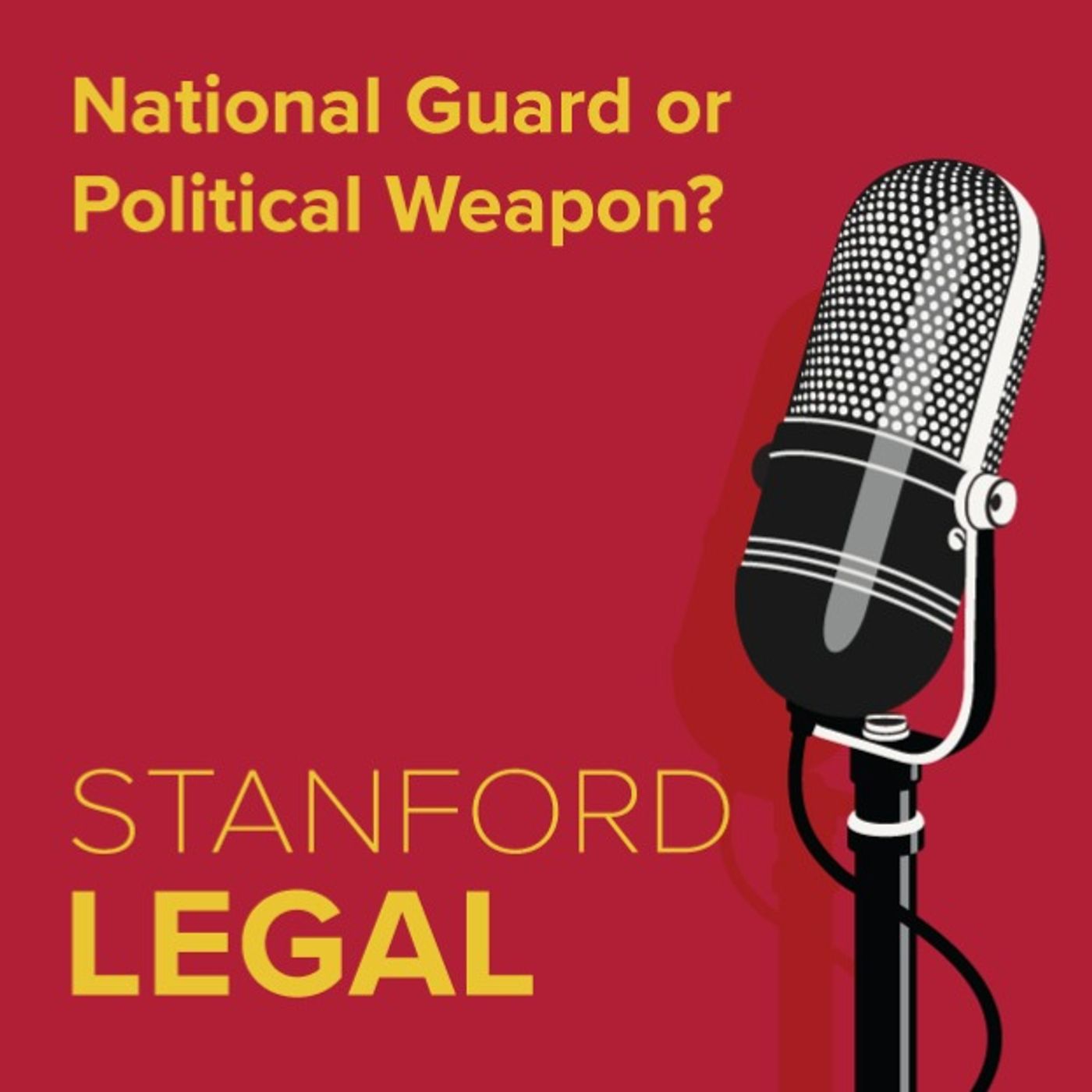
National Guard or Political Weapon?
When the National Guard shows up in American cities, it’s usually after hurricanes, fires, or floods, not political fights. But recent federal deployments have changed the landscape and raised pressing questions about how far a president’s domestic military powers can go. In this episode of Stanford Legal, host Pam Karlan talks with Professor Bernadette Meyler about the growing use of the National Guard for domestic law enforcement and what it reveals about shifting boundaries of presidential power. Links:Bernadette Meyler >>> Stanford Law pageTheaters of Pardoning >>> Stanford Law publications pageConnect:Episode Transcripts >>> Stanford Legal Podcast WebsiteStanford Legal Podcast >>> LinkedIn PageRich Ford >>> Twitter/XPam Karlan >>> Stanford Law School PageDiego Zambrano >>> Stanford Law School PageStanford Law School >>> Twitter/XStanford Lawyer Magazine >>> Twitter/X(00:00:00) Overview of National Guard Deployment (00:06:01) Changes in Immigration Enforcement (00:13:01) Continuous Deployment and Monitoring Elections (00:18:01) Training and Law Enforcement Activities of National Guard (00:24:31) Presidential Powers and Constraints (00:29:38) Ninth Circuit Panel’s Decision and Future Prospects Hosted by Simplecast, an AdsWizz company. See pcm.adswizz.com for information about our collection and use of personal data for advertising.

Get this podcast on your phone, Free


Create Your Podcast In Minutes
- Full-featured podcast site
- Unlimited storage and bandwidth
- Comprehensive podcast stats
- Distribute to Apple Podcasts, Spotify, and more
- Make money with your podcast