Episode List

when your emotions are lying to you (and what to do instead) DBT mini-season pt.6
Your feelings are real. But what if acting on them is making things worse?In this episode of Friendless, host James Avramenko continues the DBT series with three tools for navigating emotions without being controlled by them.We cover Opposite Action — the skill for when your emotion is justified, but the urge it's driving you toward would damage something you care about. We look at Problem Solving — for when the emotion does fit the facts and there's something concrete you can actually do. And we explore Building Positive Experiences — the proactive, preventative practice of filling your emotional reserves before crisis hits.James shares personal stories from his medical leave, a financial spiral, and the anxiety he felt recording this very episode — and what it looked like to apply (or not apply) these tools in real time.In this episode: The "action urge" behind every emotion — and when following it makes things worse How avoidance teaches your brain that the threat is real Why you can't half-ass opposite action The difference between a catastrophe and a problem Why positive experiences aren't a luxury — they're emotional infrastructure📧 friendlesspod@gmail.com | 📱 @friendlesspodCreate your podcast today! #madeonzencastr
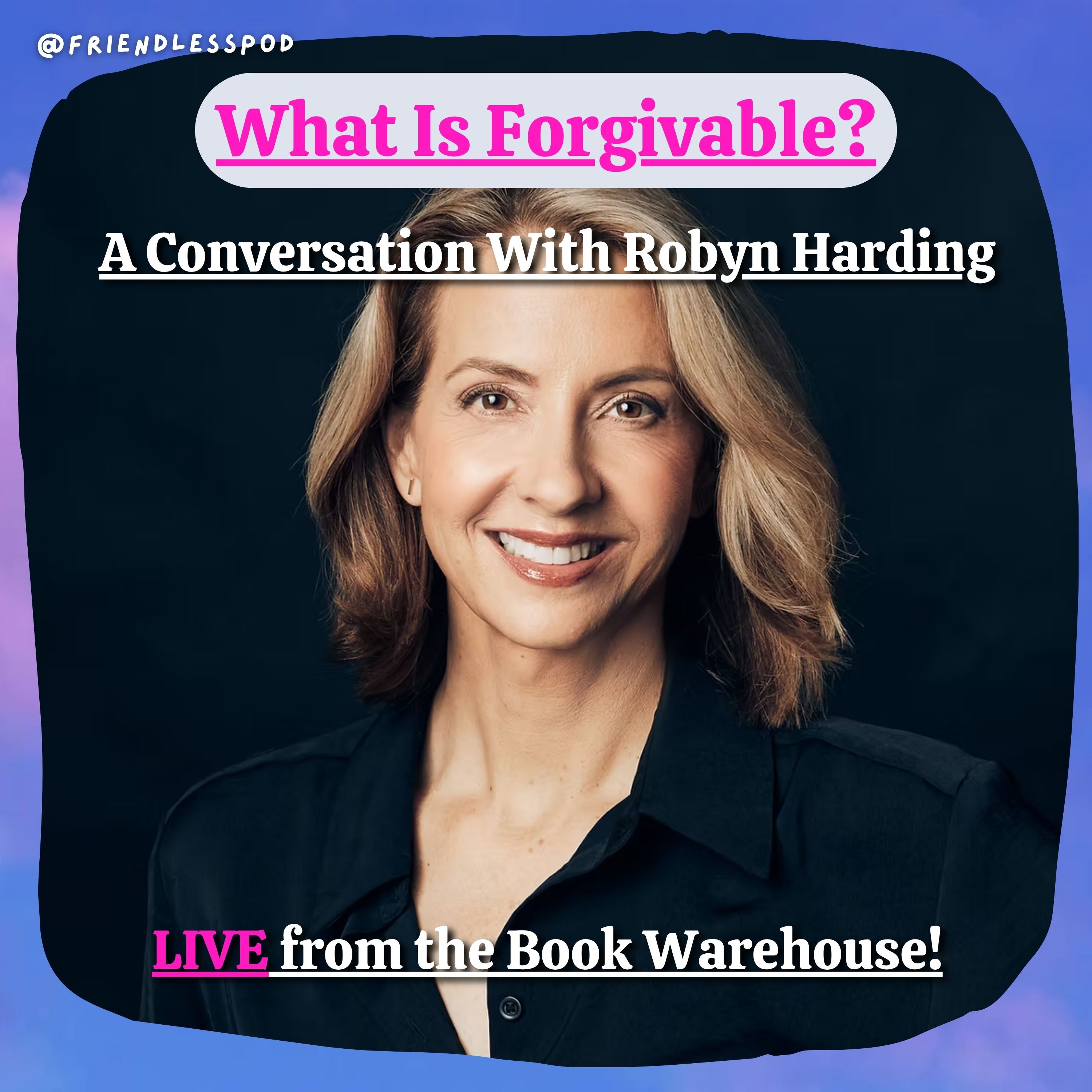
What Is Forgivable? A Conversation With Robyn Harding (Live from the Book Warehouse)
This week on a very special episode of Friendless recorded live at the Book Warehouse on Main Street, host James Avramenko interviews thriller author Robin Harding about her novel Strangers in the Villa.They discuss the inspiration for the book’s setup—a couple, Sydney and Curtis, retreat to an isolated villa in Catalonia, Spain, to repair their marriage after an affair, then invite in two Australian strangers who won’t leave—by a real trip and intensified by language and cultural barriers. They discuss character psychology, morally gray “damaged and damaging” behaviour, the cruelty of calling an affair “meaningless,” and Harding’s theme of “what is forgivable,” escalating toward an ultimately unforgivable revelation tied to exploitation and trafficking, raising questions of justice versus vigilantism. Harding describes her craft process, multiple POV, and how isolation strips away performance.Find Robyn at robynharding.com or on Instagram @rhardingwriter. Strangers in the Villa is out now — find it at the Book Warehouse!📧 friendlesspod@gmail.com | 📱 @friendlesspodCreate your podcast today! #madeonzencastr
Naming What You Actually Feel (or 'Fine' Doesn't Cut It) (DBT mini-season part 5)
This week on a very special episode of Friendless, we ask what if the goal of emotional maturity isn't to stop feeling things but to stop fighting them? In Part 5 of Friendless's deep dive into DBT emotional regulation, James unpacks what emotions are actually for, and why treating them like problems to solve is exactly what keeps us stuck.This episode covers three foundational skills: naming emotions accurately (because "I feel bad" tells you nothing useful), checking the facts (the difference between what actually happened and the story your brain added on top), and the PLEASE skill — the unglamorous daily maintenance checklist that has a surprisingly direct line to how regulated you feel.James also gets personal: about spending years terrified of his own anger, about the shame hiding underneath a text that didn't get answered, and about why exercise remains the bane of his existence.In this episode: Why emotions are signals, not malfunctions The smoke alarm analogy that reframes everything How vague labels like "fine" keep you stuck Checking the facts vs. checking the story PLEASE: Physical illness, Eating, Avoid substances, Sleep, Exercise A short practice to try right nowFriendless is a podcast about loneliness, connection, and the honest, sometimes uncomfortable work of understanding ourselves.📧 friendlesspod@gmail.com • Instagram: @friendlesspod• TikTok: @friendlesspodCreate your podcast today! #madeonzencastr

Radical Acceptance Bro! (Distress Tolerance pt. 2)
Distress Tolerance Pt. 2: Self-Soothing & Radical AcceptanceThis week on a very special episode of Friendless, we're continuing our exploration of Distress Tolerance skills as the DBT mini-season hits the halfway mark!STOP and TIPP — last week's skills — are built for acute crisis moments. This episode is for the other kind of hard: the slow burn, the ongoing grief, the situations you can't fix right now and just have to live with anyway. Two major skills today: self-soothing and radical acceptance.Self-Soothing is about giving your nervous system what it needs to feel safer — not by fixing the thing, not by numbing out, but through sensory input that tells your body it's okay right now. James breaks down what this looks like across all five senses, shares what's in his self-soothing kit, and makes a case for building your own before you need it.Radical Acceptance is probably the hardest skill in DBT. It's also, in James's experience, the most transformative. This is the practice of accepting reality as it is — fully, completely, without the layer of this shouldn't be happening — and why that's not the same thing as approval, defeat, or giving up. James draws on a deeply personal story about his divorce to show what it actually looks like when you finally stop fighting what is.In this episode:• Why stop and tip aren't enough for the slow burn — and what is• The DBT distinction between pain (unavoidable) and suffering (optional)• What self-soothing actually is — and what it isn't• A sensory breakdown of self-soothing tools across all five senses• What James carries in his self-soothing kit and why• The most common misunderstanding of radical acceptance• A personal story about divorce, gaslighting, and the moment reality finally shifted• Why radical acceptance is a practice, not a one-time decision• A short guided practice for both skillsConnect with Friendless:• Email: friendlesspod@gmail.com• Instagram: @friendlesspod• TikTok: @friendlesspodCreate your podcast today! #madeonzencastr
Don't Make It Worse: Distress Tolerance Tools (DBT mini-season part 3)
This week on a very special episode of Friendless, we're leaving the mindfulness skills behind and stepping into DBT's toolkit for emotional emergencies: the moments when you're at an eight or nine on the chaos scale, logic has stepped out of the building, and your nervous system is running the whole show. The only goal in those moments? Don't make things worse.In this episode, James breaks down two core Distress Tolerance skills:The STOP Skill — your emergency brake for when your thumb is hovering over "send," you can feel those words rising in your throat, and everything in your body is screaming do something. STOP interrupts the impulse-to-action pipeline just long enough to give you back a choice.The TIP Skills — a set of physical interventions (Temperature, Intense exercise, Paced breathing, and Paired muscle relaxation) that work directly on your biology when you're too flooded to think your way through anything. Because sometimes you can't logic your way out of a crisis. You have to use your body.James also shares two personal stories: what happened when he recorded a full 45-minute episode and forgot to hit record, and how he used the STOP skill in real time during a text conversation that was heading somewhere neither party wanted to go.We wrap with a short guided mental rehearsal so these skills are a little more accessible when the real crisis hits.In this episode:• Why mindfulness alone isn't enough when your brain is in chaos mode• What's actually happening in your nervous system during a crisis (and why the first impulse is almost always the wrong one)• The STOP skill, broken down step by step• The TIP skills: Temperature, Intense Exercise, Paced Breathing, and Paired Muscle Relaxation• The dive reflex — and why cold water actually works• Why a long exhale is a biological signal that the danger is over• A short guided rehearsal to help build your crisis response mapConnect with Friendless:• Email: friendlesspod@gmail.com• Instagram: @friendlesspod• TikTok: @friendlesspodCreate your podcast today! #madeonzencastr
You may also like









Get this podcast on your phone, Free


Create Your Podcast In Minutes
- Full-featured podcast site
- Unlimited storage and bandwidth
- Comprehensive podcast stats
- Distribute to Apple Podcasts, Spotify, and more
- Make money with your podcast