Forgiven & Corrected
https://api.substack.com/feed/podcast/7577104.rssEpisode List
Sermon 008: Glorious Now, But Not Yet
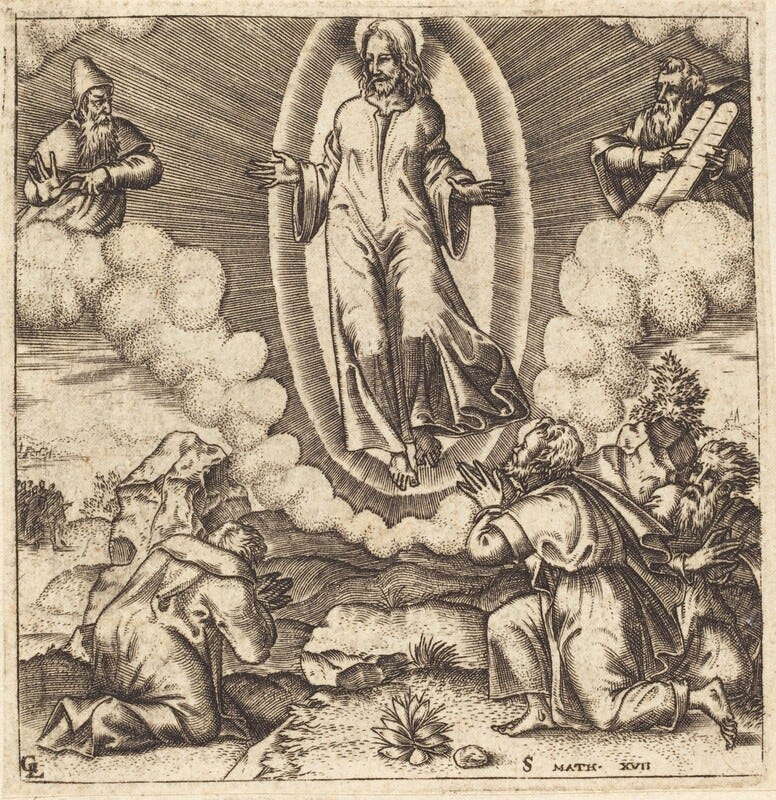
Exodus 24:8-18; 2 Peter 1:16-21; Luke 9:28-36;In the Name of the Father, and of the Son, and of the Holy Spirit. Amen.The liberating work of God through Moses and the plagues which culminated in the Passover that spared God’s people from death and released them from the yoke of Egyptian slavery is nothing to us until it finds its fulfillment in the redemptive work of Jesus Christ on the Cross.“If you could invite any three people, living or dead, to a dinner party, who would you pick?” This sort of personal hypothetical has been popular since parlor games in the Victorian Era, maybe before, and in the 60’s television hosts David Frost and Barbara Walters brought it from print media into television. Your answer can show-off a little bit of your history prowess. Politicians and other members of society reveal who their influences are, who they respect, or what people they find to be most important or interesting. Former President Barack Obama was asked this question during his book tour, and he said: Abraham Lincoln, Martin Luther King Jr., and Nelson Mandela. The tech billionaire Elon Musk, when asked in a recent interview answered: William Shakespeare, Benjamin Franklin, and Nikola Tesla. You can only imagine what kind of conversation these groups of three people from different times would say to one another after being ripped out of their historical context and placed at a dinner party with you. So why I am talking about this?Our Holy Gospel reading for today puts us in a situation similar to these hypothetical dinners. How about Moses, Elijah, and Jesus Christ? Today we hear about the Transfiguration of Our Lord, and it is one of the great mysterious events of the Bible. Jesus takes His inner circle: Peter, James, and John, up to a mountain top and is transfigured before their eyes. Matthew records that Jesus’ face “shone like the sun” (Matthew 17:2). His clothes become dazzling white. And then another detail included that all three gospel accounts of the Transfiguration record for us: Jesus is joined on top of the mount by Moses and Elijah.Approximately 1,500 years before the birth of Christ, Moses led God’s people out of slavery in Egypt (Exodus 12), he received the Law on top of Mount Sinai (Exodus 20), and by the power of the Holy Spirit he wrote down the first 5 books of the Bible, known as the “Torah” or “The Law” (Deuteronomy 31:24-26). When Moses died —just outside of the Promised Land— he was laid to rest by God Himself. Nobody but God knows where the body of Moses was buried (Deuteronomy 34:5-6).Elijah, about 850 years before the birth of Christ, was fed by ravens in the wilderness (Elijah didn’t eat the ravens… but they were sent by God like an ancient meal delivery service to bring him meat and bread every morning and every evening) (1 Kings 17:4-6). Elijah raised a widow’s son from the dead in Zarephath (1 Kings 17:19-22). Elijah confronted Ahab, the wicked King of Israel, and stood alone against 450 priests of Baal in a showdown that resulted in their slaughter (1 Kings 18:17-40). Elijah was one of the few men who never had to face death, his body was never found because God took him directly into heaven by a whirlwind (2 Kings 2:11-12).Moses and Elijah are two of the most notable and powerful prophets of the Old Testament. Both of these men were extremely important to the bible-believing community, and at different times in history, both of these men heard God’s Word spoken to them directly on top of a mountain. Now they are on top of the Mount of Transfiguration having a conversation with Jesus. What are they talking about? Well we can do a whole lot more than just imagine it, thanks to Luke’s gospel! Luke tells us something neither Matthew nor Mark record:“And behold, two men were talking with him, Moses and Elijah, who appeared in glory and spoke of his departure, which he was about to accomplish at Jerusalem” (Luke 9:30-31).Jesus, Moses, and Elijah are speaking about Christ’s departure. What departure? The Greek can help us here because you know the word: ἔξοδος. The Greek word for “departure” is exodus. There isn’t a biblically literate, Greek-reading person in the Levant who could hear the word exodus without thinking about Moses leading the 12-mile train of Hebrews out of Egypt and slavery toward the Promised Land. Hopefully you think of that too, but this is Jesus’ exodus we’re talking about, not Moses’.The liberating work of God through Moses and the plagues which culminated in the Passover that spared God’s people from death and released them from the yoke of Egyptian slavery is nothing to us until it finds its fulfillment in the redemptive work of Jesus Christ on the Cross. The ancient exodus from Egypt that Moses records in the Scriptures foreshadows our exodus —our departure— from sin and from death and from the devil. Just as God with His mighty Right Hand delivers the Hebrews from their Egyptian taskmasters, so also God with His mighty Right Hand Man, Jesus Christ, delivers us from our cruel taskmaster, the devil, unto life everlasting.Moses is here on the Mount of Transfiguration representing the Law, and Elijah the prophets. Together they are witnesses to the fact that all the Law and all the Prophets are fulfilled in the Person and Work of Jesus Christ. So Jesus, Moses, and Elijah are our special dinner guests, and they are in conversation about the mighty work of salvation that Jesus is about to accomplish. And He did accomplish it for us.But for Peter, James, and John on the Mount of Transfiguration, these things have yet to be accomplished. Peter, James, and John see this amazing glimpse of the Glory of Our Lord, and they love it! Peter recognizes the men with Jesus and says, “Master, it is good that we are here” (Luke 9:33). He wants to make tents for all three and stay for a while. But Peter is misguided. He says it is good to be here on this Mount of Transfiguration, but Jesus will show Him that what He is about to do is better and it’s necessary. Peter doesn’t yet understand the theology of the cross. And so, the cloud descends, the Father declares from heaven, “This is my Son, my Chosen One; listen to him” (Luke 9:35)! Then the dazzling light of the Transfiguration fades, and Our Lord, glorious now, but not yet, begins on the road to the cross because “suffering comes before glory” (Arthur Just, Concordia Commentary on Luke, 401). After Jesus descends the Mount of Transfiguration, He will “set his face to go to Jerusalem” (Luke 9:51). Jesus has begun to tell His disciples that He will go to Jerusalem where He “is about to be delivered into the hands of men” (Luke 9:44)... where He “must suffer many things and be rejected by the elders and chief priests and scribes, and be killed, and on the third day be raised” (Luke 9:22).The Transfiguration is a point of transition between Christ’s ministry in Galilee and His journey to Jerusalem… His journey to the cross. This is confusing to the disciples, even those in Jesus’ inner circle. Here on top of the mountain, Jesus is resplendent and glorious, and it’s heaven on earth. The disciples don’t understand that Jesus still has to suffer and die. We shouldn’t be too hard on Peter! If it weren’t for God’s revealed Word telling us that Peter didn’t know what he was saying, we would all nod in agreement. “Yes, it is good, Lord, to be here!” You might be tempted to review the list of Peter’s errors and scoff at him: “Foolhardy Peter, doubting the Lord’s instructions with the fishing net (Luke 5:5), taking his eyes of Jesus and sinking into the Sea of Galilee (Matthew 14:30), rebuking the Lord on the way to Jerusalem (Matthew 16:22), refusing to have his feet washed in the upper room (John 13:8)… even denying the Lord on the night of His crucifixion (Luke 22:54-62)…” It seems Peter is somewhat slow to understand.But how do you respond when Jesus calls you away from present glory to suffering like His? Do you understand the theology of the cross? Christ says, “If anyone would come after me, let him deny himself and take up his cross daily and follow me” (Luke 9:23). Do you take up your cross daily, or do you despise it and chafe at the Lord’s authority? Christ says, “For whoever would save his life will lose it, but whoever loses his life for my sake will save it” (Luke 9:24). Do you willingly lose your life in Christ, or do you cling to your life and build it on your possessions or your career, or your family… almost anything else?Jesus’ movement from His Transfiguration, bright and glorious, to the dark and bloody cross is a holy example for you as you walk in the way from your baptism, the washing of regeneration, to your death. Through the water and the Word of your baptism you receive faith, the Holy Spirit, the forgiveness of sins, and all the wonderful gifts that Christ promises to His Church. You are joined to Christ and your sinful self is put to death… drowned, and you rise up to walk in the newness of life. But then… you go on to suffer.Today little Euphemia was baptized and she is clothed with the dazzling righteousness of Christ… today, it is good Lord, to be here! Euphemia is made glorious today… you all are made glorious in your baptism… but also… not yet. First, Euphemia, and all of us, will suffer. She will face temptation, heartbreak, grief, and sorrow. She will suffer under my flaws as a father, and she will battle against the devil, the sinful world, and her own sinful flesh. This is what Christ has called each and every single one of us to. It seems daunting, maybe you’re overwhelmed, but my brothers and sisters in Christ, take heart: Jesus Christ has overcome the devil, He has overcome the sinful world, and He has overcome your sinful flesh. Christ does the battling for you, and He has won the victory. His suffering once for all earns mercies that are given to you anew every single morning. Because of Christ’s departure, we can depart this service and this life in peace. God’s Word has been fulfilled.Today we say goodbye to our “Alleluias” until Easter. We are going to change our paraments to purple, and then to black. Some of you fast maybe from meat or facebook or some other good gifts throughout Lent. We suffer a little bit to train ourselves for when deeper suffering comes. But you must remember that your suffering is only for a time, and “the sufferings of this present time are not worth comparing with the glory that is to be revealed to us” (Romans 8:18). In our baptism we are glorious with Christ now, but also not yet. For now we walk in danger and trials all the way, until that final day when He comes again in glory to judge the living and the dead, to make all things new, and to bring us into his heavenly kingdom where we will stand in the Glorious Light of Christ forever.In the Name of Jesus. Amen. This is a public episode. If you would like to discuss this with other subscribers or get access to bonus episodes, visit forgivenandcorrected.substack.com
Sermon 007: Do Not Walk in Darkness
Isaiah 60:1–6; Ephesians 3:1–12; Matthew 2:1–12; Psalm 72:1–15In the Name of the Father, and of the Son, and of the Holy Spirit. Amen.“The light shines in the darkness, and the darkness has not overcome it” (John 1:5). In the early chapters of John’s Gospel, Jesus is described as the light of men (John 1:4), the light that shines in the darkness (John 1:5), the true light which gives light to everyone (John 1:9). Jesus says, “I am the light of the world. Whoever follows me will not walk in darkness, but will have the light of life” (John 8:12). Dear brothers and sisters in Christ, blessed Epiphany!What does “Epiphany” mean? It means manifestation or appearance. It means something revealed or made known. Something is made visible and now it can be seen. You might use the term “epiphany” to describe that moment when you finally realize something, or when you have a great idea. Literally, “epiphany” means to shine light upon. Light and darkness have a strong connection to meanings of good and evil or ignorance and knowing. It just makes sense to us. If someone says, “I’m being kept in the dark about that,” you know he doesn’t know much if anything about it. If someone says, “That was a dark movie,” you know that if you watch it you aren’t going to walk away from it feeling light and happy. A detective tries to “bring things to light” during the course of his criminal investigation. He discovers something new, some new evidence that was previously unknown. An experience or conversation wherein we learn something new is “illuminating.” Maybe if you come to know or understand something that you should have known a long time ago, it finally “dawns” on you.This kind of symbolic understanding is natural to us, but it is also literal meaning. When you’re in a dark room and can barely make out the various shapes in the corner, you can only discover the new location of the coffee table by stubbing your toe on it. But once the lights are on, you can see the room and all of its contents, you can get from one side to the other with ease. It’s not even noteworthy. No one is pleasantly surprised or proud of you when you get up and walk through a room with the lights on. By the grace of God, the lights have been on in the church for a very long time. The church has had the right confession of who Jesus of Nazareth is for nearly two millennia. “[He] is the Christ, the Son of the living God” (Matthew 16:16).“[You] believe that Jesus Christ, true God, begotten of the Father from eternity, and also true man, born of the Virgin Mary, is [your] Lord, who has redeemed [you], a lost and condemned person, purchased and won [you] from all sins, from death, and from the power of the devil; not with gold or silver, but with His holy precious blood and with His innocent suffering and death, that [you] may be His own and live under Him in His kingdom and serve Him in everlasting righteousness, innocence, and blessedness, just as He is risen from the dead, lives and reigns to all eternity. [You know that] [t]his is most certainly true” (Luther’s Small Catechism, Apostles’ Creed, Second Article).You know this because since the Epiphany of Our Lord, it has become clearer and clearer who Jesus is, what He has done, and for whom He has done it.This is what Epiphany is about. It is about the movement from darkness into the light, from NOT knowing to knowing. The Wise Men, Gentiles from the East, following a star given to them as a sign from God, arrive at Jesus’ feet in order to worship Him. “God causing the star to shine was God announcing over the whole earth that the child born in Bethlehem was King not just of the Jews but of all” (Looking Forward to Sunday Morning by Carl C. Fickenscher II, p 37). We learn from Epiphany, as St. Paul clarifies in his letter to the Ephesians, that “the Gentiles are fellow heirs, members of the same body, and partakers of the promise in Christ Jesus through the gospel” (Ephesians 3:6). Most if not all of us in this room are what you would call a “Gentile”... or even worse, a “Barbarian.” We are not descended from Abraham. It was thought that the Gospel was only for the Jews. On Epiphany, I get to declare that the Gospel is for all people, and this is wonderful news. We Gentiles are not left to be condemned or to pay the wages of our sin. Instead, the God of all creation has redeemed us from death and the devil and hell.It’s no accident that Epiphany, this season of enlightenment, comes to us not long after the shortest and coldest days of the year. Some of you wake up and drive to work while it is still dark outside, and then you make the commute home in darkness again. This message comes to us to wake us up from our slumber, to stop our fumbling around in the dark, and to make sure that we haven’t grown accustomed to the darkness. During Epiphany, Light shines in the darkness.And what is that Light? For Isaiah the prophet, “the glory of the LORD” rises like the sun and brings the Light. Isaiah writes: “Arise, shine, for your light has come, and the glory of the LORD has risen upon you. For behold, darkness shall cover the earth, and thick darkness the peoples; but the LORD will arise upon you, and his glory will be seen upon you” (Isaiah 60:1-2). For the shepherds tending their flocks by night, it was the glory of the Lord shone around them as the heavenly host erupted into joyous song to announce the birth of the Savior, Jesus (Luke 2:8-10). For the Wise Men from the East, it was the miraculous star in the sky that led them to the Christ Child.“[B]ehold, wise men from the east came to Jerusalem, saying, ‘Where is he who has been born king of the Jews? For we saw his star when it rose and have come to worship him.’ When Herod the king heard this, he was troubled, and all Jerusalem with him;” (Matthew 2:1b-3).Here there is a break from the pattern in the Scriptures that we have seen so far. In the Gospel accounts of Matthew and Luke, many people have heard about the coming of the Lord. The Virgin Mary (Luke 1:38, 46-55), Mary’s cousin Elizabeth (Luke 1:42-43), John the unborn Baptist leaping in Elizabeth’s womb (Luke 1:41), Joseph who resolves to take Mary as his wife and to shield her from contempt and scorn (Matthew 1:24), the shepherds from the field who hear about Jesus from the angels then glorify and praise God after they find Him (Luke 2:20). All of these received the news of the birth of Jesus with thanksgiving, and they were obedient to the commands of the Lord. This is the pattern. This is God’s desire.Herod, however, does not rejoice. Herod is troubled… and all of Jerusalem with him. Herod, the Idumaean king of the Jews, hears that someone who has the power to take away his throne, the actual King of the Jews has been born. Herod knows that his claim to the throne is weak because he is not from the House of David, he isn’t even a Jew. Herod has heard the prophecies of old. What if they are true? Are they are actually being fulfilled? So he calls an assembly with all the chief priests and scribes of the people and demands that they tell him, “Where will the Christ be born” (Matthew 2:3-4)? Quoting from the prophet Micah, Herod’s chief priests and scribes answer, “Bethlehem.” In secret, Herod sends the Wise Men to Bethlehem to search out the Child and to bring him word of His location (Matthew 2:7-8). The Wise Men intend to find the Child, Jesus, in order to give Him treasures, in order to bow down before Him and worship Him. Herod, on the other hand, intends to find the Child, Jesus, in order to put Him to death. The Wise Men succeed.“And going into the house they saw the child with Mary his mother, and they fell down and worshiped him. Then, opening their treasures, they offered him gifts, gold and frankincense and myrrh. And being warned in a dream not to return to Herod, they departed to their own country by another way” (Matthew 2:11-12).Herod is enraged, and last week we read about the young boys whom Herod killed, the Holy Innocents, in his futile attempt to put Jesus to death before His time. These are two very different reactions to the Light. Herod is arrogant… prideful… unrepentant… and unbelieving. He would rather kill the Lord than humble himself. If Herod had accepted the reign of Christ, he would have to repent and live according to God’s Law. Instead of killing anyone who gets in his way, he would have to “help and support [his neighbor] in every physical need”. Instead of raising his sons to covet and lust after women, he would have to teach them to “lead a sexually pure and decent life in word and deed” and teach them that “husband and wife are to love and honor each other.” He would have to “fear, love, and trust in God above all things” (various quotations from Luther’s Small Catechism, Explanation of the Ten Commandments). You see, having the Light of Christ shine on you can be a very painful thing. When Paul was on the road to Damascus, commissioned by the chief priests and given the authority to bind and kill Christians, he was encountered by the True Light. The Light, he says, shone brighter than the sun. The Light knocks him down to the ground and blinds him for three days, during which time he does not eat or drink (Acts 9:1-9, 26:12-18). Paul goes on to be sent by God to the Gentiles, “to open their eyes so that they may turn from darkness to light and from the power of Satan to God, that they may receive forgiveness of sins and a place among those who are sanctified by faith in [Jesus]” (Acts 26:18). Paul, all the Jews, all the Gentiles… all people are called to “repent and turn to God, performing deeds in keeping with their repentance” (Acts 26:20). Notice that Paul continues in his repentance as he calls himself “the very least of all the saints” (Ephesians 3:8) and he continues in suffering as a prisoner for Christ. Paul is the Lord’s chosen instrument to proclaim the name of Christ to the people, and the Lord shows Paul how much he must suffer for His name (Acts 9:15-16). Has Paul’s encounter with the True Light been comfortable?The Light uncovers darkness, and when the light of God’s Word lays bare your utter inadequacy, the only path forward is to repent and bear fruits in keeping with repentance. This was too much for Herod. Herod would rather cling to his earthly throne and set himself up as an opponent to the Almighty God. Herod refuses to walk in the light. Herod dies an enemy of Christ. He raises sons after him to be enemies of Christ.But you are not an enemy of Christ. You are baptized. You are a child of God. Christ is your brother. The Lamp of God’s Word is a lamp to your feet and a light to your path (Psalm 119:105). As you are shown your sin, repent and be forgiven. Receive the Holy Spirit to amend your sinful life. Be the Light of Christ in your homes and at work, in your community, or wherever you go. Husbands: Love your wives and live with them with understanding, honor them, sacrifice for them, and serve them as Christ does all these things for His Bride, the Church (1 Peter 3:7, Ephesians 5:25-30). Wives: Submit to your husbands as to the Lord as the Church submits to Christ (Ephesians 5:22-24). Parents: Love your children and raise them in the discipline and instruction of the Lord (Ephesians 6:4). Children: obey your parents (Ephesians 6:1). Work diligently in your calling and put on the whole armor of God, the armor of Light. Resist the devil and temptation and repent of your sins each and every day. You have the Light of Life, do not walk in darkness. Repent and believe the Gospel of Jesus, it is for all people… and that includes you!In the Name of Jesus. Amen. This is a public episode. If you would like to discuss this with other subscribers or get access to bonus episodes, visit forgivenandcorrected.substack.com
Sermon 006: Jesus Christ, Our God and Savior
Isaiah 52:7-10; Hebrews 1:1-12; John 1:1-18, Psalm 2In the Name of the Father, and of the Son, and of the Holy Spirit. Amen.Christ, the Savior is born! Merry Christmas! Almost everything we know about the circumstances of Jesus’ birth comes from the Gospel accounts written by Matthew and Luke. Luke records how the birth of our Lord was announced to Mary by the Angel Gabriel. Gabriel says, “Do not be afraid, Mary, for you have found favor with God. And behold you will conceive in your womb and bear a son, and you shall call his name Jesus. He will be great and will be called the Son of the Most High. [...] The Holy Spirit will come upon you, and the power of the Most High will overshadow you; therefore the child to be born will be called holy— the Son of God” (Luke 1:30-32a,35). Thanks to Luke, we know that Mary responds in faith. She has been called blessed among women by all generations ever since.Matthew records how God turns Joseph’s doubt into faith by the power of His Word, how “[a]n angel of the Lord appeared to him in a dream, saying, ‘Joseph, son of David, do not fear to take Mary as your wife, for that which is conceived in her is from the Holy Spirit. She will bear a son, and you shall call his name Jesus, for he will save his people from their sins’” (Matthew 1:20b-21).Luke tells us that the decree of the first Roman Emperor, Caesar Augustus, drove Joseph and the Virgin Mary with Child to take a trip to the town of Bethlehem in order to be counted for a census. The trip was late in Mary’s pregnancy, and during their stay, Mary gives birth to the Christ Child. An angel of the Lord announces the birth of Jesus to shepherds in a nearby field watching over their flocks, “Fear not, for behold, I bring you good news of great joy that will be for all the people. For unto you is born this day in the city of David, a Savior, who is Christ the Lord” (Luke 2:10).Because of the Holy Spirit’s inspiration of Matthew and Luke, we know all this and more about the birth of Christ. From these narratives it is made clear that the birth of Jesus is “good news.” It is something that causes the angels—and the faithful—to rejoice, and it is something that fulfills many prophecies made in the Old Testament. From Matthew and Mark we know that Jesus is “great,” that He is “holy,” the He is “the Son of the Most High God.” We know that Jesus is “going to save His people from their sins.” We know that Jesus is our Savior.In our Epistle lesson for today, we read the introduction to the book of Hebrews, and it characterizes the birth of Christ as the beginning of the end of an era of great seers, prophets, and signs. “Long ago, at many times and in many ways, God spoke to our fathers by the prophets, but in these last days he has spoken to us by his Son, whom he appointed heir of all things, through whom also he created the world” (Hebrews 1:1-2). God spoke to our fathers by the prophets, but now He has spoken to us by His Son, Jesus Christ. Throughout Advent we have considered various types of Christ: the angels, Moses, Aaron, Melchizedek. These “types” that we have discussed: prophets, priests, kings… they find their fulfillment in the person and work of Jesus Christ. Christ is greater! In order to fulfill all these things, He has to be born as a human baby.This is the great mystery that we celebrate on Christmas. Christ is of one substance with God the Father, and He came down from heaven, He was conceived by the Holy Spirit of the Virgin Mary, and He was made man (Nicene Creed). God takes on a human frame and dwells with us. Christ is our faithful Prophet, Christ is our great High Priest, and Christ is our Heavenly King. Christ is our God. This Infant Child wrapped in swaddling cloths laying in a manger, by this time on the first Christmas less than half a day old, and He is our God.It makes sense, then, that the Gospel according to John begins the way it does. He doesn’t begin with the human birth of Christ like Matthew and Luke or with the beginning of His earthly ministry like Mark, but he begins much, much earlier. “In the beginning…” (John 1:1). This isn’t Luke’s beginning during the reign of Caesar, or Matthew’s beginning during the time of patriarch, Abraham, but THE beginning. The beginning of everything.“In the beginning was the Word, and the Word was with God, and the Word was God. He was in the beginning with God. All things were made through him, and without him was not any thing made that was made. In him was life, and the life was the light of men. The light shines in the darkness, and the darkness has not overcome it” (John 1:1-5).In these five, relatively short verses, John gives us enough to think about for the whole year, and probably our entire lives! It takes 17 verses to explicitly say so, but John is talking about Jesus Christ.This word teaches us a few things about Jesus. First, Jesus is the eternal God. Second, the only way that we really know or see God is through Jesus. And finally, Jesus the eternal God took on flesh and came into the world in order to bring light and life and salvation to you.We are created beings, and all we have known is this finite earthly life. It can be overwhelming to think that there was never a time when Jesus did not exist. Think about how quickly 2025 came and went… how the first outbreak of COVID was nearly 6 years ago… Disney’s Frozen—that had everyone playing Let It Go on repeat came out 12 years ago… iPhones came out 18 years ago… 9/11 was 25 years ago, Y2K was 26… the assassination of John F. Kennedy was 62 years ago… and the first color TV was sold in 1954… 71 years ago. Our life is but a breath. But God has existed from eternity. God is without beginning or end. Jesus was not created. “Jesus is begotten of His Father before all worlds. God of God, Light of Light, very God of very God, begotten, not made” (Nicene Creed). Jesus was with God (and was God) at the beginning of time, and the world was created through Him and for Him (Colossians 1:16). “[Jesus] is the radiance of the glory of God and the exact imprint of his nature, and [Jesus] upholds the universe by the word of his power” (Hebrews 1:3a). Jesus is the radiance of the glory of God. John the Baptist will describe Jesus as a light that enlightens everyone. For millennia, God’s people were fumbling around in the darkness of their own hearts until Jesus came and turned on the lights. By the light of Christ, we see the fullness of God’s love for us. By the light of Christ, we see the end of the Law is NOT to condemn us to death and hell, but for Christ to fulfill the Law and offer us full forgiveness. It is Christ who has revealed the Father to us, and He has shown us a Heavenly Father who loves us and wants to hear our prayers and promises to answer them. Jesus did not come into the world to condemn it, but to save it (John 3:17). As our Priest, Jesus made purification for our sins, and now He reigns at the Right Hand of God as our King (Hebrews 1:3).This is the mission that Jesus has completed. He was willingly born of the Virgin Mary, He humiliated Himself to become an embryo. He subjected Himself to the need for His mother’s care. Jesus was swaddled, nursed, raised, and taught. Eventually, Jesus—younger than most of us in this sanctuary—willingly gave Himself up to die. And by His death He defeated death. From the very beginning of time, Jesus knew that one day “He [would come] down from heaven and be incarnate by the Holy Spirit of the Virgin Mary and be made man” (Nicene Creed). This is the great gift that we celebrate on Christmas. Our God has come to us with healing on His wings. He brings forgiveness and eternal life. From the fullness of Jesus “we have all received grace upon grace. For the law was given through Moses; grace and truth came through Jesus Christ” (John 1:16-17).Our Lutheran Confessions speak about this mystery of Jesus Christ:“[W]e believe, teach, and confess that Mary conceived and bore not a mere man and no more, but the true Son of God; therefore she also is rightly called and truly is the mother of God.8. Hence we also believe, teach, and confess that it was not a mere man who suffered, died, was buried, descended to hell, arose from the dead, ascended into heaven, and was raised to the majesty and almighty power of God for us, but a man whose human nature has such a profound [close], ineffable union and communion with the Son of God that it is [has become] one person with Him. 9. Therefore the Son of God truly suffered for us, however, according to the property of the human nature which He assumed into the unity of His divine person and made His own, so that He might be able to suffer and be our High Priest for our reconciliation with God, as it is written 1 Cor. 2:8: They have crucified the Lord of glory. And Acts 20:28: We are purchased with God’s blood” (Formula of Concord: Epitome, VIII.12-14).Just as the angels spoke to Mary and to Joseph and the Shepherds, “Fear Not”. I can say the same to you today. Fear not, Jesus has given to all who receive Him and believe in his name the right to become Children of God… and so you are.In the Name of Jesus Christ, Our God. Amen. This is a public episode. If you would like to discuss this with other subscribers or get access to bonus episodes, visit forgivenandcorrected.substack.com
Sermon 005: Jesus Christ, Our King
Hebrews 1:1-4; Hebrews 2:5-10; Psalm 45:1-7In the Name of the Father, and of the Son, and of the Holy Spirit. Amen.Christ is King. Everything was put in subjection under Christ’s feet. Everything is under Christ’s control (Hebrews 2:8). Christ commands the morning and causes the dawn to know its place, Christ has seen the storehouses of the snow and the hail, Christ provides the raven its prey and Christ knows when the mountain goats give birth (Job 38:12, 22, 41; 39:1). He knows every hair on your head (Luke 12:7), and He knows the number of your days (Psalm 139:16). Each week during our midweek Advent services when the Thanksgiving for Light has been sung, we have proclaimed that Christ is the Lord our God, King of the Universe. Christmas Choir concerts that sing the Hallelujah Chorus from Handel’s Messiah—if they still sing it—proclaim: “The kingdom of this world is become the kingdom of our Lord, and of His Christ; and He shall reign for ever and ever. King of Kings, and Lord of Lords” (Revelation 11:15;19:16). Christ is King… and yet… we can’t see it.We hear about the triumphant victory of our King, but in many ways our lives are characterized by pain and suffering. Our bodies aching with the pains of age, we mourn the death of loved ones, broken trust and broken relationships, sometimes we even suffer violence and abuse. Some traumatic moments bring suffering that lasts for years, if not a lifetime. If you haven’t suffered yet, you will. Given enough time, we will all suffer. Philosophers have wrestled with this for a long time. It’s called “the problem of suffering.” An ancient philosopher, Epicurus, set up this paradox: If God is all-powerful, and all-knowing, and all-good… then suffering shouldn’t exist. But it does. Why do we suffer? For some people this is a very challenging question, and maybe rightly so. For the Christian the answer is simple, though it may be unsatisfying and it may be hard to hear: suffering is our fault. When mankind fell into sin in the garden all evil and suffering followed. But fast forward to today… didn’t Christ win? Didn’t Christ say on the cross, “It is finished”? Maybe you’ve thought about this before. If Christ is King, why does evil remain? Why do we suffer?This is the challenge of understanding Christ as King. Right here in our second reading from the book of Hebrews, beginning with the quote from Psalm 8: “‘You made him for a little while lower than the angels;” (Christ, God, has taken on human flesh) “… you have crowned him with glory and honor, putting everything in subjection under his feet.’ Now in putting everything in subjection to him, he left nothing outside of his control.” …everything is in Christ’s control — but it continues: “At present, we do not yet see everything in subjection to him” (Hebrews 2:7b-8). Jesus Christ is at this very moment reigning at the Right Hand of the Heavenly Father, but at present we do not see it. “But,” the reading continues: “we see him who for a little while was made lower than the angels, namely Jesus, crowned with glory and honor because of the suffering of death, so that by the grace of God he might taste death for everyone” (Hebrews 2:9). Instead of a dazzling crown of gold beset with precious jewels, we see a crown of thorns. What kind of King is this? Instead of what you might imagine the King of the Universe to look like we see a Suffering Servant. So when we ask what to do with suffering, we can, as with all things, look to Christ. What did Christ do with suffering? He endured it.Look at Hebrews again: we see “Jesus, crowned with glory and honor because of the suffering of death, so that by the grace of God he might taste death for everyone. For it was fitting that he, for whom and by whom all things exist, in bringing many sons to glory, should make the founder of their salvation perfect through suffering” (Hebrews 2:9b-10). Jesus was made perfect through suffering. Jesus tasted death for you. Jesus came down to earth to suffer for you, and now you can know that you do not suffer alone, but Christ suffers with you. Isn’t that beautiful? Who could have predicted that to show His might and power, God chose to do it through mercy and self-sacrifice. Through innocent, bitter sufferings and death. How many of the world’s invented gods humiliated themselves to become flesh and suffer for the sake of their creation? Only the True God did that, only our God, Jesus Christ, and He did it for you.From the early days of Jesus’ ministry, there was serious confusion about what exactly it was that our Lord Christ was here on earth to do. Right after he miraculously fed the 5,000 with five loaves of bread and two small fish, John records in his Gospel account that the people recognize Jesus as the prophet who is to come into the world and immediately want to “take him by force to make him king” (John 6:14). But what kind of king? Paul Kretzmann writes in his Popular Commentary, “... Jesus is not a mere Helper in physical needs; His aim is not to cater to the temporal, carnal desires of men; He is no ‘bread-king.’ [...] the idea of an earthly kingdom was not included in His plan of salvation” (Kretzmann Popular Commentary on John 6:15-21). In Luke’s Gospel, shortly after this event Jesus foretells of His death for the first time, He says “The Son of Man must suffer many things and be rejected by the elders and chief priests and scribes, and be killed, and on the third day be raised” (Luke 9:22). Here Jesus begins to correct the misconception amongst His disciples, and this is something they will not understand fully until they are filled with the Holy Spirit some 18 months later at Pentecost. Earthly kingdoms rise and fall, but Jesus’s kingdom is forever. The Explanation of the Small Catechism says, “As King, Christ rules with His almighty power over all creation, [He] governs and protects especially His church, and finally leads His church to glory in heaven” (Small Catechism 1991 p126-127). King Jesus rules over His Kingdom in order to protect and preserve His church, not from suffering or pain, but from unbelief, sin, the devil, and hell.This Advent we have been considering Christ according to his threefold office: Prophet, Priest, and King. Each week we have looked at a type of Christ and compared the two to learn more: Moses the prophet was a type of Christ, as a prophet Jesus represents God to us. Jesus brings God’s words to us, He is the very Word of God! Aaron the priest was a type of Christ, as a priest Jesus represents us to God. He offers Himself up as the atoning sacrifice for our sins and continuously intercedes for us with His Heavenly Father. Remember the type points to Christ, and Christ is the real deal, He is always greater.Up until now we’ve been thinking about it using the imagery of a shadow. Something casts a shadow. When you look at the shadow that’s the type. The thing that casts the shadow is the real thing, that’s the fulfillment. Maybe this won’t be helpful, but now I want to change the metaphor on you, and I want to use a typewriter. I tried this during a children’s message last year and it didn’t go over so well, but I hope I have a better demographic alignment now. Just in case, a typewriter has a metal arm for each letter. At the end of the arm there is an embossed letter, called the typeslug. When you push key, the bar slaps forward and puts an imprint onto the page. When you press the ‘A’ key, the typebar with an ‘A’ typeslug launches forward, presses through a ribbon of ink, and puts an ‘A’ on the page. Now, the ‘A’ on the page is not actually that metal piece, but it looks like it. So picture this: Christ is the fulfillment, Christ is the real deal, he is the King… and each one of you is a type of Christ. When you were baptized, an imprint was made on your heart. C-H-R-I-S-T-I-A-N, “Christian.” You are a child of God, and you are made a new creation. As Luther would say it, you have become a “Little Christ.”In 1999 Rev. Dr. Richard C. Eyer from Concordia University Wisconsin wrote on the Problem of Suffering:“Because we have become one with [Christ] through our baptism, our suffering has become his and his [suffering] has become ours. It is as Paul says, ‘I rejoice in my sufferings… I complete what is lacking in Christ’s suffering…’ This suffering we bear adds nothing to our salvation. We do not suffer to earn heaven. Rather, our suffering has become Christ’s suffering in us as he attaches himself to us through our baptism. [...] It is hopeful… to say that our suffering is from God for then we know to whom we must turn who is [all-good] and [all-powerful] and will turn our tears into joy in heaven.”Suffering, then, is no longer a problem for the Christian. By Christ’s suffering, you are forgiven and set free. You are joined to His death and to His resurrection by your baptism. Now, you are invited into the sufferings of Christ. This has even become a joyful thing. You are invited to share in the sufferings of your neighbor. You can even suffer wrong at the hands of others… your neighbors, your friends, your children, your spouse. You can suffer wrong without complaint and give forgiveness without end because you know the power of Christ’s sufferings for you, and all that Christ has forgiven for you. We can echo the words of the apostle Paul, “The Lord will rescue me from every evil deed and bring me safely to his heavenly kingdom. To Him be the glory for ever and ever” (2 Timothy 4:18). And we wait for His kingdom to be something that we can see. We believe it now, and one day we will see it.In the Name of Jesus, Our Heavenly King. Amen. This is a public episode. If you would like to discuss this with other subscribers or get access to bonus episodes, visit forgivenandcorrected.substack.com
Sermon 004: Jesus Christ, Our Priest
Leviticus 16:1-5, 30-34; Hebrews 4:14-16; Psalm 110In the Name of the Father, and of the Son, and of the Holy Spirit. Amen.This Advent we are considering Christ as our Prophet, our Priest, and our King. And with guidance from the book of Hebrews, we are considering Christ in His threefold office by comparing Him to various types given in the Old Testament. Last week, our type was Moses the prophet. Moses, we know! When the Hebrews were enslaved in Egypt, Moses was called by God in the Burning Bush to deliver them out of slavery. Moses appealed to Pharaoh, “Thus says the LORD, the God of Israel, ‘Let my people go, that they may hold a feast to me in the wilderness’” (Exodus 5:1b). Pharaoh knew many gods, and he even thought himself to be a kind of god… but he did not know the true God, the God of Israel. So he decided not to listen to God and did not let God’s people go. Moses repeatedly requested Pharaoh to release the Israelites so that they could serve God, and Pharaoh repeatedly rejected.But who is Moses’ brother, Aaron? When you look at the book of Exodus, you find out that the appeals made to Pharaoh by Moses were actually with Moses’ brother Aaron. When God calls Moses to be the one to go before Pharaoh, Moses replies, “Oh, my Lord, please send someone else” (Exodus 4:13). He doesn’t want to do it. Among other excuses, Moses claims he is not eloquent enough, that people won’t listen to him because he is “slow of speech and of tongue” (Exodus 4:10). Moses quickly discovers that his call is non-negotiable. However, God does assign Aaron, Moses’ brother, to help him. So Aaron serves as a spokesperson for Moses (Exodus 4:16).Moses and Aaron repeatedly ask Pharaoh to obey the LORD and release the Hebrews, hard-hearted Pharaoh repeatedly says, “No”, and as a result the people witness awesome and terrible wonders wrought by God against Pharaoh and his people: the Nile river turned to blood, overwhelming amounts of frogs, swarms of gnats, thick clouds of flies, pestilence that kills the Egyptian livestock, fiery hail to destroy buildings and crops, locusts to eat what little crops remain, and utter darkness. Finally… the final plague, the death of all the firstborn in the land of Egypt. An impartial punishment enacted on all people, whether those in the royal house of Pharaoh or those held captive in prison… a punishment prevented only by the blood of a spotless, male lamb slain at twilight (Exodus 12:5,13). This was Aaron’s first assignment. Aaron sees God’s hand pressed down hard on the Egyptians, and in great fear of death the Egyptians send out the people of Israel in haste with all sorts of plunder: gold and silver and clothing. In the first year of his service, Aaron witnesses the Plagues, the Passover, the Exodus, and the miraculous crossing of the Red Sea; he is fed by manna from heaven, and he drinks water from the rock. These are the works God’s people will be writing about, singing about, and speaking about for a long, long time. And even still today I’m here speaking about them to you. Then, while Moses is on top of the Mountain of God receiving the Law and the plans for the tabernacle, Aaron succumbs to the demands of the people and forges the golden calf. The people bow down and worship it as God and their camps fall into debauchery and sin. Not long after, the tabernacle is constructed according to God’s specifications, also the priestly garments, and Aaron is consecrated as Israel’s first High Priest… all this happens in about one year… and I’m left thinking… that’s quite a vicarage.Aaron is a priest. And today we will look at the second office of Christ’s threefold office: Priest. According to the pattern of Hebrews we are given another type, a mysterious figure, not Aaron. Someone mentioned very few times in the Bible, Melchizedek. Melchizedek is the Priest King of Salem. His name and title translate to “King of Righteousness and King of Peace” (Hebrews 7:2). Melchizedek is a type of Christ. Psalm 110 and Hebrews both attest that Christ is a priest according to the Order of Melchizedek. This is to stress that Christ is NOT a priest according to the Levitical priesthood. After all, Christ is not born of the Tribe of Levi, but comes from the Tribe of Judah.Aaron is a member of the Levitical priesthood, and like Moses the prophet, Aaron is a type of Christ too. Remember, we said last week that a type is like a shadow of something else, or a reference to it. Remember also that Christ is always greater than his types. The type is imperfect, less brilliant, and weaker by far than the fulfillment we see in Christ. This is especially true when we compare the Levitical priesthood with the priesthood of Christ. Aaron is worthy of much less honor than our Lord, and the priestly order that Aaron belongs to is not capable of achieving that which our Lord has come to achieve.As prophet, Jesus brings the Word of God to us, He is Himself the very Word of God. During His life on earth, Christ preached repentance and of the coming Kingdom of God, and he validated His word with miracles. The most miraculous and astounding proof was His own resurrection. Even today, Christ is still proclaiming Himself to be the Son of God and our Savior through the preaching of the Gospel. Christ is our prophet, and as our prophet He is God’s representative to us (Small Catechism 1991, p124).So what does Jesus do as a priest? In Martin Luther’s Lectures on Hebrews, “Luther argues that Jesus, as God’s apostle, represents him before people, while as High Priest Jesus represents people before God” (Concordia Commentary on Hebrews, p156). A priest represents the people before God, he intercedes for them, he “bear[s] the iniquity of the congregation, to make atonement for them before the LORD” (Leviticus 10:17).For the Levitical priesthood, this was a frightening responsibility, and they bore it with great weakness. Being a priest of the God of Israel was an extremely serious calling, and those who took it lightly suffered greatly for it. Aaron’s two sons, Nadab and Abihu, are priests also. In Leviticus 10, we are given a shocking account of their folly and its consequences. Nadab and Abihu offer “unauthorized fire before the LORD” (Leviticus 10:1). This is very likely referring to the mixture of incense that they brought into the Holy Place. The LORD commanded one thing, and out of carelessness, or drunkenness, or faithlessness, Nadab and Abihu offered something different… somethings strange… something of their own making. What a temptation it is to worship the LORD according to our own fickle desires instead of according to God’s Eternal Word. The result was that “fire came out from before the LORD and consumed them, and they died before the LORD” (Leviticus 10:2). The LORD says, “Among those who are near me I will be sanctified, and before all the people I will be glorified” (Leviticus 10:3). God is not mocked. Aaron accepts God’s judgement upon his sons, but he is shaken and for a time unable to carry out all his priestly duties for fear that his service would also be unacceptable to the LORD. Aaron knows that he stands before a righteous and holy God. Aaron intercedes for the people, but who will intercede for him? This is a frightening place to be, and my hope is that after last week’s midweek lesson, I did not leave you in this same place.But you have heard the Word of God and you believe it. You are a poor, miserable sinner. Even now, as a follower of Christ, you see the goodness and beauty of God’s Law illuminating the path you should go, but you still stumble into sin and find yourself rightly accused. God’s Law always accuses. Here you will feel a very strong temptation to try to justify yourself. “I tried my best” … “I didn’t know” … “It could have been worse” … “Other people are less faithful than I am.” Don’t do it. “The wrath of God cannot be conciliated as long as we set our own works against it” (Ap IV.80). As it turns out, God’s people needed more than a better prophet, we also needed a better priest—a truly righteous priest.In our Old Testament Lesson for today, after the death of Nadab and Abihu, God sets up guardrails for His priests and establishes strict regulations on when and in what manner the priests will enter into the Holy Place. He does this out of love and mercy, to protect His people and His priests. A priest is instructed to enter with a bull, two rams, and two male goats for sin offerings and burnt offerings. By the blood of these animals the priest will first make atonement for himself and for his house, and then for the people. He will even make atonement for the Holy Place, the tent, and the altar because these also are polluted by our uncleanness. It is true that there is no forgiveness of sin without the shedding of blood, and the priests of the Old Testament shed quite a lot of it. The priests will perform sacrifices each and every day, and the Day of Atonement must happen each and every year. Now, with these regulations, the priests are able to carefully conduct their business in safety, but they are still a far cry from being able to deliver what God’s people really need. They need an atonement that lasts. They need a perfected conscience. God’s people needed a better priest, a better priesthood, and a better sacrifice… they needed a better covenant. In the end, all of these things were only ever just a shadow of the things to come.If your works cannot appease God’s wrath, what can? Who can? Jesus the Christ, our Great High Priest! “Christ has been set forth as the propitiator in order that on account of him the Father may be reconciled with us” (Ap IV.80). This is where Christ’s priestly office provides you with exactly what you need. “As a Priest, Christ fulfilled the Law perfectly in [y]our stead [and] sacrificed Himself for [y]our sins. [Additionally, He] still pleads for [you today] with his heavenly Father” (Small Catechism 1991, p126). At this very moment, Christ is interceding for you at the Right Hand of the Heavenly Father, and for Christ’s sake you are forgiven and made righteous. See that the temptation to justify yourself is an evil distraction. It is a lure from the devil, who wants you to turn away from the righteousness of Christ that is given to you by faith toward your own insufficient works.The book of Hebrews tells us that Christ suffers every temptation that you do, except He does it without sin. Christ sympathizes with your weakness and redeems you. “God shows his love for us in that while we were still sinners, Christ died for us” (Romans 5:8). Christ is the perfect priest and He offers Himself as the perfect sacrifice. The sacrifice that Aaron offers is in fear, the Holy Place is obscured by a cloud of incense in a tent made with hands. And the sacrifice of a priest must first be made to atone for their own sins, and then for the sins of the people. Contrast this with Christ. Christ offers Himself as a sacrifice with all confidence. Christ knows that His perfect life is acceptable to God the Father and that His work is complete. “It is finished” (John 19:30). Now, we are given that same confidence. In this time of need, we approach the throne of grace and receive grace, and mercy, and peace. You no longer have to fear the fire of judgement because Christ’s perfect work is yours, you are forgiven and set free.In the Name of Jesus, Our Great High Priest. Amen This is a public episode. If you would like to discuss this with other subscribers or get access to bonus episodes, visit forgivenandcorrected.substack.com
You may also like








Get this podcast on your phone, Free


Create Your Podcast In Minutes
- Full-featured podcast site
- Unlimited storage and bandwidth
- Comprehensive podcast stats
- Distribute to Apple Podcasts, Spotify, and more
- Make money with your podcast