Climate Water Project
https://api.substack.com/feed/podcast/532863.rssEpisode List
Activating a global network of water restorers and advocates : Zach Weiss
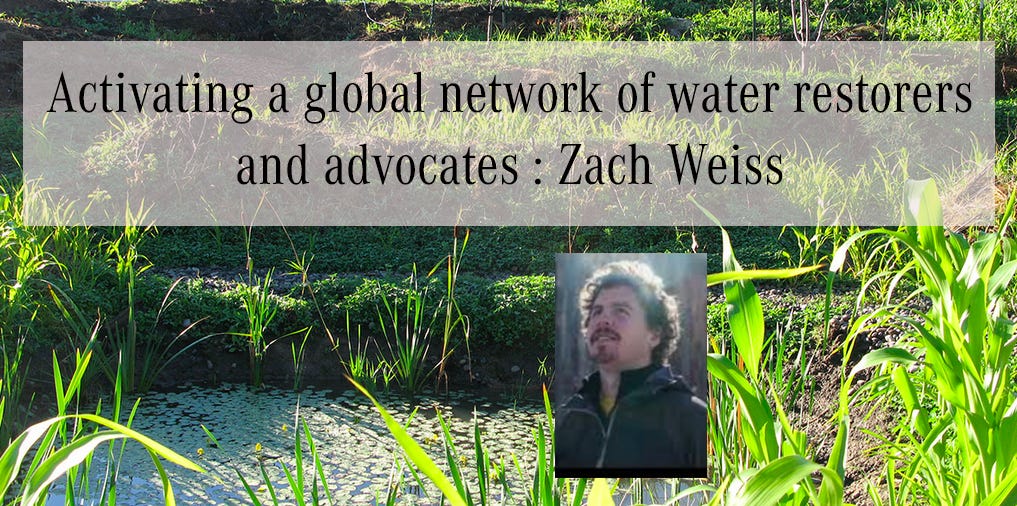
Restoring the world’s water cycles is a craft, one that takes time to learn, and a community to grow within. That community is being built.Water Stories is an education platform, community network, and hands-on career pathway dedicated to restoring the world’s water. It has been quietly growing, building a network of extraordinary people, advocating for landscape-scale change, and educating a new generation of practitioners in the art of working with water.Water Stories is following a similar path. It is a learning, training, and action platform focused entirely on water cycle restoration, offering a community-centered approach to some of the most pressing environmental crises we face: drought, flood, fire, and polluted water. Its award-winning films tell the stories of people who have raised their communities out of extreme environmental crises, and are available free to its online community. That community now numbers over 3,000 people from around the world, concerned about the future of fresh water, learning from one another across different landscapes and contexts, and supporting each other toward a better common future. Founded by Zach Weiss, Water Stories was created with a bold vision: to train a global force of water cycle restoration practitioners, equipped to heal landscapes wherever they are needed.Zach Weiss spent years learning to restore the water cycle from the ground up, studying under mentors including the legendary Austrian farmer Sepp Holzer, who urged him to take what he had learned and teach it to as many people as possible. That call to multiply the work is what drives Water Stories today.The methods Zach developed are focused on helping the land receive rainfall more effectively, slowing water down, guiding it into the ground, and recharging aquifers so they can feed springs and streams throughout the dry season. They are rooted in reading the landscape, observing where water flows, how slopes behave, where it pools or rushes away, and then working with those patterns rather than against them. In practice this means building terraces, planting strategically, putting in check dams, and creating water retention features that follow the land’s natural contours (in title picture above, are terraces leading into a water retention pond, that helps recharge groundwater, that Zach helped create in Montana USA). It is about restoring soil, restoring vegetation, and restoring the slow, generous movement of water through living landscapes.Farmers using these methods have withstood wildfires while neighboring properties burned, because their land was deeply hydrated going into summer. Others have seen vegetation flourish as rising groundwater reaches plant roots. The core idea is simple but profound: get the earth to receive water better, and life follows.Now, rather than doing that work alone, Zach is focused on training others to do it too, spreading these skills as widely and as fast as possible across the world.A groundswell takes hold when networks begin to form, when decentralized centers of activity emerge around the world, when people step into leadership, and when knowledge spreads person to person. Permaculture did exactly this through its Permacultue Design Courses, which perhaps half a million people have now completed, with many millions more practicing its principles worldwide. It spread like an octopus reaching into every nook and cranny of the globe, quietly shifting paradigms and transforming both landscapes and lives.The groundswell that Water Stories is one of the forces helping to build is beginning to feel like that.Yoga offers another useful parallel. It took off in the 1980s when enough teachers had been trained to make a living from their practice, creating a self-sustaining wave of growth. That is exactly what the Water Stories platform makes possible, a genuine career path in watershed restoration. Practitioners already report having more projects than they can handle, more land asking for attention than there are trained hands to tend it.Across the world, a broader awakening around water is underway. Scientists, farmers, indigenous communities, and restoration practitioners are all converging on the same understanding: that healing the water cycle is one of the most powerful things we can do for the planet. Water Stories sits right at the heart of that, with the tools, the community, and the vision to become one of its many central forces carrying that groundswell forward.Here is a lightly edited, abridged version of of our interview:Alpha: Cool, I’m excited to have on here again. You came on two years ago….. Maybe you could just start out by saying a little bit about the larger global water problem, and then how you came upon this path of actually trying to help the whole water situation in the world.Zach: When we look globally, I think the easiest, most succinct way to look at the challenges we’re facing is that right now, we’ve built landscapes that reject the rain, and what we’re seeking to do is help those landscapes receive the rain. The greater picture is of water cycle restoration, of rebalancing the full cycling of water through living ecosystems, of water retaining on the lands, of being circulated in the small water cycle, of being circulated slowly through the larger water cycle. But in daily practice, it really is just helping landscapes receive the rain instead of reject them.There’s just so much need for this around the world, there’s so much interest and demand for this work, way more than I could ever service on my own, and so we really started looking at — and Sepp Holzer pushed me towards doing this — how do we give capacity to people to do this work all around the world? I took my 5-year journey to getting where I am, and tried to condense it into 6 months, and we basically give people all of the essentials with none of the unnecessary stuff, so that by the end of that, they’re further along in activating these changes in their community. And it’s different for different types of people, you know, it’s really not a course where it’s like, come in and you’re gonna leave being an earth mover. That might be one route that you take, and that’s a route that we need lots of, but we need advocates, we need stewards, we need all these different people helping out in all of these different roles to make the changes that we’re really trying to make globally, around the world. And so we really try and just help people in that journey.The way I look at it is it’s one thing to get a map and say, okay, I can kind of figure out where I’m going here. It’s another to get a map and then have someone grab your hand and drag you along the trail, and teach you how to orient, and teach you how to read the map. And then you’ve already started that journey by the time something like the course is finished. And it’s just amazing — we just had a webinar earlier today, and within one year, people are making real changes in their communities. They’re becoming an expert in the field in their communities, because they’re actually practicing and engaging with it every day, and have this really great community of support to lean on and learn from one another as well.Alpha: One of your central teachings is this idea of the Watershed Death Spiral, and then also how we can restore it via the Revived Water Cycle. For instance, all the wildfires around the world are, in part, tied to this problem with hydration. Could you say a little bit about the wildfires, and also this idea of Revived Water Cycles and the Watershed Death Spiral?Zach: Yeah, definitely. I oftentimes joke that Australia and California are in this race to the bottom of the Watershed Death Spiral. Those two places are getting so severe, the fires are getting so crazy, and it frustrates me to no end that people aren’t even addressing the root problem of the issue. When everything’s drying out, all of the organic matter is oxidizing and turning into fuel for fire, rather than being broken down by life and becoming food for fungi. And so you very quickly get to this pattern of drought, fire, flood, drought, fire, flood — and they each beget each other. This is where we see just a huge potential to change things. The number of projects I’ve seen where drought’s no longer an issue, and flood’s no longer an issue, and they’re fire resilient — within a couple of years to a decade at most — it really just shows how clearly we have the solutions; we’re just not implementing them.You see places that have really revived the water cycle over huge areas. We were recently in India where rivers are flowing now, it’s cooler in the summer, the rains are coming, and the communities are back on the landscape. It’s just like, wow, why aren’t we doing this? This is so simple, the benefits are so extreme. And so this is really where we’re trying to lead people: how do we restore some kind of balance to our water household, so that water is slowly moving through the ecosystem again and again? And people are able to do it all over the world. This is one of the great things — it’s not something we need to wait for governments to act logically on, or for big businesses to develop some conscience. People on the ground, living on those landscapes, can do it today and see the results after the next rains.Alpha: Could say a little bit more about the drought-fire-flood cycle. Why exactly does fire lead to more floods, and why do floods lead to more droughts?Zach: So after a fire — and the temperature of the fire becomes really important too — the type of char that’s created actually changes. When it gets really hot, that char can become hydrophobic, actually repelling water. So in the extreme case, when a landscape burns very hot and the rains come, it’s rejecting the water both because it lost all its organic matter and because that organic matter has been turned into something that repels water. And even if you’re not getting that effect, all of the channels that water used to move through and be absorbed by are now broken. So you get all that water moving downstream more quickly than before, creating floods downstream, but because the water didn’t infiltrate, you’re also creating drought on that landscape.And the long-term drought leads back to fire. We’ve generally destroyed all the water-holding capacity of the landscape, then hardened it, plowed it, created hard surfaces that send water downstream, cut roads across it, dredged the waterways. We’ve done all these things to speed up water moving downhill, which creates floods downstream. But because that water is moving fast through the system instead of slowly, it creates persistent drought, which leads to fire. For example, woody matter that doesn’t have basic hydration to break down into the soil just petrifies and forms a nice fuel bundle. So you get all these effects acting collectively in the same direction.Alpha: You’re saying there’s this Revived Water Cycle, where certain intervention points help build the land’s capacity to hold water, rebuild the soil, and rebuild vegetation. And I think to some people it might not be obvious that making certain indentations in the earth. these earthworks, can actually do a big part in restoring this important cycle that could affect the whole global water cycle and climate.Zach: Yeah, it’s so simple. When you intervene in the right places and do the right things, you start this never-ending cycle, this perpetual motion machine that is nature. If you help slow down water, it creates more life, and that life creates more water, and it feeds into this smooth, steady cycling. There’s a really nice saying we picked up in India: where water runs, help it to walk. Where it walks, help it to crawl. And where it crawls, give it rest and allow it to enter into the womb of the earth.This is actually the recharge of the groundwater that then supplies so much of the downstream landscape. This is another neglected mega-crisis of our times — the overextraction of groundwater, mostly without monitoring. We all know what happens to a bank account if we just take out and never put anything back in: we go broke, and it gets ugly very quickly. That’s currently happening with groundwater in a lot of our planet. So by helping water slow down and go into the landscape where it’s concentrating and moving quickly, we’re also helping reverse groundwater depletion — actually charging up those groundwater sources. The big thing is just reading the landscape and making the right interventions at the right points, because the earth has a tremendous capacity to hold water. We want to hold water not in our built infrastructure, but in the earth’s womb, where it has an incredible ability to do so.Alpha: Do you want to say a little bit about some specifics of how you intervene? I know you did some work in Spain with the dehesas — to get agriculture going again in those degraded landscapes, your first step was restoring the water, right?Zach: Yeah, for me it always starts with water, though it’s water as part of a whole. Water, soil, vegetation — they’re all part of the same system. But looking at how a landscape is managing water is really the first step. What we were just talking about made me think of some students of ours in Chile. They had a really tough landscape almost all silt with almost no clay — and we were thinking, you’ve got a really tough go of it down there, but apply these same principles. They built crater gardens and retention ponds and retention features on their landscape, and they already have a spring that’s formed from the work they’ve done.By digging these little holes that collect water from the road and send it into the ground instead of downstream, they’re charging up the ground, making greenery, and even creating new water downstream as a result of that process. And the great part is you dig the water body once, and if you do it right, every time it rains after that it’s doing work. And even between the rains, it’s doing work — that’s why it’s so effective. It’s like a one-time investment for an era of nature doing its own work from that point forward. Th retention ponds are maybe a couple hundred square feet, with the biggest one around a thousand square feet or so. They really don’t need to be large; they need to be at the right points within the land, where they interact with the natural skin of the earth.Alpha: And just a couple of these help recharge the groundwater, which then affects the hydrological cycle?Zach: Yep, exactly. And the wonderful part is that water is also grabbing clay higher on the landscape and depositing it into their system, so they’re actually harvesting that process to improve their system over time with the clay the water is delivering.Alpha: Can you give some examples of what happens when the water table does rise? What are some examples you’ve seen in different places?Zach: Yeah, I think the most striking example I’ve seen was in India, where we recently visited. Rivers are flowing now because the groundwater has risen. In this area, 9 rivers are now flowing throughout the year as a result of groundwater recharge. 250,000 wells that were dry now have water again. But perhaps the most striking thing: in one of these areas, 6,000 violent bandits handed over their weapons and became peaceful farmers, because they have water again. When you talk about the impacts of recharging groundwater, it touches the waterways, the agriculture, the ecology, and even the way of life for people on that landscape. This was in Shambhal, in Rajasthan, in northwestern India — a very dry region. That’s where a lot of their projects are concentrated, though they’ve also done work in other parts of India.Alpha: I know that Sepp told you that you were doing great work on your own with all this water retention, but what you really needed was thousands of people doing it. And so that caused you to think about starting a school to train more people. Since I last talked to you, that school has probably grown quite a bit. Zach: Good mentors always push you to the next step. Sepp said probably the nicest thing he’s ever said to me, calling me his best student — but immediately followed it with, “but one of you is nothing! We need hundreds or thousands!” Really good mentors will just keep pushing you forward, and that led us to create Water Stories. We’ve now had around 400 students go through our training over the last couple of years, and it’s just incredible to see all of the changes they’re making around the world. It’s already dwarfed what I could ever hope to do within my lifetime, and we’re just at the beginning.Because for each one of these people, what they’re accomplishing within one year is just the start of a career path that’s going to span the next decade or two for many of them. Imagine the change they’re going to create over such a long period of time. It really gives you a lot of hope — wow, we really can do this. People really are good; they do want to do good things when they’re given the opportunity. That’s what they execute upon, and that’s why we built the course in a very strategic manner.We designed a course that is online, but it’s really at home in the sense that you need to go out onto the landscape and actually do all of these things. And if you do them, it will lead you to the next step. For example, we ask people to give a presentation in their community about water cycle restoration. That’s not primarily for the sake of spreading water cycle restoration — though that’s a nice byproduct — it’s because if they do that, that’s where their first client is going to come from: someone in the audience of that presentation. And then it leads to the network and the growth that people actually need to build a career around this. I think that’s why our program has been so successful: we give students a roadmap, all the steps needed to become a practitioner, and a community of hundreds of other people willing and able to support them on that journey. It makes it a lot easier. It’s one thing for visionary mavericks like Sepp Holzer or Rajendra Singh to accomplish all this, but for an average person like me or you, it’s a lot easier with some support, some people to help along the way, and some experienced mentors to draw upon — and that’s what we’ve set up our program to provide.Alpha: Cool. I was wondering if we could talk a little bit and tell the stories of a couple of your students. Maybe we could start with Nick Steiner, who I also know and who’s also come on this podcast. He was one of your earliest students.Zach: Yep, so Nick was in our first class, which I think was back in 2022 — the first time we ever ran the program — and a lot of incredible students came out of that, Nick being one of them. He went from being interested in these things and having quite a good skill set, but not having it be a full-time job, or a way of life, or a vocation, or a real cohesive business that earns his livelihood, to having a full-time water job.And for me, this was a very important part of the course. A lot of trainings teach you one little skill set and then ignore everything around that skill set that’s important to actually delivering it. So, for example, how do you manage clients? How do you set up your contracts? Do you hire people or not? How do you do estimates? We give the framework in the course for how I do all of those things, so that people can really easily move on to doing that themselves.And now Nick’s doing it full-time. He’s passing projects off to our other students because he has so many. It’s just really incredible to see that switch happen within a year, where it goes from something I’m interested in to something I’m working in full-time. And he’s doing really great projects for all sorts of farmers throughout Europe. He’s currently on an earth-moving project somewhere in Spain [Nick Steiner building a water body].Alpha: I know he does it with so much joy, too. What does he do on these farms? Zach: Yeah, the approach that we teach first looks at how do you understand the landscape — what’s on it, what features it has, what capacity it has. Then how do you understand the goals of the people there: what they’re trying to create, both their long-term goals and their immediate pressing challenges. And then how do you harmonize those two elements? In Spain and Portugal, water scarcity is a real limiting factor for most agriculture in the region. And yet, when the rains do come, all of that water just flows downstream away, where it can’t benefit that farmer or that landscape. So a lot of it is: where do we find the intervention points where we can do a relatively small amount of earthmoving? Now, sometimes it might be a big earthmoving project, but we want the maximum hydration outcome per amount of earth moved. For example, today he’s building a water body in an area where they found clay and some underground seams of water. He’s on the excavator, opening up the key, compacting it very diligently, creating a vessel within the earth that will receive the waters when they come and allow them to enter the ground, recharge, and rehydrate that space. Basically, they have this dying landscape that they’re trying to put back on life support and get going in the right direction.Alpha: So the idea is that when you build these retention ponds, or features that capture rainwater, they recharge the groundwater, and then vegetation can reach that groundwater, and that’s why the land becomes more alive. Is that the basic principle?Zach: Yeah, and it varies depending on the geology. In some areas, you might make a water body that specifically rehydrates a deeper aquifer, or a spring, or a waterway downstream. In some areas, you might make a water body that holds water all the way through the year, creating surface tension that wicks moisture out all around it and produces this beautiful green, hydrated zone. You might also use that water for irrigation on certain crops. So there’s a kind of spectrum between a very ephemeral water body that recharges the ground and a perennial water body that supplies surface water — from the water itself to the habitat — with a lot of things in between. The specifics of the landscape tell you what’s possible, and the goals of the people tell you whether it makes financial sense and is viable. Together, those things make it pretty clear what kind of project to move forward with.Alpha: Other students you want to mention? Zach: Yeah, one of my favorite students is from Japan. He’s been doing amazing work. They’re actually just starting a course tomorrow for Japanese speakers on food forestry and water cycle restoration. And they have a whole project now designed around the question: how do we lower the temperature of our city by a degree and a half through water cycle restoration? He’s also using it as a way to connect with the indigenous cultural heritage around water in Japan, which is very strong and very vibrant. Basically every culture in the world, if you go back far enough, has a deep reverence for water.They’ve been doing all sorts of really cool projects. One of my favorites: he started a food forest for a man who had been diagnosed with cancer and wasn’t expected to live very long. This man wanted to leave something for his children and grandchildren, so he started the project with Jun Omura, the student. And then he started enjoying it so much — it was going really well — and he just kept getting more and more full of life. He’s now far outlived his expected life expectancy. He created this garden to die in, but it’s actually become a garden to live in, giving him so much energy, and it will provide for his kids and grandkids. That was just a really special story — knowing that people are making such a big impact on people’s day-to-day lives. And then it begets itself, because that client tells his friends, and before you know it, Jun has this roadmap of projects and needs help because there are too many for just him. That’s the really powerful thing about this kind of work. Alpha: Cool. And what are some of the strategies he had to lower the city temperature? What are some of the projects?Zach: Yeah, basically making green spaces again, getting water staying in a living earth and circulating through vegetation. In their context, that means making green pockets to break up the heat island. They’re in a very industrial city, so the strategy is: how do we start to break up the concrete mass and add a bunch of cooling pockets? You know, a liter of water moving through a tree absorbs about as much energy in the form of latent heat as a regular car battery holds — about two-thirds of a kilowatt hour. So the more water you have moving through vegetation, the more localized and regionalized cooling you’re providing, breaking up those heat islands. They’ll actually be presenting on this next week on the 24th in a webinar we’re hosting — their whole strategy for how to lower the temperature a degree and a half in their city.Alpha: It is quite amazing, because every student you have creates all these ripple effects — just like when Sepp had you. So 400 people doing projects all around the world is remarkable. You have some students in Africa too?Zach: Yeah, we have a handful of students in Africa. One that comes to mind is Gonzalo, who’s been doing projects there. He was an architect who didn’t like being in such a corporate, sterile setting, wanted to find his way back to nature, came and volunteered on a project, and has since been working in South Africa on his own project and on projects for clients, building water bodies. And another student of ours, Stenbergen, in Kenya, is actually starting a project with a university — still in planning phases, but on university grounds as an education resource for people at Nairobi University. Natalie Topa is doing all sorts of amazing work throughout Africa. In many ways, I think Africa and South America are the best places to potentially lead the way here, in that they have a more direct relationship with the land and a real desire to do a little bit of work to improve their own quality of life.To give you a sense of this: we did one training in a very remote village in Mozambique. We trained 15 people — we called them water MVPs — and built one water body together. The next day, people in the community were already using that water to water their gardens, do their laundry, and meet their daily needs. But then we left, and with the help of 50 villagers, they built 26 water bodies in the two weeks that followed. So from a 5-day training with the local people, they went on to create all these little water bodies all around their village — a place where they have huge water scarcity issues in the summer and real challenges growing enough food, especially with animals coming through from the nature reserve. To have that kind of impact on people’s way of life in just a few days — there aren’t too many things where you can really do that.Alpha: Other students you want to mention?Zach: In Australia, Claire Vanderplank comes to mind. She had a big event there, and she started the Western Australia Water Alliance. She’s been doing water projects for clients and friends, but is also very focused on advocacy, because the reality is that so many people who need to know what’s possible have no idea, and so many policymakers who need to make different decisions have no idea either. This goes back to the point that we need storytellers, authors, artists, musicians — it’s not just about getting in the machines and digging the holes. That’s a critically important piece; without it, there’s nothing. But we need all these other layers around it to create real change. Claire is doing a really good job activating local communities and building community support that will make it easier and easier for her and others in the area to do projects year after year — more interest from clients, more support from regulatory bodies..Alpha: And Claire was the person who felt the river was asking her — “how come you don’t drink me?”Zach: Yeah, exactly. That’s a big part of developing a relationship with place: spending the time to let your monkey mind go quiet and receive information. She mentioned sitting next to a water body and it asking her, why don’t you drink me? And that’s a great question, because water used to be drinkable everywhere. There are entire watersheds now where it’s not even swimmable or fishable anymore, and that is shocking. That is a bad state of affairs.So this idea of being a voice for the voiceless is really important. You know, imagine the earthworm in the soil — it has no voice to say, hey, stop spraying chemicals on me, but it still suffers from them, and it has no doctor to go to for relief. So how do we each, as humans, start to be that voice? Whether it’s for the river, the forest, the earthworm, or the fish.Alpha: You provide support for your students to actually host workshops, right? Zach: Exactly, and I can’t tell you how many times we’ve heard from students: they say, well, I put together the presentation, and only 3 people showed up. But I figured I’d just give them my full attention, and they really loved it. And then they put on the next event, and it’s 12 people. And then the next one, it’s 20 people! Because this is something that just has so much potential, it’s so exciting, that it just grows and grows. There’s so much opportunity. And so, yeah, that’s exactly it — how do we make this groundswell of community activation happen?We’re trying to build community, foster networks. In a very practical sense, we’ve had a lot of situations where students from the course end up starting businesses or efforts together with other students, because they can each contribute where they have skills and capacity, and lean on others where they’re more deficient. And it’s just a lot more fun and enjoyable for everyone to push that boulder uphill together, rather than each person trying to push their own boulder alone.Alpha: And in your education platform, you have some different tracks, too, right? One for people who really want to work the land and help clients, one for people who want to work their own land, and one for advocates working on policy. And I know you have someone in Oregon who’s pushing some policy around water?Zach: Yeah, absolutely. Actually, a group of several students banded together and formed PLUG Oregon — Permaculture Land Users Group Oregon. Last I talked to them, they were getting very close to pushing through some exemptions that would allow farmers to create water retention features and hold rainwater. Because the reality is water law in the western US is so broken — it’s just a total mess — and it actually makes it very difficult for people to do meaningful projects. And so this group of students said, let’s fix this in our state.And the reality is, when you speak with confidence, clarity, and a pure heart, people listen. So, yeah, we have these three different archetypes. The person who wants to do it professionally and earn their livelihood doing this. The steward who wants to do it on their own place. And the advocate who’s going to share this with the world. They all have a really important role. We have a lot of retirement-age people do our course through the advocate track, and they’re the ones who, in many ways, create the opportunities for young professionals. Alpha: And over the last two and a half years since I last talked to you, how would you say this whole water movement has been evolving?Zach: You know, it’s been really interesting to see it start to get a lot more mainstream traction than I ever would have imagined. Since we last spoke, I’ve worked on a job for the Department of Defense. The Water Conference had a whole segment on the power of green water for climate stability. The Global Commission for the Economics of Water has released a series of reports. A European Union Commission released reports saying, basically, we need to do decentralized water retention all throughout Europe to solve these challenges. So it’s definitely starting to get a lot more mainstream attention.But the big thing I keep coming back to is: give all of my time and energy to the people who are the future practitioners. They do so much in one year’s time, and they give so much inspiration to each other and help support each other. When we have events, it’s like this little village forms of the best people in the world — these amazing little experiences. So I’ve really come to see: these are the people who are going to do it, and I should do everything in my power to support them, get them off and running, and be there for them over the years as they need it. The webinar we just did today — I left so inspired. It’s crazy, because I started all of this about 4 years ago, and now I look at it and think, wow, these people are so inspiring. How are they doing so much so quickly?It’s like we’re all part of this superorganism, each getting to push in a little bit and contribute what we have. And it honestly restores a lot of my faith in humanity. I often tell people, I live in this tiny little bubble, and in my bubble, everyone wants to help, everyone is an altruistic person — and I love my tiny little bubble. I want to stay in it. And this bubble is just slowly growing. When people enter it, they’re like, oh, it’s really nice in here, this is really fun, everyone’s really supportive — and that just helps it grow a little bit at a time.Alpha: Cool. Yeah, it sounds like getting in on the ground floor of a whole movement. Do you want to say a bit about your upcoming course — when it is, how long it runs, and how people can sign up?Zach: Yeah, so we have a live and a self-paced version. It’s the same basic content, but the live version is a cohort of students from around the world, with live sessions with me and a whole bunch of extras if you’re able to participate in real time. People like both versions, but they say it’s well worth it to do the live — the live sessions alone are worth it. Registration is open now through March 27th, and then the program starts and runs for 6 months as we go through all the content together. But it really is also a long-term thing. After the 6 months, it moves into an alumni membership, which people are welcome to join. We have people still meeting each month who started with us at the very beginning, years ago, and you can come and go as you like.And that’s the other big thing I’ve found: for some people, 6 months and they’re off and running — great. For others, that journey might take a year or two, or even five years. So how do we build a community of support so that all these different journeys can reach their destination? So it’s a 6-month program, then open-ended. There are sessions and new videos every week, and it’s all set up so everything is asynchronous except for the live sessions. It’s not a case of joining a call and sitting through a lecture you could have watched as a recording. It’s all built around watching the produced content beforehand, and then getting together to discuss it — so we can really dive deep into each topic and each module together. It opens once a year in the spring, runs through the end of September or October, and then the self-paced option is available anytime.Alpha: Cool. And this is the Water Stories course. How people can find it?Zach: WaterStories.com. The Water Stories Core Course is what we call the program. And for people who aren’t sure yet, we have a lot of free content — films, animations. If you’re not ready to jump in, we say spend a year just digesting all of it so you can really get the maximum out of the program when you do. A lot of people spend years learning from the free content, and then when they’re really ready to make that big leap, they enter the program. We just released a new film last week and will be releasing another one next week, because we really just want to get this information out there. So check out the stories section of WaterStories.com. We also have a Mighty Network community, a great place to meet other people and learn from one another. There are a lot of next steps you can take even if you’re not ready to jump into the course.Alpha: And what’s the time commitment for the course?Zach: It depends how much you want out of it, but I tell people to expect 5 to 10 hours per week if you want to become a professional by the end of 6 months. Some people may even want more. It’s basically 2 hours of content, 2 hours of live sessions, and then 2 to 6 hours of outdoor activities, because the course really is what you make of it. We lead you toward all the actions, but if you don’t do them, you’re going to learn half as much. So it’s definitely worth making sure you have enough time when you sign on.Alpha: Okay, cool. Thanks, that sounds great. Well, it’s been great having you on, and I’m excited to be part of this water movement with you. Any concluding words?Zach: I’m just excited for your forthcoming book — I can’t wait to read it. I think the biggest thing I’d say is: just get out there and do it. Sepp Holzer always told me, do something and something happens. Go outside in the rain. The water will teach you everything you need to know — where to intervene, where not to intervene, all of it. Just get out there and start reading from the Book of Nature, and you’ll be really surprised what it tells you.………………………………………………….The Water Stories course begins this Friday Mar 27th, 2026 if you are interested in signing up. https://www.waterstories.com/core-course. If you enter the code ‘CLIMATEWATERPROJECT’ you can get $100 off the course.Course Intro video ………………………………………………………………….. Get full access to Climate Water Project at climatewaterproject.substack.com/subscribe
Rewilding, beavers, and water restoration : Derek Gow
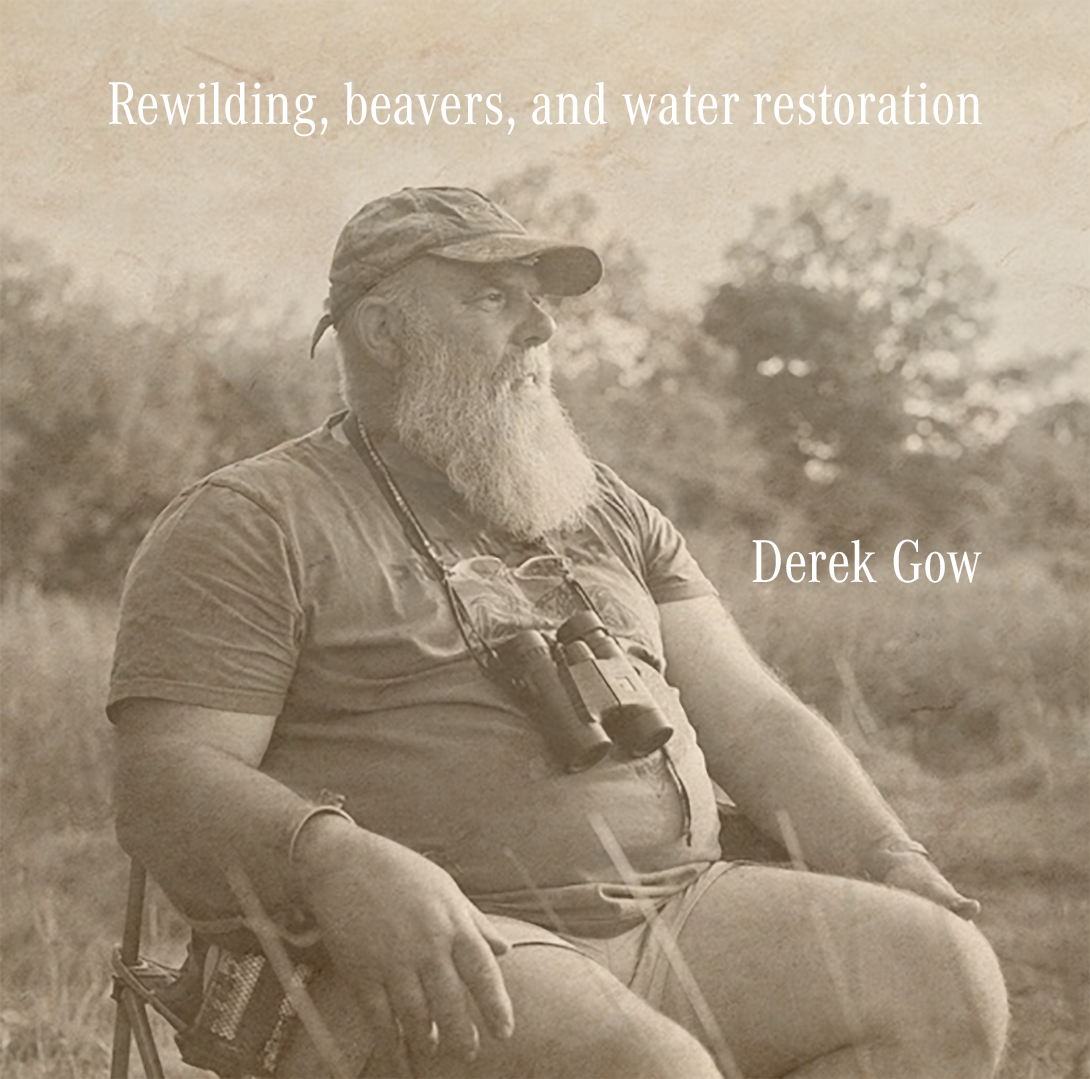
The idea of bringing back the beaver to the UK was an idea that was scoffed as too eccentric, even by environmentalists. But Derek Gow, against a lot of opposition, has pioneered bringing the beaver back, so that they are now once again part of the UK landscape, restoring the wetlands and rivers.Born in Dundee in 1965, Gow left school at seventeen and spent his early years in agriculture. He was inspired by the writing of Gerald Durrell, and jumped at the chance to manage a European wildlife park in central Scotland before moving on to develop two nature centres in England. That early immersion in wildlife conservation set him on a path that would eventually make him, in the words of George Monbiot the person who has done more to restore Britain's missing fauna than anyone else in the country (words written in the blurb for Gow’s memoir).Gow was the first to import and quarantine beavers for projects in the UK, sourcing animals from Poland, Bavaria, and Norway. It was the opening salvo in what would become a long and often maddening battle against institutional resistance. Since the early 1990s, in the face of outright opposition from government, landowning elites, and even some conservation professionals, Gow imported, quarantined, and assisted the reestablishment of beavers in waterways across England and Scotland, while responding to the opposition with characteristic bluntness, charm, and what his supporters describe as an almost reckless willingness to keep pushing when anyone else would have given up.Beavers were once common throughout England, Wales, and Scotland but became extinct in the sixteenth century, hunted for their fur, meat, and castoreum - a secretion used in perfumes, food, and medicine. Their disappearance was the removal of a keystone engineer from the landscape. Beaver dams create wetlands, slow water flows, filter pollutants, and provide habitat for an extraordinary range of species. Through gnawing on stems and coppicing trees, beavers stimulate regrowth that provides homes for more insects and birds, while also enabling more constant water flows and better water retention during droughts. In 2015, several families of beavers were reintroduced in Devon, in the UK, as part of the River Otter Beaver Trial - the first legally sanctioned reintroduction of an extinct native mammal in the country. Over the following five years, the two original breeding pairs expanded to at least eight, and researchers found 28 dams built across the catchment, impounding water across nearly two kilometres of watercourse. Findings from the trial showed that beavers reduced flood flows by up to 60%, even during very wet weather, by holding back water in newly created wetlands and allowing it to trickle out slowly rather than surge downstream. In the flood-prone village of East Budleigh, a family of beavers constructed six dams upstream, with the measurable result that peak flood flows through the village were significantly reduced. The animals were also found to clean water supplies, removing large quantities of soil, manure, slurry, and fertilisers from rivers and streams. Beavers have been steadily increasing their numbers over the years. There are now over 2000 in Scotland, and around 500 in England. Wildlife trusts are looking to release more this year.Today, Gow farms a 300-acre property on the Devon-Cornwall border that he is transforming into a rewilding haven, while continuing to be influential in the reintroduction of the Eurasian beaver, the water vole, and the white stork in England. He has written about the whole extraordinary saga in his book Bringing Back the Beaver.Here is an edited, abridged section of our interviewAlpha: This whole field of water restoration and rewilding - how did you get into it? Derek: I started working with water voles which are a very small animal in Britain. Water voles are one of the characters in Kenneth Graham’s book The Wind in the Willows. The character of Ratty, sculling up and down the idyllic English River with his friends, used to represent a very common animal. They were incredibly common in British waterways from the beginning of the twentieth century, and writers at the time referred to their overwhelming presence.Around 100 years ago water voles prospered. But by the 1960s and 70s, canalization of rivers, concrete banks, pollution, and the introduction of North American mink from fur farms caused massive declines. The animals once lived in chains of colonies along waterways. When those chains break and populations fragment, they can’t find unrelated mates and they disappear.Today the species has lost around 97% of its British range. The remarkable thing is that they are extremely robust. If you reintroduce them correctly with the right gene base and numbers, they recover easily. Their decline shows how harshly we’ve treated the Earth.I began working on water vole reintroductions about thirty years ago. We’ve learned a lot, though we haven’t saved them entirely. Early in that work, digging ponds and cutting trees to create wetlands, we began to realize something else must once have been doing this before us. And somebody eventually asked: do you understand what beavers do? At the time, I really didn’t.So in the early 1990s I went to Poland and spent a month visiting wetlands where beavers had been reintroduced in the 1960s. Wading through these incredible ponds with floating islands of vegetation, orchids flowering, frogs jumping away, dragonflies landing on your head—you reach the great beaver lodges in the middle of this living world.You quickly realize the animal that created habitat for water voles and many other species is the beaver. People call them a keystone species, but beavers are bigger than that. They are a function of nature itself. Apart from humans and elephants, they may be the third most impactful species on the planet in terms of habitat creation. That was my first journey into understanding beavers.Alpha: So you were a farmer when you started introducing the voles?Derek: Yes, on and off. I was also working on conservation projects. And water voles and beavers became central to those.When I started talking about bringing beavers back to Britain in the mid-1990s, people laughed. Most conservationists thought it was ridiculous.Yet when I traveled to Poland, Germany, Russia, and the United States where beavers had been reintroduced, I realized it was perfectly feasible. Much of Britain still has the trees beavers need. The problem wasn’t ecology—it was misunderstanding and inertia. Historically beavers were heavily hunted for fur and for a substance called castoreum in their scent glands, which contains salicylic acid, related to pain relief compounds. Because of hunting, their populations collapsed. By the early twentieth century only about two thousand remained in Eurasia. Governments eventually protected them, and slowly populations began recovering.Alpha: And there are two species of beavers, right? The North American and the European?Derek: Yes. When Europeans arrived in North America there may have been about 100 million beavers. The fur trade reduced them to around 2.5 million. In Eurasia the collapse happened over a longer period but was just as catastrophic.Ecologists studying North America have been able to track the environmental impact of removing beavers. Rivers eroded, floods increased, soils washed away, chemicals flowed into waterways, and ecosystems collapsed. Our pursuit of beavers was ruthless.Yet ancient cultures understood their importance. Leaders of the Zoroastrian religion in Iran over two thousand years ago forbade killing the “water dogs,” warning that deserts would advance if they were destroyed.Alpha: Wow. They figured that out that long ago?Derek: Yes. But modern societies largely forgot.Alpha: So when beavers build dams, how does that affect rivers and floodplains?Derek: Beavers are lazy animals. When they first arrive in a landscape with wetlands, they live easily—floating around eating reeds and plants. But they are territorial. As populations grow, younger animals move upstream into smaller creeks where they build dams.These dams create wetlands that act like giant sponges. During heavy rainfall the wetlands absorb water and slow its movement. Water can take ten times longer to pass through the system than it otherwise would. That breaks flood peaks for communities downstream.A great example is the Bridge Creek project on the John Day River in Oregon. Conservationists built structures to help beavers rebuild dams. The beavers reinforced them, slowing water flow and reducing flood damage dramatically. Beavers can have enormous effects, but only if we allow them enough space.Alpha: So many rivers today are straightened and engineered, but naturally they would be braided and slow-moving?Derek: Exactly. Nature never produced anything that flows in a straight line. Humans did that. For centuries we drained wetlands, built pumps, and tried to enslave water. Now climate change brings heavier rainfall and the water pushes back into places where we built our towns. We call that a disaster. But really it’s nature reclaiming what was always hers. The sooner we reshape landscapes to work with water again, the sooner we’ll realize the beaver may be one of our best allies.Alpha: So how is the rewilding effort going in the UK and Europe?Derek: So the rewilding movement in the UK… There’s a huge amount of talk about rewilding. The most famous rewilding project in the UK is a place called Knepp Castle in Sussex, and that is the home of a couple called Charlie Burrell and Izzy Tree. They have effectively rewilded their estate over the last quarter century for nature, and the results of what they’ve done, the cessation of farming, the use of big old breeds of domestic animals as proxies for extinct animals, has just been remarkable.The response of all the other wild species that live there is incredible. Bird numbers have risen with much greater diversity and abundance, and it really shows that if you approach even meat production in a different way — lower densities of animals, feeding them no extra supplements — you can create a landscape that is very rich in other life while still keeping some cattle.Elsewhere in Britain you’ve got other people talking about rewilding. There are all sorts of shapes and forms that it takes, from managed landscapes with very low densities of domestic animals to places where perhaps some wild ungulates are present — though there are very few of those left in Britain. Maybe a few wild boar and a few red deer.Different organizations and individuals are doing this for different reasons, so it is slowly growing in Britain as a way of approaching land use. But our government is incredibly hesitant about it, and our nature conservation authorities can be very difficult when it comes to moving this process forward quickly.To be brutally frank, things like the beavers, the reintroduction of the beaver , has been a thirty-year battle with all sorts of obstacles. The nature conservation organizations really did not help much at all until about the last five years. Even now, when it comes to government organizations, the bureaucracy involved with removing a few beavers into a new river system — it would be easier to move nuclear missiles and point them at the Irish than it would be to move the beavers.Europe is much more advanced. There’s been a huge degree of liberal thinking and action there, again for possibly about thirty years. One of the best parts of Europe to visit if you want to look at initial rewilding is the Netherlands. There have been large projects like the Oostvaardersplassen above Amsterdam where they’ve taken six thousand hectares of what was going to be industrial land reclaimed from the bed of the North Sea and allowed wild herds of large herbivores to live there and regulate themselves. This allowed the plant landscapes to develop and drew much other wildlife to it.Now all the way through Europe you see different projects of different sorts, with different species and habitats forming, and it is incredibly encouraging.When you look at responses to wolf reintroduction — for example in places like Yellowstone and Colorado in the United States — and then compare it with the Netherlands, which people imagine as windmills and tulips, the wolves are right the way through that landscape now. They are in people’s back gardens eating pygmy goats. People encounter them on walks while Nordic walking or walking their dogs.In the main everybody regards their presence quite rationally. A few weeks ago a wolf attacked and bit a child and it was shot, but nobody is jumping up and down about it or making a huge fuss that the wolf is back.If you look at that over time, we do evolve as a species in our relationship with nature. If wolves had returned to the Netherlands fifty years ago the main response would have been to kill them all. Now the vast majority of people are prepared to tolerate them.Alpha: Do you want to say a bit about your efforts to reintroduce the beaver — where you introduce them and what you had to fight through?Derek: My efforts to reintroduce the beaver… well, now we’re reintroducing them into habitats that are suitable. In the last few weeks the first licenses have come through to put more beavers out in England, and to reach the point where we had that official permission has taken nearly a quarter of a century.When the beavers first came, I imported them for areas where landowners were putting up large fences and keeping them in enclosed areas. But sooner or later beavers — which are basically made by God with bolt cutters on their faces — got through the fences and out into the surrounding wetlands and simply started living there.So there have been illegal colonies of beavers living free in England without licenses for maybe twenty years or more.My role was importing these animals and giving them to people. Nobody broke the law initially; some of the beavers simply escaped.Now we hold beavers for projects that are going to release them into wetlands. We have big buildings on the farm designed for this. Beaver families come here and stay for a couple of weeks where we feed and look after them before they move on to their final destination. It’s like a beaver hotel.Initially there was a lot of advocacy — film work, media, talking to organizations about beavers. I don’t do much of that anymore. I think no human being can do that for their entire life and remain balanced. You have to move on to other interests.My interests now are restoring other species that depend on beavers, such as water voles, or species that benefit from beaver wetlands like white storks. Because not many people are working on those creatures, that’s where I focus now.The whole thing has changed greatly from being a lonely guerrilla war to something where many organizations and individuals are involved with restoring beavers.I have beavers living free on my farm, and in the summer evenings my greatest pleasure is to get a bottle of cider, sit outside with binoculars, and watch them doing whatever they’re doing and watch all the other life that revolves around them.I don’t want to fill in any more forms on their behalf or fight any more political battles. Those days are done.Alpha: Thank you so much for getting the whole movement going. Do you want to say a bit about the white storks and what you’re doing with them?Derek: When the beaver disappeared and we destroyed the wetlands, we also destroyed everything that lived in them — fish, waterfowl, cranes, white storks, black storks, bitterns, everything.White storks were once recorded nesting in Britain in the 1400s and again after the Second World War. From the time of the ancient Greeks and Aesop they were seen as symbols of joy, recovery, hope, and rebirth.But in Britain when they sat on the roofs of people’s houses we simply thought: there’s lunch. So we killed them.As the species recovered in Europe they sometimes passed over Britain, but they would not breed here because birds have to be born somewhere to think of it as home. If no young storks are born in Britain, none will return here to nest.So our project began with a feasibility study in 2017. With funding from Knepp Estate we imported orphaned storks from a wildlife hospital in Warsaw Zoo.Some could fly and some could not. The ones that could fly eventually left, but over time birds in the enclosures and the free-flying birds started breeding.They built nests high in oak trees around Knepp. Last year there were around forty-seven nests and the numbers grow every year. The aim is to restore the stork as a breeding bird in Britain.Britain is a very conservative country, and some conservationists argue there are not enough historical records to prove they belong here. You can spend years arguing with people about that.But when ordinary people see these great birds spiraling into the sky or landing on their chimneys, they realize how spectacular nature can be. In a time when Britain is one of the most nature-depleted countries in the world, we need symbols of hope.The white stork has become one of those symbols.Alpha: So nature itself can regenerate quite fast if we get it started again?Derek: Nature can regenerate if we help it. We’re very good at cultivating animals we want to eat — billions of chickens, millions of cattle.But if we decide to help other creatures as well, there can be a different future for us as a species. We don’t have to be the plague we’ve become; we can be something benevolent.Around the world there are remarkable people who devote their lives to the creatures they love.Governments rarely save species. Often governments initially support industries destroying them. But small groups of committed people can change everything.When North American bison were reduced to fewer than a thousand animals, a handful of people protected small herds. Those herds became the foundation for the hundreds of thousands of bison that exist today.Alpha: On your farm you’ve turned it into a sanctuary for wildlife. Can you say a bit about that?Derek: I originally accumulated about four hundred acres of land near Dartmoor. I used to farm here.Now there are a few cows, but they are here as lawnmowers and to provide dung and hair for insects and birds. They are not here for meat or milk.The grasses and herbs grow tall like hayfields. Voles live beneath them, insects burrow into the roots, dung beetles roll the manure into balls and take it underground.We have opened perhaps a hundred ponds. The beavers create more wetlands every year. Birds like skylarks that once were absent are now breeding here.Soon white storks will fly here and build nests on the farm buildings. We’ve reintroduced wild geese, water voles, water frogs, and many other species. Tomorrow we’re even moving ants to restore anthills that were plowed away decades ago.We’re not saving the planet, but we are creating a place where people can see what is possible and be inspired.Alpha: Do you have any advice for people who want to get into rewilding?Derek: My advice is simple — bloody do it. This is not a rehearsal.It’s easy to sit in an armchair and assume someone else will take responsibility. If something truly matters to you, look at what you can do and do it.If you wait too long, age will catch up and the opportunity will pass.Do it quickly and enjoy the rewards and the fun and satisfaction that come from helping life prosper. Get full access to Climate Water Project at climatewaterproject.substack.com/subscribe
Supply chains & insurance: the secret levers to restore water - Stephanie Betts
I met Stephanie Betts a couple of months ago and was struck by her dynamic and enthusiastic energy. She had launched a pioneering, ambitious, and viable project to restoring the water cycle in a large scale systems way. Last week we sat down and talked about her project and her life.Stephanie Betts had worked in law and investment banking and was leading meetings between M&G (global investment manager) , the Bank of England and NGOs like Client Earth, looking at best practice governance for climate. Then came her first aha moment: the CEO of AXA, a major French multinational insurance company, declared to her that a world at plus four degrees would no longer be insurable. Insurance, she realized, wasn’t just a financial instrument. It was the key to dealing with climate change.She pivoted into insurance, becoming Head of Climate Alliances, Coalitions & Reporting for Aon - an insurance broker, that matches risk with capital, clients with underwriters, and counts major corporations and governments as clients.Insurance, at its core, is about understanding and pricing risk. The industry runs on calculating probabilities and turning them into prices. Stephanie started looking at something more fundamental than individual premiums. She was seeing entire sectors, entire geographic regions, becoming uninsurable. When water systems fail, it’s not just one farm or one business that becomes too risky to cover. It’s everyone who depends on that watershed. The insurance industry had been tracking this for years through their payouts: floods and droughts accounted for a large proportion of their disaster claims. But what Stephanie realized was that this wasn’t just about paying out more claims. It was about approaching a threshold where the risk becomes so high, so unpredictable, that insurance itself breaks down. Whole classes of people, whole industries, would simply have no coverage available at any price. The system only works if risks are manageable and calculable.Even before joining Aon, she had realized that water was important. But now it was getting clearer it was the fundamental risk underlying everything. Water runs through so many industries, from agriculture and technology to manufacturing and energy. It is the foundation of our society and the basis of our food security. As she puts it: “The risk isn’t just to the individual crop; it’s the dependency of our entire society on water. If the watershed fails, the entire economic system becomes uninsurable. We have to treat the water cycle as the ultimate infrastructure.” From within Aon, who initially just saw Stephanie’s interest in water as a hobby, she started to educate and convince the network around her of the importance of water.Then came her next aha moment: she realized farming was key to the whole water issue. Agriculture uses a large percentage of our total water supply, and the water footprint of regenerative agriculture was much smaller than industrial farming. Regenerative agriculture was the way to deal with water. She began to focus intensely on this connection. She saw that insurance could be a way to unlock investments, to get money flowing toward solutions. For the food industry, a switch to regenerative agriculture would make them less risky to insure. As she explains: “Insurance is the seed of resilience. By leveraging risk analytics, we can move from simply paying for a disaster to incentivizing the prevention of one. We are matching risk capital to the transition.”In other words: instead of just writing checks after disasters happen, insurance companies could lower premiums for farmers who prevent disasters from happening in the first place. But more importantly, by fixing the underlying water risk, they could keep entire sectors and regions insurable.The claims data said that regenerative farmers filed far fewer insurance claims than industrial farmers. They were more resilient. Through decades of heavy machinery and chemicals, industrial soil had become compacted and lifeless. When heavy rain hit, the ground acted like concrete. The water ran off, taking the topsoil and crops with it, leading to massive flood claims.Regenerative farmers, using cover crops and avoiding tilling, had rebuilt the organic matter in their soil, creating a sponge effect. High-carbon, aerated soil can hold up to ten times its volume in water. In a flood, the soil sponge absorbs the excess. In a drought, that same sponge slowly releases stored moisture back to the plants. Regenerative crops often stay green for weeks longer than neighboring industrial crops during heatwaves.For an insurer, it was key that a single farming practice lowered the probability of having to pay out claims on both ends of the extreme weather spectrum. Both floods and droughts. As Stephanie explains: “When we restore the soil sponge, we aren’t just fixing a farm; we are protecting the collateral. Healthy soil is an appreciating asset because it builds its own resilience against both flood and drought.”In financial terms, collateral is what backs up a loan. If a farmer borrows money to operate, the land is the collateral. If that land becomes degraded and can’t produce crops reliably, it becomes worthless as collateral. But healthy soil that can weather both floods and droughts? That becomes more valuable over time, not less.Industrial plants had “tiny little roots” because they were “spoon-fed” fertilizers at the surface. They didn’t need to work for their food. During extreme weather events, these shallow-rooted plants were easily uprooted. In healthy soil, plants had to reach deep into the earth to find nutrients and interact with fungi. Some of these roots could be a meter long, creating a massive underground anchor system. When storms hit, these plants stayed put.Industrial farming also created economic volatility. Wild swings in costs and income. It depends heavily on expensive, energy-intensive inputs like fertilizers and pesticides. If gas prices spiked or supply chains broke, the industrial farmer’s costs skyrocketed. If they couldn’t afford the inputs, the crop failed. Regenerative farmers used the soil’s natural biochemistry to provide nutrients, creating more stable, predictable business models. For an insurer, a farmer with lower, more stable costs is less likely to go bankrupt during a bad year.Stephanie applied this to what she calls the earth’s “first mile.” The beginning of the supply chain, where raw materials are actually grown in the soil. Industrial farming had turned fields into a toxic cocktail of compacted dirt. “Industrial farming has created a toxic cocktail of soil degradation,” she says. “From a financial perspective, this turns the land into a depreciating asset. It’s essentially mining the future to pay for the present.”A depreciating asset is something that loses value over time, like a car. Industrial farmland, stripped of its nutrients and ability to hold water, becomes less and less productive. It’s like slowly destroying the machine that makes your money.When rain hit these degraded fields, it ran off like it would from a parking lot, causing the downstream floods that insurance programs struggled to cover. The realization was that they needed to pay farmers to deal with flood and food security. To fix the problem at its source.Then came the next step: to shift this system, we needed to focus on supply chains.To understand why this matters, you have to step back and look at the fundamental question: what are the levers for large-scale change to restore water on this planet? Economics is one of the fundamental driving forces of societal behavior. And supply chains (the networks that move commodities from soil to shelf) are the basis of how the economic system actually works. They’re not just logistics; they’re the invisible architecture that determines what gets grown, how it gets grown, and who profits from it. If you’re looking for an innovative leverage point to shift the whole system, supply chains provide exactly that. Change the rules at the chokepoints (the handful of massive companies that sit between millions of farmers and billions of consumers) and the entire system has to adapt.A few key companies control the flow of massive amounts of commodities. Change the rules at those chokepoints, and the entire system shifts. A powerful real-world example of this is the Flood Re model in the UK. Historically, insurance companies viewed floodplains simply as high risk. But as one-in-a-hundred-year floods began happening every decade, the industry reached a breaking point. They realized they couldn’t just keep raising premiums or building higher concrete walls. They had to manage the risk at its source. This led to a key moment for the industry, where they became advocates for nature-based solutions, recognizing that floodplains act as natural relief valves. They impacted where development occurred by refusing to give insurance to people who built on floodplains. For the food industry operating on just-in-time logistics (where ingredients arrive exactly when needed with no excess inventory), any break in the supply chain is a massive financial hit. A drought in Brazil means no cocoa. A flood in Vietnam means no rice. Studies show that during drought years, regenerative fields can maintain yields up to 90% better than conventional neighbors. For corporations, that would mean consistent raw materials and protection against the price spikes that happen when harvests fail.As Stephanie points out: “Investors and banks are looking for stability. In a world of volatile climate ‘fat-tails,’ nature-based solutions aren’t just ‘nice to have.’ They are a strategic hedge against systemic collapse.” (Fat-tails refers to extreme events that are supposed to be rare but are becoming more common.) She used this argument, showing insurance companies and investment banks how to lower their risk and depreciation, and enlightening food corporations how valuable regenerative agriculture could be for protecting their businesses, to begin building a global partnership. After leaving Aon, she’s launched a project which has been assembling major food corporations, investment banks, and insurance agencies to incentivize and help finance the shift from industrial agriculture to regenerative agriculture. Their goal is to redirect several billion a year to create this shift.“De-risking the first mile of the supply chain will help scale food production sustainably to feed a growing global population, while limiting supply chains’ impact on nature,” she explains. “Producers will benefit from lower raw material volatility. They will also have access to crop data on a real-time basis, allowing for transparency, risk management, and reporting.” They are initially focusing on cocoa, coffee, cotton, soy, and palm oil, water-intensive crops, for which a switch to regenerative agriculture will have a huge impact on the global water and soil footprint. By making regenerative agriculture the new standardized requirement for these commodities, she’s working to use the leverage of global supply chains. The transformation is similar to what happened with the palm oil industry. For decades, activists and governments struggled to stop deforestation through treaties and local laws, with little success. The real tipping point will occur will when a handful of global traders (the chokepoint companies sitting between millions of farmers and billions of consumers) realize deforestation had become a massive financial and reputational liability. A regional example of this shift began in 2013 when Wilmar International, the world’s largest palm oil trader, adopted a “No Deforestation, No Peat, No Exploitation” policy. Within just one year, nearly all major global traders followed suit, bringing over 90 percent of the world’s palm oil trade under similar sustainability commitments. By setting these requirements at the refinery and trading level, the industry created a powerful market signal: if a producer’s methods didn’t meet the new standard, they risked losing access to the global market entirely. Once satellite monitoring caught up to these corporate pledges, palm oil-linked deforestation in Indonesia and Malaysia plummeted, eventually dropping by over 90 percent from its peak.By proving to insurers, investment banks and corporations that regenerative agriculture protects their concerns of food stability and supply chain reliability, Stephanie's working to turn the insurance industry and global supply chains into engines for water and soil restoration. Below is edited version of segments our interview. In the full audio version, you might find the final third particularly intriguing if you are interested in finding out more about how supply chains can be such a leverage for restoring water and soil. …...Alpha: Hi, it’s great to be here. I have with me today Stephanie Betts. Welcome.Stephanie: Thanks, Alpha, it is really nice to meet you again. I’m really excited to be on the podcast. A lot of people used to say water was my hobby. I’m glad to see that it’s not just mine. It’s a real topic that many people are spending a lot of time thinking about now, which is great. Alpha: Yeah, great to have you. You’re going to bring a different dimension to this whole water topic that we don’t talk about as much, which is the insurance and some of the finance side.Stephanie: Yes. My background is a bit different from a lot of people you’ve interviewed because I spent a bit of time looking at the archive to make sure we brought something that was a bit different. It’s not so much about the science of water and what happens—really gaining a deep understanding of the water cycle, which is fascinating and something we learn about all the time—but it’s really about how we move forward. It’s about solutions, action, and how we handle the risk that we’re facing now. We have increasing dependencies that we’re more aware of in terms of business and the global economies and the way they work.In a way, that’s not linear. We’re facing risks that are starting to be multi-layered and nonlinear, and how do you deal with that? I think the goal is to think in systems because if you look at water, it’s a very layered system. You have transportation, rain, cloud seeding, plants, and roots—all sorts of ways in which water connects to other parts of the system. I think that if we want to address the large-scale problems we’re facing on the planetary level, we need to start thinking in layered systems as well.On planet Earth we have enough water so far for most people to live comfortably (if we set aside the 2 billion plus people who actually do not have access to safe water already) means we’ve been lucky to have these “pale blue dots.” What do we do next to make sure we can stay, and that the next 50 years do not see us disappearing? Because if you run out of water, you run out of life. It’s a pretty urgent situation.Alpha: I’m excited to dive into these solutions with you, but how about we first get into how you got into water and your background?Stephanie: My background is actually law. I started as a disclosure lawyer working for a law firm called Sullivan & Cromwell, which is a well-known Wall Street law firm. That had a profound influence on me because I’ve always had this idea that you need transparent information; investors need to make the right decision. If you do not have the right level of information, you cannot make the right decision and you end up with financial markets that are not working optimally. From there, I went to investment banking and brokering for nearly 20 years where I worked for Lehman Brothers first, then JP Morgan and Citigroup. I’ve done my “tour of duty” in the big funds in the financial system.From there, I set up a sustainable business which brought me a bit more forward as to what is happening outside of finance. I realized people didn’t know very much. I realized that finance knew enough to take action, but they were not yet taking the right action. So I decided after 10 years of setting up this business—which involved cotton, hence why the water footprint became important for me—to go back to the City like an activist hiding in plain sight, trying to find the levers for change.I decided not to go back to my old world because I knew that investment banking world. I decided to go into asset management because they were my former clients and I wanted to see how people who manage huge amounts of money embed climate risk. I joined M&G for about four years, ended up working with the Bank of England and engaging with their climate unit to see how we could improve our practices as a firm to disclose more on climate. How are we going to hook financial systems to the right level of disclosure so we can get to the right outcomes? After that, I realized that finance is good, but it’s not really where the big lever is. I know it sounds odd, but actually what I found out is that it was insurance. I decided to join insurance just to get under the skin of it all, so I joined AON, the global insurance broker. That was phenomenal because there I had a first-hand view of what clients are thinking about when looking at risk, what kind of risk they are looking at, and what insurers are able or not able to do.That was the beginning of my thinking around water, which led me to set up my own business about two years ago to tackle that problem. I’m happy to delve more into the issues we’ve seen and how we’ve designed a platform and a solution to hopefully start. It’s a complicated thing, but I’m thinking again in terms of engineering: how we kickstart change and make sure we can hook the best solutions that already exist to better outcomes. We do not have the time to reinvent the wheel. We do not have the time to totally change capitalism, but we can rewire certain areas of it and that alone will give us the levers to get better outcomes.Alpha: Well, you have a fascinating background coming in from this with investment banking and the sustainable business side. A lot of people do think finance is the leverage and are worried about how economics and money fit together. It’s interesting that your insight was that it was insurance that was the lever. Do you want to explain a little bit more?Stephanie: Yes, there were two levers. It was really interesting. I remember the precise moment. I was always concerned about climate. When I left the City 20 years ago and I told my clients, “Guys, I’m going to be away. I’m having children. I don’t know when I’m back, but watch out for clean air and clean water. We’re going to be running out of all of that, and keep an eye on commodities.” That was my farewell to them. I could see that India and China were expanding and industrializing at a fast rate. In Europe—I’m speaking from England, but I’m French (and half Haitian, which is interesting for topics like water problems, erosion, and deforestation)—you could see it took the developed world 200 years to get there while China and India were doing this over 50 years. You can see the strain it brings on the systems and the entire population, which is exploding worldwide. We’ve gone from 5 or 7 billion to looking at 10 billion very shortly. Suddenly we’ve doubled the population, but the resources have shrunk. We need to manage that, and water is at the absolute nexus of all of that.One day, I was sitting next to an elevator doing some research for a presentation, and I came across a quote from the then CEO of AXA who said that a world at +4 degrees would no longer be insurable. That was that. There was a before and after. As a lawyer, you think an uninsurable world is a very scary world. As a young adult, I did an internship in Haiti where the rule of law was non-existent. I could really see what an uninsurable world looks like. You buy a house and someone says it’s not your house. You try to sell it and they say no. People come and seize your property. You’re not insured for anything. If you cannot insure your car, you’re not going to get in your car. If you cannot insure a project, that project is not going ahead. Interestingly, you can have the money from finance, but if insurance doesn’t want to insure a program or an asset, your asset is now valueless. You’re starting to see that in pockets of California where people are struggling to get insurance for their homes. Insurance has a huge role to play as a lever.Then a very good friend of mine, who was a very senior underwriter at Munich Re, and I used to chat about work. The more I talked about it, the more I thought what they were doing was interesting. They were insuring everything. I thought, “Is there anything you do not insure?” and he said, “No, because if the world has to go around, you need insurance.” When I put the two together, I knew I had to go into insurance. That’s when I went to AON. It was clear that for many clients, especially in the food and beverage area, climate change was the biggest issue. They didn’t necessarily know how to handle it and the long-term structural problems like yield attrition and lack of water.Alpha: Say more on AON.Stephanie: AON is one of the largest brokers worldwide for insurance. They match risk and capital. They find companies that need insurance and find the right underwriters to insure that particular risk.Alpha: Can you explain more about your perspective? You said as a lawyer you looked at this situation being uninsurable. What are the legal ramifications for that? My friends were trying to buy houses in California and had problems with insurance due to wildfires.Stephanie: The problem is that a bank will only lend you money for a mortgage if they know they have an asset they can eventually repossess. That’s the guarantee. But if that asset is not insured—especially in a high-risk region like California—the banks can’t give you a mortgage. It’s that little grain of sand that can stop everything from moving.Imagine you have a huge project and need to invest hundreds of millions in building infrastructure. Banks are not going to lend hundreds of millions for a big project unless it’s insured. And insurance is not going to play ball if they don’t have data that proves they’re not going to lose their shirt on that investment. Interestingly, large parts of the world like Africa are almost entirely uninsured. There is almost no insurance in Africa. Why? Because insurance doesn’t have enough data to be able to run the right calculations. Insurance is a numbers game.But what’s been fascinating recently is even the numbers game is changing. Right now, the problem is—and you’ll need a climatologist to tell you more about this—you have these fat-tailed risks that are coming more often than they used to. The calculation you had based on previous cycles is not necessarily applicable to the world going forward. That’s a big break for insurance. How do you handle that when the frequency and intensity of extreme weather events is accelerating?If we don’t deal right now with the underlying cause of those extreme climate events, insurance is going to become irrelevant because premiums will become so expensive people can’t afford them, or there will be events that you can no longer insure for. We still have a window, but we need to move.In Phoenix, Arizona, you can no longer build a development unless you can confirm you will have water supply for the next 100 years. It’s getting harder to prove. Local governments can’t issue permits if they think people will be stranded with no water. They’ve been relying on groundwater, but they have drought, hotter temperatures, and pressure on the Colorado River.I see a conflict coming between finance and population. You have hedge funds saying water is “the next oil” or “the next gold” and buying water rights, and then you have farmers and populations. Finance, business, and industry all need access to water—from energy to data centers. Then you still have to feed the population. How do local governments allocate water to these different constituents? Phoenix is a huge hub for data centers, which use millions of gallons of water, creating competition with agriculture.Alpha: You have a timeline of how you came to the realization of it. You were a lawyer, then in investment banking, then you had a realization about insurance. At what point did you have a realization about water and the soil?Stephanie: Good question. I always have a visual moment of when the penny dropped. I was at Aon and I thought, “If insurers are grappling with these big problems, what do we do to calm things down and rewind a little bit? What is the lever of change?”I realized the biggest issue was that in a warming world, we’re going to have less water available. Then I looked up the biggest influence on water. It was so simple: 70% of the world’s fresh water goes straight to agriculture. When you think about the water in your shower, that isn’t it. It’s what you eat and what you wear.I knew that regenerative agriculture was able to reduce your needs in fresh water by about 50%. If on a global basis you could move from 70% to 35%, that gives you a huge margin. We can’t move the whole planet to regenerative systems right now, but we can try because that’s when we’re going to reduce the pressure on water.Alpha: I don’t think a lot of people connect that. They realize agriculture uses a lot of water, but they don’t say the solution is “regen,” at least in the insurance business.Stephanie: It’s coming. People are getting serious about this because it’s happening. We’ve seen the ground collapse in places like Turkey because people have taken too much water out of the ground. When yields are down by 50% because of drought and the soil is unable to cope, or when floods take away the topsoil, you realize you’re trapped in a negative loop.For me, it was straightforward: we need to look at soil. A healthy soil is very open and aerated. You have the worms and the fungi interacting. When the rain comes, it acts like a sponge and can hold up to 10 times its volume in water. When you look at the roots of plants in healthy soil, they can be a meter long. But in poor soil, you have tiny little roots.When an extreme weather event like a storm or flood arrives, the crops with short roots get pulled away because the topsoil gets washed away. The plants with deep roots don’t get pulled away because the soil is elastic. When the event is over, they recover and they have plenty of water because they are saving it. When the next event arrives, like a drought, they can access water deep under which the others can’t. What’s happened is over 50 years of intense agriculture with tractors compacting the soil, but also with a lot of fertilizers that have killed the unique biochemistry of the soil. All that good soil infrastructure has been lost. That is what regenerative farmers are trying to rebuild. People like Gabe Brown, for instance, are at the forefront of this. There is a massive movement in America and a “Groundswell”—which is also the name of an amazing conference here in the UK—of regenerative farming.What gives me hope is that insurers are smart; they follow the money. In all these conversations, we need to follow the money, because that is the only way you get solutions that people will adopt and keep. Insurers are starting to notice they have two types of farmers. Traditional farmers who use heavy pesticides, chemicals, and heavy machinery are hit very hard by extreme weather events. They are always putting their hands up for a payout. The other pool—the regenerative farmers—actually don’t need payouts because their crops survive the events.Suddenly, insurers are looking at these two pools much like they did with smokers and non-smokers in the 1980s. They are starting to give them very different insurance costs. It is becoming more financially beneficial to move to regenerative agriculture than to stay with existing protocols.Then there is the nutrient element. I tell my children, “I’m trying to save your bacon here.” Most food in shops is made using products that weren’t “good enough to get in my car,” because fertilizers are often toxic byproducts of the chemical industry. People naively think pesticides just mean bigger fruit; they don’t realize that what goes into the soil goes into the plant, then the animal, and eventually into us. That is why we have escalating issues with chronic illnesses. We need to make good food accessible to all, but that requires a major system change.People often ask, “How can we be running out of water when it rains so much and there are floods?” I tell them, “Do you want to drink the water on the road?” That water damages aging infrastructure and carries topsoil runoff. A friend of mine farming in Devon recently had a “one-in-a-hundred-year” flood. Farms all around them were wiped away, but because they have practiced regenerative farming on their estate for years, their water was running clear. The water sank into the ground, and they didn’t lose any crops. It’s very concrete.If we can harness governments and insurance to move to regenerative practices at scale, it will make a massive difference. Our supply chains were set up 200 years ago for a very different world. We are operating under different constraints now. A big part of preserving water is looking at your diet—the water footprint of your food. I looked up the footprint of a simple lunch sandwich: it’s about 200 gallons. If you add a bag of chips, it gets “spicy.” The water used to irrigate the potato is one thing, but then it goes to a factory to be washed, processed, and packaged. Each step adds to the water and carbon footprint.In my perfect world, you eat flavorful, seasonal food from a regenerative supply chain. We need to make people dream about this possibility, not just scare them. A brilliant example is Louise Mabulo and The Cacao Project in the Philippines. She created the “Napa Valley of Cacao” by helping farmers move to regenerative practices. These farmers are now making money, buying cars, and improving their lives.We have a planetary problem, so we need a planetary solution. I decided to focus on five “worst” supply chains: cacao, coffee, palm, rice, and cotton. Cacao, coffee, and palm are linked to deforestation that disrupts the water cycle, while rice and cotton use extreme amounts of water. Our project creates a “plug-and-play” program for corporates to transform their supply chains from depleted to regenerative.Supply chains are engines that go all around the world. Instead of making them engines of destruction, we make them engines of regeneration. We’ve brought insurance and finance into the mix, creating a big insurance pool for each commodity. We’re working with partners like Aon, ERM, and Fauna & Flora.Alpha: Are your working with all insurance companies?Stephanie: It’s a mix of insurance, finance, and organizations that work on the ground with farmers. If you are a company like Nestlé or Mars and you want to ensure your beans are free from deforestation, how do you know? There is a massive gap between the head office in Switzerland or the US and the “first mile” of the supply chain.We are bridging that gap with technology. Five years ago, it didn’t exist, but now with AI and satellite data, we have transparency. You can see a chicken run from space! But data isn’t enough; you need infrastructure on the ground. You need agronomy, village champions, and investment in tools. We are giving corporates a “sweetener” with insurance to work across the entire arc of the supply chain. This creates better livelihoods for farmers, lower volatility for corporates, and higher GDP for governments.Alpha: You saw that agriculture is the key thing, and that regenerative agriculture is more resilient to “fat-tail” risks. You’re leveraging the companies downstream that have the money to help the farmers upstream switch. It’s a key to the whole system.Stephanie: Exactly. We are losing between 25 and 75 billion tons of fertile topsoil every year. It takes 100 to 1,000 years to rebuild just one centimeter of that soil. At this rate, 90% of the world’s soil will be degraded by 2050. It’s like an office where nine out of ten employees don’t show up for work; nature is hanging on by a thread.Indigenous populations have this right; 80% of remaining biodiversity is under their control. We need to go back to that old wisdom. It’s not a corporation’s job to worry about planetary boundaries—their job is to make chocolate or coffee. That’s why we stepped in. We are running pilots in Africa and Latin America to “test the plumbing” of this architecture. Once we are up and running, we are talking about a billion dollars at work in each supply chain.It isn’t even that expensive because, once engineered properly, the program pays for itself. If you take a tiny sliver of the $500 billion coffee trade and invest it in a concerted way, the impact is enormous. AI enables us to exchange information and monitor protocols across different landscapes. There is a small window of time, but a massive opportunity.Alpha: This is mind-blowing. In finance and insurance, everything is about incentives. You started with insurance because they have a direct incentive to address water risk.Stephanie: The main game for me is water. Nobody wants to pay for water because it’s a common good—the “tragedy of the commons.” But if you hook it to a value people do care about, like a smooth supply chain or protecting their assets and bonuses, you hook it to capitalism. Depleted supply chains work for no one. Once farmers make money through these practices, they become a brand new market for insurance. Remember, the protection gap is 70% worldwide. Insurance has 70% to gain by helping the world become more resilient.Stephanie: There is plenty of room to grow, but we need to do a few steps first. You have to make sure people have better livelihoods so they do the right thing to support those livelihoods. It’s all about how you hook it and how you organize it. Depleted supply chains serve no one, but regenerative supply chains serve everybody. They serve the head office, the customers, the farmers, the government, and the insurers.The challenge was moving from depleted to regenerative. That transformation is difficult because no company can do it on its own. But if you do it at the supply chain and country level, with the support of government and policy, it suddenly becomes a new norm. Think about seatbelts. Nobody cared about seatbelts in the 70s; kids were just driving around. Then, suddenly, you had to have them, and now everybody wears one. You needed policy for that.Things like that can happen overnight, but we don’t have policy at the planetary level yet. So, we had to go via the market. Once it happens in the market and people see the benefits, we’re hoping other supply chains will have “FOMO”—they’ll want to do the same.Alpha: This is a really interesting point. Last year, we were looking for the trigger points to tip the water cycle into better systems. We talked about different places to push, but none of us were thinking about supply chains. It’s a foundational economic idea. Since supply chains are the engine of the whole system, revamping them shifts the incentives to align with the water cycle.Stephanie: To get there, we just need a shift in those supply chains because they are the only things big enough and efficient enough to give us the fast transformation we need. Policy is one thing, but if policy isn’t moving, we go to the market. When I was a kid, I remember Superman going around the globe so many times you could see the lines of his travel. That’s how I see supply chains in my mind. They are “Supermanning” the globe in cars and trucks; they are everywhere and impacting everything. If we can make them supportive of a better life and water, we win.Water is my real mission—my not-so-secret mission. But we needed to embed it into something financially relevant for companies. That’s how you hook it to insurance and the financial system to create a chain reaction.Alpha: How much is the idea of water discussed in the insurance and finance sectors right now?Stephanie: I’ll be honest with you: water and insurance is a complicated one. The Green Climate Fund has a smart water expert who is looking at infrastructure projects worth $12 billion a year. But water is challenging because it’s a common good. That’s why you see people buying land for water rights and digging deeper to grab more water. You see it in California with thirsty crops like almonds; a farm turns on the tap and nothing comes out because a hedge fund next door had the money to dig deeper.Alpha: You’re pushing the economic side, which influences policy. If a corporation is whispering to the government that they need to restore the water cycle, policy becomes easier.Stephanie: And they’ll want a reward for it! When they show investors they are looking after nature, it’s a benefit. We also have sovereign wealth funds like Norges Bank and the Japanese pension funds making big moves. Norges Bank issued a report stating that 96% of their assets were exposed to “nature risk.” They told companies: “If you do not report on your impact on nature and show us a direction of travel, we will dump the stock.” These are funds worth two trillion dollars.I think the next step is the stock exchange requiring disclosure on nature. Nature underpins our financial system; everything we trade, eat, or fly comes from the ground. If the ground is depleted, we cannot continue to create economic growth.There was an enormous report by the CFTC (Commodities Futures Trading Commission) called How to Manage Climate Risk in the U.S. Financial System. They said the prices in the options market are no longer real because nobody knows how climate will affect the “underlying asset.” We have no idea what orange prices will be in five years. We are working on very thin ice, and that is a “zone of danger” for the global financial system.Once you ask people to disclose a risk, they naturally start to manage it. Managing it means reducing our footprint on natural capital and water. It’s about resilience—not just because I love beavers and keystone species, but because the resilience of our financial system is intricately linked to nature.Alpha: This has been amazing—seeing how to use supply chains for a massive shift in regen ag to help the water cycle. Any closing words?Stephanie: Just thank you for listening and for your interest in water. People often forget they have agency. As citizens and communities, we have the power to buy the right products and support the right supply chains. Never forget you’ve got agency—whether you work in policy, investment, or just as a consumer. We have the power. Get full access to Climate Water Project at climatewaterproject.substack.com/subscribe
Precipitationsheds and the socio-economics of rain: Patrick Keys
In Bolivia, farmers wait anxiously for rains. Meanwhile, Bolivian consumers buy beef and soy from Brazilian suppliers whose operations are clearing the very Amazonian forests that generate Bolivia's rainfall. The atmospheric connection is real but the economic feedback loop is invisible. If Bolivian businesses and policymakers could see this connection as clearly as they see a map of trade routes, would they make different choices about whom to buy from? Would Brazil negotiate differently if it understood that the forests it's clearing don't just affect its own climate, but control a neighboring country's water supply, a country that happens to supply a significant percentage of Brazil's natural gas?These are the questions that the work of Patrick Keys, a professor at Boston University, raises. He is taking the work of moisture recycling (aka the small water cycle, aka precipitation recycling) in exciting and pioneering directions. He is making the geographical sinks and sources of rain clearer, and then transforming moisture recycling from atmospheric physics into something socio-politico-economic: maps that show which upwind regions supply a location's rainfall, and frameworks for understanding how economic decisions in those distant regions create invisible dependencies. He's building the conceptual infrastructure for embedding atmospheric connections into the social and economic systems that actually shape land use.Working with Ruud van der Ent (interviewed here previously), he developed the precipitationshed framework, which maps how much rain falling in a particular location comes from which upwind regions. A city might receive portions of its rainfall from countries A, B, and C, or provinces D, E, and F. By making these connections spatially explicit, the framework transforms vague atmospheric dependencies into actionable geographic information. This required inventing new vocabulary - terms like precipitationshed and evaporationshed had to be coined to discuss atmospheric source regions, linguistic innovations necessary for thinking clearly about phenomena that previous frameworks couldn’t adequately describe. From their paper, precipitationshed is ‘defined as the upwind atmosphere and surface that contributes evaporation to a specific location’s precipitation (e.g. rainfall). We apply the precipitationshed as a tool for better understanding the vulnerability of rainfall dependent regions (e.g. dryland rainfed agriculture).” [Keys 2012]. The precipitationshed gave moisture recycling the same kind of geographical grounding that watersheds gave to rivers.Keys then applied this framework to map mega-cities worldwide, identifying which might be most vulnerable to land-use change in their precipitationsheds. His 2018 paper combined precipitationshed boundaries, rates of land-use change in source regions, reliance on terrestrial versus oceanic moisture, and robustness of municipal water infrastructure to create a vulnerability index. It was the beginnings of a translation exercise of sorts: how to convert land and atmospheric physics into the kind of comparative risk analysis that could sit alongside assessments of aging pipes or aquifer depletion in a city planning document.The mapping of atmospheric vulnerabilities built the platform for his next stage of work. Together with Lan Wang-Erlandsson (also interviewed here previously), Keys pushed the framework into new territory: moisture recycling as an ecosystem service embedded in social and economic systems. Places downwind buy from businesses upwind that affect the land. Economic behavior affects how businesses treat the land, which then affects the rain downwind. It’s a feedback loop where economic behavior is integrated into the hydrometeorological flow. In their 2017 paper “On the social dynamics of moisture recycling,” they propose a new field: socio-meteorology. And they write: “this paper provides insights for resource managers, particularly land and water managers, who are searching for new leverage points within their dynamic social–ecological systems. Understanding where key feedbacks, bottlenecks, and potential cascades are located within a system can provide managers with better information about the consequences of direct or indirect intervention within their systems.”Keys and Wang-Erlandsson analyzed three countries with different social-ecological configurations. Mongolia recycles 13% of its own moisture and receives 29% from Russia. Its precipitationshed is geographically vast but socially isolated - the moisture comes from remote Siberian forests and Kazakh steppes with little economic or political connection to Mongolia. Niger generates only 9% of its own rain, depending on moisture from Nigeria, Chad, Sudan, and across the Sahel. Here, multiple neighboring countries with active trade relationships, migration flows, and shared resources all influence each other’s rainfall through land-use change, creating a regionally interconnected system.Bolivia recycles 18% of its own moisture and receives 28% from Brazil. Brazil’s soy and beef production drives Amazonian deforestation, reducing moisture available to Bolivia. Yet Bolivia supplies a signficant percentage of Brazil’s natural gas imports, creating economic interdependence. Global commodity markets, international conservation programs and distant financial actors all influence land-use decisions in Bolivia’s precipitationshed - what Keys calls a tele-coupled system, where spatially disconnected actors drive local change while experiencing no feedback from the atmospheric consequences.Through these case studies, Keys and Wang-Erlandsson mapped the complex networks of interactions, categorizing different network topologies as isolated, regional, or tele-coupled, and showing how each creates distinct governance challenges. Their work sits at the intersection of economic geography, which examines how location shapes economics; spatial economics, which studies the role of distance and place in economic systems; and ecological economics, which constrains economic analysis by biophysical realities. The rain falling on your city isn’t just a weather event. It’s the downstream consequence of land-use decisions made by people you’ve never met, influenced by market forces you don’t control, mediated by institutions that don’t know you exist. And your economic choices -where you buy your food, what you consume - are propagating back through that same system, affecting rainfall patterns elsewhere in ways you can’t see.Economic activity in one location, such as deforestation for cattle ranching, reduces moisture available to another location through reduced rainfall for agriculture, creating invisible water transfers mediated by the atmosphere rather than by shipping containers. Every economic transaction that changes land use is simultaneously shifting hydrometeorological patterns - a causal chain that conventional economics typically ignores.Keys describes his vision for a coupled model that could simulate these systems dynamically - tracking not just moisture flows but also economic networks, political institutions, social dynamics, and climate change, all interacting in real time. “If you think it’s actually a social ecological system, some sort of complex adaptive system with feedbacks, then you have to be able to do that,” he explains. “You have to be able to kind of have the other part of that connection. Otherwise, it’s like only it’s like half of a simulator, right?” Building such a model would require bringing together network scientists, economists, political scientists, and climate modelers together to connect the dots.Here is an abridged, edited version of our interview into the exciting fields of precipitationsheds and the socio-economic-political dimensions of rainPat: I’m an assistant professor in the Department of Earth and Environment at Boston University and I have been doing moisture recycling research since 2010. My background is kind of a real mixed bag. I have an undergraduate degree in biology from Willamette University. I have a master’s of science and civil engineering from the University of Washington with a focus on kind of water resources and climate change. Then I started an environmental consulting company called Keys Consulting Incorporated, super creative name, and we focused on climate change, impacts, adaptation, resilience with clients all over the place, with projects all over the world. Then I realized I was still really curious about the world and I had a chance to go back to get my PhD and so I took it and I got my PhD in sustainability science at Stockholm University. I was a research scientist at Colorado State and then I moved into an assistant professor role. Then I recently moved to Boston University. That’s like a real quick snap.Alpha: Cool. Moisture recycling also goes by other names, precipitation recycling and small water cycle. You want to just say briefly what it is?Pat: My research is quite a bit broader than moisture recycling but I spend a lot of time in that world. For me, the idea of moisture recycling is just a atmospheric water cycle. It’s thinking about the sources of water on the surface of the earth. That’s evaporation, transpiration. It can be either from an ocean or a land surface. The moisture recycling part is understanding where it arises, where it travels through the atmosphere and then where it falls out later as precipitation of some sort. I know some people define moisture recycling on a much more local scale or a regional scale or only on land or all sorts of things. For me though, I take a pretty broad view and it’s just this idea if you’re tracking and understanding the sources and sinks of atmospheric moisture, you are probably thinking about moisture recycling in my mind.Alpha: Okay, cool. Did you get first get interested in this when you were doing your PhD at Stockholm?Pat: I went out to the Stockholm Resilience Center and worked with a whole bunch of different people thinking about surface water. I upgraded a surface watershed model for that fellowship. Right at the very end, Line Gordon and I started talking about this other project idea, which was instigated by a conversation Line had had with a colleague of hers, Huberts Savenije in the Netherlands. Line said, hey, I know this guy and he has a master’s student that had just come out with this really cool paper on moisture recycling. And so we had this big plan to try and build a research team with me and the Stockholm group and with Hubert Savnije and Ruud van der Ent in the Netherlands. So I’ve known Ruud since 2010. I know you had him on your show.The first paper we sort of cooked up was this idea of precipitationsheds, essentian analogy to surface watersheds - how can we think about sort of airborne sources of moisture, sources and sinks. I actually still have a notebook somewhere where at the time Ruud and I were trying to talk about what would be the best name for this sort of unit, names like skyshed and rainshed. The other day I found this notebook and I saw all these names crossed out.Alpha: That’s cool. I like hearing stories about how words came into being because basically you’re defining a lexicon for a new kind of field. I have heard people talking about the precipitation shed. Pat: Well honestly its I think the most important thing in looking back at that body of work the idea of this unit. Let’s work with this unit in a spatial sense, because it permits talking more specifically about an area on the surface of the earth that might be connected to some other place downwind. The purpose was to try and see whether or not that was a reasonable thing to do. Like, and that’s actually what my PhD was really all about was like, how reasonable is this approach? How useful is this idea? That’s what my PhD ended up being on.Alpha: And the ‘shed’ part is to make you think about the watershed to kind of analogize that idea.Pat: Sort of that. And also that it’s shedding, it’s shedding moisture.And so we want to understand what was the kind of upwind area, the upwind catchment, so to speak, that supported precipitation in a particular location. I am interested in are people using the source and sink idea more now? And I think they are. Alpha: So the precipitationshed tells you the source of where you’re waiting for comes from. There’s also one a word for where it goesPat: That is something that Ruud coined in a paper that he wrote, I think in 2013 which was the evaporationshed. So that’s where does a region’s evaporation go?Let’s take Colorado, for example. So you can think of all the places that contribute moisture to Colorado. So that sort of set if you drew a circle around it, that would be its precipitationshed, the place that supplies Colorado precipitation. The tricky question is how do you draw a line? Or how do you weigh the importance of regions that are contributing moisture? Because ultimately, a lot of regions could be contributing tiny, small fractions of moisture. So at some point, you want to say, Well, we’re not really talking about those places.So which places are we talking about? That gets to be pretty tricky. And I think that’s also where this very hydrology oriented subject sort of butts right into sustainability science, which is a very problem oriented thing. We’re talking about land use change, we want to understand the consequences of land use change in this particular place. Well, then maybe whatever lines that you draw in terms of upwind and downwind source and sink regions might have to correspond in some way to that would that would matter to this problem that you’re focusing on. Alpha: So for Colorado, what would you say the precipitationshed for Colorado and what is the evaporationshed for Colorado?Pat: My master’s student that just graduated just did that. So, so what her work shows, her name is Katherine Humphries. She just finished her master’s degree at Colorado State. And what she found is that the sources of moisture for Colorado, for Eastern Colorado, and especially the northeastern part of Colorado - lot of it actually comes from kind of regional sources. When I say regional, I mean, within Colorado, and adjacent states, there’s a pretty substantial contribution from the Gulf of Mexico, the Pacific Ocean, also from the Gulf of Baja California, so that body of water. There’s also substantial continental sources as well. And how much? I would actually like cite the paper, but she’s submitting the paper sort of like this week, so I can’t cite it yet.Alpha: How much does California contribute to Colorado’s rain?Pat: A little bit, some. And I should say again, this is, I’m really speaking primarily about northeastern Colorado right now. But California would some, if only by virtue of the fact that it’s evaporating and it’s sort of, if the Pacific Ocean is making its way to Colorado, California is sort of in the way. And there was a cool study that was done years ago - they looked at the Colorado River and how the moisture that arises from much of the irrigation and the lower watershed of the Colorado River, which is sort of this mass of canals and irrigation. A lot of that moisture then transports, or some of it, transports back up to the headwaters of the Colorado River. So there’s this circularity in the water cycle for the Colorado River to a certain degree, not completely by any means, but to a certain degree.Alpha: And what about Utah? Is there a lot of evaporation from Utah that ends up in ColoradoPat: But Utah is a pretty dry place, as you know. So there’s some evaporation from some of the bodies of water and also from some of the higher altitude mountainous areas with forests and so forth. And that’s true of the entire sort of quote unquote, desert southwest. Is there are still lots of mountains, lots of forests at higher altitudes, and those end up kind of showing up pretty clearly as sources of moisture. They’re not dominant by any means, but they do represent sources of moisture. When tracing moisture cycling remember that for a given location, in Northeastern Colorado, Boston, wherever, Oregon, you could draw a line of where this is the moisture coming from, but all those places are also contributing elsewhere.So it’s not a one to one relationship. You have some moisture is arising in Boston, and it’s going to travel elsewhere. Some fraction will go to a particular place, and maybe you care about that place, but we can’t forget that it’s also contributing to lots of places. So the diffuse character of this quantity makes it a little bit trickier in some ways than say a watershed where there is a more of a one to one relationship. There was some fantastic work that really dug into the archetypes of landscapes and how they partition evaporation precipitation and runoff as a way to sort of way to understand that water challenges are going to manifest in wildly different ways depending on the kind of which archetype you’re in. If you are in a system where actually you’re dominated by runoff versus evaporation, you’re going to have a different set of challenges for the most part than a place that’s dominated by evaporation with very little runoff. There was a really cool paper that was based on CESM isotope-based water tracking, a series of papers, Harrington et al. I want to say, that used the isotope-enabled version of the Community Earth System Model that’s developed primarily out of NCAR and Boulder, the National Center for Atmospheric Research. And this isotope-enabled version allows essentially online water tracking while the model is running. They can sort of track the moisture in different ways. And so there was some cool work that looked at North America and parceled it off into these different segments and looked at sort of the exchange of moisture among those segments, as well as disaggregating it from evaporation, interception, and transpiration to really tease out, well, what flux part of the evaporative flux is actually connected, connecting these two places that are transpiration dominated, which tells you something about the importance of land use.Alpha: There’s seven states in the US that depend on the Colorado river water for their water.It’s a huge problem because it looks like we’re draining the Colorado River, and there won’t be enough water in two decades or three decades. And it’s, officials are at a loss of what to do. So, my question is like, can we restore some more of the rain in the precipitation shed to kind of increase the Colorado River?Pat: This is such a tricky question. I would say that that level of intervention would presume a way better understanding of the system than we actually have. And by that, I mean, you know, we’re just starting to, I feel like we’re just starting to get a handle on a sense of the variability, etc., associated with some of these kind of the flows of moisture. Atmospheric rivers as a research topic is not that old. Now, I mean, to some people, you’d be like, oh, it’s been around for decades.And it’s like, that’s still not that old. And that’s a critical component for understanding the major sort of sources, the major events that inject moisture into parts of the Colorado River basin, if not, you know, parts of basins around the world. And so that’s one part. Another part is the fact that a major part is that we now have a moving target with climate change. So almost all of the phenomena that we’re talking about from an atmospheric science perspective that are going to matter for moisture cycling, changes in humidity, changes in prevailing wind pattern, storm tracks, etc., changes in temperature gradients, the fact that the land is drying out more quickly in the ocean, all this stuff is happening and matters for understanding moisture cycling. And depending on the decisions that society makes around its carbon, we could either be a lot warmer or a little warmer. And I would say we’re just now starting to get good comprehensive studies on climate change, the way that different climate change scenarios will have different types of moisture recycling. Alpha: You have looked at mega cities and how much they can restore their water systems and rain.Pat: That was something I did during my PhD. In a paper we tried to figure out, is there a way to talk about, in a way like the way we talk about the vulnerability of municipal water supplies, for these mega cities that could arise from the rate of land use change, the amount of land use change in their sort of upwind source areas and their precipitation sheds. Some cities are pretty resistant to upwind effects in part because they’re coming from the ocean for the most part. Their sources are coming from the ocean. So like humans can only really affect that through global climate change for the most part. But some places are intensely reliant on terrestrial sources of moisture wehre those terrestrial sources are experiencing pretty dramatic types of land use change. So there are places on the world that could be ppretty vulnerable. There are mega cities whose domestic water, municipal water supply are pretty exposed to upwind change. If I was in one of those highly vulnerable cities, and I was in charge of water, I would probably say, oh gosh, I should make sure I’m aware of this and thinking about this and maybe do our own studies, right?Alpha: So this is where the land use in the surrounding area upwind, like if you cut down the trees, will affect the rain in that city downwind.Pat: The amount of how much it affects, how it affects is all, it’s so variable in the sense that it depends on where you are on the planet. It depends on when you get your precipitation. It depends on what is your municipal water storage system.So that’s something we actually considered in that mega city paper was on a city by city basis, we sort of looked into, well, how robust is their kind of municipal infrastructure for storing, transporting the water for their city? Is it a run of pipe that they’re just sticking a pipe in the river? And it’s like, if the river’s low, they’re low? Or do they have the good work of reservoirs?Alpha: So which were the major cities you found that the rain did depend on the surrounding area the most?Pat: The four cities were Karachi, Shanghai, Wuhan, and ChongQing. And so those four cities stood out as being particularly vulnerable across all of the different metrics. It’s not a surprise to me in part because there is a lot of land use change across Asia. And part that’s part of the analysis is what’s the rate of land use change in some of these places. On that side of the Eurasian continent, the terrestrial sources are very high. On governanceThe FAO, the UN Food Agricultural Orginizaton has a strong interest in this, they’re producing a report as we speak about the benefits of forests to agriculture, and a chapter on that in that report is looking at the kind of say the climate side and a big part of that is thinking about moisture cycling. That’s a really good example of a pretty high level governance institution that is interested in this topic. I should mention that the one of the funders for Kat’s (Katherine Humphries) work I mentioned earlier. She had done this moisture cycling analysis for northeastern Colorado, for a very extreme year in 2023 where we had the record breaking precipitation events. And so the Colorado Water Conservation Board, a state level agency wanted to understand more about that that extreme year and partially funded Kat’s thesis. And so one of the deliverables for that thesis was essentially, you know, where did that extreme rain come from. How can we understand that extreme rain in the context of, and it was all rain I should say or it was, you know, rain and hail.So that’s another example of an institution that I think became aware of the possibility to ask this kind of question, in part because one of the faculty in the Department of Atmospheric Science at Colorado State. His name is Russ Schumacher. He’s also the state climatologist. So he is having very much on the ground discussions with producers or like agricultural producers in Colorado about Colorado’s climate. And he’s engaged with policymakers at the state level, talking about Colorado’s climate, not just climate change but you know climate, you know variability, etc.Agriculture is a huge part of Colorado’s economy, especially some local economies. And so putting that so this is something that he I think he shared this with that agency and they said, oh wow, should be interesting to understand. So I think you’re right that there’s a certain amount of if you can share this, the fact that there is this kind of scientific possibility to understand this phenomena a little bit more broadly.Ecosystem serviceAlpha: You’ve been doing work to frame vegetation generating rain as an ecosystem service.Pat: One of the papers in my PhD was asking this question, sort of can we frame moisture cycling as an ecosystem service and if so what does that look like what would that mean how would we do that. And it’s good you mentioned Lan Wang-Erlandsson because as part of her PhD she had developed this evaporation model that simulated evaporation partitioning at the land surface. So evaporation is moisture turning from liquid phase to gas phase, but there’s lots of different ways that can happen. If it water can fall on say a leaf that’s called interception and if it re evaporates from the surface of that leaf that’s been intercepted and then re evaporated. If water falls to the soil and gets taken up by the tissues of the plant and then evaporated up a still motto that’s called transpiration. It functions differently you can sort of so you can simulate that so you can if you have land use data soil data precipitation climate data, etc. I think it was really useful providing kind of a first order estimate, a conservative estimate for the effect of vegetation on moisture recycling. If you wanted to get more detailed you’d use a dynamic model like an earth system model with different land surfaces. Then you could get at a lot more of the dynamic processes, you know, changes in that diurnal cycle changes in seasonality.And so another scientist, Becky Chaplin Kramer, who has led a ton of ecosystem service work, she invited me to contribute sort of this data and a little bit more analysis to some work where she was trying to combine multiple index of critical natural assets around the planet with moisture cycling being one of those sort of critical natural assets ecosystem services. And so that idea has gotten a little bit more traction and is still sort of ricocheting around. It’s probably what has motivated the FAO to be more interested.Social-economics of rainAlpha: Cool. Yeah, I think ecosystem services framework helps certain organizations, and governmental groups too… And then you and Lan also did some work on social ecological modeling?Pat: We wanted to try and do this idea of how land use can affect precipitation in a different place, and Lan and I wanted to see if there’s a back loop. Is there anything that connects the place that’s receiving precipitation back to that upwind source region? To really investigate that we wanted to think about sort of social dynamics, economic dynamics, political dynamics. And when you start using that language in the context of an ecosystem service, you bump right into this concept of social ecological systems, SES, which are a way to study coupled human and natural environments. It draws a lot from the complexity science community, thinking about how there are feedbacks that exist within these systems that lead to emergent phenomena, all sorts of stuff. If we think about moisture cycling in the context of a social ecological system, then the moisture cycling side is sort of part of the kind of ecological connection, a main feedback in some ways that ecosystems upwind are connected to the ecosystems downwind via the atmospheric water cycle.We did a deep dive into a couple of case studies like in Bolivia, Niger and Mongolia.What we tried to do is we said let’s map the precipitationsheds for these locations. And that gives us the boundary in which to sort of consider the spatial scope of these social connections, economic connections, policy connections. And this was really an exploratory paper in some ways that was an attempt to sort of open up this conversation that was already, there were already other kind of spokes into the conversation, but from different communities. So there’s a couple other communities, one’s called sociohydrology and one’s called hydrosociology (they sound the same, but they’re different). I’d say there’s still a ton to do there. Lan has a PhD student who’s working on this still that’s really starting to dig into some of these social dynamics. I’ve got a couple of grant proposals that have been submitted to try and dig into this phenomenon more in part because if there are, if some places do have much stronger social kind of back loops to their upwind areas. Those are levers of change, right. So those that those are ways that those places are potentially tied into affecting their own precipitation, albeit through totally different mechanisms, policy mechanisms, economic mechanisms, trade mechanisms. I’m really excited about that work. I think there’s a ton left to do so many questions and almost all of them rely on, aside from funding, but rely on really deep interdisciplinary work to understand those systems, which me sort of waiting into initially is good for generating an initial question or set of questions, but beyond that, you really have to start working with experts in their respective disciplines.Alpha: Could you give an example what you mean by the social back loop?Pat: Let’s say there is a patch of land upwind that is a mosaic of forest and range lands and croplands. It evaporates water, which falls down, downwind to a city, let’s say Montevideo, in Uruguay. Well does Uruguay buy product from that area upwind? Is its economy locally dependent in any way on the products generated upwind? Is its economic activity would be promoting or discouraging certain land use decisions which are then affecting it.Alpha: Oh, wow.Pat: Trying to disentangle that question is complex. A lot of different ways of thinking about the connectivity. There’s network science from there. There’s economics in there. There’s policy sciences in there. Institutional science is even like history involves. And so that’s why it’s a really it’s not an easy question to ask in some ways.The biological side is simple by comparison, right? We take this grid-ed climate data. We ask this question. We answer it. We write a paper. But then we want to talk about what are the connections that are poorly documented, which do not fit any sort of grid structure. They don’t follow physical laws. How do we study that question to then connect it back? A dream scenario would be to build a cool simulator to say this is how we could simulate change in an upwind area and its effects downwind. But if you think it’s actually a social ecological system, some sort of complex adaptive system with feedbacks, then you have to be able to do that. You have to be able to have the other part of that connection. Otherwise, it’s like only it’s like half of a simulator, right? Like you’re only simulating half of the system, not simulating all of the other stuff. And if there are some really important slow or fast feedbacks, reinforcing feedbacks, especially you could get some really surprising outcomes. Alpha: Yeah, that’s good. So yeah, so it’s kind of cool how you’re bridging the people part with the ecological part. Usually people decide to study one or the other, right? Economists, they treat nature almost as a separate physical process, but economics really is a subset of nature because people are subset of nature.Pat: You’re going to need a whole other podcast series for that one.Alpha: It’s interesting that you’re using a complexity theory lens to write so a system and right and you actually have a fondness for looking at things from a systems perspective, right? Pat: I don’t do a ton of work through that lens but I think actually most of my work is implicitly through a systems lens. I got my PhD at the Stockholm Resilience Center resilience. And that institute has a deep connection to something called systems ecology, which really came out of systems thinking complexity, complexity science. And so a lot of my academic training, especially my formative PhD training was infused with that sort of lens that systems thinking lens. I actually taught a class on systems thinking, sort of a one shot systems thinking course at CSU, which was a ton of fun to teach. It was such a cool class to teach really asking questions, asking these undergrads to think deeply about sort of the systems that were embedded in what kinds of leverage points exist, etc. We use a book called thinking and systems that was written by Donella Meadows. Alpha: In economics you have emergence like the invisible hand. So it’s interesting when you’re trying to tie ecosystems with the sociology and then seeing what emergent things arise, and seeing what complexity arises. You change the rules a little bit and you get really different emergences. Maybe you just change a little bit how the ecosystem connects to the sociology. You get very different behavior, maybe more favorable behavior.Pat: I think almost all the ingredients are out there scattered or different disciplines. I think a really strong big opportunity is some of the advances in, I would say, like complex network science is probably a really good entry point for starting to wrap our heads around some of the social processes. So you could think about networks, social networks, political networks, economic networks, and from those networks, you can actually distill almost rules or kind of governing principles that make that network work, mathematical rules, I should say. And that’s what would permit you to start to develop something like a simulator is if you had, you could translate what you observe in the data in the networks that you find into something that can be represented in numbers. And that’s how then you can really connect that into some sort of simulation. And so there’s a ton of work on complex networks. I mean, that’s a whole massive field with sub fields. And there’s even been some work on complex networks related to moisture cycling to distill the moisture tracking findings into a complex network and then use that network to then ask and answer questions. And then the people have done similar things for people and it’s really just a matter of like, which networks do we need to develop and understand and sort of glue together to make the sort of representation of something that we can simulate and explore change and. So I mean, it’s not for I don’t think it’s for a lack of data per se. It’s a lack of essentially finding the right people to work together to connect the dots that are already there.Alpha: Yeah, that’s really interesting. The social system is a network and the moisture recycling is a network. You can think about each tree as a node in the water network where the tree decides whether to transpire water up or not, whether to bring water from the groundwater. Basically you’re moving water between these nodes.Pat: The other thing that I’m really interested in is exploring how ecosystem stress, say from drought can propagate through moisture recycling to affect other places. So if you’re in Gabon in in Africa, it gets a lot of moisture from the ocean, but also from East and Central Africa, from Kenya and from the Congo Basin. If you’re in Gabon, your precipitation sensitive to the evaporative stress in East Africa. Are you seeing a signal in your variability or seasonality, the actual magnitude of the amount of water that you’re getting? Are you seeing any sort of signature signal of evaporative stress or changes in evaporative stress as a result of that being transmitted through moisture cycling? And the reason I’m interested in that is in part it’s getting at a different aspect of sort of the kind of the complex and the kind of network connectivity of these ecosystems to one another.I want to understand the teleconnected aspect over land mediated by the ecosystems in multiple ways. This is motivated in part because then it permits talking about the dependence of one place on the governance of another, where you can say this place is actually dependent in some ways on the way this place over here chooses to govern its land. I’ve done a little bit of work on governance of moisture cycling, and this is another way to sort of continue deepening that work through a slightly different lens, not just saying hey these places exchange moisture with one another which is interesting in itself, but saying this place is actually somewhat dependent or sensitive to exposed to the policy decisions in this place in this specific measurable way.Alpha: Right, yeah. So the ecological stress in one location affects another location, then you would be interested in perhaps helping that other place have less ecological stress.Pat: In my opinion it’s honestly a route to cooperation right. It’s also something that would lend itself more to sort of trans boundary connections trans boundary cooperation. It’s rare that you would just have two countries next to each other. Canada and the United States are an exception of two giant countries that are next to each other with few other countries sort of involved in their moisture cycling. Most countries at the total mess. And so as a result you have to think about these sort of like consortiums of countries with transboundary relationships. Alpha: And this opens the door to bring in negotiation and game theory.Pat: All sorts of other dimensions for sure. Tipping points and planetary boundariesPat: Tipping points is an idea that’s been around for ages. And that idea has been incorporated into the planetary boundaries framing. The planetary boundaries framing is this suggestion that there are specific thresholds within the Earth system that to cross those thresholds would begin the transition to a new Earth system system.Alpha: Moisture recycling could play into the planetary boundary.Pat: In the initial framing of the planetary boundaries it was based on surface water and thresholds in surface water related to environmental flows - the flows that are necessary for the ecosystems in a particular river to be sustained and to last and be resistant to change. That was adjusted in the last decade to include quote unquote green water, to look at the evaporative side, the atmospheric side of water, thinking about all the landscapes that are not really where runoff is pretty marginal and where it’s much more about precipitation and the evaporation and really that exchange. So there is now a green water planetary boundary, essentially that other half of the water cycle dominated by precipitation evaporation versus precipitation runoff. And that green water boundary has attempted to fold moisture recycling. I’m a co-author on a green water planetary boundary paper. I will say that the planetary boundaries are still a really evolving concept and I think even the people that are in on the inside would acknowledge that that, you know, every year, there’s new insight about what the details of this or that planetary boundary are. Alpha: Did you have any final thing you might want to say?Pat: I think one thing that has guided my research, for moisture cycling especially but I would say it’s true across the board, and is to find the questions that are really interesting to me personally. And then in some ways chasing them even if some of the people that are around me are less excited. I think if I can leave you with one thing something that would be valuable in my view is if you’re excited about chasing something keep chasing it you know because I think that there’s so many more questions out there than we realize to even that we haven’t even realized we should be asking them. I think we have the sense that we’ve discovered everything right that every rock has been turned over scraped clean that there’s nothing left to do and that’s like hilariously not true. Especially in this thorny challenging area of thinking about the intersection of anything physical natural earth system ecosystem hydrologically related and people we still think that we’ve scraped the rock clean we haven’t.If you’re interested and curious and excited about something keep chasing it even if you have to put it on like not even the back burner like the warming section of your of your stove top that’s like barely keeping it warm. Don’t lose it, right. I’ve had to do that multiple times in my career where I have to set something aside to work on something else for whatever reason but don’t forget that that’s there because that could be the biggest thing that you contribute to like our understanding of the world.ReferencesKeys, Patrick W., R. J. Van der Ent, Line J. Gordon, Holger Hoff, R. Nikoli, and H. H. G. Savenije. "Analyzing precipitationsheds to understand the vulnerability of rainfall dependent regions." Biogeosciences 9, no. 2 (2012): 733-746.Keys, Patrick W., and Lan Wang-Erlandsson. "On the social dynamics of moisture recycling." Earth System Dynamics 9, no. 2 (2018): 829-847.Keys, Patrick W., E. A. Barnes, R. J. Van Der Ent, and Line J. Gordon. "Variability of moisture recycling using a precipitationshed framework." Hydrology and Earth System Sciences 18, no. 10 (2014): 3937-3950.Wang-Erlandsson, Lan, Ruud van der Ent, Arie Staal, Miina Porkka, Arne Tobian, Sofie te Wierik, Ingo Fetzer et al. Towards a green water planetary boundary. No. EGU21-13583. Copernicus Meetings, 2021. Get full access to Climate Water Project at climatewaterproject.substack.com/subscribe
The big groundwater crisis - food, water, pollution, and social unrest : John Cherry interview Part I
I was mesmerized listening to John Cherry talk about groundwater, so absorbed that I didn’t notice that two hours had gone by. With lucid clarity, he laid bare the massive groundwater crisis engulfing us.Cherry speaks from a place of gravitas. He’s won the Stockholm Water Prize, known as the ‘Nobel’ of water, which is awarded in conjunction with the Royal Swedish Academy of Sciences, the same institution behind the Nobel Prize itself. He wrote the seminal Groundwater textbook that shaped our modern understanding of groundwater hydrology. He essentially pioneered the entire field of groundwater contamination.In our conversation, he poignantly pointed out that the water crisis is really a crisis of groundwater. 99% of liquid freshwater is groundwater, and groundwater supplies 40% of our food, and 70% of irrigation, but many major aquifers are already overdrawn. The Ogallala, which grows a sixth of the world’s grain, could be largely unusable within decades. Once natural buffers against drought, aquifers are now drained, leaving regions like California, Spain, São Paulo, and Cape Town vulnerable to even short dry spells.He noted that the Agricultural ‘Green’ Revolution of the mid 20th century wasn’t just about using synthetic chemicals and high-yield seeds to produce more food, it was also withdrawing more groundwater. Cheap pumps fueled massive irrigation, temporarily boosting yields but eroding soils and depleting aquifers. Today, exhausted soils and collapsing aquifers are twin legacies of that mid-century surge.Global “virtual water” trade has been hiding the growing groundwater crisis. Wealthy nations import crops grown with disappearing groundwater, from Peruvian blueberries to Arizona alfalfa for Saudi Arabia. Far from increasing food security, globalization has made local water crises a global problem.There was so much rich material in our interview that I couldn’t squeeze it all into one written article (Substack has length limits), so I’ve split this into two parts. Part II will go further into the crisis, and also explore solutions - regenerative agriculture, rainfall harvesting and managed aquifer recharge. The audio podcast remains one complete episode.Here is a lightly edited, abridged version of the interview : Part IAlpha: Lets give you a little bit of an intro. You’ve written a very widely regarded textbook on groundwater, and you were a pioneer of contaminant groundwater.John: Yeah, I wrote that book Groundwater with a colleague, published in 1979. There weren’t any other modern books on the market, so it became a widely used book for many decades. It’s on the Groundwater Project website and it’s one of our most highly downloaded books, even though it’s very old.Alpha: Yeah, it’s very readable. At some point you began exploring the bigger picture idea of why groundwater is so important to the world.John: Yeah, I started the Groundwater Project as a follow-up to the textbook by Al Freeze and myself. The idea was to just publish a few books on the web and then it grew and grew, and that got me into looking at the bigger picture. Bigger picture lectures are what I’ve been giving for the last four or five years. First I was talking about the bigger picture of the state of groundwater science, and now it’s really about the bigger picture of groundwater in the world and how it’s kind of ignored and unappreciated and mostly pictured incorrectly.Alpha: You’ve won some of water’s biggest prizes. The Lee Kuan Yew Prize and then the Stockholm Water Prize.John: I won the Lee Kuan Yew Prize of Singapore in 2016, and then the Stockholm Water Prize in 2020, rather late in my career. But it kind of caused me then to want to develop responses to broader questions. Really, it was the Lee Kuan Yew Water Prize when the interviewers would ask me, “Why is groundwater important?” The technical things for which I won the prize were entirely irrelevant in terms of the big picture. So I realized I had to develop responses to the question of why groundwater is important.Alpha: I think for a lot of people, when they first hear about groundwater, they don’t really realize they should have any significant thoughts about. It’s just this water deep underground which we don’t see. And yet, I think you’re saying there’s actually this whole groundwater crisis that’s looming that has repercussions for many things—from our food to our water systems. Really key to human society.John: Yeah, and it’s now recognized that there’s a global water crisis. The World Bank and UNESCO and all the global organizations pay lip service to that, that there’s a global water crisis. But they never get to the point of what’s the nature of the crisis. It’s primarily a groundwater crisis because groundwater makes up 99% of all liquid fresh water. The number you see in the textbooks is always less than that because they include ice. But when you take ice out of it, it not being a liquid, groundwater is 99% of all liquid water. And most of the time, all of the water that flows in streams and rivers is groundwater. It’s called base flow. All wetlands are fed by groundwater, and most ecology that’s water-related has a groundwater feed. People just don’t recognize that because you don’t see it.About half the people in the world drink groundwater to some degree or another. And 40% of the food these days is produced by irrigation, but 70% of the irrigation water is groundwater. The standard number you see everywhere is 40%. But if you include the groundwater that’s flowing in the rivers nearly all the time, if you include that in the irrigation number, then it’s 70%. So groundwater, the 99% number, you almost never see that mentioned. The number for food is always underestimated. There’s just misunderstanding of the importance of groundwater.There’s the concept of peak water, which isn’t given much attention, but then there’s the concept of peak groundwater and the depletion of aquifers around the world. So it’s the heart of the global water crisis and it’s becoming the heart of the food crisis from the water point of view.Alpha: Can you give us some of the basics of groundwater? Like how much groundwater there is relative to freshwater? I don’t think people realize exactly how groundwater comes up and that streams are fed by groundwater. Can you give us some overview?John: So when it rains in most areas, rainwater infiltrates through the soil and gets to the water table. The water table is the first free water. If you were to go out in your backyard and dig a hole, eventually you’d find free water in the hole—where the water level would come. If you take a post hole auger and make a hole, and if you’re in a part of the world where there’s enough rainfall, then not far down—five, ten feet or whatever—you’ll have free standing water. That free standing water level is the water table.In the upland areas of the landscape, the water table has high energy water and that water flows toward the low-lying land in a flow system. Just like streams have a flowing regime, groundwater has a flowing regime. The water flows from higher elevation to lower elevation areas that are called discharge areas. Streams and rivers are almost all discharge areas. Wetlands are almost all discharge areas. By that term, we mean that there’s water seeping up and discharging into the surface water body.What people don’t realize and what schools don’t teach is that groundwater is beneath us everywhere. It’s very unfortunate in the schools—there’s not a well outside the door. Students could have been measuring the water level at least at about any school in the world, seeing what’s happening to it over a long time. Sometimes when it rains, the rainfall gets down to the water table and recharges groundwater, but in many cases when it rains, water doesn’t get all the way to the water table and that water goes back into the atmosphere.The most important—one of the most important concepts in the so-called water cycle—is the water table. If you look in the scientific literature, even generally in the literature, people in the news media and in the literature not written by groundwater experts refer to water levels. A water level is a meaningless term. It’s just the water level in a well someplace. That’s not usually the water table, and the water level in a well can reflect how water is being drawn out of the aquifer—it reflects many things. But it’s the water table that’s really the critical entity that relates to plants and forests and streamflow and all of that.Alpha: So when rainfall infiltrates into the soil, some of that soil water is brought back up by the trees or used by the different plants, right? But then some of it, if it’s lower down, keeps seeping down into the aquifers.John: Yeah, if it rains enough in many areas, then part of that rainfall makes it all the way through the soil. It makes it past the roots and gets to the water table. Generally, once it gets to the water table, it starts its subsurface journey. Now there are roots that go down to the water table, but most of the water that actually gets to the water table continues on, traveling in its flow system.That travel—groundwater flows at rates of a few inches a day. A lot of groundwater is old. A lot of groundwater is decades or hundreds or thousands of years old. Unlike surface water, when you drill a well someplace, the water might be 10,000 years old or it might be a few months old. Much of the water used in the world is water that’s geologically old. That water is being mined. In the Middle East—Saudi Arabia and many countries in the Middle East and in Brazil—they’re pumping out water that’s tens of thousands of years old, water that went into the ground in the geological past.But water that’s coming out of wells in North America and Europe is generally relatively young. It’s generally younger than 70 years. That’s in a way almost unfortunate, because almost all the water that’s younger than 70 years in the industrialized world has anthropogenic chemicals in it. It’s contaminated. I use the word contaminated not to mean that it’s going to kill you, but to mean that it contains chemicals of human origin.Alpha: What is the extent of aquifers? Can you discuss a little bit about the world’s aquifers? What are some of the major aquifers? John: There’s a map I show in my lectures of the world’s largest 68 aquifers, major aquifers. In the United States, there might be a dozen of them. There’s a major aquifer in Northern Africa. These 68 aquifers apparently supply 40% of the world’s drinking water, and at least a third of them are going dry. A third of them are apparently dewatered to the point where they can’t recover. Even if we stopped over-pumping them, they wouldn’t recover. They would take centuries to recover.One of the big aquifers is the High Plains aquifer, also called the Ogallala aquifer in the United States. It runs from South Dakota to Texas. It’s so big and so highly used that its irrigation accounts for one-sixth of the world’s grain supplies. It’s being drained and in some places, it will be drained beyond use in another 20 or 30 years. That’s irreversible. In other words, the economics of agriculture in places like Nebraska is such that the farmers will drain it and then they’ll move on to something else.That aquifer wasn’t really used before the 1950s. It began to get used in the 1950s because drilling machines developed after the Second World War and modern pumps allowed that aquifer to be used. Many parts of those states were almost semi-deserts before irrigation started. That story is worldwide. Pumps arrived, drill rigs arrived, and the dewatering of aquifers started in the ‘50s. In many cases, the pumps have to go deeper and the rate of pumping exceeds the rate of recharge. In other words, the amount of rainfall that makes its way to the water table is relatively small compared to the rate of pumping. We call that depletion. Many—a third of these 68 largest aquifers—are being depleted, which means the water is being mined.People talk about climate change, but there’s two parts of climate change. There’s the natural climate change and then there’s the anthropogenic part of climate change. But in the past, there have been very long droughts. When long droughts come, the only water you have available is groundwater. If you’ve already pumped a lot of the water out of your aquifer, then you don’t have resilience.A lot of these aquifers that needed to not be over-pumped are now lacking in resilience because when the long droughts come, they’ll be pumped because there’s no alternative. Now, how that’s going to play out in terms of world agriculture, I have no idea. But the Ogallala apparently supplies one-sixth of the world’s grain, and the Japanese and a variety of other countries are dependent on grain coming from that aquifer—grain from irrigation.Alpha: Can you give us a sense of a little bit how the Ogallala aquifer works? John: Well, when you’re pumping it heavily, most of the water that falls in that area that you’re pumping ends up in the wells. Before we started pumping, aquifers like that, the water might be decades or hundreds of years old. You have the natural flow system for groundwater where the groundwater is flowing along slowly. Then when you tap into it, you basically draw everything towards your wells. Of course, everything then changes.In many areas, groundwater is increasingly contaminated because the water we’re pumping out is younger than 70 years. About 70 years ago was when all the use of industrial chemicals began. Now there’s the Green Revolution in agriculture, which is a total misnomer. In the late 1940s, the United Nations realized that famines could come back with a vengeance, and it was recognized that there needed to be preparations to prevent that.The first part of the preparations to prevent famines was to develop better grains—better plants, better wheat, better rice and so forth. That was the first part of the Green Revolution. Then with that came fertilizers and pesticides. There was great fanfare to the Green Revolution in the 1960s and 1970s because the amount of food on the world market was almost an oversupply at times. The fear of famine basically disappeared and the credit was given to, shall we say, modern agriculture—given to fertilizers and pesticides.Whereas in fact, a major part of the increased food supply that went along with the Green Revolution was pumping groundwater. It was basically the invention of good drill rigs and modern pumps. You almost never read that. Now the Green Revolution, the increase in agriculture production per acre, leveled off in 1980. The world has been able to produce more and more food apparently not by increased productivity on the soil, but by basically cutting down forests and developing more land.But the Green Revolution, that type of chemical agriculture, depletes the carbon in the soil. One of the results of the Green Revolution has been to have less productive soil. Now that’s separate from the irrigation issues. You’ve got soil becoming less productive and you’ve got many aquifers becoming less productive. But many aquifers are going to become very much less productive apparently in another decade or two, contributing to what people are saying is going to be a globalized food crisis.Now in Canada, it used to be that we were relatively self-sufficient in food. Then the Green Revolution came along, and now we get much of our food from California and Mexico. When we go into a grocery store here and we look at where our fruit comes from, where our raspberries come from and all of that stuff, much of it’s coming from California and from Mexico, and much of that food is unsustainable food. That’s got to do with the global food supply chain and basically the idea of virtual water.Whenever we look at what we’re eating, we should realize that it’s got water in it and the water is referred to as virtual water. The British professor who developed that term got the Stockholm Water Prize about 20 years ago. Water is being shipped around the world in food, and much of this water in food is unsustainable water. It’s unsustainable because it’s from aquifers that are being depleted.Now Saudi Arabia began to pump water at a crazy rate a few decades ago as their population increased. They’re beyond peak groundwater, far beyond their peak groundwater. Now they basically sustain themselves with oil money that allows them to buy food, which has all this water.Alpha: So the whole Green Revolution—we give credit to all the synthetic fertilizers, but the credit isn’t really warranted because it actually messed up the soil. But actually, you’re saying that groundwater was also a big part of that, because we figured out how to irrigate a lot more. Now we’re realizing we shouldn’t be slowly destroying the soil with these chemicals because then you can’t produce food in the long run. But also, the other thing is that we’ve depleted the groundwater to make that revolution. We’re facing this double whammy kind of crisis.John: We’re facing a double whammy—depleted soil and depleted aquifers. As I mentioned, many of the aquifers are so depleted that even if we stop pumping now, it would be decades or centuries before the water level gets back up. When we deplete an aquifer, the pressure in the aquifer goes down. That means your pumps have to go deeper, but also the water table goes down. You’re basically drying out the land.In many parts of the world, early on there were flowing wells—flowing wells all over the place in Europe and North America. You hardly see a flowing well now. And there were springs. What we’ve done over the last 70 years is we’re drying out the continents. We don’t see springs and we don’t see flowing wells.Henry Darcy, who developed Darcy’s equation, which is the basis for groundwater science, did that because there were so many flowing wells in France and so many flowing fountains in Paris that he was curious about it. Now you don’t see any of that.Alpha: You also brought up the whole idea of virtual water, right? I was wondering if you could explain a little, because that whole idea of virtual water is important. Now that we’ve depleted the groundwater in certain places, we’re depleting virtual water. John: The term virtual water was developed by Tony Allen, a geography professor in London. He realized that when we look at food, all food has water to produce it. Then he looked at the world—he traveled a lot—and he realized that water was being shipped around the world in food.He recognized that places like Saudi Arabia could continue to exist with a large population if they could import food, and that food comes with water. There’s a research group in the Netherlands that took over that idea and quantified it. They did a lot of quantifying and they’re still at it. They draw maps and diagrams with arrows indicating how much virtual water goes from the US to Japan, how much virtual water goes from Peru up to Canada, et cetera.When I buy my blueberries, which I like very much, I always look to see where they come from. Many of the blueberries we buy in Canada come from Peru. When I started looking into that a few years ago, there’s actually a peer-reviewed paper published on that pointing out that much of the agriculture product from Peru that’s entered the global food marketplace is produced by dewatering their aquifers.The countries where you have money can buy their food and can have blueberries at any time of the year because they’re shipped in. Much of that is virtual water that’s unsustainable. The key is unsustainable virtual water.Alpha: The virtual water depends partly on the groundwater; it’s now networking the world’s access to groundwater in a way that when you collapse, usually it’s just a local effect, but now it’s actually going to have repercussions, right? If Saudi Arabia is using Arizona water and buying all the land, and that collapses, that affects Saudi Arabia and multiple other places.John: Economists of course really like the idea of globalization. Decades ago, it was thought that the globalized movement of food around the world—provides more security, food security, because then you’re getting your food from a variety of places. But the end result is in fact increasing food insecurity because of the virtual water part of it.Alpha: Can you say a little bit more—we talked about Ogallala in the US—can you talk about some of the other continents and the state of the aquifers there?John: Yeah, the other place in the US where there’s a lot of over-pumping is California. As you well know, when a drought comes to California, there’s a huge crisis and drill rigs come from all over and they pump more and more and there’s more land subsidence, et cetera. The Central Valley of California and other parts of California are thriving in many cases on unsustainable water.In other parts of the world—in North Africa, in Morocco, in Algeria, Saudi Arabia, Egypt—in general, where people are pumping groundwater, it’s unsustainable groundwater. But I might mention the whole issue of drought. California thinks they’re having a drought when they don’t have lots of rain for two or three years. By the third or fourth year in California, it’s a crisis and it’s referred to as a drought. Well, that’s barely a drought. In paleohydrology, a real drought is ten or fifteen years.We humans have gotten so off track in not realizing the dependency we have on water that we’re not realizing that with or without any carbon dioxide-induced climate change, big droughts should be expected to come. Spain has had a long drought—I guess it just broke recently. Spain had a four-year drought that was really affecting their agriculture and their exports.South Africa—when the media wants to talk about drought, they talk about South Africa. In 2016 to 2017, they had a two-year drought. I actually happened to be there at a conference in 2017 and they were right in the midst of the drought. They were talking about turning the taps off and all of that stuff. But that wasn’t a drought at all. It was two years without rain and their reservoir went dry. They hadn’t backed it up with wells or anything. There was a big crisis to bring in drill rigs, but that was all too late.São Paulo in Brazil had a four-year drought and that was a total calamity down there. That’s only four years. In general, when it comes to drought, our security is gone in many cases because we’ve drained our aquifers. The purpose of not draining an aquifer is to save that water so that when you have a drought, it’s there as a reservoir. Pretty well all the major aquifers in a dry climate area are drained to the point where resilience is lost.You never hear mentioned in these cases that these are short periods without rainfall. And you never hear mentioned in general how the aquifers that are supposed to provide the resilience are providing it. In some cases, they’re not providing it because the wells aren’t located in the right places at the right depth.Now, India—India is a total crisis in the making. India pumps like 90% of the world’s groundwater. They’ve got 1.4 billion people. India’s going to add 300 million people before they peak. They have 600 million people dependent on agriculture. When drilling wells became common in India, which was in the ‘70s and ‘80s, all the farmers switched to what they call tube wells.Before that, they had dug wells. We switched from dug wells to tube wells and that changes everything. Then the government subsidizes electricity. India has a groundwater crisis in many areas because with subsidized electricity, the farmers have pumped too much water and in some cases the water is arsenic, et cetera.Iran is now into five or six years of drought and has the most severe water crisis in the world. People who look at Iran say there’s going to have to be major human migrations. They mismanaged their water. Apparently they built dams and done all a bunch of things. But one of the things that we’ve done in human societies is engineers like to build dams. The world has tens of thousands of dams. Huge numbers of dams have been built. When drought comes, the dams go dry. That’s what’s happened in Iran and other places.If the only water that humans have, other than melting glaciers, that is there when you have a drought is groundwater, and it needs to be viewed as being a very precious resource because it’s the water of last resort. Part II of the interview….John Cherry’s The Groundwater Project John Cherry and R. Allen Freeze Groundwater bookStockholm Water Prize : John Cherry Get full access to Climate Water Project at climatewaterproject.substack.com/subscribe
You may also like









Get this podcast on your phone, Free


Create Your Podcast In Minutes
- Full-featured podcast site
- Unlimited storage and bandwidth
- Comprehensive podcast stats
- Distribute to Apple Podcasts, Spotify, and more
- Make money with your podcast