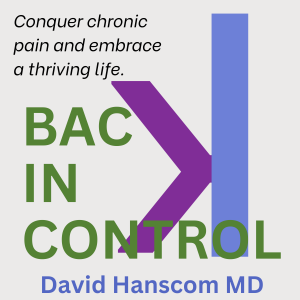
Back in Control with David Hanscom, MD
https://feeds.megaphone.fm/MBSLLC5019756315Episode List

Going from Wellness to Wonderful
In this episode, Dr. David Hanscom talks with internist Dr. Matt Lederman and Oriental Medicine and family practitioner Dr. Alona Pulde. They share their approach to healing that begins with understanding the physical and emotional context of the patient and helping them develop awareness about how this affects their health. Learning to deal with uncomfortable emotions and seeing how feelings are generated by needs is key. Their goal is to help patients learn to thrive – to experience joy and be happy. Alona Pulde, MD is a board-certified practitioner of Acupuncture and Oriental Medicine & Family Medicine Physician and Dr. Matthew Lederman is a board-certified Internal Medicine physician & CNVC Certified Trainer of Nonviolent Communication. After ten years of serving Whole Foods Market as corporate Vice Presidents, helping launch their national comprehensive medical & wellness centers, coaching and retreat programs, and integrated hospital and insurance networks, Dr. Pulde and Dr. Lederman moved on to co-found their new venture, WeHeal and their new book Wellness to Wonderful. For more information on Wellness to Wonderful, visit: www.weheal.health/wellness-to-wonderful Explore the WeHeal Platform at: www.weheal.health Learn more about your ad choices. Visit megaphone.fm/adchoices

A Cultural Code for Healing
In this episode, Dr. David Hanscom continues his discussino with psychological anthropologist and ethnomusicologist Dr. Tamara Turner. She explains the cultural context of the Algerian Diwan community’s approach to healing from pain and trauma through trance dancing. She found that one of the most important factors in making this an effective healing tool was the community’s belief that suffering is an accepted part of being human. The Diwan cultural code discourages talking much about suffering and feeling like a victim. Instead it emphasizes a focus on gratitude as well as a very strong sense of family and community. Trance dancing is a form of community support to help its members release the emotions tied to their suffering so they can heal. Dr. Tamara Turner is a psychological anthropologist and ethnomusicologist who has spent more than 15 years researching the role of music and dance in healing across cultures. Her award-winning research in North Africa focuses on Sufi music and dance rituals designed to deal with inter-generational trauma among Black communities who are descendants of slaves from the trans-Saharan slave trade. As both an academic, international speaker, and musician, she has published extensively across arts and health disciplines and has held research positions in the US, UK, and Europe. For more information, visit: https://kcl.academia.edu/TamaraTurner. Learn more about your ad choices. Visit megaphone.fm/adchoices

Dance of Healing
In this episode, Dr. David Hanscom talks with psychological anthropologist and ethnomusicologist Dr. Tamara Turner. She shares the origins of her award-winning research into the role of dance and healing in North African communities. Her initial focus was on a career in classical music. But she developed an interest in other types of music that eventually led her to study the music of West and North Africa. She discovered that in Morocco and Algeria, certain communities used music and trance dancing as a healing modality for pain and trauma. These healing rituals could last 8-9 hours. The movement of the dance would lead to an altered state and the level of trance ranged from light rapture all the way to complete dissociation. Dr. Tamara Turner is a psychological anthropologist and ethnomusicologist who has spent more than 15 years researching the role of music and dance in healing across cultures. Her award-winning research in North Africa focuses on Sufi music and dance rituals designed to deal with inter-generational trauma among Black communities who are descendants of slaves from the trans-Saharan slave trade. As both an academic, international speaker, and musician, she has published extensively across arts and health disciplines and has held research positions in the US, UK, and Europe. For more information, visit:https://kcl.academia.edu/TamaraTurner. Learn more about your ad choices. Visit megaphone.fm/adchoices

Discovering How Our Brains Process Chronic Pain
In this episode, Dr. David Hanscom talks with pain psychologist, neuroscientist and co-founder of Aivo Health, Melissa Farmer. Or eight years, she has worked with world-renowned neuroscientist Dr. Vania Apkarian on how our brains process chronic pain. She shares the important discoveries resulting from that work including how, over time, the brain shifts the processing from sensory centers to the older emotional learning areas. This is an adaptive strategy that the brain uses to free up threat processing resources. Thus, pain becomes an emotional memory hard wired into our neural circuits. The good news is that this is reversible using techniques we have control over. Melissa Farmer, PhD is one of about 5 people in the U.S. who is both a pain psychologist and neuroscientist. With 16 years of experience working with people who live with hard-to-treat chronic pain. Dr. Farmer was trained at one of the few multidisciplinary pain clinics in North America, at McGill University, where she treated patients with a combination of cognitive behavioral therapy, mindfulness-based stress reduction, and meditation techniques for pain relief. She worked alongside Dr. Apkarian for 8 years contributing to his groundbreaking findings. Dr. Apkarian is a world-renowned neuroscientist and the first scientist to discover that chronic pain is maintained by emotional brain circuits, not tissue damage. His research reveals how the brain contributes to chronic pain and his findings emphasize that emotional learning and memory underlie the long-term suffering of chronic pain. She left the academic research world to co-found Aivo Health together with Dr. Apkarian and a pain patient, driven by the mission to bring effective and compassionate pain care to people who need it. For more information, visit: https://www.aivohealth.com/. Learn more about your ad choices. Visit megaphone.fm/adchoices

The Healing Balance
In this episode, Dr. David Hanscom continues his discussion with internationally renowned Ayurvedic clinician, Zeeba Khan. She describes how doshas (mind body spirit compositions) can indicate the types of illnesses or disorders you might be susceptible to. She identifies the 3 doshas – Vata Dosha, Pitta Dosha and Kapha Dosha – and gives examples of what they might signify for health. The first step in working with a client is to diagnose their doshas. From there she will work to bring the most out of balance dosha into balance. To do this, she questions her clients about diet, sleep, stress, what brings them joy and how often they engage in those things. She also asks them why they want to get better. She has discovered there is always an element of forgiveness and compassion in the healing process. Zeeba is an internationally renowned Ayurvedic clinician, meditation teacher, energy healer and motivational speaker who uses holistic treatment to restore her patients’ mental, physical, emotional, and spiritual health and to prevent disease and disorders. In particular, she focuses on healing trauma, which often leads to anxiety, depression, feelings of loss, and low self-esteem. She has presented month-long workshops to corporate clients, including some well-known global leaders and has also led meditation and yoga workshops at schools internationally to incorporate wellness education into their curriculum. She is also a leading practitioner with Mindvalley’s Soulvana meditation app. In 2020, she was honored by an invitation to be part of a live interactive session hosted by His Holiness The Dalai Lama on the topic of integrated healthcare and compassion. For more information, visit: https://www.zeebahealing.com/. Learn more about your ad choices. Visit megaphone.fm/adchoices
You may also like


Get this podcast on your phone, Free


Create Your Podcast In Minutes
- Full-featured podcast site
- Unlimited storage and bandwidth
- Comprehensive podcast stats
- Distribute to Apple Podcasts, Spotify, and more
- Make money with your podcast