The RISE to Intimacy Podcast
https://rss.buzzsprout.com/2574043.rssEpisode List

Why Great Long-Term Relationships Still Struggle With Sex
You’re still in love with your partner and committed to a fulfilling life together, yet something feels off. The chemistry that once felt effortless now feels unpredictable or absent. You care deeply for each other, but you are completely out of sync sexually. If you’ve ever wondered why sex feels so hard when the rest of the relationship is fine, it isn’t necessarily a sign that you’re failing. It’s more likely a sign that stress, emotional disconnection, or old conditioning are quietly shaping your desire.When this tension lingers, sex starts to feel loaded. You might find yourself making excuses, feeling pressured, or waiting to want sex the way you used to. Attraction becomes something you analyze instead of something you feel, and you may begin to interpret a lack of desire as a personal rejection. Meanwhile, routines take over, the same old scripts repeat, and the emotional safety you need to feel open begins to erode.In this episode of The RISE to Intimacy Podcast, I reveal what is actually happening beneath the surface when desire becomes mismatched in long-term relationships. I explore how the mental load, trauma, and toxic cultural messaging impact your connection. You’ll learn the vital difference between spontaneous and responsive desire, why feeling "seen" is a prerequisite for arousal, and how you can begin rewriting your sexual script to find that spark again.1:33 – Why fluctuating desire is often a signal for conversation rather than a sign of failure4:27 – The hidden impact of stress, mental load, and survival mode on erotic energy5:58 – The difference between spontaneous desire and responsive desire, and why it matters7:55 – Emotional connection as a prerequisite for physical intimacy for many partners10:07 – Why asking “What does emotional connection mean to you?” changes everything12:21 – The powerful role of social, cultural, and religious conditioning in shaping desire15:42 – How shame around pleasure can quietly suppress sexual expression18:21 – Trauma’s influence on agency, boundaries, and sexual safety20:10 – Practical shifts that help couples reconnect without pressure or performanceMentioned In Why Great Long-Term Relationships Still Struggle With SexRise to IntimacyRise to Intimacy Free 30-Minute ConsultLeave a rating and review

How AI Is Quietly Rewiring the Modern Dating World
You want real connection in a world that feels increasingly artificial, but the modern dating scene often leaves you feeling exhausted and quietly discouraged. You long for something organic and meaningful, yet you’re navigating systems that reward speed and constant availability over depth. If you feel like retreating from the apps and the emotional whiplash, it is a sign that your nervous system is trying to adapt to an environment that was never designed for your emotional safety.When you are caught in this tension, attraction starts to feel confusing. You might find your chemistry going flat or feel overstimulated by options while staying undernourished by connection. Intimacy can start to feel like something you measure rather than something you experience.In this episode of The RISE to Intimacy Podcast, I explain why dating feels so different right now and how AI is quietly restructuring the way we experience attraction. I explore how these platforms are designed for engagement rather than bonding, and how a lack of relational education affects the way we approach each other. You can learn how to reclaim your agency, slow down, and build a foundation for dating that prioritizes authentic curiosity.2:26 – How algorithms are narrowing attraction in ways most people never consciously notice7:02 – How engagement metrics on dating apps are quietly training users 12:11 – How choice overload impacts satisfaction and why trust is now harder to build on the apps13:38 – The pros and cons of AI companions and how they’re designed to mirror emotional validation17:41 – What you can do as a single person in the AI-mediated space of online dating18:42 – Why the real fracture in modern dating is educational, not ideologicalMentioned In How AI Is Quietly Rewiring the Modern Dating World Rise to Intimacy Free 30-Minute ConsultLeave a rating and review

How Erectile Dysfunction Is a Nervous System Response
When my partner Dallas experienced erectile dysfunction in his mid-twenties, he felt broken. He believed something was fundamentally wrong with him, and struggling with anxiety and PTSD only added fuel to those feelings. Erectile dysfunction is often attributed to age, hormones, or attraction, but when it happens in your twenties, the confusion feels even sharper. The shame can spiral quickly when you love your partner but your body still goes into protection mode.In this episode of The RISE to Intimacy Podcast, Dallas joins me to talk about his journey. We discuss how silence and misunderstanding lead to conflict and why this is actually a nervous system response rather than a lack of attraction. We look at how performance pressure and hypervigilance keep the body stuck and why there is no "quick fix" for these complex patterns. Dallas shares how he used emotional regulation to stop being afraid and find his way back to pleasure.00:52 – Common myths about erectile dysfunction and what you should do before you see a sex therapist2:56 – What Dallas was thinking before sex even began and how one difficult experience can create an anxiety loop that feeds itself5:59 – Statistics that prove how common erectile dysfunction really is7:08 – The conflict that grew between Dallas and his ex-partner when he couldn’t talk about sex8:12 – Why performance pressure blocks pleasure at the nervous system level and the role of hypervigilance, dissociation, and emotional withdrawal10:36 – Why 12 weeks of therapy is rarely the full story and the importance of practicing regulation skills outside the therapy room14:19 – How waiting too long to seek help can harden resentment and how long you should wait to re-engage in sex conversation after regulation18:18 – What you can start doing if you’re experiencing erectile dysfunction21:20 – Dallas’ final words of wisdom and how he feels now after therapyMentioned In How Erectile Dysfunction Is a Nervous System ResponseRise to Intimacy Free 30-Minute ConsultLeave a rating and review

Why Unmet Attachment Needs Sabotage Your Sex Life
You love your partner, but you feel your body shut down the moment intimacy begins. Something inside you tightens even when you want to feel close. These moments don't mean you have a lack of love or desire. They are often signals from your attachment system. Your nervous system has built-in needs for safety, trust, and emotional closeness. When those needs aren't met, your brain can interpret your partner as a source of threat or pressure instead of a safe space.There is a learnable process for creating the emotional safety your nervous system needs to soften. You can understand why closeness feels risky and learn how to interrupt patterns before they spiral. Building responsiveness outside the bedroom creates the climate where sex becomes appealing again. It is about moving away from performance so intimacy can feel inviting instead of overwhelming.In this episode of The RISE to Intimacy Podcast, I talk about four reasons why unmet attachment needs quietly sabotage your sex life. I explore what is happening beneath the surface when desire drops or the pressure to perform rises. I also break down exactly what to do using the tools of regulation, clarity, repair, and emotional safety.2:19 – Why your nervous system can’t access arousal without safety and tips to get into a regulated space before initiating (or even talking about) sex5:30 – Subtle ways emotional unavailability erodes sexual desire over time and a 5-minute daily ritual to rebuild emotional responsiveness8:15 – How reassurance-seeking through sex can unintentionally create pressure and the reframing language that reveals the real need12:02 – Why avoiding conversations about sex often leads to mechanical or resentful intimacy13:27 – The link between early messaging about sex and avoidance as an adult and how to make space for honesty, clarity, and safer sexual explorationMentioned In Why Unmet Attachment Needs Sabotage Your Sex LifeRise to Intimacy Free 30-Minute ConsultLeave a rating and review
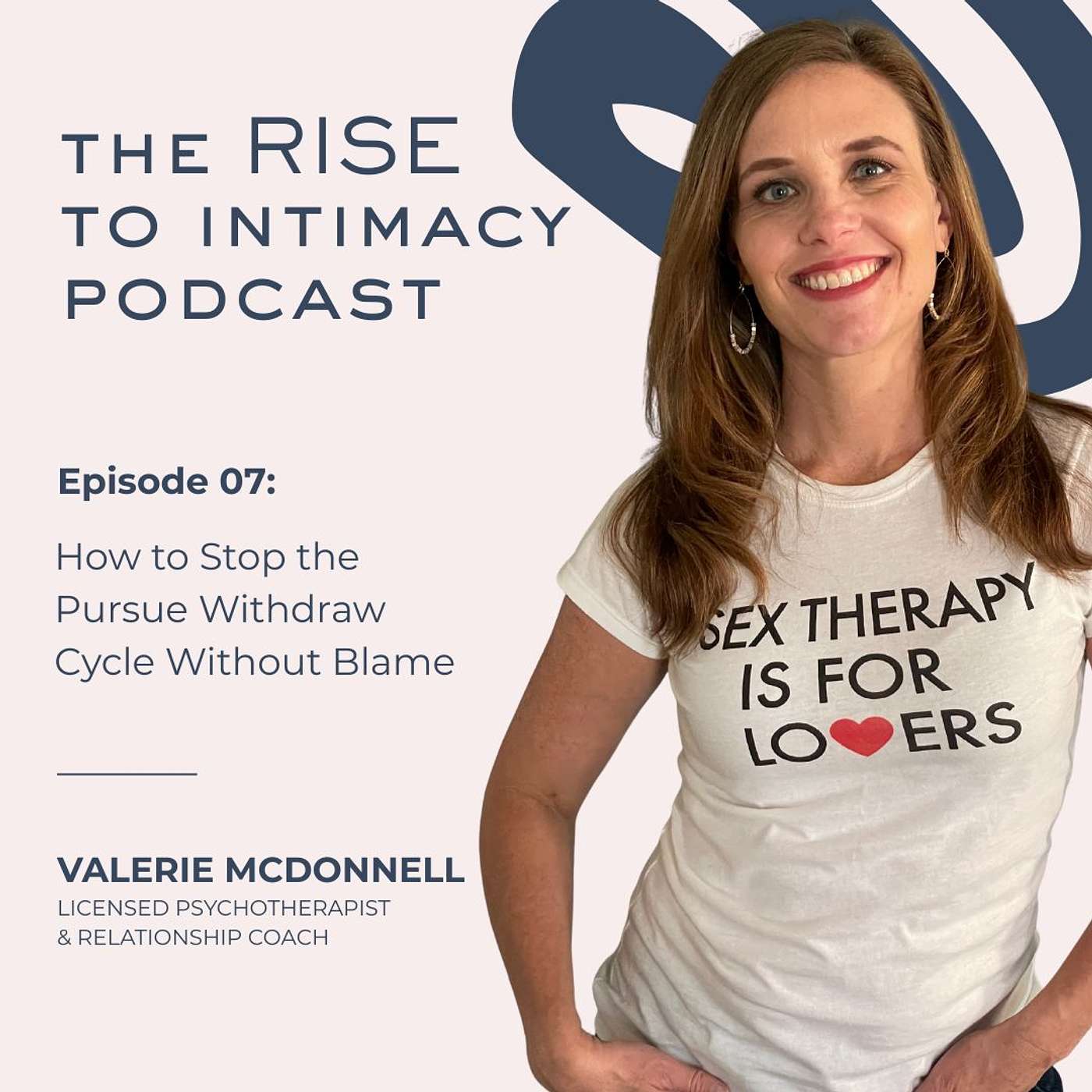
How to Stop the Pursue Withdraw Cycle Without Blame
One of you moves toward the relationship to close the gap. The other moves away to reduce overwhelm or conflict. This is the pursue-withdraw cycle, and it is one of the most common and painful patterns in any relationship. If you have ever felt like you are chasing connection while your partner shuts down, you are not alone. This cycle does not mean your relationship is broken. It means your nervous systems are trying to protect you in opposing ways.When you are stuck in this loop, intimacy starts to feel like a threat to your sense of self. The pursuer often wonders if they are too much or if they even matter. The person who withdraws often feels like they can never do anything right. To break this cycle, you have to look beneath the surface of the conflict and dive into the deeper, unspoken wounds. You have to learn how to regulate your body so you can move from being adversaries to being teammates.In this episode of The RISE to Intimacy Podcast, I walk through why you fall into this dynamic and what is happening in your body when it triggers. I share four powerful, trauma-informed strategies to help you break the cycle for good. We talk about how to name the pattern out loud, how to speak from your fears instead of your defenses, and how to create repair rituals that stick. You can learn how to find your way back to each other without losing yourselves.1:47 – How opposing protective strategies can create a loop that neither partner intends3:49 – What makes high-functioning, high-achieving couples especially vulnerable to this cycle4:52 – Ways to regulate before you withdraw from or pursue your partner6:49 – How naming the pattern out loud causes the cycle to lose its power7:47 – The subtle difference between fighting about logistics and revealing emotional truth10:04 – Repair rituals you can create to reconnect after a cycle occursMentioned In How to Stop the Pursue Withdraw Cycle Without BlameRise to Intimacy Free 30-Minute ConsultLeave a rating and review
Get this podcast on your phone, Free


Create Your Podcast In Minutes
- Full-featured podcast site
- Unlimited storage and bandwidth
- Comprehensive podcast stats
- Distribute to Apple Podcasts, Spotify, and more
- Make money with your podcast