
Episode List

Turning Students into Founders at Stanford Climate Ventures
Dave McColl is Executive Director of Stanford Climate Ventures (SCV), a program designed to help students build climate companies through rigorous go-to-market strategy and hands-on company building. SCV is a project-based course at Stanford University that has helped launch dozens of startups across energy, infrastructure, and industrial decarbonization. In this episode of Inevitable, Yin Lu, General Partner at MCJ, sits down with McColl to unpack the SCV playbook—from “earned secrets” to the importance of customer discovery. The conversation also features three founders who came out of the SCV ecosystem: Carla Pinzon, Founder of Expand Power, solid-state transformers for a more flexible grid Raj Tilwa, Founder of Focal, personalized heating systems for commercial spaces Nico Pinkowski, Founder of Nitricity, decentralized fertilizer with air, water, and renewable power Together, they share how SCV shaped their companies, from early pivots and customer insights to product-market fit, and what it takes to build sustainable businesses. Episode recorded on March 13, 2026 (Published on April 14, 2026). In this episode, we cover: (0:00) An overview of Stanford Climate Ventures (SCV) (5:12) The origin of SCV and its community-driven model (10:14) How SCV works: discovery, iteration, and “earned secrets” (16:25) The biggest founder mistake: ignoring the customer (18:56) What predicts success: discovery volume and team dynamics (25:51) Carla Pinzon (Expand Power): solid-state transformers for a modern grid (32:21) Finding product-market pull through customer discovery (35:56) Raj Tilwa (Focal): personalized heating vs heating entire spaces (44:21) 100+ interviews to find a real painkiller in hospitality (52:10) Nico Pinkowski (Nitricity): decentralized fertilizer production (58:31) How product-market fit can take years Enjoyed this episode? Please leave us a review! Share feedback or suggest future topics and guests at info@mcj.vc.Connect with MCJ:Cody Simms on LinkedInVisit mcj.vcSubscribe to the MCJ Newsletter*Editing and post-production work for this episode was provided by The Podcast Consultant

Improving Weather Forecasting with WindBorne
John Dean is Co-Founder and CEO of WindBorne, a company building next-generation weather balloons and an AI-powered forecasting layer to improve global weather prediction. WindBorne’s balloons can stay aloft for weeks — collecting critical atmospheric data across oceans and remote regions where traditional weather infrastructure doesn’t reach. In this episode of Inevitable, Dean explains why weather forecasting has remained largely unchanged for decades and why better data—not just better models—is the key to improving weather predictions. Our conversation explores how WindBorne’s balloon constellation captures atmospheric data at a global scale, how AI models like WeatherMesh translate that data into more accurate forecasts, and why extreme weather and infrastructure gaps are creating urgency for better systems. Dean also shares how the company makes money across data, forecasting, and insights—and his long-term vision of building “a planetary-scale nervous system.” Episode recorded on March 19, 2026 (Published on April 7, 2026) In this episode, we cover: (0:00) An overview of WindBorne (2:57) How weather forecasting actually works (4:36) Why traditional weather balloons haven’t changed in decades (12:50) What WindBorne is: long-duration balloons, global data collection and a weather intelligence platform (14:14) What makes WindBorne different: better sensors, batteries, and communications (17:35) Atlas: WindBorne’s global balloon constellation (18:17) How better weather data improves hurricane predictions (20:35) Airspace safety and the realities of flying balloons at scale (24:35) WindBorne’s business model: data, forecasts, and insights (29:30) Why weather data matters for energy markets and grid reliability (32:09) The long-term vision: Building a “planetary-scale nervous system” (35:41) Why AI + physical infrastructure is a “net good” for society Enjoyed this episode? Please leave us a review! Share feedback or suggest future topics and guests at info@mcj.vc.Connect with MCJ:Cody Simms on LinkedInVisit mcj.vcSubscribe to the MCJ Newsletter*Editing and post-production work for this episode was provided by The Podcast Consultant
Alex Blumberg on Turning Buildings into Grid Assets with DaisyChain Energy
Alex Blumberg is Co-founder and CEO of DaisyChain Energy, a company building a hardware-enabled software platform that turns commercial buildings into flexible grid assets. Best known as the founder of Gimlet Media and co-creator of Planet Money, Blumberg’s second venture focuses on solving one of the most overlooked problems in climate: the misaligned incentives inside buildings. In this episode, Blumberg explains why building decarbonization has stalled—not because of smart grid technology, but because of economics. The conversation explores how DaisyChain uses submetering and rate arbitrage to create immediate financial value for building owners, while unlocking the ability to deploy batteries, heat pumps, and other distributed energy resources over time. They also discuss their expansion into hospitals, where power quality issues create major operational risk, and how the same platform can solve both problems. At a system level, Blumberg outlines a future where aggregated building loads become flexible assets that help stabilize the energy grid and reduce peak demand. We’re proud to have invested in DaisyChain and support their journey towards the modernization of the grid. Episode recorded on March 12, 2026 (Published on April 1, 2026) In this episode, we cover: (0:00) An overview of DaisyChain Energy (2:06) Why Alex Blumberg started a climate company after Gimlet (6:17) Why buildings are a messy but critical climate problem (6:52) How DaisyChain works (10:08) The split incentive problem in multifamily buildings (13:53) Why decarbonization upgrades don’t pencil financially today (15:47) Submetering and turning buildings into mini-utilities (19:08) Using financial incentives—not climate—to win customers (22:53) Turning buildings into flexible energy grid assets (27:15) The power quality problem in hospitals (31:00) Increasing net operating income vs protecting revenue (34:55) The long-term vision: a flexible, distributed energy grid Enjoyed this episode? Please leave us a review! Share feedback or suggest future topics and guests at info@mcj.vc.Connect with MCJ:Cody Simms on LinkedInVisit mcj.vcSubscribe to the MCJ Newsletter*Editing and post-production work for this episode was provided by The Podcast Consultant
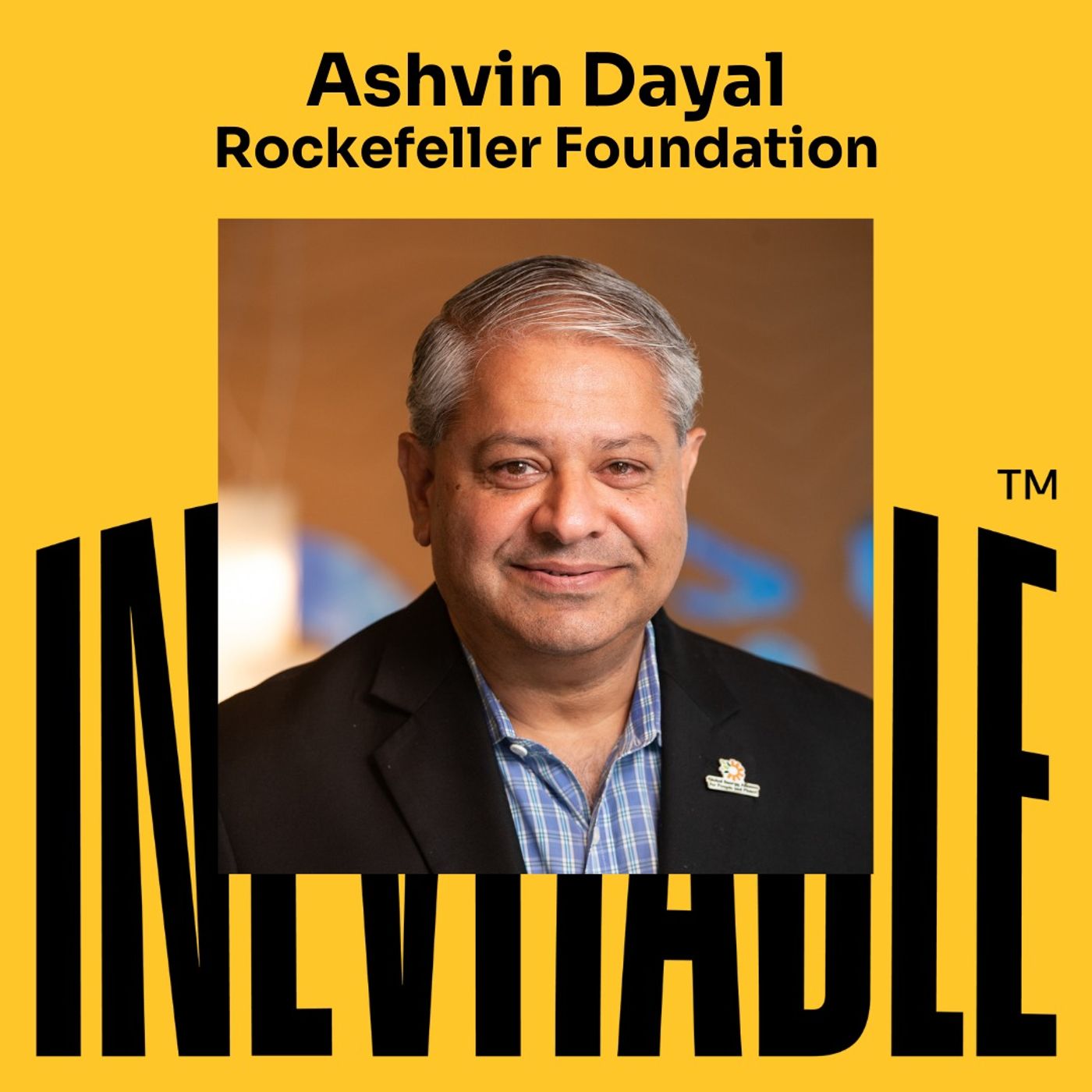
Inside Rockefeller's Big Bet: The Global Energy Alliance with Ashvin Dayal
Ashvin Dayal is Senior Vice President for Power and Climate at the Rockefeller Foundation, where he oversees the Global Energy Alliance (GEA), a multi-billion-dollar initiative backed by the Rockefeller Foundation, the IKEA Foundation, and the Bezos Earth Fund to expand access to clean, reliable electricity worldwide. In this episode of Inevitable, Dayal explains why energy access remains one of the defining development challenges of the century, with roughly three billion people still lacking enough electricity to meaningfully power economic activity. The conversation explores how philanthropic capital can unlock private investment in markets that commercial investors often avoid, the rise of distributed solar and mini-grids in places like India and across Africa, and how programs like Mission 300 aim to electrify hundreds of millions of people in the coming decade. Dayal also shares lessons from a decade of deploying distributed energy systems, the growing role of digital tools and AI in managing complex power systems, and why the Rockefeller Foundation is now exploring nuclear and small modular reactors as part of the future global energy mix. Episode recorded on March 4, 2026 (Published on March 17, 2026) In this episode, we cover: (0:00) An overview of the Rockefeller Foundation (2:31) Ashvin’s background in disaster response and climate resilience (8:16) What energy access really means for economic opportunity (10:15) The “modern energy minimum” and the 3 billion people below it (14:11) The Rockefeller Foundation and the creation of GEA (19:06) How philanthropic first-loss capital unlocks clean energy investment (24:19) Why distributed solar and mini-grids work for emerging markets (27:57) Lessons from Smart Power India and scaling rural electrification (36:39) Mission 300 and the effort to electrify Africa (42:05) Why Rockefeller is exploring nuclear and SMRs (47:09) Rockefeller’s legacy: from Standard Oil to global clean energy Enjoyed this episode? Please leave us a review! Share feedback or suggest future topics and guests at info@mcj.vc.Connect with MCJ:Cody Simms on LinkedInVisit mcj.vcSubscribe to the MCJ Newsletter*Editing and post-production work for this episode was provided by The Podcast Consultant

Turning Wasted Renewable Power into AI Compute with Rune
William Layden is Co-founder and CEO at Rune, a company building modular, behind-the-meter micro data centers that plug directly into solar and wind plants. These units operate on a fully electric, DC-to-DC architecture—bypassing the traditional grid and unlocking new economics for compute at renewable energy sites.In this episode of Inevitable, Layden explains how solar clipping and curtailment leave vast amounts of clean power stranded—and how Rune’s “RELIC” units turn that waste into usable compute. The conversation dives into DC architecture, Bitcoin as a beachhead market, and why traditional data centers are ill-suited to an era of distributed energy. Layden also unpacks why modular infrastructure may be the fastest path to deploying AI-scale compute at the edge of the energy transition.Episode recorded on Jan 27, 2026 (Published on Feb 17, 2026)In this episode we cover: (0:00) Intro(3:19) An overview of Rune(7:15) How energy flows and gets los in today’s power stack(10:50) Clipping: the hidden inefficiency in solar(14:17) Curtailment: why the grid rejects clean energy(20:47) Starting with Bitcoin before scaling to AI workloads(25:50) Which compute loads can run interruptibly(27:26) Rune’s business model and value to power producers(33:16) Where Rune operates and who’s backing it(36:10) Why modular, DC-native design matters for scaleLinks:William Layden on LinkedIn: https://www.linkedin.com/in/william-laydenRune: https://www.rune.energy/ Enjoyed this episode? Please leave us a review! Share feedback or suggest future topics and guests at info@mcj.vc.Connect with MCJ:Cody Simms on LinkedInVisit mcj.vcSubscribe to the MCJ Newsletter*Editing and post-production work for this episode was provided by The Podcast Consultant










Get this podcast on your phone, Free


Create Your Podcast In Minutes
- Full-featured podcast site
- Unlimited storage and bandwidth
- Comprehensive podcast stats
- Distribute to Apple Podcasts, Spotify, and more
- Make money with your podcast
