Episode List
Courage to Be Rubbish
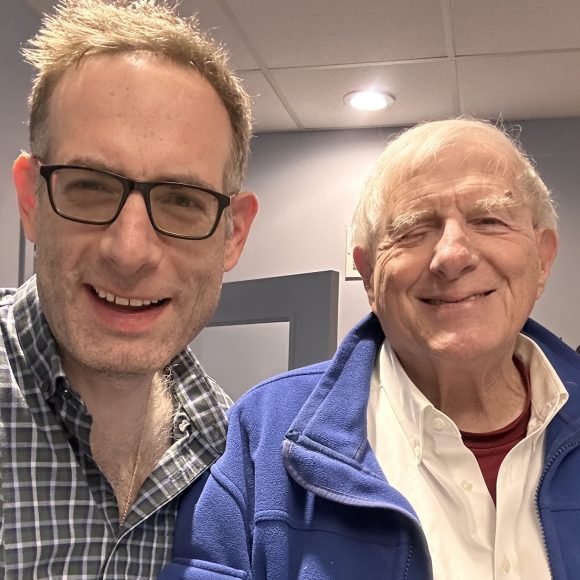
“God, I am so NOT relaxed right now. But I need to just embrace what I read recently — you need the courage to be rubbish. Just relax, stop worrying about everything being perfect, and do it.” I said that to my dad, Lloyd, as we sat down to record our podcast last week–which turned out to be the opposite of rubbish. We spoke our minds. What it means to live in the gain versus the gap, Lloyd’s honest relationship with pessimism and age, and why we both keep showing up to do this work. Oh, and our latest feelings about the Cubs. Listen on your favorite podcast app using pod.link. . View the podcast at the bottom of this post or on our YouTube Channel. Follow us on Social and never miss an update! Facebook: https://www.facebook.com/swarfcast Instagram: https://www.instagram.com/swarfcast/ LinkedIn: https://www.linkedin.com/company/todays-machining-world Twitter: https://twitter.com/tmwswarfblog ************* Link to Graff-Pinkert’s Acquisitions and Sales promotion! ************* Episode Transcript Noah: God, I am so NOT relaxed right now. But I need to just embrace what I read recently — you need the courage to be rubbish. Just relax, stop worrying about everything being perfect, and do it. So that’s what we’re going to do today. Lloyd: I will attempt not to be total rubbish. Just partial rubbish. Noah: You don’t want to try to be rubbish — you want to feel okay with being rubbish. Are you okay with being rubbish? Lloyd: It’s difficult to accept. What I really want to be able to say is: today has been a good day. I struggle with that sometimes. Noah: I’m glad to hear that, because you came in an hour ago kind of like me, unsettled. Do you feel grateful today? Lloyd: I do. I feel grateful for having this day. Noah: I just finished listening to this book about gratitude, 30 days, a different angle each day. The one I listened to this morning: be grateful for moments before they happen, not after. Thank the world for this unforeseen, magnificent thing that’s about to happen, even if it seems mundane. So today on my commute, I said: thank you for the magnificent thing that’s going to happen while I’m sending out quotes to customers. Lloyd: I’m grateful to be here with you, passing ideas back and forth, disagreeing, trying to come up with something provocative and useful. Noah: You wanted to talk about why you’re still in the machinery business at 81. Why are you? Lloyd: The question I ask myself every day is: why am I so damn obsessed about age? About being 81. How did I get to live to be 81, and am I still any good at what I’m pretending to do every day? Noah: That’s BS. You’re not pretending anything. Lloyd: There is an aspect of what I’m fighting against: my negativity and pessimism. A leader beset by negativity doesn’t do a good job. I fear my fear about how the business is going to do is self-defeating. Noah: What’s interesting is that business has been so rough for many months, and yet you keep getting right back up. Not complaining. Finding optimism in the next thing. To me, that makes you an amazing optimist. Lloyd: Depends on the day. Every day in business you get hit with problems, with disappointment in others, in yourself. The hard part, and it gets worse as you get older, is staying buoyant. Knowing the next day could be better. Noah: And that’s where the courage to be rubbish comes in. Just push through. Noah: I woke up this morning feeling kind of yucky too. A deal isn’t working, I’m questioning my purpose. But here’s what I do: every night before bed, I write down my wins for the day. 99% of the time, there’s something genuinely positive, a good call with a customer, time with family, learning something new. And every day I write down one serendipitous thing that happened. When you name it, things have more meaning. Lloyd: (on age 81) Some days I think: Lloyd, you’re so fortunate. This is 18 years of gravy after a heart attack, enjoy each day. And other days I think: 81, I’m almost out of days, and that’s depressing precisely because I’m enjoying each one. I don’t want to be out. Noah: That’s living in the gap versus the gain right there. Lloyd: Explain the “Gap in the Gain” concept. Noah: Great book. Highly recommend it. It’s by Dan Sullivan and Benjamin Hardy. The idea: high achievers set ideals, “I want to be rich, I want to be happy,” and they never feel like they’ve arrived because the ideal keeps moving. That’s living in the gap. But if you actually define what a win looks like and document when you win, you start living in the gain. It totally changes your mindset. It’s why it’s powerful to look back at the end of the day before you sleep, and Sullivan even suggests writing down a win for the next day before it’s happened. Lloyd: Write down what you’ve won when you haven’t experienced it yet? Noah: I know, mysterious. I almost never do it. But it ties back to being grateful in advance. I think it puts you in the right frame of mind. Lloyd: I don’t write it, but I imagine it. And giving thanks usually puts me in the right frame of mind to go to sleep. Lloyd: Let’s talk about why we do these podcasts. Why do I write the blog? Noah: The Graff-Pinkert Times, the granddaddy of Today’s Machining World. Was it ever really about business? Lloyd: Honestly? It was a showcase for my writing. Ego gratification, and to brand the company, give it an image of quality and originality. But the underlying reason was as a showcase for my creativity, using the machinery business as a vehicle. Noah: You have a master’s in journalism from Michigan. You wrote for the Michigan Daily. You did it partly because it’s fun. Lloyd: That’s right. And it still is fun. To create something original that nobody has ever done before, and see it published. It’s still a thrill. Noah: I feel like it fills a hole in me, a sense of purpose. I want it to leave its mark. You want something different: you want somebody to actually reach out and say it affected them. Lloyd: I want the dopamine. But I also believe the things I write have sufficient merit that people should read them and get value. The piece I wrote yesterday about my wife Risa’s headache coaching program, I spent a lot of time on it, felt good about it. Then I looked and there were no comments. Did anybody read this? Did anybody care? Noah: We really need to put likes back on the website. Lloyd: But I do believe that somebody in Arizona is going to read that, or tell someone in Boise about it, and they’re going to say: my mother desperately needs this. Noah: Let’s finish on a high note. We’re both very enthusiastic about the Cubs this year. Cade Horton, the phenom everyone was so high on, got hurt after one game and they announced Tommy John surgery, out for the season. The team had been four and six, tight, underperforming. And then the day they announce the surgery, everybody just comes out loose. They win nine to two, then six to two, sixteen hits in the first game. I believe that was serendipity, a jolt that made people play grateful, play loose. What do you think? Lloyd: Let me tell you my true honest belief about my beloved Chicago Cubs. Noah: Mm-hmm. Lloyd: I believe every day, they will lose. Noah: (laughing) Really. Lloyd: Therefore, every victory is a gift, a wonderful upset. Noah: I think when they win, everything’s right with the world. When they lose, eh, it’s just a game. I’m going to think about something else. I think you’re messing around here. Lloyd: I’m telling you the truth. Noah: I think this podcast itself was a little serendipitous. We always say we’re going to do more episodes together. We only end up doing one or two a year. Today I didn’t have anyone else to interview. And we both started out kind of eh, and I think we’re ready to go kick some butt. Lloyd: Let’s do it. Question: What’s your move when you wake up feeling rubbish?
Manufacturing Acquisitions with Purpose, with Mike Payne (Part 1)-EP 232 (Best of Swarfcast)
On today’s podcast, I’m talking with Mike Payne, owner of Hill Manufacturing and Fabrication in Broken Arrow, Oklahoma, to peek inside the mind of a prolific acquirer of manufacturing companies. Before purchasing Hill in 2018, Mike spent 20 years in M&A, orchestrating over 100 deals across nearly every industry. Since then, Mike has acquired four machine shops, and he’s constantly scouting for more opportunities to expand. What struck me about Mike isn’t just his deal-making successes – it’s his genuine passion for manufacturing. While some people get caught up in the game of acquisition deals, Mike seems to remain committed to his stated purpose, making quality parts and building lasting companies. *********** Listen on your favorite podcast app using pod.link. View the podcast at the bottom of this post or on our YouTube Channel Follow us on Social and never miss an update! Facebook: https://www.facebook.com/swarfcast Instagram: https://www.instagram.com/swarfcast/ LinkedIn: https://www.linkedin.com/company/todays-machining-world Twitter: https://twitter.com/tmwswarfblog ************* Link to Graff-Pinkert’s Acquisitions and Sales promotion! ************* Main Points Working in the M&A Industry Mike Payne’s career began in the mid-1990s when he graduated from the University of Tulsa with a computer science degree. He started a software company specializing in shop floor data collection, working with manufacturers during the era when Walmart was pushing barcode implementation. This early exposure to manufacturing sparked his interest in seeing how things were made, from tires to fishing reels. After successfully growing and selling his software company in 2003, Payne transitioned into private equity, where he spent 15 years buying companies across various industries. What set him apart in the M&A space was his approach: rather than just completing deals and moving on, he would typically take board positions or operational roles in the acquired companies to ensure their success. He completed over 100 deals during this period, attributing some of his success to being an outsider who asked “dumb questions” that often led to valuable insights. Purchasing Hill Manufacturing and Fabrication In 2018, Payne purchased Hill Manufacturing and Fabrication, a company he’d known for 30 years. The company, established in 1976, had become “tired” under an owner looking to sell, with minimal reinvestment in equipment and growth. Payne saw this as an opportunity to revitalize a solid business. Since his acquisition, the company has doubled in size through both organic growth and the acquisition of four additional shops. What distinguishes Payne’s approach to business is his complex motivation. While he openly acknowledges his desire to make money (“I’m a capitalist”), he emphasizes that his greater satisfaction comes from creating opportunities for others. At 51, he could coast or even retire, but he continues growing his business because he enjoys developing his team and seeing them succeed. He shares examples like watching a 27-year-old manager building his first home and starting a family. Payne also maintains strong relationships with the previous owners of companies he’s acquired. He shared a story about receiving a photo from a couple whose shop he bought in 2022. While he was at IMTS viewing the latest manufacturing technology, they sent him a picture from their retirement travels of an old lathe in an Arizona campground. This exemplified his goal of not just making profitable deals, but helping owners successfully transition into their next life phase. Philosophy of Business Growth The conversation also touched on the philosophy of business growth. While Payne acknowledges that maintaining a steady, non-growing business can be viable, he believes companies need to at least stay current with technology and market demands to avoid slow decline. He shared an example of a recent acquisition target that had gradually declined from $2 million to $1.2 million in annual revenue because they weren’t reinvesting or replacing lost customers. Throughout the interview, Payne’s enthusiasm for manufacturing shines through. He describes the satisfaction of seeing raw materials transformed into finished products and particularly enjoys giving shop tours to people unfamiliar with manufacturing, as their fascination helps him see the magic of manufacturing through fresh eyes. He compared this to hiking with his daughter, who helps him notice beautiful details he might otherwise miss in his rush to reach the destination. The discussion reveals Payne as someone who has successfully merged the analytical skills of a private equity investor with a genuine passion for manufacturing and people development, creating a business approach that values both profitability and purpose. Questions: If you were to acquire a manufacturing company, what would you be looking for? What would it take for you to sell your manufacturing company? Check out Mike Payne’s podcast, Buy the Numbers. The blog was assisted by Claud.ai
Why Some People Build Companies and Others Don’t, with Mike Payne (Part 2) – EP 233 (Best of Swarfcast)
I often ponder—why do some people own and build companies, while most people are destined to spend their careers as employees. In Part II of my interview with Mike Payne, owner of Hill Manufacturing & Fabrication, we explore this question. Mike comes from a family of six generations of teachers, not business managers or entrepreneurs, and he says he was a “mess” in high school without direction. There’s no question that he’s smart and ambitious, but there are lots of people out there with those qualities, and only a small handful of them acquire and grow manufacturing companies. I enjoyed pushing Mike to analyze how and why he does what he does, and I think he enjoyed being pushed. Spoiler alert, it goes a lot deeper than just making a bunch of money and being your own boss. *********** Listen on your favorite podcast app using pod.link. View the podcast at the bottom of this post or on our YouTube Channel Follow us on Social and never miss an update! Facebook: https://www.facebook.com/swarfcast Instagram: https://www.instagram.com/swarfcast/ LinkedIn: https://www.linkedin.com/company/todays-machining-world Twitter: https://twitter.com/tmwswarfblog ************* Link to Graff-Pinkert’s Acquisitions and Sales promotion! ************* Interview Highlights Do the Richest People Work Less? Noah Graff: Many people in the world work incredibly hard, but the richest people aren’t necessarily the ones working the hardest. What is it about entrepreneurs and successful company owners who can replace themselves that makes them different? Mike Payne: I’ll start with a slight disagreement. You said the richest people don’t work the hardest. I don’t totally disagree, but let me use one example that challenges that—Elon Musk. He’s the richest person in the world, and I’d venture to say he works harder than anybody. Noah: A lot of the richest people don’t work as hard as somebody in India digging a ditch, or somebody working three jobs. It depends what you mean by work. Mike: As a society, we think this way. My own team sees me drive a nice truck and go on trips, and they think, “I’m working harder than he is.” In many ways, they are—physically for sure. This is true of most successful people. And I want to distinguish between business owners and successful business owners, because there are many business owners in the world. If I put myself in the category of someone who works hard and is “successful,” I still get up and go to work every day. But my favorite line, which I read a couple years ago, is perfect here: “The best thing about owning your own company is you get to choose which 80 hours a week you work.” I’m not stuck on someone else’s schedule. I get to do it whenever I want, but I have to do it. Why Mike is a Company Owner Noah: Let’s go back to the hardest question—why are there certain people like you who just naturally take charge? Mike: I have a sense of purpose that’s bigger than me. When we talked about creating opportunities for my people, that’s my purpose. Yes, I want to buy companies, make money, do good deals, but a lot of that purpose is to create opportunities for other people. Your purpose could be a lot of things, but with a purpose, you automatically do more. You’ve got to care about something. I can see it with everybody we hire in the shop. If they have a purpose in their life, they’re a better employee than the ones who see it just as a means to get a paycheck on Friday. Noah: Do you think your parents did something to make you have this mentality? Mike: No, I can’t point to that. My dad’s side of the family is six generations of educators. Mom’s side was farmers, blue-collar labor workers. I didn’t have that “I’m gonna follow in the footsteps” thing at all. But in all honesty, I don’t know that I can even really take credit for it. All I ever did was just work. I work hard. I’m not the smartest person in the world, I’m definitely not the best looking, but I do work hard and I always worked hard. When I got myself in binds, financially or otherwise, the only thing I ever knew to do was work harder. How his Wife Changed Mike’s Life Noah: Can you recall a big serendipitous moment in your life? Mike: My wife and I went to the same high school. I was two years older. We both went to the University of Tulsa. We knew each other, had mutual friend circles, but weren’t close. I was a mess in high school. I didn’t have a lot of direction in life. When I think about me then versus me now, I’m like, how does that journey even add up? How does that guy become this guy? I was finishing my sophomore year of college, she’s coming in as a freshman. I see her at the bar and say, “Hey, I know you, we went to high school together.” It takes me like two months to convince her to go on a date with me because she’s so well-grounded that all she knew was the me from high school. She’s like, “I’m not dating that guy. He’s a mess.” From that point forward, I had to prove myself. I had to convince this woman that I had changed and that I had purpose in life. Quite honestly, I would still tell you today that I out-kicked my coverage. Question: Why do you own your company, or why would you want to own a company?

Your AI Life Coach Is Lying to You, with Brooks Canavesi–EP 262
Today’s AI conversation is about vulnerability—not automation, efficiency, and replacing jobs. Brooks Canavesi, co-founder of Baryons, is taking AI somewhere different. He’s not trying to replace the human. He’s trying to make the human better. I’ve actually been using ChatGPT to supplement my own life coach for a while now, so when I learned what Baryons is building, I had to find out more. The company calls it a Flourishing Partner. It’s an AI platform that checks in with you on your phone, holds you accountable, and actually pushes back when you need it. The goal? Help people flourish. Listen on your favorite podcast app using pod.link. . View the podcast at the bottom of this post or on our YouTube Channel. Follow us on Social and never miss an update! Facebook: https://www.facebook.com/swarfcast Instagram: https://www.instagram.com/swarfcast/ LinkedIn: https://www.linkedin.com/company/todays-machining-world Twitter: https://twitter.com/tmwswarfblog ************* Link to Graff-Pinkert’s Acquisitions and Sales promotion! Brooks has been in technology for a long time. His team built systems for DARPA, the Department of Defense, Mary Kay Cosmetics, and AccuWeather before landing in the AI space. They were working in machine learning before most people knew what it was. But Brooks is honest about the fact that ChatGPT was a reset for everyone, including them. What he and his team decided to do with that moment is what makes this conversation interesting. While the big frontier labs like OpenAI, Google, and Anthropic raced toward general intelligence, Brooks wanted to build something more specific. Something more human-focused. “We wanted to focus on increasing human agency. Not taking jobs away, but working with humans to improve their overall abilities.” Baryons’ product is voice-based. You call in, talk to your AI Mentor for a few minutes, set your intention for the day, and check back in at the end of your shift. It listens. It remembers. And unlike most AI tools, it’s designed to challenge you, not just tell you what you want to hear. That last part matters more than it sounds. Brooks explained that a lot of therapists are seeing clients come in with damage done by AI tools in between sessions. LLMs such as ChatGPT, Claude, and Gemini can be sycophantic. They agree too easily. They reinforce patterns instead of breaking them. Baryons is built to interrupt that. For businesses, the product goes even deeper. When you have a whole team using it, Baryons anonymizes the signals and surfaces patterns for leadership. If eight out of ten people on the manufacturing floor are mentioning the same supply chain problem, management hears about it without anyone being called out. It’s a way to give employees a voice and give leadership information they’d never otherwise get, especially in a remote or distributed workforce. Brooks told me that people who use Baryons regularly start to change in ways others can notice, including him. “I hear from people I haven’t seen in six months. They say ‘something’s different about you. And it’s a good thing.’” I pushed Brooks to explain what separates Baryons from how I’m using ChatGPT Plus, which has persistent memory built in and could read my voice inflection (though I haven’t used that setting yet). He said there are overlaps, but it’s different when you call Baryons on the phone to check in because the exchange feels even more like talking to a person. The sycophancy is also a huge difference. I asked him to explain why Baryons is different. He said it comes down to what they call the Understanding Engine. It’s a patented technology that analyzes how you speak, the words you use, your tone, and up to 26 dimensions of how you think. It’s designed to build a picture of you the way a person would, organically through conversation, and use that to respond in the way that actually serves you. It doesn’t just reply in a way that feels good in the moment. I like to think I want to be challenged, but I confess that when ChatGPT asks me sensitive questions like a mentor might, sometimes it can really cut. I’ve lashed out at it, saying “you don’t understand me!” I’ll type swear words at it. Sometimes it really doesn’t get me. But unfortunately it’s also right sometimes about things I don’t want to hear (in my case, read on a screen). I am slightly nervous about how it will feel. But I’m going to try Baryons. The image of myself interacting in an oral conversation with an AI agent on my phone makes me uncomfortable. I think before long it’s going to sort of feel like I’m talking to a real person. Thinking about this makes me feel ummmm…what’s another word for uncomfortable. I guess I’ll ask Claude for a suggestion. From Claude: For that last word — you’re describing the feeling of unexpected intimacy with a machine. A few options: Vulnerable — probably the most honest and resonant Exposed — similar but slightly more raw Uneasy — softer, more ambiguous Strange — simple, unpretentious, very you I’d go with vulnerable. It’s honest, it fits the personal development theme of the whole piece, and it’ll resonate with readers who feel the same way about the idea. Question: Could you ever see yourself working with an AI Mentor?
Robots that Know Where to Go, With George Konidaris (Best Of)
Seems like right now every podcast is doing an interview centered around artificial intelligence. But I waited until I found the right story, one that was truly relevant to our audience in the machining world. Today’s guest on the podcast, George Konidaris, is the cofounder of the startup, Realtime Robotics. He is also a professor of Computer Science and the director of the Intelligent Robot Lab at Brown University. Right now, programming a robot arm to perform a repetitive task typically requires a robot integrator to program where every joint of a robot should go. It’s a ridiculous and tedious process. But with Realtime Robotics’ AI technology, you can instruct a robot to do a task and you don’t have to tell it a zillion steps explaining HOW to do the task. Listen on your favorite podcast app using pod.link. . View the podcast at the bottom of this post or on our YouTube Channel. Follow us on Social and never miss an update! Facebook: https://www.facebook.com/swarfcast Instagram: https://www.instagram.com/swarfcast/ LinkedIn: https://www.linkedin.com/company/todays-machining-world Twitter: https://twitter.com/tmwswarfblog ************* Link to Graff-Pinkert’s Acquisitions and Sales promotion! Interview Highlights Noah Graff: Explain your company, Realtime Robotics. George Konidaris: Realtime Robotics is a company that does real-time robot motion planning. We focus on how a robot can automatically generate its own motion. Typically a robot integrator programs every aspect of a robot’s motion in order to accomplish a repetitive task. This means deciding where every joint of a robot arm should go. With our system, you can tell the robot where it needs to put its business end. This is where I would like you to weld, or I would like you to pick up the object over there. We compute the rest of the motion for you. Graff: How do you control the robots? Konidaris: The majority of our installations are programmed using a PLC. It used to be that you would have to set every joint on the robot to a specific value. Now instead, you can send much higher level commands to the PLC. Graff: So it takes less training than using a typical robot controller? It takes less training and less effort. We can reduce PLC programs that are often hundreds of statements long to single digit statements in many cases. You get out better efficiency, and we make sure there are no collisions. You don’t have to run what you’ve programmed and eyeball it to make sure it doesn’t collide. Graff: This can integrate with all different brands? Konidaris: Yes, we think of robot arms the way most people think of printers, which is that they’re all peripherals. Our job is to provide drivers for those peripherals. To you, they should look just the same because they have similar functionality. You don’t have to go learn the programming language associated with one robot brand. You just plug it in. Graff: It sounds a little like ChatGPT in that it does a lot of the tedious work for you. Konidaris: I think the analogy is very apt. One way that I would think about the difference though is that ChatGPT is a top down of intelligence to start with language, which is very high level, and symbolic and abstract. But what’s interesting about robots and what’s interesting specifically about robots and AI is that is not yet where the challenges are. The challenges are much lower level. Just moving through space, just doing perception, just generating motion. We’ve automated so much stuff because we’ve had to deal with the fact that robots are so physically stupid. Graff: It seems like this technology might take away value from cobots a little bit. Konidaris: One way to think about cobots is they have two distinguishing features. One is that they’re very easy for a person to program by manipulating the robot. The other one is that cobots are safe to have around people. One way to think about how that’s been done is they’re light and weak and compliant. By “weak” I mean it’s not going to knock your head off if it hits you. (Cobots) are not as fast, they’re not as precise. In many industries where you really need throughput, you can’t apply a cobot because it just doesn’t have the performance that you need. What we’re hoping to do is to substitute a different technical solution. The robot is not going to hit stuff because it knows how to not hit stuff. Graff: These robots, even with their intelligence, still require a professional integrator? Konidaris: (Yes), the integrator is doing a couple things. They’re designing your work cell for a performance characteristic or a meter specification. That’s a mechanical engineering skill that requires a professional. Also, they’re choosing components like the end of arm toolkit, the particular conveyor belt, and the PLC. They are integrating those into the work cell and writing the logic that controls them. But then the third thing that (integrators) often have to do is spend a lot of time hand designing the robot motion. In particular, if there are multiple robots in the work cell, they need to try and coordinate the multi-robot motion ahead of time so that nothing ever collides. And that’s where the real talent comes. We’ve looked at use cases where it takes 13 weeks of engineering just to get the multi-robot coordination right. We can drop it to one (week) because in our case, that last part, you just plug the robots into the same box and they never hit each other. Graff: Mostly your product is used in automotive plants? Konidaris: Yes, that’s right. They have severe throughput constraints. In many cases, the cost of a single robot isn’t anywhere near the cost of extra cycle time, so they’re happy to pay to add extra robots. I think a typical statistic we saw is adding a single robot only gets you an extra 25% of throughput speed up—as opposed to the 100% theoretical, which no one ever gets. But with our system you can see more like 75%. So you can get much more of the win using the extra robot because they can pass pretty close to each other and they’re mutually cognizant of that. Question: How have you used robots in your machine shop? Or, how would you like to use them?





Get this podcast on your phone, Free


Create Your Podcast In Minutes
- Full-featured podcast site
- Unlimited storage and bandwidth
- Comprehensive podcast stats
- Distribute to Apple Podcasts, Spotify, and more
- Make money with your podcast