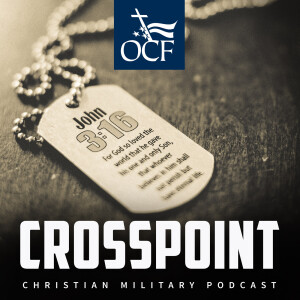
OCF Crosspoint Podcast
https://ocfcrosspoint.libsyn.com/rssEpisode List
Making Christian decisions in the gray areas of military life
Matters of conscience, Part 1: In part one of this two-part series on matters of conscience, Josh Jackson talks with CH(CPT) Chris Erickson, USA, an active-duty Army chaplain serving with 1-41 Infantry Battalion at Fort Carson, Colo., and LTC Lee Robinson, USA, an Army aviator and West Point professor who directs the American Politics Program. Together, they examine how Christian military leaders can think through gray areas of faith and profession when the Bible does not seem to give a simple, direct answer. Rather than focusing only on what is legal, the conversation explores how leaders can ask what they should do in a given moment. This episode is worth hearing if you are trying to navigate the space between religious liberty, leadership responsibility, and wise judgment in uniform. This is Lee's third time as a guest on OCF Crosspoint. While it isn't necessary to listen to his previous interviews, consider listening to both episodes since Chris and Lee will reference them at a few points. Listen here: Navigating the wall of separation between church and state Faithful Leadership: You won't get this perfect—and that's OK Questions answered and themes covered in this interview include: How should a Christian military officer discern whether something is a matter of conscience? A matter of conscience is defined less by the specific decision and more by the process used to reach it. Lee explains it as an area where civil authority does not dictate the outcome—something shaped by personal conviction, informed by reason, study, and Scripture. Chris adds that leaders must go beyond asking "what is legal?" and instead wrestle with "what should be done?" These situations often arise in gray areas where Scripture does not give explicit direction, requiring leaders to arrive at a decision they can be "fully convinced" of in their own mind (Romans 14:5, ESV). Can a Christian military officer share their faith when asked about their leadership philosophy? Yes, with important nuance. When a soldier asks about a leader's philosophy, that question opens a door the leader didn't force open. Chris argues that a soldier-initiated question is meaningfully different from a leader promoting religion unprompted. Lee's experience illustrates the tension: he shared Scripture-rooted principles without explicitly connecting them to his Christian faith, largely because other soldiers were present. Chris challenged that, arguing honest answers—including the faith source—aren't coercion. Both agree the key questions are: Who started the conversation? Is this a public or private exchange? Could sharing be perceived as using rank to promote belief? How should a Christian officer respect religious differences while staying true to his faith in a diverse unit? Chris argues that a leader needs a settled "theology of approach" before they are ever in the moment, working out in advance what he or she believes about expressing and sharing faith, and about respecting others' spiritual accountability. Romans 14:12 (ESV) anchors this: "Each of us will give an account of himself to God." Every soldier is individually accountable to God, not through their commander. Lee adds that religious pluralism is "our greatest moral argument to the world," and leaders who model genuine respect for diverse convictions honor that. The practical test: Am I seeking to provide comfort and care, or to promote my faith? How should Christian officers balance faith expression with leadership responsibility and authority? A key theme is the distinction between expressing faith and promoting it through authority. Chris stresses that using one's position to promote religion undermines true religious freedom, while sharing personal beliefs appropriately can be part of authentic leadership. He encourages leaders to examine their "why", whether they are seeking to influence belief or simply being transparent about what shapes them. Lee adds that leaders must consider how their actions affect unit cohesion and perception, especially in public or group settings, requiring leaders to think through factors like environment, audience, and intent rather than relying on rigid rules. Is it appropriate for a Christian commander to pray with troops after a tragedy? Lee shares a vivid example from combat after two soldiers in his company were killed by enemy fire. Standing before the formation, he had not planned to pray, but seeing their faces, he believed they needed more than facts. Before praying, he told them that if they were not praying people, he respected that and they did not have to participate. He then offered a non-denominational prayer for the families, for one another, and for the actions ahead. Lee says he would make the same decision again—though he never prayed once as a battalion commander, relying on Chris for that function. Chris frames the moment plainly: "You were not seeking to promote your faith. You were seeking to promote comfort." In his view, stepping in to provide comfort through personal belief is "good leadership"—not an attempt to advance religion. What is the difference between expressing Christian faith in uniform and using military authority to promote religion? Chris argues that Christian leaders do not need to eliminate religion from their lives or silence themselves, but they do need to examine why they are doing what they are doing. The problem is not faith itself but using authority to promote faith. That distinction matters for commanders and chaplains alike. Chris pushes back on the idea that chaplains automatically have broader permission simply because of their role. The goal should not be to pressure others into belief, but to offer comfort, care, counsel, wisdom, and support. A leader may share from personal belief but must not use official position to advance religion as such.
What's happening in ROTC that most OCF members don't see
Guest Spotlight: Approximately 60% of active-duty officers commission through ROTC programs at more than 1,500 colleges and universities—making campus ministry to cadets and midshipmen a strategic mission field. In this episode of the OCF Crosspoint podcast, we hear from John Hoyman, OCF's Director of ROTC Ministry and a 30-year Army veteran (Active Duty, National Guard, and Army Reserve), about the renewed vision and momentum in ROTC outreach. John shares his personal connection to OCF, why evangelism and discipleship are central to his vision, what he is witnessing spiritually among cadets and midshipmen, and how OCF members can tangibly invest in the next generation of Christ-following officers. If you are an active duty, Guard, Reserve officer, retiree, or ROTC cadet wondering how faith intersects with military leadership, this conversation offers both encouragement and clear next steps. Learn more: https://www.ocfusa.org/rotc Contact: rotc@ocfusa.org Questions answered and themes covered in this interview include: 1. Why is Christian evangelism and discipleship in ROTC programs essential for future military officers? John explains that his vision for ROTC Ministry begins with "evangelism and discipleship." His first priority is "how do we bring cadets and midshipmen to Christ and then build that relationship and help them become more Christ-like." Because these students are preparing to lead in the military, their faith decisions now will shape their entire careers. While he affirms the value of campus ministries such as Cru, Navigators, and Baptist Student Union, he emphasizes that OCF uniquely helps cadets think about "how to apply their coming profession in their spiritual life." ROTC ministry allows them to ask, "How do they become an officer that represents Christ?" It also connects them to a lifelong fellowship that continues beyond graduation and throughout a military career. 2. What is God doing spiritually among ROTC cadets and midshipmen right now? John describes the current season as "total excitement." He points to the Eastern ROTC Retreat, which has exceeded previous attendance—filling both the Heritage House and the Harrison House with a waitlist still growing weeks before the event. He sees "an outpouring of people that want to grow in their faith… find out who Jesus Christ is… connect with other believers." Beyond numbers, he highlights student initiative. Cadets are stepping into leadership, asking how to start fellowships, and seeking to serve younger students. He also observes "a renewed interest in spiritual things," with young people asking deeper questions—not just about occupation, but about purpose and truth. John calls it "an exciting time to be in this ministry." 3. How can a Christian military officer disciple and mentor ROTC cadets in a practical way? John shares a simple framework from former ROTC Director Tom Hemingway: "Find a cadet, pray daily, communicate weekly, and meet monthly." He encourages active-duty officers, retirees, and even those in graduate school near campuses to invest in one-on-one mentoring and discipleship relationships. He describes what he calls the "OCF diaspora"—officers who retire or relocate and may unknowingly live near a university with an ROTC program. Even visiting a campus Bible study once a month can be impactful. John notes that his own monthly investment at Penn State has been spiritually refreshing, saying it was "really refreshing to see these young people seeking Christ." Those interested can email John (rotc@ocfusa.org) to explore involvement. 4. Why does OCF provide unique Christian fellowship continuity for officers throughout their military careers? John explains that while cadets should find a local church during school and after commissioning, military life often involves frequent moves and limited continuity. OCF offers a network that "carries with you past your undergraduate years into a vital relationship with other believers throughout your career." Unlike most campus ministries that naturally conclude after graduation, OCF fellowship continues into active duty and even retirement. John highlights how retired officers can later reinvest in ROTC ministry, creating a generational cycle of mentorship. This continuity helps officers integrate faith with profession over the long term, rather than compartmentalizing their spiritual lives from their leadership responsibilities. 5. How are Christian military ministries collaborating to serve ROTC cadets more effectively? John emphasizes a spirit of cooperation rather than competition among ministries serving ROTC students. He references collaboration with Valor (Cru's ministry to ROTC students) and leaders such as David Preston and CH(MAJ) Jeff Struecker, USA (Ret.), including work on a film series addressing the moral ramifications of killing from a Christian perspective. He describes "a cool synergy" between young cadets eager to grow in Christ and seasoned officers who have sought to honor Christ in their careers. From retreats to weekly calls to shared leadership at programs like Rocky Mountain High, John says there is consistent partnership happening behind the scenes. He expresses gratitude for standing "on the shoulders of giants" who have built strong inter-ministry relationships. Key Takeaway: John hopes listeners remember that "God is doing a work among college students right now." There is a present opportunity for investing in the spiritual lives of future military leaders. Whether through prayer, mentoring, or partnership, OCF members are invited to join that work while the door is open. OCF Ministry News: Enjoy an impactful Conference Center visit: If you're looking for an opportunity to hit the pause button and reconnect with loved ones, consider a summer program at White Sulphur Springs (Manns Choice, Pa.) or Spring Canyon (Buena Vista, Colo.). Support OCF during your visits to the grocery store: Find out if a store near you is eligible, enroll using OCF's organization number, then shop as normal to contribute effortlessly to OCF's mission and vision at no added cost to you. Share your life updates: Visit ocfusa.org/deployment to let us know about an ongoing or upcoming deployment. Visit ocfusa.org/update to let us know of a change in rank, duty status, contact information, or something else.
Accelerate change or lose: A futurist's guide to Biblical leadership
Guest Spotlight Today's episode features more of the conversation between Crosspoint host Josh Jackson and Lt Gen Clint Hinote, USAF (Ret.). Within his 35-year career as a fighter pilot, military strategist, and senior leader, Clint also served as a futurist for the Air Force prior to retiring in 2023. He is now a professor of policy analysis at the RAND School of Public Policy. Clint breaks down how to think strategically about the future without getting paralyzed by uncertainty, how to read the signals of change, and how to communicate vision. Whether you're leading in military, ministry, or marketplace settings, this conversation offers actionable wisdom for navigating uncertainty and leading with conviction. Mentioned in this episode: White Sulphur Springs' Summer R&R #2, during which Clint will serve as the guest speaker "Good leadership lifts others": Practical truths for Biblical leadership, Part 1 / October 2025 "No perfect leaders, no perfect lives": Five common qualities of Biblical leaders / November 2025 Clint's Nehemiah Bible study, developed during a prior deployment and used at WSS If you would like to share your own story, complete the form on OCF's "Be a Guest" webpage. Alternatively, if you have an idea for a guest or topic we should consider for a future episode of the show, send an email to podcast@ocfusa.org. Points to Ponder As you listen to this conversation with Clint, here are a few questions to ponder in your personal time, with a small group, or with a mentor: Having heard Clint's explanation of a futurist, how would you define the term? How do you handle change when it comes? Why might you embrace or avoid it, as the case may be? Why is the "why" of making changes in an organization so vital? What can you learn from Biblical examples of future-oriented leaders? Ministry News Enjoy an impactful Conference Center visit: If you're looking for an opportunity to hit the pause button and reconnect with loved ones, consider a summer program at White Sulphur Springs (Manns Choice, Pa.) or Spring Canyon (Buena Vista, Colo.). Check out the OCF Sisterhood: Visit our newest webpage to stay in the know, join the conversation, or help shape women's ministry efforts. Meet the Council Class of 2029: Learn more about and pray for our newly elected Council members.
A new take on the "armor of God": The power of fighting as a unit
Guest Spotlight Today's episode features a conversation between Crosspoint host Josh Jackson and LTC Brittany Simmons, USA (Ret.). Brittany served 20 years in the Army Military Police Corps, including deployment to Iraq as a platoon leader from 2004-2005. In this episode, Brittany challenges the common individualistic reading of the Armor of God passage in Ephesians 6. Drawing from her combat experience and understanding of Roman military formations, she explains why Paul's analogy was always meant to be understood not only individually, but also collectively—as a unit linking shields together, not isolated soldiers fighting alone. She discusses finding battle buddies, the danger of spiritual isolation, and practical ways to intentionally build Christian community whether you're actively serving, recently relocated, or settled in one place. Brittany also mentions two upcoming events, which women can attend for Biblical teaching, fellowship, and more: OCF Leading Women: 20-22 March at White Sulphur Springs in Manns Choice, Pa. Summer Celebration #4B (Women's Track): 28 June-3 July at Spring Canyon in Buena Vista, Colo. If you would like to share your own story, complete the form on OCF's "Be a Guest" webpage. Alternatively, if you have an idea for a guest or topic we should consider for a future episode of the show, send an email to podcast@ocfusa.org. Points to ponder As you listen to this conversation with Brittany, here are a few questions to ponder in your personal time, with a small group, or with a mentor: When you read Ephesians 6:10-18, do you naturally think of individual armor or collective defense? Why? Who are the "battle buddies" in your spiritual life right now—people you're intentionally linking shields with? Brittany mentions that in combat, soldiers who go off alone become the most vulnerable. Where in your spiritual life might you be trying to fight alone? How does understanding prayer as "communication with the Commander" change the way you approach it—both individually and collectively? What's one practical step you could take this week to find or deepen community with other believers? How might your military experience give you unique insight to share with civilian Christians about the power of working together? Ministry News Read others' stories about impactful Conference Center visits: If you're considering a family retreat, ministry gathering, or just need to step away and breathe, check out stories from those who have enjoyed the same at OCF's Conference Centers. Listen to OCF's newest podcast: Anchored & Armed, hosted by Mackenzie and Naomi, will feature authentic, relatable conversations about military life for women in uniform or women who love someone in uniform. Be sure to subscribe to keep up with their new episodes. Register for one of four upcoming regional retreats for ROTC cadets and midshipmen: Eastern ROTC OCF/Valor/Navs Retreat: 6-8 February at White Sulphur Springs in Manns Choice, Pa. Rocky Mountain ROTC Spiritual Fitness Retreat: 13-15 February at Spring Canyon in Buena Vista, Colo. Midwest All-Service ROTC Retreat: 13-15 February at Riverside Bible Camp in Story City, Iowa Southern California ROTC Retreat: 20-22 February at Owl Creek Farms in Temecula, Calif.
Christmastime reflections & New Year expectations with CEO/Executive Director Scott Fisher
Today's episode features Col Scott Fisher, USAF (Ret.), who serves as OCF's CEO and executive director. Throughout his 27 years of service in the U.S. Air Force, Scott and his wife Christie were involved in OCF ministry as Local Leaders across the globe, on OCF Council, and to our chaplains. Scott joins Crosspoint host Josh Jackson to share about the meaning of the Christmas story, to address those facing the unique challenges of military life during the holiday season, and to discuss God's faithfulness to individuals and to the OCF ministry. After also sharing some expectations and prayerful plans for 2026, Scott encourages OCF members to get involved in one of various ways to glorify the Lord through the military community. Here are links to the resources and stories mentioned in this episode: Annual Impact Report Local fellowships, details of which are visible on the OCF Directory Women's ministry efforts, led by Kristin "KG" Goodrich (kristin.goodrich@ocfusa.org) Partnership opportunities If you would like to share your own story, complete the form on OCF's "Be a Guest" webpage. Alternatively, if you have an idea for a guest or topic we should consider for a future episode of the show, send an email to podcast@ocfusa.org.
You may also like




Get this podcast on your phone, Free


Create Your Podcast In Minutes
- Full-featured podcast site
- Unlimited storage and bandwidth
- Comprehensive podcast stats
- Distribute to Apple Podcasts, Spotify, and more
- Make money with your podcast