
SPERI Presents...
https://feeds.acast.com/public/shows/speri-presentsEpisode List
Ground Level: Streaming and Surveillance w/ Eric Drott
Scholars argue that streaming platforms have turned music into a technology of surveillance. Thanks to music streaming, now more than ever before, music accompanies us as we move across the physical, social and geographical spaces that define our everyday lives. Music has been traditionally imagined as a means of self-expression. More often than not, it is used to channel our emotions and deal with our everyday lives. Music becomes a soundtrack to the routine, to the mundane, to the banal, but also of the special and most eventful moments of our lives. Today, with the help of our guest, we will start from this idea, but we will problematise it by outlining how streaming platforms use and commercialise the relationship between music and everyday life, collecting and selling behavioural data. Concepts discussed: commodity, commodification, decommodification, consumer surveillance, social reproduction, crisis of social reproduction, self-care, protest music, resistance. Host: Dr Frank Maracchione, SOAS University of London. Guest: Professor Eric Drott, Professor of Theory at the University of Texas in Austin. His research spans several subjects, including contemporary music cultures, streaming music platforms, music and protest, genre theory, digital music, and the political economy of music. His first book, Music and the Elusive Revolution (University of California Press, 2011), examines music and politics in France after May ’68. His second book, Streaming Music, Streaming Capital (Duke University Press, 2024), examines the political economy of music streaming platforms. He is also co-editor of the Oxford Handbook of Protest Music with Noriko Manabe. References:Appadurai, A. (Ed.). (1986). The Social Life of Things: Commodities in Cultural Perspective. Cambridge University Press.Baumol, W.J. and W.G. Bowen. (1966). Performing Arts. The Economic Dilemma. A study of Problems common to Theater, Opera, Music and Dance. New York: The Twentieth Century Fund.Drott, E. A. (2018). Music as a Technology of Surveillance. Journal of the Society for American Music, 12(3), 233–267.Drott, E. (2019). Music in the Work of Social Reproduction. Cultural Politics, 15(2), 162–183.Drott, E. (2024). Streaming Music, Streaming Capital. Duke University Press.United Musicians and Allied Workers. (2026). Justice at Spotify. https://weareumaw.org/justice-at-spotify This episode is produced by the SPERI Presents… committee, including Chris Saltmarsh, Josh White, Frank Maracchione, and Andrew Hindmoor. This episode was edited by Frank Maracchione with support from Chris Saltmarsh. Music and audio by Andy_Gambino. Hosted on Acast. See https://acast.com/privacy for more information. Hosted on Acast. See acast.com/privacy for more information.
Ground Level: Commuting and Sustainability w/ Vicki Reif-Breitwieser and James Jackson
Every day, millions of people travel to and from their main occupation. Commuting is a central part of daily life, but it is also political. Managing the public transport network is an important part of the job of local officials, for example the mayor of London. Public transport policies are likewise a key element of any progressive strategy for sustainable development, including in the UK, where electrification and nationalisation are reshaping mobility. Everyday political economy has long discussed commuting through Marxist and feminist analyses of labour alienation, particularly in relation to caring jobs undertaken by those socialised as women. We take a different perspective, focusing instead on the global dimensions of the everyday political economy of transport electrification in public and private transport, and exploring the everyday realities of electrification supply chains. Concepts discussed: green growth, green extractivism and mining, green transition and China’s role, electrification policies, electric vehicles, indigenous and everyday resistance. Host: Dr Frank Maracchione, SOAS University of London. Guests:Vicki Reif-Breitwieser is a postgraduate researcher in Politics at University of Sheffield. Her research focuses on conflict and violence associated with extractive industries in Latin America. Her PhD thesis interrogates the relationship between extractivism and the green transition with extensive fieldwork in Argentina. Dr James Jackson is a Hallsworth Research Fellow at University of Manchester having completed his PhD at SPERI. His work examines the politics of the electric vehicle transition and the intersection of fiscal, monetary and climate policy. He has published widely on the politics of the electric vehicle transition in Germany and the UK, and he is currently writing a monograph on the subject. ReferencesDavies, M. (2016). Revisiting the Everyday in IPE with Henri Lefebvre and Postcolonialism. International Political Sociology, 10(1), pp. 22-38.Gudynas, G. (2021). Extractivism: Politics, Economy & Ecology. Fernwood Publishing.Haas, T. (2021). The Political Economy of Ecological Modernisation in Germany. New Political Economy, 26(4), 660–673.Jackson, J. (2023). (Re)coordinating the German political economy: E-mobility and the Verkeswende. German Politics, 33: (4), 807-829.Jackson, J. (2023). Decarbonisation through modernisation: The UK’s EV transition as a vehicle of industrial change, Competition and Change, 28: (2), 231-250.Keil, A. K., & Steinberger, J. K. (2024). Cars, capitalism and ecological crises: understanding systemic barriers to a sustainability transition in the German car industry. New Political Economy, 29(1), 90–110.Reif-Breitwieser, V. (2023) ‘The political economy of managing conflict: the state-corporate nexus and 'greening' extractivism’ SPERI Blog, 21st November. Available at: https://speri-blog.sites.sheffield.ac.uk/blog/2023/the-political-economy-of-managing-conflict Reif-Breitwieser, V. & Tidy, J. (2024) ‘Extraction, infrastructure, and the coloniality of violence: Why land matters’ SPERI Blog, 28th November. Available at: https://speri-blog.sites.sheffield.ac.uk/blog/2024/extraction-infrastructure-and-the-coloniality-of-violence Remme, D and Jackson, J., 2023. Green Mission Creep: Extractivism and the circular economy of electric vehicles, Journal of Cleaner Production, 394, 136346. DOI: 10.1016/j.jclepro.2023.136346This episode is produced by the SPERI Presents… committee, including Chris Saltmarsh, Josh White, Frank Maracchione, and Andrew Hindmoor. This episode was edited by Frank Maracchione with support from Chris Saltmarsh. Music and audio by Andy_Gambino. Hosted on Acast. See https://acast.com/privacy for more information. Hosted on Acast. See acast.com/privacy for more information.
Ground Level: Cannabis and the State w/ Adam Lloyd, Gulzat Botoeva and Matt Bishop
Drugs, alcohol, and other recreational substances are central to everyday social life and form a significant, contested and repressed sector of the global economy. Importantly, it is a market that states seek to disband or regulate through domestic and international political institutions. Through their encounter with state institutions, substances become a central political issue at all levels of policymaking: from youth policy to the fight against organised crime, from local neighbourhood councils to international security forums, from small artisanal production to global agricultural supply chains. In this episode, we focus specifically on the political economy of grassroots cannabis production and its interaction with the state to understand how morality, values, and (il)legality shape the political economy of recreational substances. Concepts discussed: state, legality, illegality, regulation, moral political economy, racial capitalism.Host: Dr Frank Maracchione, SOAS University of London. Guests: Adam Lloyd is a postgraduate researcher in Politics at University of Sheffield, focusing on the political economy of cannabis legalisation in North America, exploring the broader socio-economic and policy implications of cannabis reform. Dr Gulzat Botoeva is Senior Lecturer in Criminology at Swansea University. She investigates illegal economic activities ranging from drug trafficking in Central Asia to illegal gold mining and small-scale hashish harvesting in Kyrgyzstan.Dr Matthew Bishop is Senior Lecturer in International Politics at University of Sheffield. His research focuses on the political economy of development, with particular attention to small states and peripheral economies, and the political economy of drug policy in the Americas.References: Andreas, P. (2011). Illicit globalization: Myths, misconceptions, and historical lessons. Political Science Quarterly, 126(3), 403–425. https://doi.org/10.1002/j.1538-165X.2011.tb00706.x Baird A, Bishop ML & Kerrigan D (2021) “Breaking bad”? Gangs, masculinities, and murder in Trinidad. International Feminist Journal of Politics, 24(4), 632-657. https://doi.org/10.1080/14616742.2021.1931395 Baird A, Bishop ML & Kerrigan D (2023) Differentiating the local impact of global drugs and weapons trafficking: How do gangs mediate ‘residual violence’ to sustain Trinidad’s homicide boom?. Political Geography, 106.Bishop, M. L. (2016). Negotiating flexibility at UNGASS 2016: Solving the “world drug problem”? SPERI Global Political Economy Brief No. 5, Sheffield Political Economy Research Institute (SPERI), University of Sheffield. https://sheffield.ac.uk/sites/default/files/2022-10/Global-Brief-5-Negotiating-Flexibility-at-UNGASS-2016-Solving-the-World-Drug-Problem.pdfBotoeva, G. (2014). Hashish as cash in a post-Soviet Kyrgyz village. International Journal of Drug Policy, 25(6), 1227-1234.Botoeva, G. (2015). The monetization of social celebrations in rural Kyrgyzstan: on the uses of hashish money. Central Asian Survey, 34(4), 531–548.Botoeva, G. (2021). Multiple narratives of il/legality and im/morality: The case of small-scale hashish harvesting in Kyrgyzstan. Theoretical Criminology.Chouvy, P. A. (2016). The myth of the narco-state. Space and Polity, 20(1), 26–38.DeVillaer M. R. (2024). Buzz kill: The Corporatization of Cannabis. Black Rose Books.Dillis, C., Biber, E., Bodwitch, H., Butsic, V., Carah, J., Parker-Shames, P., Polson, M. & Grantham, T. 2021. Shifting geographies of legal cannabis production in California. Land Use Policy, 105, 105369.Seddon, T. (2016), Inventing Drugs: A Genealogy of a Regulatory Concept. Journal of Law and Society, 43: 393-415.This episode is produced by the SPERI Presents… committee, including Chris Saltmarsh, Josh White, Frank Maracchione, and Andrew Hindmoor. This episode was edited by Frank Maracchione with support from Chris Saltmarsh. Music and audio by Andy_Gambino. Hosted on Acast. See https://acast.com/privacy for more information. Hosted on Acast. See acast.com/privacy for more information.
Ground Level: RuPaul's Drag Race and Globalisation w/ Helton Levy and Mariya Levitanus
Shows like RuPaul’s Drag Race have brought queer TV into the mainstream of global media. Scholars of everyday political economy highlight how both producing and watching television shape global queer identities. Dominant media channels promote specific, standardised ways of being queer, often celebrated as victories of LGBTQAI+ visibility, yet at the cost of erasing alternative expressions. Global media tend to privilege urban, Western narratives, marginalising rural, local, and Global Majority experiences. Queerness is often framed as progressive only when detached from place, tradition, or indigeneity. Popular formats, particularly in drag, have commodified queerness, smoothing over linguistic and visual differences for global appeal. Still, alternative forms of queer expression continue to surface across TV, art, digital platforms, and community spaces, offering more grounded and resistant modes of visibility. Concepts discussed: commodification, globalisation, queerness, visibility and invisibility, resistance. Host: Dr Frank Maracchione, SOAS University of London. Speakers: Dr Mariya Levitanus is a Lecturer in Counselling and Psychotherapy at the University of Edinburgh, as well as a queer activist and psychotherapist from Kazakhstan. Her earlier research explored the everyday narratives of queer individuals in Kazakhstan, while her current work focuses on Russian queer and trans* migration to Central Asia following the full-scale invasion of Ukraine in February 2022. Dr Helton Levy is a London-based journalist, lecturer, researcher, and visual artist. They work as lecturer in digital and visual media at London Metropolitan University. They are the author of Globalized Queerness, and The Internet, Politics, and Inequality in Contemporary Brazil: Peripheral Media. They have published widely on digital activist cultures, social media discourse, queer media, and Latin American studies. Reading list: Butler, J. (2015). Notes toward a performative theory of assembly. Cambridge: Harvard University Press. Levitanus, M., & Kislitsyna, P. (2024). “Why wave the flag?”: (in)visible queer activism in authoritarian Kazakhstan and Russia. Central Asian Survey, 43(1), 12–32. https://doi.org/10.1080/02634937.2023.2234955 Levy, H. (2023). Globalized Queerness: Identities and Commodities in Queer Popular Culture. Bloomsbury Publishing.N-ost - border crossing journalism. (2023). Behind the Mask: Contemporary Drag Culture in Kazakhstan. https://www.youtube.com/watch?v=KtgXoysv5Tw Pereira, P. P. G. (2019). Reflecting on Decolonial Queer. GLQ, 25(3), 403–429. https://doi.org/10.1215/10642684-7551112Schramm, C. (2012). Queering Latin American coloniality and the cross-cultural production of racialised sexualities. Journal of Intercultural Studies, 33(3), 347-362. https://doi.org/10.1080/07256868.2012.673476 Sultanalieva, S. (2023). ”Nomadity of Being” in Central Asia : Narratives of Kyrgyzstani Women’s Rights Activists (1st ed. 2023.). Springer Nature Singapore. https://doi.org/10.1007/978-981-19-5446-7 Corrigendum: In the episode, we incorrectly mentioned January 2026 as the signing date of Kazakhstan’s anti‑LGBTQ law. The correct date is 30 December 2025. This episode is produced by the SPERI Presents… committee, including Chris Saltmarsh, Josh White, Frank Maracchione, and Andrew Hindmoor. This episode was edited by Frank Maracchione with support from Chris Saltmarsh. Music and audio by Andy_Gambino. Hosted on Acast. See https://acast.com/privacy for more information. Hosted on Acast. See acast.com/privacy for more information.
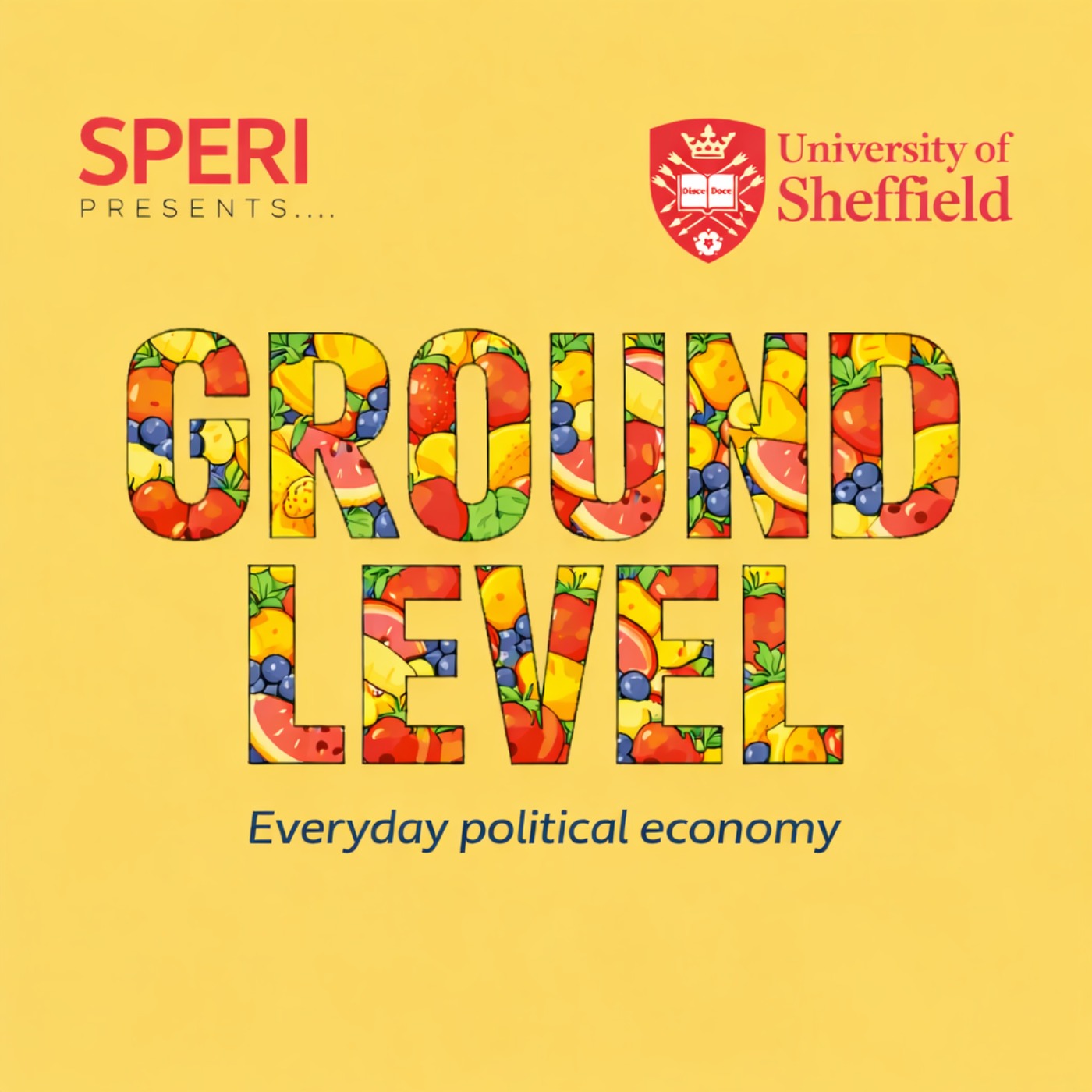
Ground Level: Food and War w/ Nadine Bahour
Everyday life is often described as common, usual, uneventful, slow, and mundane, yet it can easily become unpredictable, anxious, and traumatic. This episode explores contexts in which war and political violence closely interact with everyday life. To discuss the everyday political economy of state-mandated violence, we focus on survival. Where critical political economy frames survival as part of everyday resistance connected to labour agency, we move to discuss the political economy of actual survival as represented by gathering food when supply chains become instruments for violence and repression. We discuss the political economy of survival by exploring the sources of food insecurity in Palestine and the food-related abuses employed by the Israeli state, first as part of its colonial project and after October 2023 as part of the genocide of the Palestinian people. Concepts discussed: survival, social reproduction, genocide, violence, resistance, starvation, humanitarianism. Hosts: Dr Frank Maracchione, SOAS University of London.Gwilym Evans, University of Sheffield.Speakers: Nadine Bahour is the Research Program Coordinator for the Palestine Program for Health and Human Rights at Harvard University. Nadine is originally from Ramallah, Palestine, and her work studies the impact of settler colonialism on healthcare access and quality. Material discussed in the episode: Bahour, N., Anabtawi, O., Muhareb, R., Wispelwey, B., Asi, Y., Hammoudeh, W., Bassett, M. T., Mills, D., & Tanous, O. (2025). Food insecurity, starvation and malnutrition in the Gaza Strip. Eastern Mediterranean Health Journal, 31(4), 281–284. https://doi.org/10.26719/2025.31.4.281Gisha. (2012). Reader: "Food Consumption in the Gaza Strip - Red Lines". Gisha - Legal Centre for Freedom of Movement. https://www.gisha.org/UserFiles/File/publications/redlines/redlines-position-paper-eng.pdf Ross, A. (2021). Stone Men: The Palestinians Who Built Israel. Verso Books.Further readings: Abusalim, J., Bing, J. and M. Marryman-Lotze. (2022). Light in Gaza: Writings Born of Fire. Chicago: Haymarket Books. Devereux, S. (2024). Was There a Famine in Gaza in 2024? IDS Working Paper 613. Brighton: Institute of Development Studies. https://doi.org/10.19088/IDS.2024.042. El Masri, Y. (2024). 12: Food-Making in the Sisterhoods of Bourj Albarajenah Refugee Camp: Towards Radical Food Geographies of Displacement. In: Hammelman, C., Levkoe, C.Z. and Kristin Reynolds. (Eds). Radical Food Geographies. Bristol University Press. https://doi.org/10.51952/9781529233445.ch012IPC - Integrated Food Security Phase Classification. (2025). GAZA STRIP: Famine confirmed in Gaza Governorate, projected to expand | 1 July – 30 September 2025. 22 August. https://www.ipcinfo.org/fileadmin/user_upload/ipcinfo/docs/IPC_Gaza_Strip_Acute_Food_Insecurity_Malnutrition_July_Sept2025_Special_Snapshot.pdf Nimer, F. (2024). Food Sovereignty in a Palestinian Economy of Resistance. Al-Shabaka’s Palestine, 27 August. https://al-shabaka.org/briefs/food-sovereignty-in-a-palestinian-economy-of-resistance/ Pearce, F. (2025). As War Halts, the Environmental Devastation in Gaza Runs Deep. Yale Environment 360, 6 February. https://e360.yale.edu/features/gaza-war-environment Roy, S. (2023). The Long War on Gaza. The New York Review of Books, 19 December. https://www.nybooks.com/online/2023/12/19/the-long-war-on-gaza/ Seidel, T. (2021). Settler Colonialism and Land-Based Struggle in Palestine: Toward a Decolonial Political Economy. In: Tartir, A., Dana, T., Seidel, T. (eds) Political Economy of Palestine. Palgrave Macmillan, Cham. https://doi.org/10.1007/978-3-030-68643-7_4This episode is produced by the SPERI Presents… committee, including Chris Saltmarsh, Josh White, Frank Maracchione, and Andrew Hindmoor. This episode was edited by Frank Maracchione with support from Chris Saltmarsh. Music and audio by Andy_Gambino. Hosted on Acast. See https://acast.com/privacy for more information. Hosted on Acast. See acast.com/privacy for more information.






Get this podcast on your phone, Free


Create Your Podcast In Minutes
- Full-featured podcast site
- Unlimited storage and bandwidth
- Comprehensive podcast stats
- Distribute to Apple Podcasts, Spotify, and more
- Make money with your podcast