JavaScript Master Podcast
https://anchor.fm/s/705e04c8/podcast/rssEpisode List

JSMP 4: Misko Hevery on Qwik - No hydration, auto lazy-loading, edge cacheable, and fun
What's up everyone, this is Dariusz Kalbarczyk co-founder of NG Poland, JS Poland, AngularMaster.dev & WorkshopFest.dev. Welcome back to the JavaScript Master Podcast. https://js-poland.pl Today, together with Miško Hevery, who is an CTO at Builder.io, creator of Qwik, Angular, Angular.js and co-creator of Karma.js, we will tell you about everything that happens around Qwik. Hi Miško. How are you? For those who don't know you yet, please tell us about yourself? What exactly do you do at Builder.io? What does your work day look like? Before we get started, I wouldn't be myself if I didn't ask you about Angular. I know that this podcast is supposed to be dedicated to Qwik, I know it is your newest baby and you surely love it very much. Am I correct? I also know that you are the creator of AngularJS, about which I once wrote a book, which completely changed my professional life. For that I would like to publicly thank you now! Tell us how you started your adventure with Angular, what was the main driving force for you, to create this amazing framework, and what goals did you set for yourself at the beginning of this journey? Let's now turn to the main topic of our conversation which is: Qwik. Qwik offers the fastest possible page load times - regardless of the complexity of your website. Qwik is so fast because it allows fully interactive sites to load with almost no JavaScript and pickup from where the server left off. What does it mean? What goals did you set for yourself this time? What, then, is the difference between the current generation of frameworks and Qwik? Why is Qwik unique? What is the biggest benefit of switching to your new baby? Since Qwik gives us something like a screenshot of the data, how often is the dynamic data from the server refreshed? Does Qwik help the developer write applications faster, or is it focused on download speed. For whom would you recommend Qwik, and for what? For developers of small sites or rather for big players, or maybe for both? What's the easiest way to get started with Qwik? Is the entry threshold high? What is Qwik city and why do we need it? https://qwik.builder.io https://partytown.builder.io

JSMP 3: Kevlin Henney on 97 Things Every Programmer Should Know
What's up everyone, this is Dariusz Kalbarczyk co-founder of NG Poland, JS Poland, AngularMaster.dev & WorkshopFest.dev. Welcome back to the JavaScript Master Podcast. https://js-poland.pl Today, together with Kevlin Henney who is an author, keynote speaker, technologist, trainer and independent consultant on software development, will talk about 97 Things Every Programmer Should Know! Hi Kevlin, how are you? Before we delve into the world of technology, for those who don't know you yet, please tell us about yourself. How did you start your adventure in programming? You are the author/co-author of many books. What changed in your life after the publication of your first book? Tell us about O'Reilly's book series: “97 Things Every Architect / Programmer Should Know”. Is this content somehow timeless? The topic of today's podcast is: 97 Things Every Programmer Should Know. I know 97 is a lot, but let's focus on some of the most important, most exciting, most useful things every programmer should know, in your opinion. Let's start with Bugs and Fixes - This topic undoubtedly affects everyone Build and Deployment process - Should I Deploy early and often? Coding Guidelines and Code Layout Design Principles and Coding Techniques Domain Thinking Errors, Error Handling, and Exceptions Learning, Skills, and Expertise Performance, Optimization, and Representation - It's never too early to think about that? Professionalism, Mindset, and Attitude - I like this sentence very much: Write code as if you had to support it for the rest of your life. These are big words, but how true. Refactoring and Code Care Reuse Versus Repetition Simplicity - Is simplicity one of the keys to programmer happiness? Teamwork and Collaboration Tests, Testing, and Testers What advice would you give to people who are starting their careers in the software world today, and what for those who are old-timers? Two books you would recommend to our listeners, one technical and one non-technical? Books recommended by Kevlin: Modern Software Engineering by David Farley Logicomix by Aposotolos Doxiadis and Christos Papadimitriou Recommended workshop with Kevlin: Refactoring to Immutability Architecture with Agility
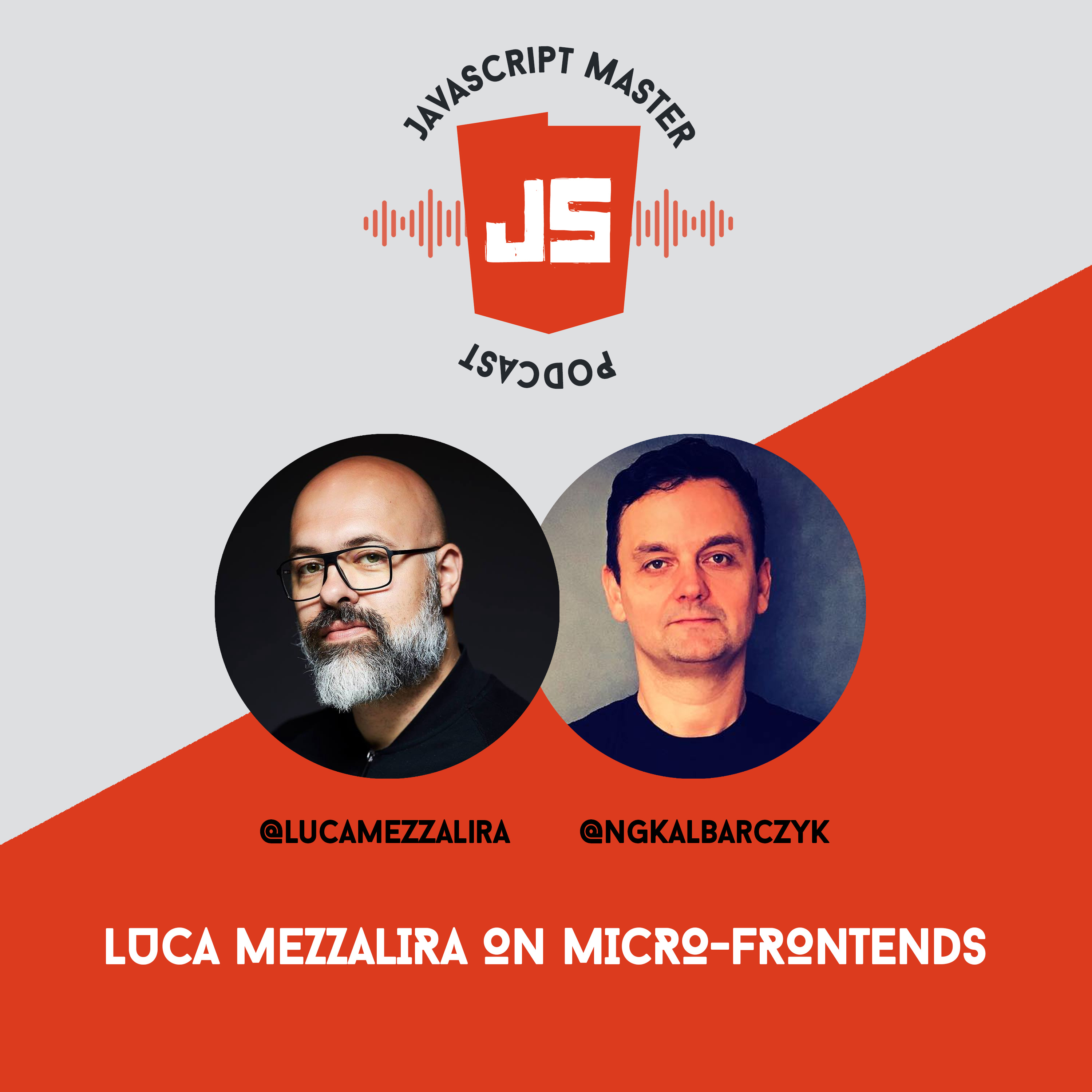
JSMP 2: Luca Mezzalira on Micro-Frontends
What's up everyone, this is Dariusz Kalbarczyk co-founder of NG Poland, JS Poland, AngularMaster.dev & WorkshopFest.dev. Welcome back to the JavaScript Master Podcast. Today we've got a special guest from London UK, Principal Serverless Specialist, Solutions Architect at AWS Cloud - International Speaker - OReilly Author Ladies and gentlemen... Luca Mezzalira Hi Luca, How are you? Please introduce yourself and tell us what you do. What exactly does a Specialist Solutions Architect do at AWS cloud? Now let's go back a few years. When did you start your adventure in programming? Why Micro-frontends are the answer to today’s increasingly complex web applications? You are the author of 2 books, the first published in 2018 : Front-End Reactive Architectures and the latest : Building Micro-Frontends: Scaling Teams and Projects, Empowering Developers Can we go through some of the topics from your latest book, I would like you to give our listeners an idea of what exactly they can expect? The micro-frontends principles How to divide an existing application in micro-frontends Introduction to the micro-frontends decisions framework Next topic: a review of every possible approach for developing this architecture pattern What are the best practices for implementing micro-frontends in a project What are the main challenges faced by teams developing micro-frontends? Automation and fast feedback loop for your developers - how can we achieve this? What is the the impact of micro-frontends inside an organization How to porting a single page application (SPA) to micro-frontends In the past 7 months you worked with Zack Jackson (module federation) and Joel Denning (single spa) and Matteo Figus (opencomponents) to solve the MFE discoverability alongside the deployment method. Tell us about it. We'll be able to see you at the JS Poland conference in October. Please tell us what your speech will be about. What’s the future holds for micro-frontends? Your favorite technical and non-technical book? Best open source project you would like to recommend to our listeners? https://js-poland.pl

JSMP 1: Chris Heilmann on Development Tools
JavaScript Master Podcast with Chris Heilmann What's up everyone, this is Dariusz Kalbarczyk co-founder of NG Poland, JS Poland, AngularMaster.dev & WorkshopFest.dev. Welcome back to the JavaScript Master Podcast. Today we've got a special guest from Berlin, Germany, Principal Program Manager for Browser Tools at Microsoft, JavaScript lover. Ladies and gentlemen... Chris Heilmann Hi Chris, How are you? Please introduce yourself and tell us what you do? The robots are coming and we need to make a great example for them. What do you mean by this text? How can we set a good example for them? What computer did you start programming on? What was your first computer program, were you proud of? What has changed since you started programming in your perception of the world of technology? Does software rule the world? How many books have you written? What is the most exciting and what is the most difficult about writing a new book? You work as anPrincipal Program Manager for Browser Tools at Microsoft. What is your working day like? Why did you choose to take on developer tools as a new experience after being in DevRel for so long? By the way, what does being a DevRel mean to you? What are the main problems you see with Developer Tools at the moment? What are problems you face as a Developer Tools creator? What can the community do to help you? What are some things you are proud of having achieved in this role and how did you do it? How big is your team? How is it structured? What is going on in the development stack for the web that puzzle you? You’ve been doing JavaScript for ages. Do you see patterns that keep coming up in the JavaScript community? What is a term that people keep using that annoys you when it comes to coding and technology? What is a finding you had in Developer Tools that might surprise people? How do you measure the success of Developer Tools? What is a feature you are really excited about that people should play with? What do you think is needed to get us to become more effective as a community? How can people learn more about what you do? What do you think about TypeScript? Is there a chance that TS will completely replace JS in the coming years? Do you remember the first edition of the JS Poland conference five years ago? You will be performing at JS Poland soon, what have you prepared for the participants this time? Non technical part: What kind of person is Chris? How do you see yourself? Do you have some hints for us regarding self-organization? Do you have any favorite hobbies? What’s about your work/live balance? Do you have some hints for us? Thank you for providing a lot of valuable information during this recording. Finally, can you recommend any interesting podcast or book to our audience?







Get this podcast on your phone, Free


Create Your Podcast In Minutes
- Full-featured podcast site
- Unlimited storage and bandwidth
- Comprehensive podcast stats
- Distribute to Apple Podcasts, Spotify, and more
- Make money with your podcast