Learning Bayesian Statistics
https://api.riverside.fm/hosting/iA4hgdZC.rss/Episode List
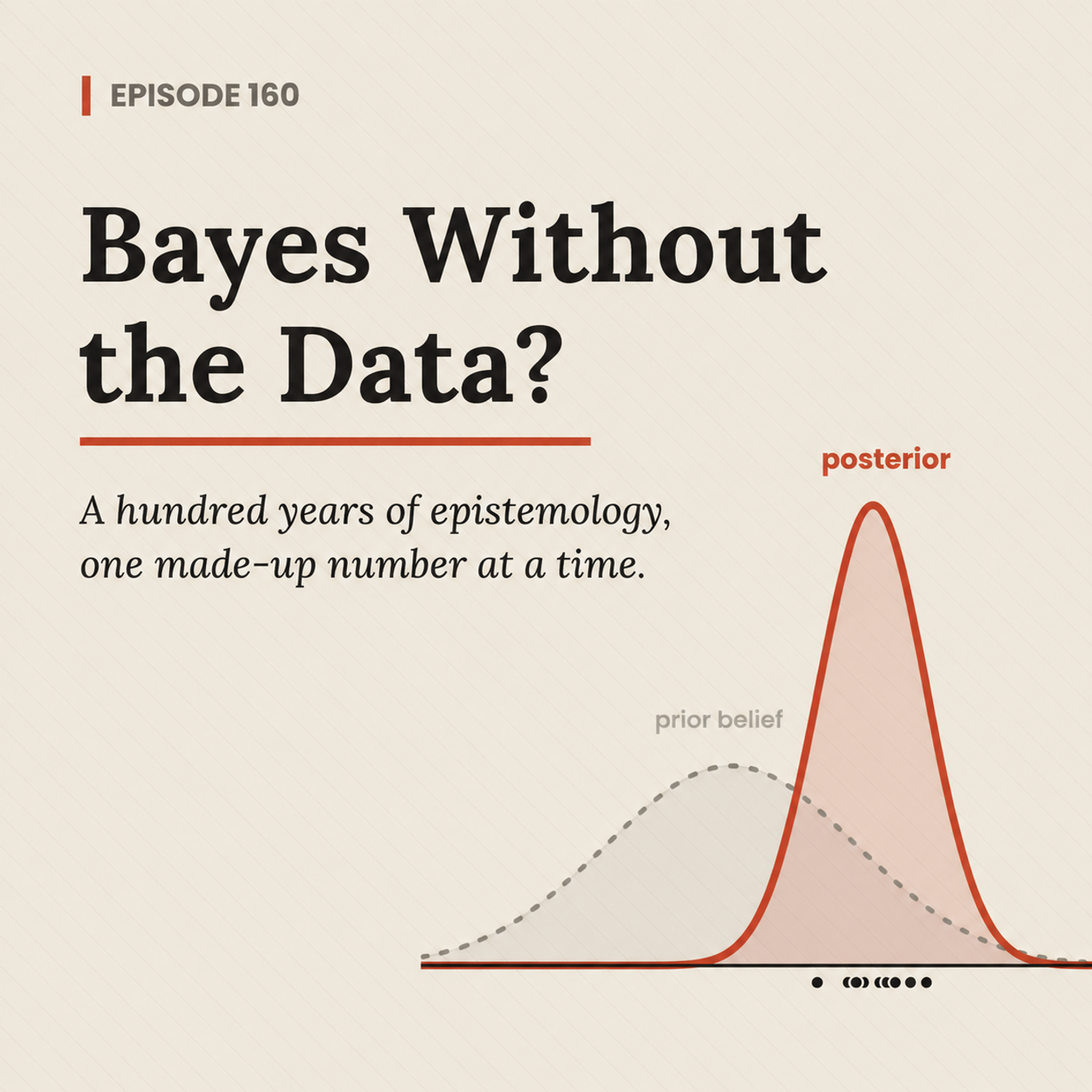
Bayesian Epistemology Is "Bayes' Theorem Without the Data"
Today's clip is from episode 160, featuring Vaden Masrani. In this conversation, Vaden lays out a sharp critique of Bayesian epistemology - the roughly hundred-year-old philosophical tradition, popular in some Oxford-adjacent circles, that treats subjective probability estimates as legitimate even when there's no data behind them.Vaden's core objection: doing Bayes' theorem on numbers you made up in your head is like fitting a regression line to an empty scatter plot - the math looks rigorous, but there's nothing underneath it. He argues this "math-washing" can trick people into thinking a decision is well-informed simply because it's dressed up in probability language, when frequentists and data-driven Bayesians alike would say the same thing: no data, no model.Get the full discussion hereSupport & Resources→ Support the show on Patreon→ Bayesian Modeling Course (first 2 lessons free): Our theme music is « Good Bayesian », by Baba Brinkman (feat MC Lars and Mega Ran). Check out his awesome work!
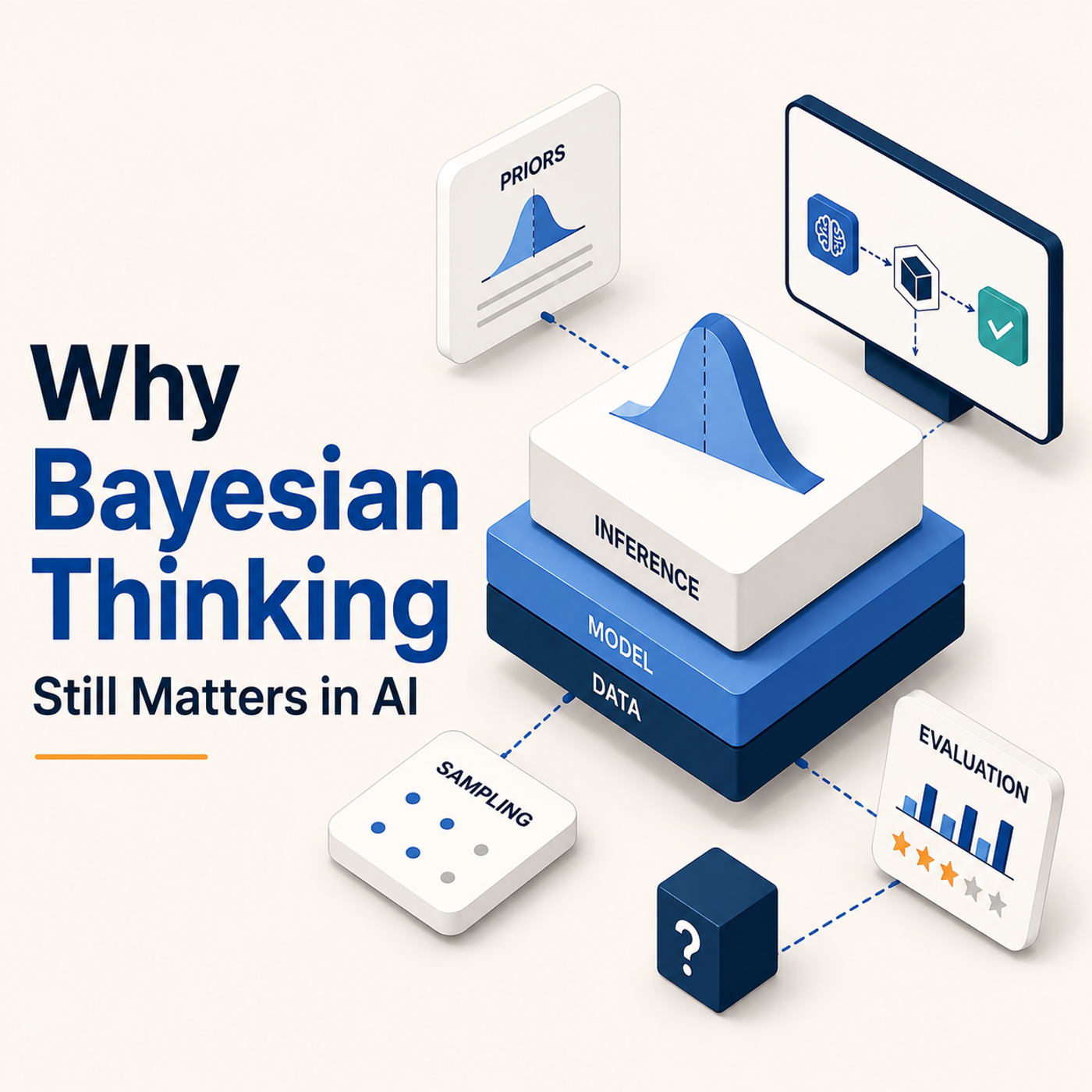
Why Bayesians Have an Edge in AI
Today's clip is from episode 162, featuring Chris Krapu. In this conversation, Chris explains why Bayesian thinking remains surprisingly valuable in today's AI landscape - even when the models themselves aren't explicitly Bayesian.Rather than uncertainty estimation, Chris highlights a different advantage: Bayesian training provides a deep intuition for concepts like priors, sampling, rejection sampling, and high-dimensional geometry, making it much easier to understand and apply modern AI research. He also discusses why Bayesian methods are becoming increasingly relevant for evaluating agentic AI systems, where complex workflows and limited evaluation data make hierarchical models and sensible priors especially powerful.Get the full discussion hereSupport & Resources→ Support the show on Patreon→ Bayesian Modeling Course (first 2 lessons free): Our theme music is « Good Bayesian », by Baba Brinkman (feat MC Lars and Mega Ran). Check out his awesome work!
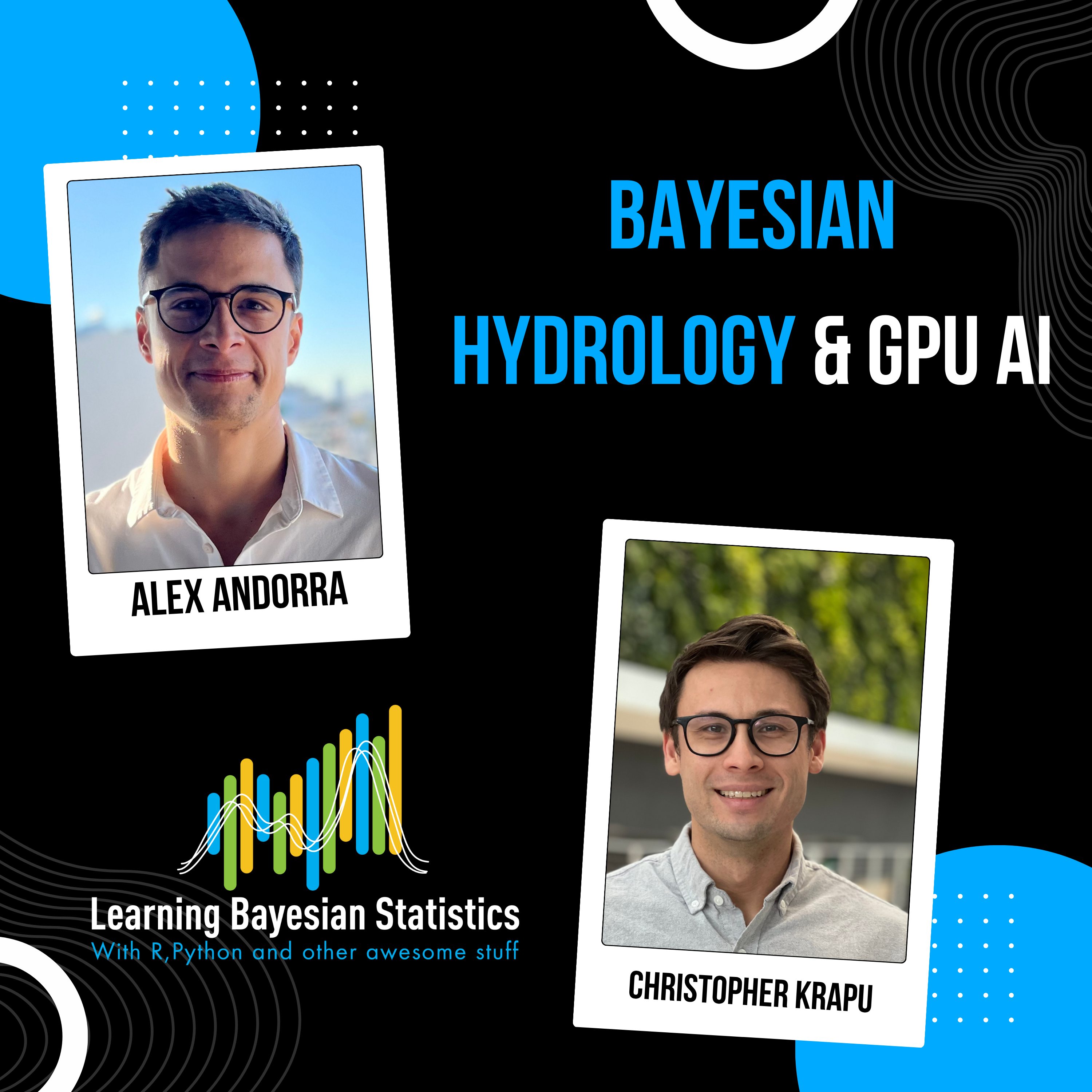
#162 Bayesian Hydrology & GPU AI, with Christopher Krapu
Support & Resources→ Support the show on Patreon→ Bayesian Modeling Course (first 2 lessons free)Our theme music is « Good Bayesian », by Baba Brinkman (feat MC Lars and Mega Ran). Check out his awesome workTakeaways:Q: How does putting a Gaussian process on unknown coordinates fix noisy location data in mineral prospecting?A: In mining and geostatistics, the classic Gaussian process model, known there as kriging, assumes you know exactly where each sample was taken. Chris’ project broke that assumption on purpose: the recorded coordinates for each core sample were only accurate to within a rough radius. By treating the true locations as latent variables and putting a Gaussian process over them jointly with the measurements, the model could still reconstruct the underlying gold-concentration field, even though the exact sampling locations were never known precisely. It's a demonstration that Gaussian processes can absorb structural uncertainty that looks, at first glance, like it should make the problem impossible.Q: What is "Poverty Bayes," and what did it cost to train a two-million-parameter Bayesian model?A: Poverty Bayes was Chris’ experiment in seeing how cheaply a large Bayesian model could be trained using modern cloud infrastructure. He fit a hierarchical logistic regression with close to two million parameters, using PyMC's Hamiltonian Monte Carlo on a single A100 GPU rented through Modal, a serverless platform that deploys a Python script straight to GPU hardware with almost no setup. He'd originally guessed it would cost around five dollars, the price of a Big Mac, but the real bill came in an order of magnitude lower. A model that would take a Gibbs sampler weeks to run, and that once required a research lab's dedicated GPU, now costs pocket change and a few minutes of setup.Q: What's the current bottleneck in Bayesian-at-scale tooling?A: Chris argues the software has largely caught up: PyMC's JAX backend and NumPyro make GPU-accelerated Bayesian modeling work out of the box for most problems. What's missing is common knowledge. Companies are clearly running large Bayesian models in production, but the results stay behind corporate firewalls. Chris’ proposal is a community benchmark effort: which frameworks handle a million-parameter Markov random field on a given GPU out of the box, since this kind of expensive, slow-running benchmark is a poor fit for standard CI pipelines but valuable for the field to know.Chapters:22:57 When does GPU acceleration actually pay off for a Bayesian model?26:33 What did it cost to train a two-million-parameter model on Modal?30:36 What happened when Chris asked 200 different LLMs to flip a coin?34:50 Where do Bayesian ideas show up in the agentic AI systems Chris builds at Nvidia?40:16 Are statisticians being made obsolete by large language models?41:19 How does putting a Gaussian process on unknown coordinates fix noisy data in mineral prospecting?58:05 What is Chris looking forward to working on next?Thank you to my Patrons for making this episode possible!Links from the show here
The Next Step Beyond LLMs: Foundation Models for Inference
Today's clip is from episode 161, featuring Luigi Acerbi. In this conversation, Luigi explains one of the biggest engineering bottlenecks facing transformer-based probabilistic models—and how his group found a way around it.The core challenge is that many inference models treat data as an unordered set, making them naturally permutation invariant. That's statistically elegant, but computationally painful: every time a new data point arrives, the model has to recompute attention over the entire dataset from scratch, preventing the kind of KV caching that makes modern language models so efficient.Luigi walks through his team's solution: a hybrid architecture that keeps the original context fully set-based while introducing a causal-attention buffer for newly arriving data. The result is dramatically faster inference- up to 100× faster in some settings - opening the door to applications like reinforcement learning, active data acquisition, and, ultimately, Luigi's long-term vision of a foundation model for Bayesian inference.Get the full discussion hereSupport & Resources→ Support the show on Patreon→ Bayesian Modeling Course (first 2 lessons free)Our theme music is « Good Bayesian », by Baba Brinkman (feat MC Lars and Mega Ran). Check out his awesome work
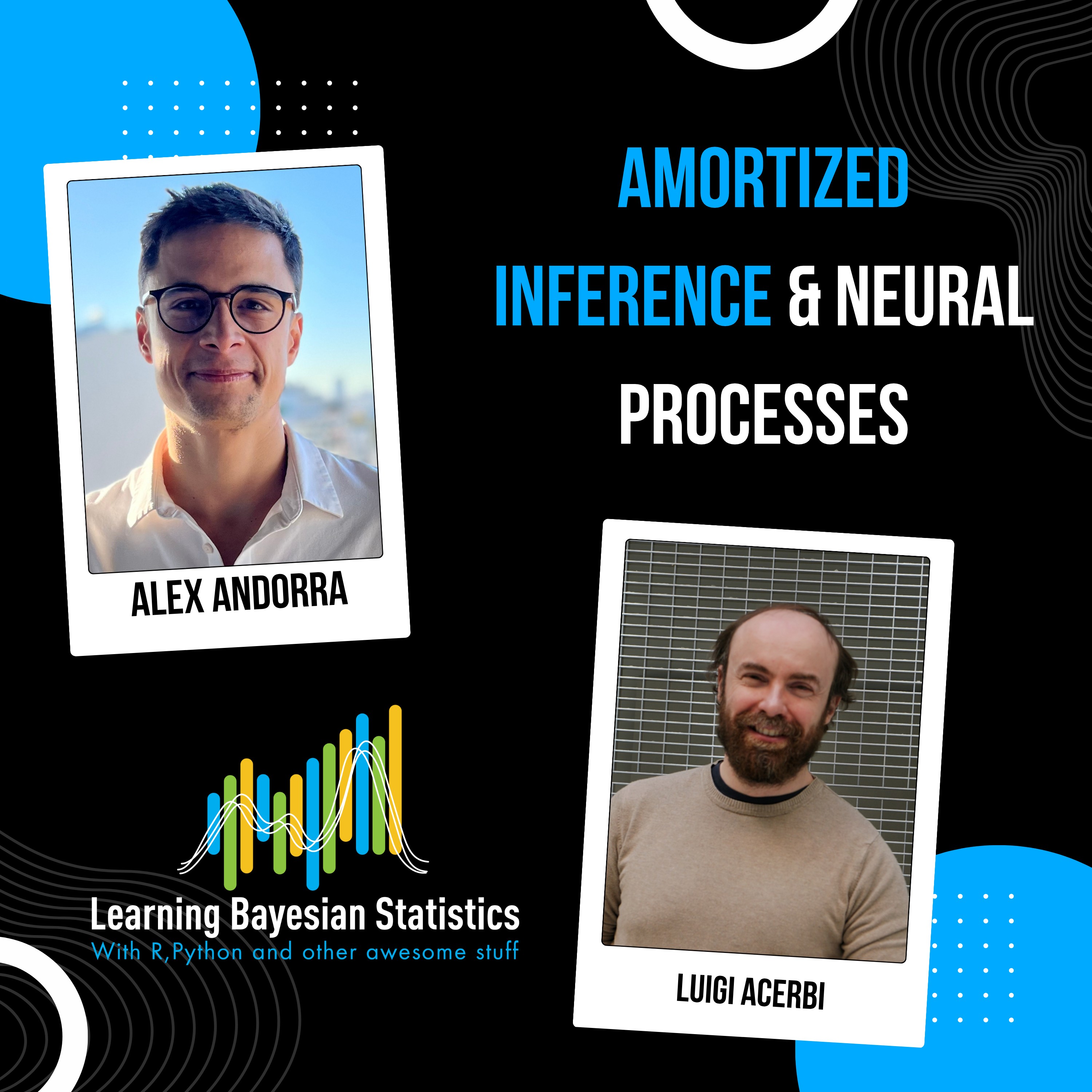
#161 Amortized Inference & Neural Processes, with Luigi Acerbi
Support & Resources→ Support the show on Patreon→ Bayesian Modeling Course (first 2 lessons free)Our theme music is « Good Bayesian », by Baba Brinkman (feat MC Lars and Mega Ran). Check out his awesome workTakeaways:Q: What is Variational Bayesian Monte Carlo (VBMC) and how is it different from Bayesian optimization?A: VBMC borrows the machinery of Bayesian optimization but aims at a different target. Bayesian optimization fits a Gaussian process surrogate to an expensive function and uses it to hunt for the optimum. VBMC instead treats the log-posterior as the function to model, evaluates it at a few carefully chosen points, and keeps the whole reconstructed shape rather than just its peak. That gives you the full posterior, not a single best-fit value. Where MCMC might need tens of thousands to millions of evaluations, VBMC often reconstructs a good posterior approximation from a few hundred, which matters when each evaluation is slow.Q: When should you reach for PyVBMC, and when is it the wrong tool?A: Two symptoms tell you PyVBMC might help. First, speed: if a single evaluation of your log density takes on the order of a second, running MCMC over tens of thousands of evaluations becomes painful, and PyVBMC's few-hundred-evaluation budget pays off. Second, dimensionality: because it leans on a Gaussian process surrogate, it works well up to roughly 10 to 15 parameters and degrades beyond that. If your model already runs fine in Stan or PyMC, you do not need it. It shines for expensive, low-dimensional models common in science and engineering, where you are modeling a process rather than composing nice distributions.Full takeaways hereChapters:00:18:13 What is Variational Bayesian Monte Carlo (VBMC) and how does it differ from Bayesian optimization?00:30:21 When should you use VBMC versus BADS in practice?00:31:20 What is Bayesian Adaptive Direct Search (BADS) and how does its hybrid optimization strategy work?00:39:18 What are neural processes, and why are transformers a natural neural process architecture?00:45:54 What is the Amortized Conditioning Engine (ACE) and what problem does it unify?00:55:42 What do PriorGuide and the new autoregressive buffer paper solve for amortized inference?01:02:03 How does the new autoregressive buffer speed up predictions in transformer probabilistic models?01:06:11 What is Luigi Acerbi's vision for a foundation model for inference?01:09:26 What is ALINE and how does it add active data acquisition to amortized inference?01:12:43 How does Luigi Acerbi connect LLM agents, Bayesian decision theory, and the nature of intelligence?01:18:44 For a PyMC, Stan, or NumPyro user, where should you start with VBMC, BADS, or BayesFlow?Thank you to my Patrons for making this episode possible!Links from the show here
You may also like









Get this podcast on your phone, Free


Create Your Podcast In Minutes
- Full-featured podcast site
- Unlimited storage and bandwidth
- Comprehensive podcast stats
- Distribute to Apple Podcasts, Spotify, and more
- Make money with your podcast
