Humans On The Loop
https://api.substack.com/feed/podcast/4644.rssEpisode List
Neuroscience in Hyperspace with Andrew Gallimore
In this episode we join pioneering psychedelic neuroscientist Andrew Gallimore (Website | X | Instagram | Substack) to probe the bewildering high-dimensional horizons of DMT research and their implications for our understanding of consciousness and the structure of reality. In his book Death by Astonishment, Gallimore argues DMT expands the brain’s “representational reach,” enabling perception of high-dimensional structures and apparent interaction with non-human “intelligent agents,” challenging standard accounts that treat the experience as mere hallucination, dreams, or Jungian archetypes. What new shapes will we—and our sciences—take as we integrate the intense strangeness of these experiences? How do we even begin to practice “truly psychedelic” science? And what insights might we be able to bring “home” to the Flatland where we spend most of our waking lives?Andrew has talked about this work in many, many other venues (his conversations with Jesse Michels and Danny Jones were especially good), so I wanted to carry the conversation into fresh terrain. Consider this episode the “200 level course”, or at least my best attempt ask a brilliant and provocative researcher some very complicated questions.Over our two hours together we discussed neuroimaging findings that challenge the “dream” and “archetype” interpretations of DMT phenomenology, how criticality and noise in complex systems inform our understanding of the psychedelic experience, and the methodological problems inherent in studying ontologically shocking experiences while maintaining scientific rigor. We also probed the philosophical implications of DMT research—such as the possibility that consciousness is more fundamental than matter—and the possible connections between DMT hyperspace and life in an era of advanced technology. Andrew also gave some context on the Noonautics research non-profit its partnership with the newly-launched Eleusis facility, a carefully-crafted venue for extended-state DMT work. But perhaps my favorite part of this conversation was spent in speculation, about how science and even language might evolve to meet the challenges presented by the ineffable high-dimensional reality that DMT reveals to us.✨ Like/Subscribe/Comment where you listen! YouTube • Spotify • Apple Podcasts✨ Become a member for our reading group, community calls, and years of members-only recordings — including the excellent raps we had recently on Alexander Douglas and Wendell Berry.✨ Become a founding member to access my online courses, including Jurassic Worlding and How To Live In The Future.✨ Browse and buy all of the books we discuss on the show at Bookshop.org✨ Music: “Scalar Reconfigurations” & “City of Jewels”✨ Contact me to collaborate or hire me as a consultantChapters00:00:00 Intro00:08:15 Gallimore’s Origin Story00:13:00 DMT as a Technology00:20:01 “Entities” & Methodological Problems00:29:06 World Models and EEG Clues00:36:57 Why The Psychedelic State is Not a Dream00:44:11 Noise, Criticality, and New Order00:47:50 The Temperature-Noise Motif00:52:47 Metabolism & Dimensionality00:53:47 The Cortex & Representational Reach00:57:44 Do We Need New Language to Study The DMT Realm?01:00:45 Is There Only The Subject?01:09:31 Psychedelic Science As Altered Observation01:17:34 DMTx & Eleusis Plans01:21:55 The Future of Transdimensional Research01:31:44 A Call for HumilityCited WorksNeural correlates of the DMT experience assessed with multivariate EEGby Christopher Timmerman et al.The Overfitted Brainby Erik HoelThe evolution of syntactic communicationby Martin Nowak et al.The Transcension Hypothesisby John SmartMiguel Fuentes & Marco Buongiorno Nardelli on Music, Emergence, and Societyfor Complexity PodcastAncient Extinction Events, Apocalyptic Cults, and DMT Entitieswith Michael on The Danny Jones PodcastOther MentionsStephen SzáraNick SandDonald HoffmanKarl FristonJordi RibaDavid ChalmersWilliam BurroughsJohn LillyPhil DickTerence McKennaRobert Anton WilsonJohn D. BarrowMentioned & Related Podcast Episodes This is a public episode. If you'd like to discuss this with other subscribers or get access to bonus episodes, visit michaelgarfield.substack.com/subscribe
(Re)Building Trustworthy Institutions with Nathan Kinch
Today’s very overdue conversation is with AI ethicist and organizational trust expert Nathan Kinch of Trustworthy By Design (Website | LinkedIn), asking questions like: How do institutions made of decent, well-meaning people continue to behave out of alignment with their stated values? How do we dig ourselves out of a catastrophic collapse in trust? How can we design practical, participatory “living labs” for organizational reflection and facilitate convivial, playful environments for working together?“Certainly one of the world’s leading figures on ethics in practical applications.”— Fionn Delahunty, NLP Lab at University of GalwayAs we frequently observe on this show, we need to rework our ideas of agency and identity to adapt them to advances in our understanding of complex systems. Decisions emerge within a nexus of nested, multi-scale dynamics, and our species flourishes or fumbles in intricate symbiotic relationships with the collective intelligences embodied in cultural technologies like states, markets, corporations, and social clubs — beings that, by any reasonable account, live in worlds alien to our own lived experience and demonstrate their own goals and values. Getting them to behave in ways that nourish us requires a much more nuanced theory of change than that which created them in the first place, perhaps even a radically different vision of the links between biology, psychology, society, and environment. And given that AI is a beast of a similar order to these other “egregores” — the entities of collective computation that arise from our efforts to coordinate at scale and then impose their own top-down causal influence on our thoughts and actions — learning how to align individual and organizational purpose can give us profound insight into how to live well alongside (or in the proverbial guts of) newer, more obvious forms of non-human intelligence like LLMs that amplify our biases through lossy compression and feedback, and shape both our desires and view of adjacent possibility.In other words, the “intent-to-action” gap in corporate ethics and the “paperclip machine” problem in our built wilderness of black box super-machines are structurally identical. And if we can “tame” the secular gods of the modern industrial era , our self-domesticated species may actually still get a chance at living in a zoo of our own choosing.If you are caught in a system of technologically mediated social dilemmas — and who isn’t? — this will speak to you, and I’m excited to share it.✨ If you enjoy this podcast, please consider liking, subscribing, and commenting wherever you listen: YouTube • Spotify • Apple Podcasts • Etc.✨ Become a member for access to our study group and community calls, and for those recordings — including the excellent raps we had recently on Alexander Douglas and Wendell Berry.✨ Become a founding member for access my five-week science and philosophy course at Weirdosphere and the raw recordings of every unreleased episode! (Anyone can chat with my course transcripts in a dedicated Google Notebook here.)This is a reader-supported publication. Please consider becoming a member:✨ Browse and buy all of the books we discuss on the show at Bookshop.org✨ Contact me with inquiries or hire me as a consultantReferenced & RelatedWhat’s trust got to do with it?Nathan KinchThree reasons why AI ethics is strugglingNathan KinchIf ‘Trust is a must’ for AI governance — here are 3 things regulators should doHilary SutcliffeBluesky and enshittificationCory DoctorowEnvironmentally Mediated Social DilemmasSylvie Estrela et al.FLD On Navigating Complexity in Education: A Conversation with Dave SnowdenTim LoganThe corporate cultivation of digital resignationNora Draper & Joseph TurowWilliam GibsonJohn VervaekeRajiv SethiMat MytkaNadia LeeBarronness Onora O’Neill This is a public episode. If you'd like to discuss this with other subscribers or get access to bonus episodes, visit michaelgarfield.substack.com/subscribe
AI Doesn't Have To Be This Way feat. Alex Komoroske
This week go deep with Alex Komoroske, CEO and co-founder of Common Tools, about his vision for a more saner, more intentional tech paradigm in which the historical contingencies that gave us the digital world we have today have been fundamentally reworked.The version of AI most of us have come to accept or reject looks like corporate-owned super-assistants with all your data. Instead, we could have a decentralized ecosystem where software self-assembles around you—private, personal, and prosocial. Alex speaks on this possible world with authority: he spent 13 years at Google as PM Director on Chrome’s web platform, Search, and AR, and later led corporate strategy at Stripe before co-founding Common Tools with Bernhard Seefeld.Some of the waypoints in our conversation include: confidential compute, emergent ontologies, where we want friction, the tyranny of the marginal users, the rise of the generalist, the importance of context ownership, and software ephemerality.We can’t take a reasonable principled stance on the promises and perils of AI without considering the vast unexplored possibility space that Alex opens in this conversation. I’m grateful that I get to share it with you and help light the way for promising alternatives to what many of us have come to accept as “the way things are.”Links to extensive additional reading and listening below!✨ If you enjoy this podcast, please consider liking, subscribing, and commenting wherever you listen: YouTube • Spotify • Apple Podcasts • Etc.✨ Become a member to support the show and score myriad perks, like our book club: our next call is on Wendell Berry’s Standing by Words this Sunday, Feb 15th!✨ Become a founding member for access to my five-week science and philosophy course at Weirdosphere and the raw recordings of every unreleased episode! (Anyone can chat with my course transcripts in a dedicated Google Notebook here.)✨ Browse and buy all of the books we discuss on the show at Bookshop.org✨ Contact me with inquiries or hire me as a consultantReferenced & Related• The FLUX Collective (team project w/ several people mentioned in this episode)• Bits and Bobs (Alex’s long-running archive of weekly notes)• Common Ground (Alex’s dialogues w/ Aishwarya Khanduja of The Analogue Group)• The Iterative Adjacent Possible (Alex on Medium)• The Runaway Engine of Society (Alex on Medium)• Thinking like a gardener not a builder, organizing teams like slime mold, the adjacent possible, and other unconventional product advice (podcast w/ Lenny Rachitsky)• Media and Machines by Anu Atluru at Working Theorys• Accelerando & Glasshouse & Halting State (three books) by Charles Stross• The Transparent Society by David Brin• The evolution of Covert Signaling by Paul Smaldino• Landscape rules predict optimal superhighways for the first peopling of Sahul by Stefani Crabtree et al.• The Tyranny of the Marginal User by Ivan Vendrov• 1,000 True Fans by Kevin Kelly• Blindsight & Echopraxia (two books) by Peter Watts• The Computer as a Communication Device by J.C.R. Licklider & Bob Taylor• Silicon Valley’s quest to remove friction from our lives by Rohit Krishnan• The Most Valuable Commodity in the World is Friction by Kyla Scanlon• Bernhard Seefeld• Situated Software by Clay Shirky• Das Rad (animated short)• Geoffrey West• Mark Pesce• Fred Turner• Robert David SteeleExplore hundreds of related podcast episodes in the archives! This is a public episode. If you'd like to discuss this with other subscribers or get access to bonus episodes, visit michaelgarfield.substack.com/subscribe
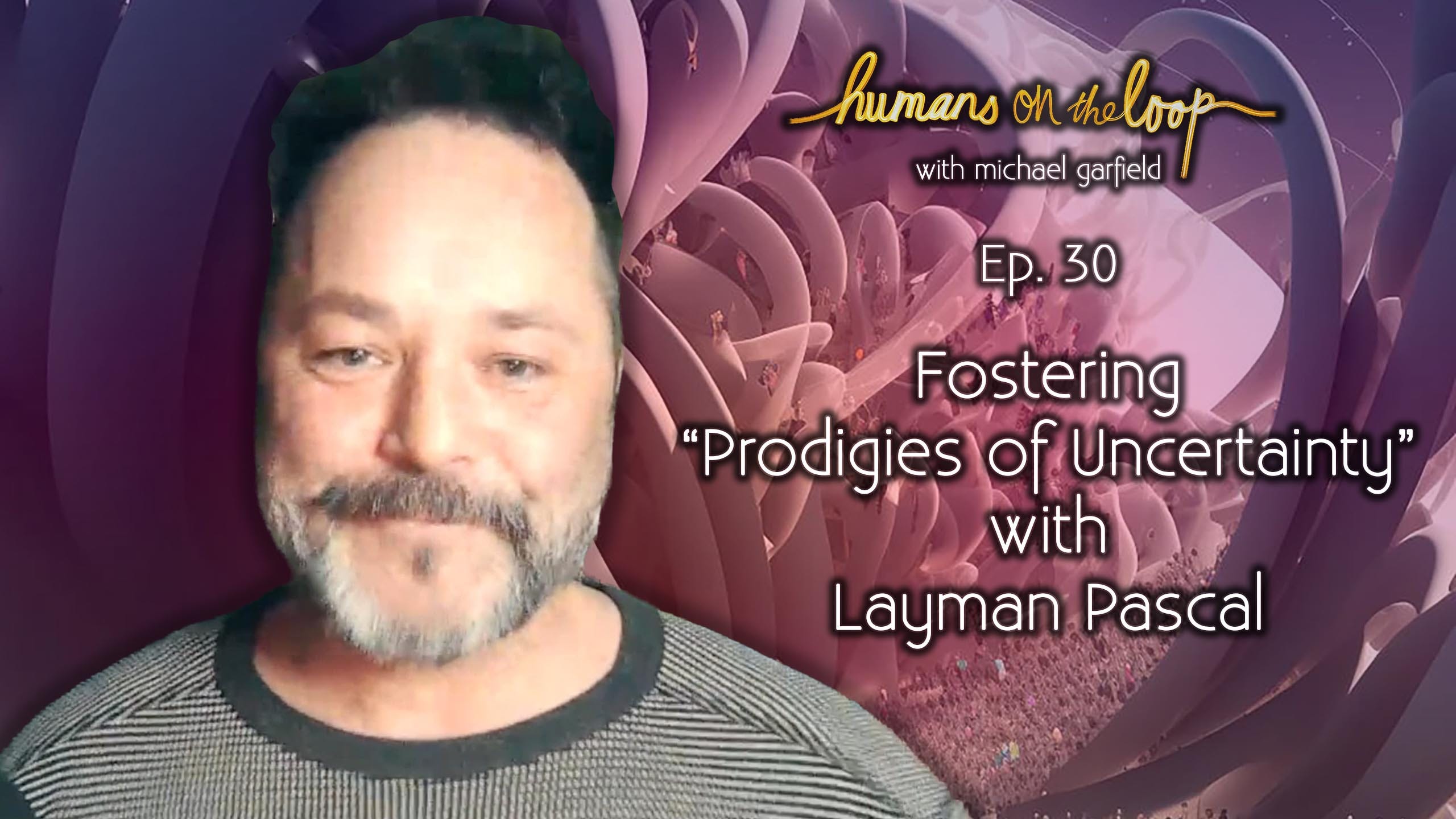
Fostering "Prodigies of Uncertainty" with Layman Pascal
The world is getting weirder every day… We need weirdness specialists. Maybe the best guy for the job is my friend, the brilliant “metashaman” (and possible octopus) Layman Pascal. In his own words, Layman “used to be a Canadian meditation teacher, yoga instructor & philosopher of Integral Metatheory but he’s feeling much better now.” He leads the Metamodern Spirituality Labs, hosts The Integral Stage, Soulmakers+, and (forthcoming) Untegral Stage podcasts, and provides unique online courses. He is also a founding member of several think tanks in the developmental psychology and spirituality space, senior editor of Emerge online & is allied to numerous institutes across the field. In addition to many journal and anthology articles, he is the author of Gurdjieff for a Time Between Worlds, Sex, Death & the Occult, as well as an upcoming book about Nietzsche. Layman is known for his philosophical work on the metaphysics of adjacency, complex nonduality, coaxial developmental stage theories, sacred naturalism, archaic futurism, embodied spirituality & the “integration-surplus model of religion and spirituality” for a post-postmodern civilization facing numerous accelerating and converging crises. In this conversation we cover a lot of ground in a very short time, including: the nature of futurity and how humankind’s relationship to the future is changing; how to surf intense peculiarity'; the abiding sociocultural role of “shamanoid” personalities and other useful weirdos; “wartime” mobilization for The Big Us; and other deep and delightful subjects. It’s my honor to finally decant this year-old recording, now more pertinent than ever…✨ If you enjoy this conversation, please consider liking, subscribing, and commenting on your favorite podcast provider to help this work (and you!) find new allies: YouTube • Spotify • Apple Podcasts • Etc.✨ Our next Humans On The Loop book club discussion is for Wendell Berry’s Standing by Words on Sunday February 15th! Become a member to participate in these calls, exclusive Discord members channels, and our monthly hangouts.✨ All of the unedited, unreleased episodes are available to founding members here.More links• Explore the archives for nine years of mind-expanding conversations• Browse (nearly!) all of the books we discuss on the show at Bookshop.org•Dig into the Humans On The Loop pitch deck• Explore the Google Notebook for How To Live In The Future, my five-week science and philosophy course at Weirdosphere• Contact me if you have burning questions!Cited pieces by Layman• The Soul of AI w/ Lee Chazen (YouTube)• The MetaModern Business Bureau (MMBB) (Substack)• Apocalyptarians (Substack)• The Society of Partial Deterritorialization (Substack)• The Two-Handed Demons (Substack)Cited pieces by others• Wendell Berry - Standing by Words• Hakim Bey - Temporary Autonomous Zone• Steven Johnson - The Revenge of the Humanities• Carol Dweck - Mindset• William James - On Some Mental Effects of the EarthquakeMentioned people with dialogues on my show• Jim Rutt (181)• William Irwin Thompson (42, 43)• Erik Davis (99, 132, 140)• Timothy Morton (223)Mentioned people without dialogues on my show• Terence McKenna (although I’ve interviewed Terence’s brilliant close friends Ken Adams and Bruce Damer multiple times; check the archives for episodes 4, 109, 209)• Alexander Bard• Andrew Huberman• Harry S. Truman• Jacques Lacan• H.P. Lovecraft• Doug Irwin• Nassim Taleb• Friedrich Nietzsche This is a public episode. If you'd like to discuss this with other subscribers or get access to bonus episodes, visit michaelgarfield.substack.com/subscribe
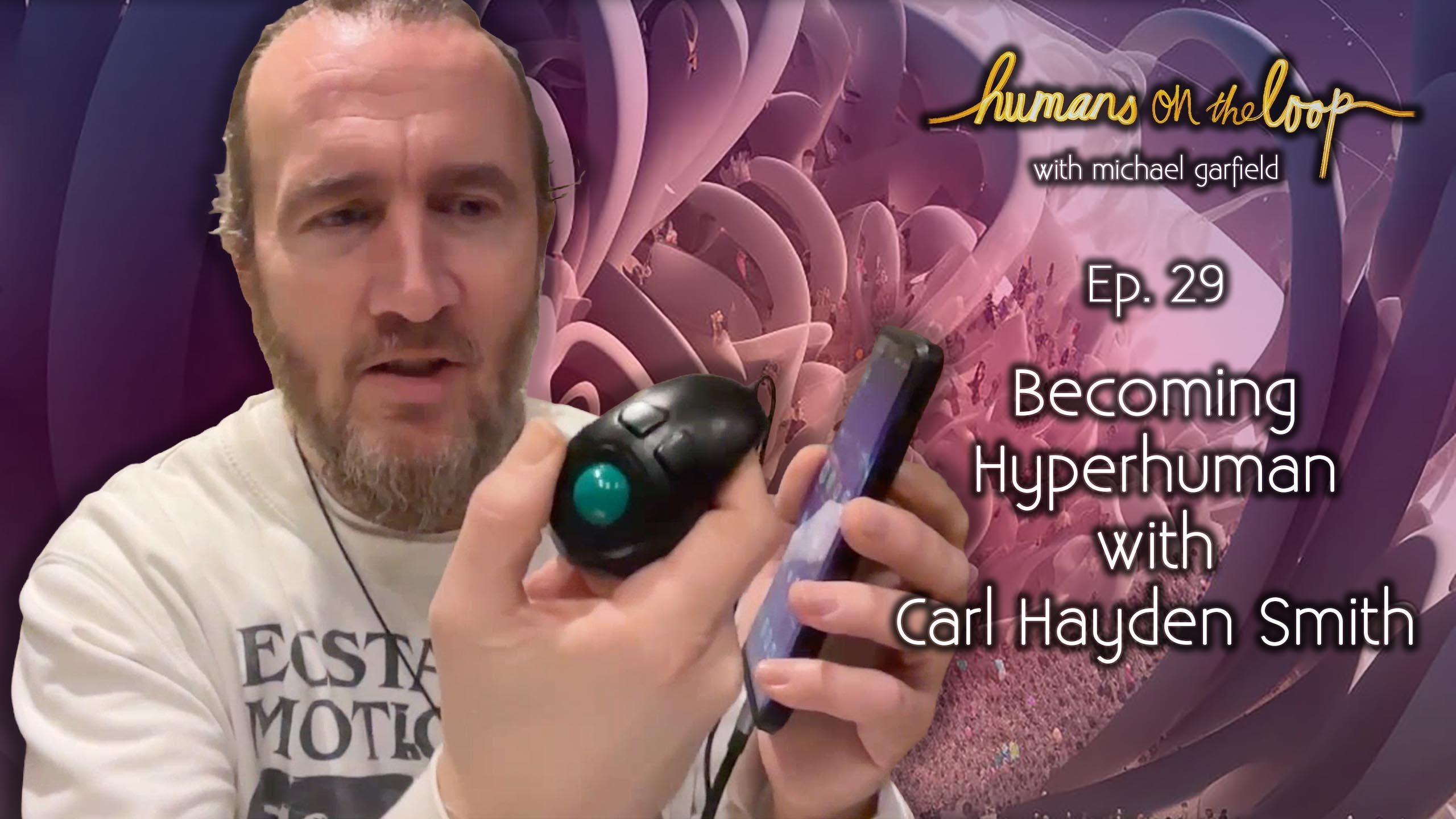
Becoming Hyperhuman with Carl Hayden Smith
This week we come at technology sideways with help from hyperspace explorer Carl Hayden Smith, Associate Professor of Media at the University of East London (Talks & Papers), Founder of The Museum of Consciousness at New College, University of Oxford , co-founder of the Cyberdelic Nexus, Director at Noonautics and head of Context Engineering at Eleusis.✨ Carl is currently teaching a course on Apocalyptic Hyperhumanism with Layman Pascal at Cadell Last’s Philosophy Portal! More info and enrollment here.✨ Our next Humans On The Loop members hangout is this Sunday January 18th at 10:00 am Mountain Time! Calendar invite coming soon for subscribers.✨ All of the unedited, unreleased episodes are available to founding members here.✨ Show Links• Dig into nine years of mind-expanding conversations• Browse the books we discuss on the show at Bookshop.org• Learn more about the Humans On The Loop project and its goals• Explore the Google Notebook for How To Live In The Future, my five-week science and philosophy course at Weirdosphere• Contact me if you have burning questions✨ MentionsMax CooperHunter S. ThompsonDoug Rushkoff Friedrich NietzscheAndrew GallimoreJohn VervaekeK. Allado-McDowellDale PendellJoël de RosnayJoshua DiCaglioCharles EisensteinFred TurnerMark ZuckerbergMichael DouglasRichard BartlettGordon White This is a public episode. If you'd like to discuss this with other subscribers or get access to bonus episodes, visit michaelgarfield.substack.com/subscribe





Get this podcast on your phone, Free


Create Your Podcast In Minutes
- Full-featured podcast site
- Unlimited storage and bandwidth
- Comprehensive podcast stats
- Distribute to Apple Podcasts, Spotify, and more
- Make money with your podcast
