Episode List
Snake Oil Has an Expiration Date
It's Kris and Matt this week, and the conversation goes places. It starts with Matt going all-in on Apple and a leaked Claude Code source dump, then pivots into AI companies repeating social media's diversity-of-thought mistakes and why LLMs still can't beat "better than the average human" as a goalpost. The episode closes with a surprise detour into accounting, finance, and why double-entry bookkeeping is one of the original distributed systems.We've got supporter content, of course! This week that includes a home lab infrastructure rant about terrible BMC/IPMI systems, a nuanced deep dive into corporate DEI and code-switching, Matt's chocolate shop tax war stories, LLC vs S-Corp tradeoffs, and why engineers who dismiss finance are worse engineers. Not a supporter yet? Fix that today by heading over to https://fallthrough.fm/subscribe where you'll get not only extra content but also higher quality audio. Sign up today!If you prefer to watch this episode, you can view it on YouTube.No episode of Break this week. We'll have more aftershow episodes soon! In the meantime, catch up on previous episodes at https://break.show.Thanks for tuning in and happy listening!Table of Contents:Prologue (00:00:00)Chapter 1: Matthew Goes All In on Apple (00:01:10)Chapter 3: The Claude Code Source Leak (00:08:24)Chapter 4: AI Companies and the Diversity of Thought Problem (00:14:13)Chapter 6: LLMs Are Not Better Than Humans (00:17:16)Chapter 7: AI Hype, Big Data Deja Vu, and Snake Oil (00:21:17)Chapter 8: Serial Founders Are Deadbeat Fathers (00:23:33)Chapter 9: The Hidden Heroes Who Run Companies (00:33:01)Chapter 11: Engineers Need to Respect (and Learn) Finance (00:35:03)Chapter 13: Double-Entry Accounting Is an OG Distributed System (00:50:41)Hosts Kris Brandow - Host Matthew Sanabria - Host Socials:WebsiteBlueskyThreadsX/TwitterLinkedInInstagram (00:00) - Prologue (01:10) - Chapter 1: Matthew Goes All In on Apple (08:24) - Chapter 3: The Claude Code Source Leak (14:13) - Chapter 4: AI Companies and the Diversity of Thought Problem (17:16) - Chapter 6: LLMs Are Not Better Than Humans (21:17) - Chapter 7: AI Hype, Big Data Deja Vu, and Snake Oil (23:33) - Chapter 8: Serial Founders Are Deadbeat Fathers (33:01) - Chapter 9: The Hidden Heroes Who Run Companies (35:03) - Chapter 11: Engineers Need to Respect (and Learn) Finance (50:41) - Chapter 13: Double-Entry Accounting Is an OG Distributed System
Who's Afraid of Superintelligence?
We've got a full panel! In this episode, Kris, Matt, Steve, and Ian have a deep dive into superintelligence, AGI, and why the fear around them might say more about us than about AI. Steve draws a line from colonialism anxiety to alien invasion movies to superintelligence panic. Kris argues that a truly rational superintelligence would see that oppression consistently fails and cooperation wins. The conversation moves through whether AI is already oppressive, what it means for AI to be a subtle overlord, and why the real threats are mundane failures of leadership, not robot uprisings.We've got supporter content, of course! This week that includes a philosophical tangent on whether referencing external knowledge counts as knowing, a heated debate about whether humans are hierarchical by nature, Matt's island thought experiment about hierarchy inevitably emerging, and Ian's argument that not everyone needs to be a builder. Not a supporter yet? Fix that today by heading over to https://fallthrough.fm/subscribe where you'll get not only extra content but also higher quality audio. Sign up today!If you prefer to watch this episode, you can view it on YouTube.No episode of Break this week. We'll have more aftershow episodes soon! In the meantime, catch up on previous episodes at https://break.show.Thanks for tuning in and happy listening!Table of Contents:Prologue (00:00:00)Chapter 1: Meet the Panel (00:00:54)Chapter 2: Defining AGI and Superintelligence (00:03:00)Chapter 3: The Spicy Takes: Has AGI Already Arrived? (00:11:38)Chapter 4: What Does It Mean to Know? Memory vs. Intelligence [Extended] (00:17:56)Chapter 5: A Black Perspective on Power and Intelligence (00:18:55)Chapter 6: Did They Actually Win? Dominance Hierarchies and Revolution (00:26:18)Chapter 7: AI Is Already Oppressive: Why Aren't We Worried About That? (00:33:53)Chapter 10: AI as the Subtle Overlord (00:48:55)Chapter 12: What We Should Actually Be Worried About (00:58:47)Chapter 13: Intelligence, Eugenics, and What the Word Even Means (01:08:06)Chapter 14: Naming the Machines: AI Identity and Claude's Constitution (01:22:32)Chapter 15: We vs. Me: Language, Identity, and Collective Pronouns (01:25:14)Epilogue (01:31:10)Hosts Kris Brandow - Host Ian Wester-Lopshire - Host Matthew Sanabria - Host Steve Klabnik - Host Socials:WebsiteBlueskyThreadsX/TwitterLinkedInInstagram (00:00) - Prologue (00:54) - Chapter 1: Meet the Panel (03:00) - Chapter 2: Defining AGI and Superintelligence (11:38) - Chapter 3: The Spicy Takes: Has AGI Already Arrived? (17:56) - Chapter 4: What Does It Mean to Know? Memory vs. Intelligence [Extended] (18:55) - Chapter 5: A Black Perspective on Power and Intelligence (26:18) - Chapter 6: Did They Actually Win? Dominance Hierarchies and Revolution (33:53) - Chapter 7: AI Is Already Oppressive: Why Aren't We Worried About That? (48:55) - Chapter 10: AI as the Subtle Overlord (58:47) - Chapter 12: What We Should Actually Be Worried About (01:08:06) - Chapter 13: Intelligence, Eugenics, and What the Word Even Means (01:22:32) - Chapter 14: Naming the Machines: AI Identity and Claude's Constitution (01:25:14) - Chapter 15: We vs. Me: Language, Identity, and Collective Pronouns (01:31:10) - Epilogue
The Joy of Building
This week Kris and Matt go full homelab. The conversation starts with Kris refreshing his dev setup: migrating NeoVim to 100% Lua, switching from ZSH to NuShell, and rethinking Tmux, all with the help of an LLM. The discussion then moves into hardware: Framework Desktop vs. Mac Studio, the RAM price explosion, 10G networking, WiFi with Private Pre-Shared Keys, and GPUs without display ports. The episode closes with a teaser for a future discussion on why Kris isn't worried about superintelligence.We've got supporter content, of course! This week that includes a mechanical keyboards deep dive, Kris's custom AI research system that runs 73 agent calls in parallel, the memory bandwidth gap between Mac Studio Ultra and datacenter GPUs, and the joy of discovering headless GPU cards. Not a supporter yet? Fix that today by heading over to https://fallthrough.fm/subscribe where you'll get not only extra content but also higher quality audio. Sign up today!If you prefer to watch this episode, you can view it on YouTube.No episode of Break this week. We'll have more aftershow episodes soon! In the meantime, catch up on previous episodes at https://break.show.Thanks for tuning in and happy listening!Notes:Lazy.nvimMason.nvimTree-sitterHelix EditorGhosttyNushellZellijZMXTable of Contents:Prologue (00:00:00)Chapter 1: Baby Prep and Desk Organization (00:00:59)Chapter 2: Upgrading NeoVim with LLM Assistance (00:04:22)Chapter 3: The Vim Journey: Why Terminal Editors Still Win (00:09:41)Chapter 4: Terminal Emulators: Ghostty, Helix, and the Quest for Speed (00:17:12)Chapter 5: LSP, TreeSitter, and the End of the M-to-N Plugin Problem (00:20:14)Chapter 6: Customizing Key Bindings and Evaluating Your Tools (00:28:44)Chapter 8: Switching to Nushell (00:37:53)Chapter 9: Tmux, Session Persistence, and When to Drop Your Multiplexer (00:51:31)Chapter 10: Claude Code's RAM Problem and Agent Permissions (01:03:04)Chapter 12: The "Nothing Matters in Six Months" Paradox (01:11:23)Chapter 13: Hardware Dreams: Framework Desktop to Mac Studio (01:13:52)Chapter 15: 10G Networking and the Magic of Private Pre-Shared Keys (01:21:15)Chapter 17: AI, Superintelligence, and a Teaser for Next Time (01:29:17)Epilogue (01:36:16)Hosts Kris Brandow - Host Matthew Sanabria - Host Socials:WebsiteBlueskyThreadsX/TwitterLinkedInInstagram (00:00) - Prologue (00:59) - Chapter 1: Baby Prep and Desk Organization (04:22) - Chapter 2: Upgrading NeoVim with LLM Assistance (09:41) - Chapter 3: The Vim Journey: Why Terminal Editors Still Win (17:12) - Chapter 4: Terminal Emulators: Ghostty, Helix, and the Quest for Speed (20:14) - Chapter 5: LSP, TreeSitter, and the End of the M-to-N Plugin Problem (28:44) - Chapter 6: Customizing Key Bindings and Evaluating Your Tools (37:53) - Chapter 8: Switching to Nushell (51:31) - Chapter 9: Tmux, Session Persistence, and When to Drop Your Multiplexer (01:03:04) - Chapter 10: Claude Code's RAM Problem and Agent Permissions (01:11:23) - Chapter 12: The "Nothing Matters in Six Months" Paradox (01:13:52) - Chapter 13: Hardware Dreams: Framework Desktop to Mac Studio (01:21:15) - Chapter 15: 10G Networking and the Magic of Private Pre-Shared Keys (01:29:17) - Chapter 17: AI, Superintelligence, and a Teaser for Next Time (01:36:16) - Epilogue
The Least Contentious Proposal in the History of Go
Dylan's back this week joining Kris and Matt to tackle Go's UUID proposal (#62026). What Dylan thinksshould have been the least contentious proposal in the history of Go. The panel digs into the proposed API's shortcomings, the flawed ecosystem survey used to justify it, and why the Go team's library design philosophy doesn't hold up. The conversation builds into a broader critique of community dynamics and code of conduct double standards.As always, we've got supporter content! This week that includes the psychological cost of dismissive governance and who actually gets heard, the opaque proposal review process, what the Go developer survey numbers really say about community trust, and a debate over whether GitHub is even the right platform for proposal discussions. Not a supporter yet? Fix that today by heading over to https://fallthrough.fm/subscribe where you'll get not only extra content but also higher quality audio. Sign up today!If you prefer to watch this episode, you can view it on YouTube.No episode of Break this week. We'll have more aftershow episodes soon! In the meantime, catch up on previous episodes at https://break.show.Thanks for tuning in and happy listening!Notes:proposal: uuid: add API to generate and parse UUIDTable of Contents:Prologue (00:00:00)Chapter 1: Catching Up with the Panel (00:01:05)Chapter 2: The UUID Proposal (00:03:07)Chapter 3: GitHub as a Discussion Platform (00:08:33)Chapter 4: The History of UUID Versions (00:12:08)Chapter 5: The Flawed Ecosystem Survey (00:16:20)Chapter 6: The Proposed API: New, NewV4, NewV7 (00:27:56)Chapter 7: Library Design Philosophy vs. the Go Team's Approach (00:31:33)Chapter 8: The Default Debate and the RFC's Intent (00:41:51)Chapter 9: Code of Conduct Double Standards (00:50:51)Chapter 14: Cultural Communication and the Path Forward (00:59:37)Epilogue (01:04:23)Hosts Kris Brandow - Host Dylan Bourque - Host Matthew Sanabria - Host Socials:WebsiteBlueskyThreadsX/TwitterLinkedInInstagram (00:00) - Prologue (01:05) - Chapter 1: Catching Up with the Panel (03:07) - Chapter 2: The UUID Proposal (08:33) - Chapter 3: GitHub as a Discussion Platform (12:08) - Chapter 4: The History of UUID Versions (16:20) - Chapter 5: The Flawed Ecosystem Survey (27:56) - Chapter 6: The Proposed API: New, NewV4, NewV7 (31:33) - Chapter 7: Library Design Philosophy vs. the Go Team's Approach (41:51) - Chapter 8: The Default Debate and the RFC's Intent (50:51) - Chapter 9: Code of Conduct Double Standards (59:37) - Chapter 14: Cultural Communication and the Path Forward (01:04:23) - Epilogue
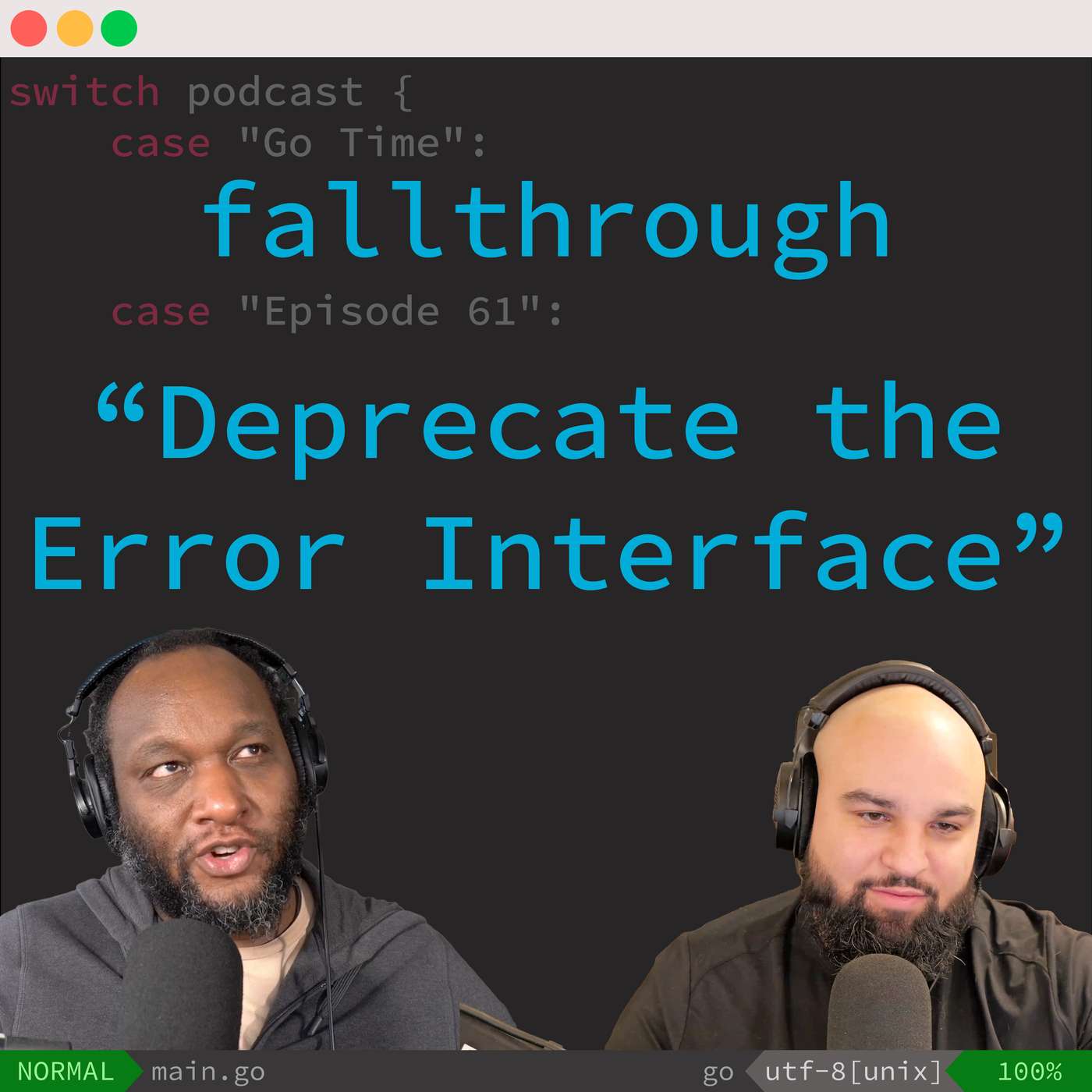
Deprecate the Error Interface
Another week, another Kris & Matt duo episode! This week, they're picking up where Bryan Cantrill's "Complexity of Simplicity" framework left off and asking what it means for Go's future. Kris argues Go is squarely rebellious (simple and emergent) and that the community needs to stop appealing to the Go team and start owning the ecosystem. The episode builds to a (potentially unpopular) proposal: deprecate the error interface.As always, we've got supporter content! This week that includes Oxide's counter-cultural approach to hiring, a riff on tech industry irony and title inflation, and a deep dive into why Go couldn't ship general-purpose coroutines. Not a supporter yet? Fix that today by heading over to https://fallthrough.fm/subscribe where you'll get not only extra content but also higher quality audio. Sign up today!If you prefer to watch this episode, you can view it on YouTube.No episode of Break this week. We'll have more aftershow episodes soon! In the meantime, catch up on previous episodes at https://break.show.Thanks for tuning in and happy listening!Table of Contents:Prologue (00:00:00)Chapter 1: Catching Up and Guest Plans (00:00:56)Chapter 4: Go as a Rebellious Language (00:05:38)Chapter 6: Go's Unique Position: Rebellious and Revolutionary (00:09:40)Chapter 7: Modules, SemVer, and Where Go Missteps (00:12:55)Chapter 8: Stop Appealing to the Go Team (00:16:01)Chapter 9: Building a Community-Owned Ecosystem (00:24:46)Chapter 10: Recapturing Go's Excitement (00:32:09)Chapter 11: The Problem With the Error Interface (00:41:01)Chapter 12: Multiple Returns and Deprecating the Error Interface (00:48:06)Epilogue (00:56:13)Hosts Kris Brandow - Host Matthew Sanabria - Host Socials:WebsiteBlueskyThreadsX/TwitterLinkedInInstagram (00:00) - Prologue (00:56) - Chapter 1: Catching Up and Guest Plans (05:38) - Chapter 4: Go as a Rebellious Language (09:40) - Chapter 6: Go's Unique Position: Rebellious and Revolutionary (12:55) - Chapter 7: Modules, SemVer, and Where Go Missteps (16:01) - Chapter 8: Stop Appealing to the Go Team (24:46) - Chapter 9: Building a Community-Owned Ecosystem (32:09) - Chapter 10: Recapturing Go's Excitement (41:01) - Chapter 11: The Problem With the Error Interface (48:06) - Chapter 12: Multiple Returns and Deprecating the Error Interface (56:13) - Epilogue
You may also like





Get this podcast on your phone, Free


Create Your Podcast In Minutes
- Full-featured podcast site
- Unlimited storage and bandwidth
- Comprehensive podcast stats
- Distribute to Apple Podcasts, Spotify, and more
- Make money with your podcast