Olympic National Park is the 8th most visited National Park in the US. About 95% of the park is roadless and designated wilderness, making it one of the most wild and undeveloped parks in the entire National Park system. Many of these most-visited parks have a significant road footprint, which makes much of their interior accessible. In contrast, Olympic National Park is largely one big wilderness, absent of roads. There are highways encircling it, and a few spur roads reaching in a few miles, but none...
Olympic National Park is the 8th most visited National Park in the US. About 95% of the park is roadless and designated wilderness, making it one of the most wild and undeveloped parks in the entire National Park system. Many of these most-visited parks have a significant road footprint, which makes much of their interior accessible. In contrast, Olympic National Park is largely one big wilderness, absent of roads. There are highways encircling it, and a few spur roads reaching in a few miles, but none passing through the interior.
Dosewallips River Trail is the remains of one such spur road that washed out in 2002. The road reroute/repair proved too costly, and so has added to the relative inaccessibility of the canyon.
When paired with the East Fork Quinault River Trail, this makes an enticing 35-mile multi-day backpack traverse through Enchanted Valley in the southern interior of the park.
The Enchanted Valley offers lush old-growth rainforests, towering mountains with countless waterfalls, and an iconic chalet, nestled in an absolutely stunning valley.
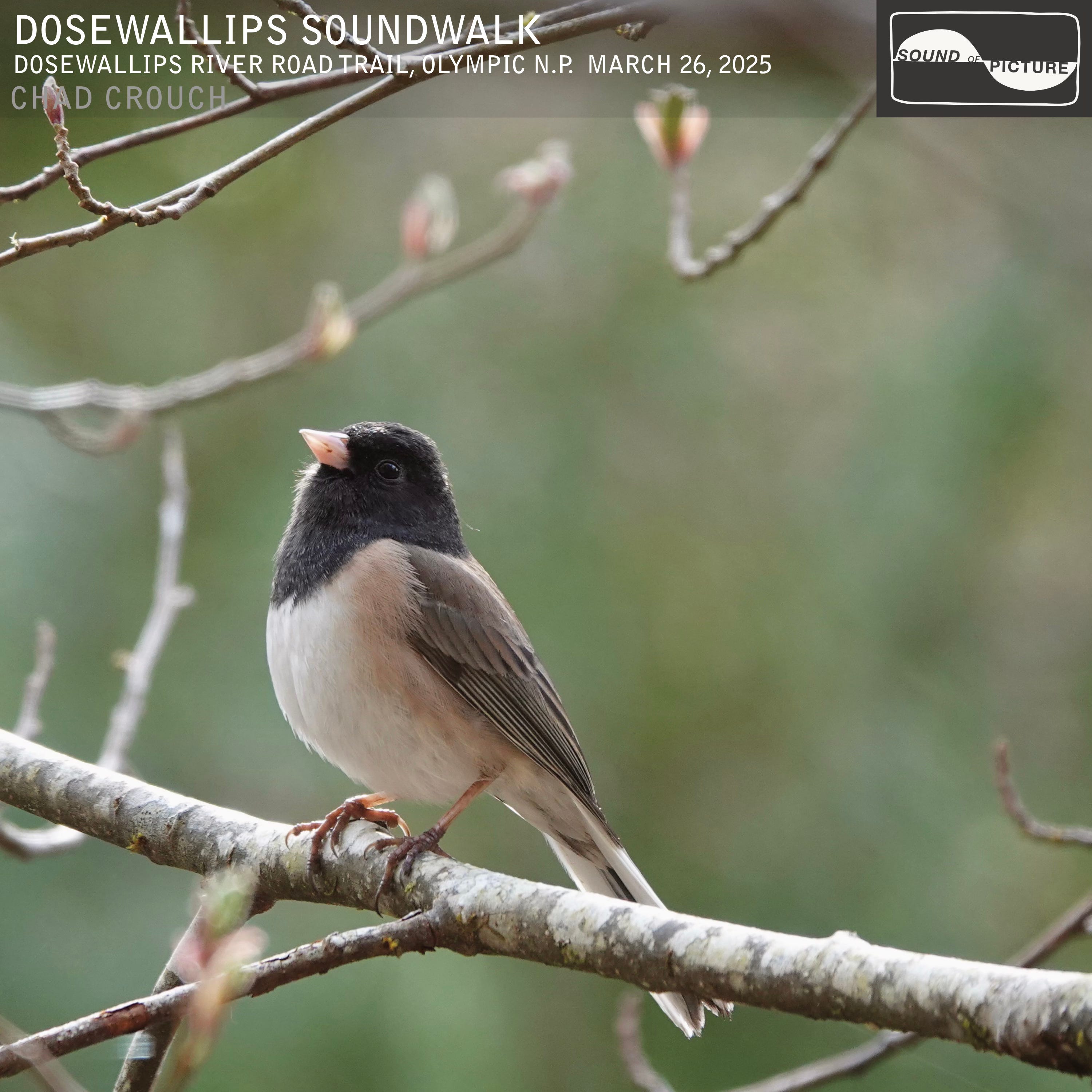
This soundwalk barely scratches the surface of the wilderness soundscape that awaits the visitor here, but it’s an appealing teaser. In these lower reaches, small wetlands thrive, fed by creeks coming down the mountain, making for ideal frog habitat.
Trilliums burst through the resplendent mosses found here.
A Great Blue Heron perches above a creek channel.
The name Dosewallips derives from a Twana Indian myth about a man named Dos-wail-opsh who was turned into a mountain at the river's source. Twana is the umbrella term for nine bands of Coast Salish groups that lived around Hood Canal, the largest being the Skokomish. As with so many tribes of the Pacific Northwest, a defining conflict the Skokomish faced over the last century was the salmon fishery collapse.
The ironically-named 1855 Treaty of Point No Point established a roughly 5000-acre reservation at the Skokomish River delta for the Twana bands, roughly 30 miles south of where the Dosewallips meets the Hood Canal, part of the Salish Sea. The 1920’s-era Cushman Dam projects on the North Fork of the Skokomish not only blocked fish passage to the upper river, they also removed the water from the river, tunneled it through a mountain, and dumped it directly into Hood Canal. From 1930 to 2008 the North Fork of the Skokomish ran nearly dry. Because lower river flows no longer flushed sediment and debris in the lower river, it caused a devastating pattern of flooding in the Skokomish valley where two-thirds of the Skokomish Reservation is within the floodplain.
After decades of legal struggle, the tribe reached a settlement in 2009 with Tacoma Power that resulted in a 2010 amendment to the dam’s federal license. This restored about 40% of natural river flows and gave the tribe joint management authority. The river now has considerably more water, a salmon restoration effort is in place on the North Fork, and the delta benefits from increased flows. Still, it’s just the first step toward restoration. The Skokomish valley is still flood-prone after 80 years of sediment aggradation, and the fish passage solutions are as yet underperforming.
So, what does this have to do with listening to the sounds of the Dosewallips River? For me, listening to a place just naturally arouses my curiosity. Who is making the sound? Why is it called Dosewallips? Who named it? Where are they now? What will I find upriver, downriver? How will the sound change? How has it changed over time?
That the mountain, river, and tribe were named after a mythical chief who was transformed into a mountain tells us something about a worldview tied to the language, where the landscape itself is imbued with not only personhood, but ancestry. Twana people viewed the river not as a resource, the land not as property, but as a living entity, as family. Coast Salish people spoke of animals with a similar non-hierarchical framing. Salmon were seen as gift-bearing relatives.
This was such a departure from the Euro-American worldview it was, and is, both hard to grasp and easy to dismiss. With the benefit of hindsight, though, it’s worth questioning how the English language encodes a worldview that can lead to short-sighted outcomes.
My score for the Dosewallips soundwalk is very relaxed and minimal; just four instrument voices in all. I drew inspiration from the frog choruses. It’s unusual for me to rest on an undulating single chord arpeggio for several minutes, but that’s what felt right for “Part 7, Frog Chorus”.
Now that I know a little more about the area, I’m eager to make a return. Thanks for reading and listening. Dosewallips Soundwalk is available on all music streaming services today, February 13th, 2026.
This is a public episode. If you'd like to discuss this with other subscribers or get access to bonus episodes, visit chadcrouch.substack.com/subscribe