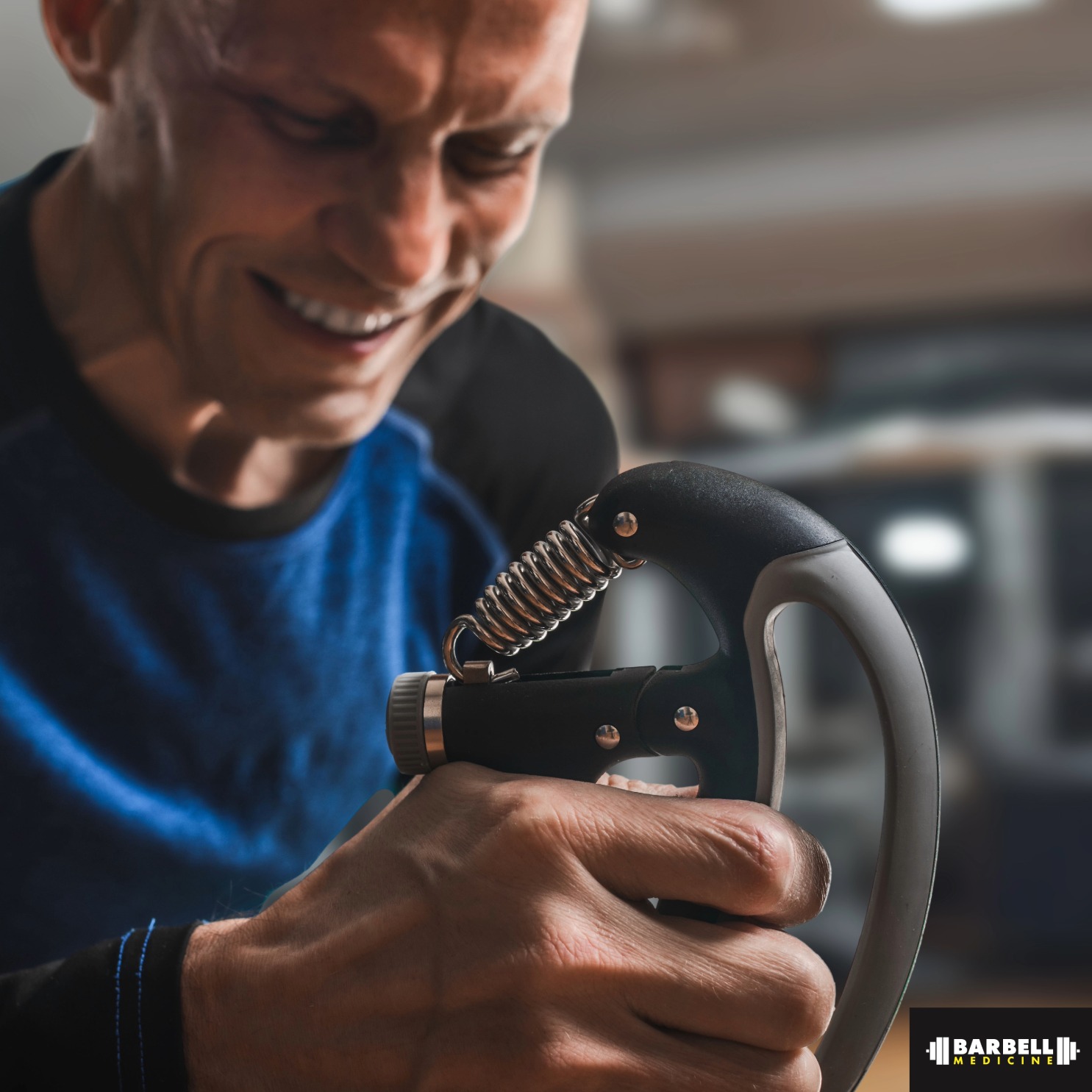
Can a simple one-second squeeze predict your risk of cardiovascular disease, cognitive decline, and all-cause mortality? Dr. Jordan Feigenbaum and Dr. Austin Baraki explore why grip strength has become the go-to metric for the longevity industry and why most people are interpreting the data incorrectly.Timestamps:[00:00] Intro: The Longevity Industry’s Thermometer Error[01:42] The Neuro-Axis: Anatomy of a Maximal Squeeze[06:43] The 35-3-5 Rule: Biomechanics of Grip[09:12] Asymmetries and Clinical Red Flags[17:31] Dynapenia vs. Sa...
Can a simple one-second squeeze predict your risk of cardiovascular disease, cognitive decline, and all-cause mortality? Dr. Jordan Feigenbaum and Dr. Austin Baraki explore why grip strength has become the go-to metric for the longevity industry and why most people are interpreting the data incorrectly.
Timestamps:
- [00:00] Intro: The Longevity Industry’s Thermometer Error
- [01:42] The Neuro-Axis: Anatomy of a Maximal Squeeze
- [06:43] The 35-3-5 Rule: Biomechanics of Grip
- [09:12] Asymmetries and Clinical Red Flags
- [17:31] Dynapenia vs. Sarcopenia: Why the Hand Fails First
- [18:41] Normative Data and the PURE Study Statistics
- [27:16] Genetics, Lean Body Mass, and Predictive Power
- [31:44] Absolute vs. Relative Grip Strength (The Metabolic Signal)
- [37:03] Bro-Science Beatdown: Neural Jitter and Training Readiness
- [42:19] The Extensor Training and "Grip Maxing" Myth
- [45:13] Programming: Systemic Training vs. Indirect Grip Work
- [48:10] The Straps Debate: Are You Killing Your Gains?
- [52:03] Final Verdict: Hierarchy and Health Priorities
Key Takeaways:
- Grip is Systemic: Handgrip strength tests the integrity of the entire system, from the motor cortex in the brain down to the tendons and bones. It is a proxy for overall muscular quality and neurological health.
- Predictive Power: According to the PURE study, for every 5 kg decrease in grip strength, there is a 17% increased risk of cardiovascular death and a 7% increased risk of non-cardiovascular death.
- The Sarcopenia Floor: Clinical "red zones" for probable sarcopenia are
View more