
The Intercept Briefing
https://feeds.acast.com/public/shows/f5b64019-68c3-57d4-b70b-043e63e5cbf6Episode List

Can the Left Win in the Midwest? Abdul El-Sayed Says Yes.
On Tuesday, Abdul El-Sayed and Rep. Haley Stevens, D-Mich., will face off in the Michigan Democratic Senate primary. The race is the next biggest test of whether progressives can win statewide, particularly in purple territory.The Michigan race is one of the most expensive primaries of the cycle. Outside groups have spent upward of $50 million in support of Stevens or against El-Sayed. Most of that money is coming from the American Israel Public Affairs Committee and its affiliated groups — close to $30 million, which their largest investment ever in a single race, according to The AP.“It's just anti-democratic on its own terms,” El-Sayed, the former public health official, tells The Intercept Briefing. “I always ask people, “OK, you're covering this as a very close race, but would it be close if they didn't have $60 million to spend? Would it even be a close race at all?’”This week on The Intercept Briefing podcast, host Akela Lacy asks, can progressives win outside of blue cities? El-Sayed argues, if you focus on the issues people care about and act on them, you can: "Look, you have an option that's not bought off by all the same corporations. And that option is desperately clear about wanting you to have healthcare, and also wanting your kid to have a good school, and also making sure that there's not a data center that gets planted in your backyard to automate your job away.”Lacy explores that question further with Ryan Clancy, a Wisconsin state representative and founding member of the state legislature’s current Socialist Caucus, and Thom Hartmann, a progressive political commentator. Clancy says voters he speaks to in Milwaukee “want a fighter. People want people in office who are going to fight for the middle class, fight for actual transformative change.” He adds, “The idea that in order to win in a purple district that is roughly split between Democrats and Republicans, that you need when you're a Democrat, to look as much like a Republican as possible is just not helpful.” Polling suggests that El-Sayed has a commanding lead over Stevens in the Democratic primary. But polls for the November general election narrow sharply when El-Sayed is up against Trump-backed Republican candidate Mike Rogers; one shows Rogers beating him by 10 percentage points, which the Stevens’s campaign has leaned into.“We've been in this change moment. We're sick and tired of neoliberalism. We're sick and tired of Reaganism. We're sick and tired of the status quo. We're sick and tired of a dying middle class. We have been living in this moment, in my opinion, since 2000, and I think in a big way since 2008. Obama promised hope and change, and really just brought us a bunch of health insurance companies,” says Hartmann. “I'm not sure if we're there yet to the point where a good message like El-Sayed's message can overcome millions of dollars from Israel and from big corporations. That's going to be the big challenge.”The Intercept invited Stevens on the program for an interview but as of publishing have not heard back yet.Full transcript: https://interc.pt/4fRLS8aKeep our investigations free and fearless at theintercept.com/join. Hosted on Acast. See acast.com/privacy for more information.

Trump’s National Killer Police Force
Within the span of a week, federal immigration agents shot and killed two people in Maine and Texas, and another was hit by a truck and killed in Florida after trying to avoid ICE agents. A fourth person recently died in ICE custody after reportedly being denied medication. Their deaths prompted yet another round of questioning as to how federal immigration agents have amassed so much power and so little accountability. This week on The Intercept Briefing, host Akela Lacy speaks with Naureen Shah, of the American Civil Liberties Union, and Nayna Gupta, of the American Immigration Council, on the consequences of allowing the government to build a national policing force that’s bringing Trump’s war on immigrants into communities across the country.“The $240 billion injection that the Trump administration has given ICE and Border Patrol make these agencies — which already were the largest federal law enforcement agencies — make them far larger than anything that we've seen at the federal law enforcement level,” says Shah. “Their budgets are bigger than that of many, actually most militaries around the world.”“It's not really just about who they're hiring and even the training that they're getting — it's the message that they get all the way from the top,” says Shah. “And of course, the message after the killings of Alex Pretti and Renee Good was, you have immunity in the conduct that you're engaged in. It's basically a message of, you're going to get away with it. Don't worry about it.”“The signal from the very top of the administration is unmistakable: Arrest as many people as possible without regard for the actual impact on public safety, without regard for the killings that may result, the harm that results.”Congressional funding for those agencies has outpaced any action on comprehensive immigration reform. And with Republicans pushing to strip voting rights from millions of Americans while campaigning against immigrants, says Gupta, the solution is to neutralize their argument by creating a path to citizenship — a proposal with broad bipartisan support. “There's no question that the immigration enforcement agenda that this administration is pursuing ties to voting rights. Now, the question is, given that, how do we still make sure we're offering solutions and reforms that can be viable and build a broad enough coalition of support to overwhelm that far-right base and the way they've weaponized this issue?” Gupta says. “I think those kinds of conversations are a more effective antidote to the far right's effort to weaponize the immigration system, not only to hurt immigrants, but to hurt core democratic rights like the right to vote.”Full transcript: https://interc.pt/4wk7elzKeep our investigations free and fearless at theintercept.com/join. Hosted on Acast. See acast.com/privacy for more information.

Trump’s Formula for Forever Wars
President Donald Trump blew up the temporary ceasefire after the U.S. launched a series of airstrikes against Iran over the weekend. The two nations have continued to exchange strikes throughout the week, with Iran targeting U.S. allies in the Middle East, as Congress debates further entangling the United States military with Israel — a proposal that would give Israel enormous leverage over U.S. defense policy.“This is a formula for a forever war,” national security reporter Spencer Ackerman tells The Intercept Briefing. A major champion of such forever wars was Sen. Lindsey Graham, who passed away over the weekend. “Lindsey Graham never met a war he didn't like, never met a war he didn't want to send other people's children to wage,” says Ackerman, who writes the Substack Forever Wars. “The white whale for Lindsey Graham and many others in the bridge between neoconservatism and MAGA was Iran — assaulting Iran not only at home, but rolling back its regional challenge to U.S. and Israeli power in the Middle East.”“Whatever else MAGA says about wars,” says Ackerman, “what it wants is domination. It wants domination not only at home, but abroad. That's where Graham recognized — that instead of being someone like John McCain, who sought to occasionally butt against, fight against Donald Trump — that Graham could help maneuver Trump into being a vehicle for their shared project. And he did that with really tremendous success.”“It occasionally cost Graham dignity, but ... he saw that as an easy trade-off if it meant maneuvering Trump into a kind of position that Graham, had he been president, had he been secretary of state, had he been secretary of defense, would've wanted to pursue.”In a recent piece for Forever Wars, Ackerman writes about Graham’s legacy of warmongering and preserving Guantánamo Bay, or as he describes it, “an extrajudicial cage that is still swallowing people.” Ackerman has reported from Iraq, Afghanistan, Guantánamo Bay, and many U.S. bases. He currently writes for Zeteo and Forever Wars, where you can sign up for his newsletter. Politics reporter Akela Lacy also drops in to discuss how the turmoil at home and abroad is impacting the midterms. After Democratic Senate candidate Graham Platner dropped out of the race, Lacy says, “Maine Democrats are in a situation where they're all trying to become the nominee that the party picks to replace Platner on the ballot to go against Collins in November. Many of those candidates have now come out and called to abolish ICE outright after the shooting in Maine."Keep our investigations free and fearless at theintercept.com/join. Full transcript: https://interc.pt/4wMaTbq Hosted on Acast. See acast.com/privacy for more information.

INTRODUCING: First America by Rebecca Nagle
The Intercept Briefing is happy to share the first episode of journalist Rebecca Nagle's new podcast series, First America. Episode Description: We’ve all been told the American Revolution was fought over taxation and representation. But that’s not what the Declaration of Independence says. According to our founders, in their own words, what they were most upset about was Native Americans. How did we all miss that? Rebecca sits down with historian Ned Blackhawk (Western Shoshone) to talk about how hunger for Indigenous land drove the Revolution. Welcome to First America, the true story of how the United States came to be, and how our current political moment was 250 years in the making.Rebecca Nagle is an award-winning advocate and writer focused on advancing Native rights and ending violence against Native women. Nagle is a citizen of Cherokee Nation and a two spirit/queer woman. Nagle is the host of the podcast This Land focused on treaty rights and tribal sovereignty in Oklahoma. Hosted on Acast. See acast.com/privacy for more information.
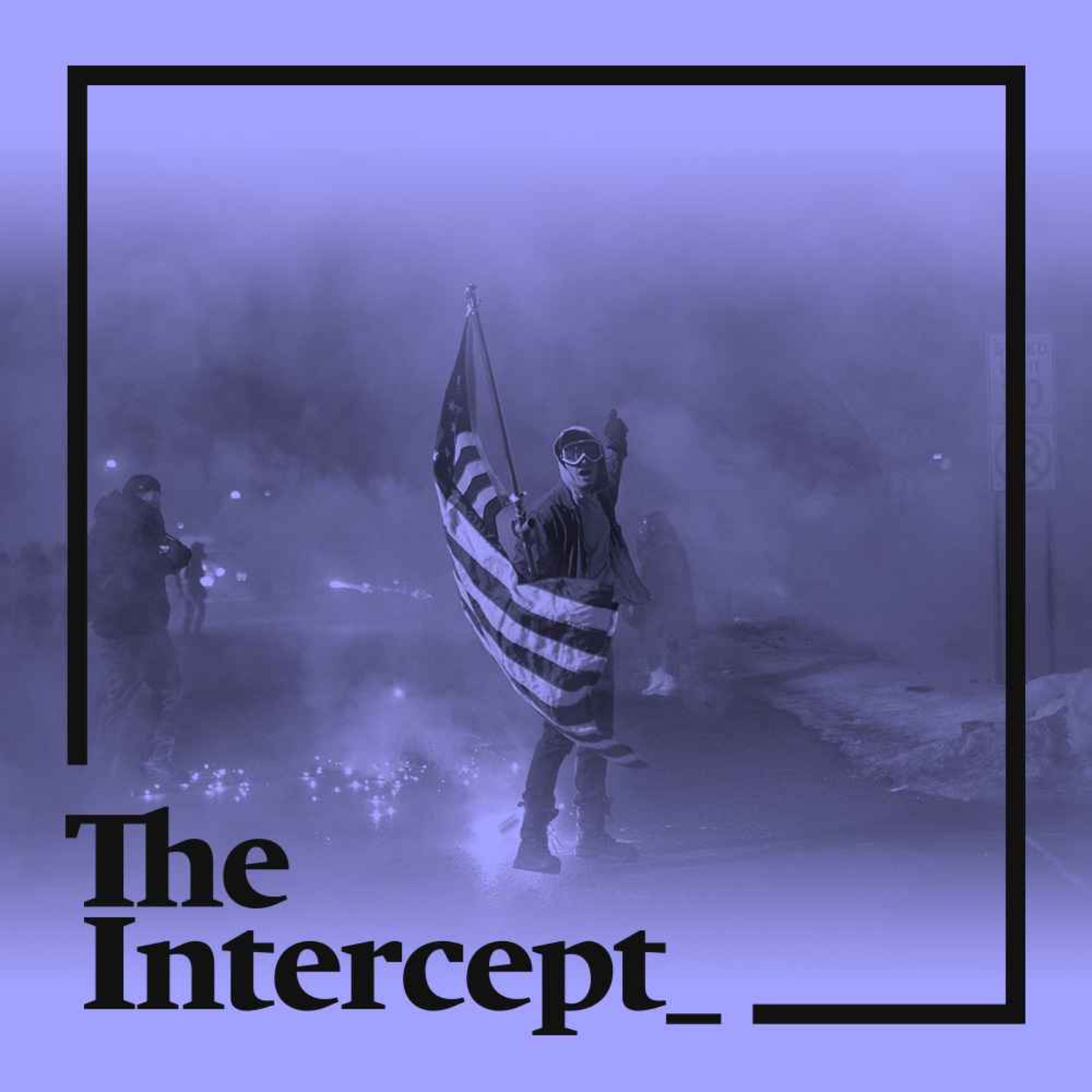
Rebecca Nagle on the Boomerang of Empire
Last spring, President Donald Trump issued the “Restoring Truth and Sanity to American History” executive order, taking aim at federal parks, monuments, museums, and sites that have cast the United States’s “founding principles and historical milestones in a negative light.” On the Fourth of July this year, the White House published its 162-page “Saving America’s Story,” attacking the Smithsonian Institution directly for “anti-white activism,” “illegal alien activism,” “transgender activism,” and more broadly for adopting “an ideological framework that no longer treats the American story as a shared national inheritance to be taught or celebrated, but as a political instrument to divide, dispirit, and discourage our citizens.”“We're in this moment where we are fighting over how America tells its past,” journalist Rebecca Nagle tells The Intercept Briefing. “It can be scary in a moment when it feels like the stakes are really high to really interrogate the myths that we all carry, that we all hold about who our country is and where it started because it's really tempting to want to think, 'OK, if we just wind the clock back 10 years, if we just go back a few election cycles, we'll be back to a democracy that's strong, that's stable, that's solid, and we'll all be fine.’ It's much more scary to say, ‘Oh, actually, if we want to talk about where authoritarianism comes from in the United States, it's actually at the foundation.’”As the United States celebrates its 250th birthday this year, the Trump administration has been ramping up its efforts to erase not just the dark parts of U.S. history but also the contributions of basically anyone who isn’t a white, Christian man. That project has included taking concrete steps to remove all traces of the history of people who don’t fit that description, Black people, immigrants, civil rights advocates, women and gay and trans people — including the first people to live on this land: Native Americans.This week on the podcast, Nagle speaks to host Akela Lacy about her new podcast series “First America,” which examines how Native people have been largely written out of the American story, and how that story informs the current political crisis in the U.S.“One of the big claims that the series makes is that the foundation is in itself is a myth. Because at the same time that our founders were building a democracy, they were also building an empire. The way that you govern an empire, the way that you govern other people by force, is not democratic,” says Nagle, a citizen of Cherokee Nation. “This identity crisis we're having around authoritarianism and democracy, and how could authoritarianism be sneaking into our democracy — what we argue is that it's actually always been there.”“A lot of what is happening now — it's not new, it's not un-American, it's not unprecedented. Sometimes it's not even unconstitutional! It's actually just taking these parts of our government that for a long time most Americans didn't know was there or didn't really think about, and Trump is just pulling it into the center,” says Nagle. Full transcript: https://interc.pt/44WnPj7Keep our investigations free and fearless at theintercept.com/join. Hosted on Acast. See acast.com/privacy for more information.







Get this podcast on your phone, Free


Create Your Podcast In Minutes
- Full-featured podcast site
- Unlimited storage and bandwidth
- Comprehensive podcast stats
- Distribute to Apple Podcasts, Spotify, and more
- Make money with your podcast
