
Hotel Bar Sessions
https://feeds.transistor.fm/hotel-bar-sessionsEpisode List

Failure
We live in an age with a curiously cheerful relationship to failure. But that optimism was built for a world that no longer quite exists. For three generations now, doing everything right-- getting an education, holding down a full-time job, following the sensible plan-- has stopped reliably buying a house or a secure retirement. When a single failure can be genuinely ruinous, the advice to dust yourself off and "fail fast, fail forward, fail better" starts to sound like a privilege reserved for those who can already afford it.So what actually is failure? Who who sets the standard? Is failure really as generative as we like to tell ourselves, or is that a comforting story that only holds up when the stakes are low? Can a person fail at life, or only in it? And if our failures have become so devastating that no one dares risk them, is the fix a better attitude toward failing, or a world that stops punishing people so severely for it?This week, we take seriously the possibility that our growing dread of failure is a rational response to a world that has made failing unaffordable. The real answer, we suggest, may be less about how to fail better and more about how to build a world where other people's failures aren't so ruinous.Grab a drink and join us as we fail our way through Beckett, Nietzsche, Kierkegaard, and Camus toward some clearer sense of what it means to fall short — and toward imagining Sisyphus, if not happy, then at least clear-eyed.Full episode notes available at this link:https://hotelbarpodcast.com/podcast/failure---------------------SUBSCRIBE to the podcast now to automatically download new episodes!SUPPORT Hotel Bar Sessions podcast on Patreon here! (Or by contributing one-time donations here!)BOOKMARK the Hotel Bar Sessions website here for detailed show notes and reading lists, and contact any of our co-hosts here.Hotel Bar Sessions is also on Facebook, YouTube, BlueSky, Instagram, and TikTok. Like, follow, share, duet, whatever... just make sure your friends know about us! ★ Support this podcast on Patreon ★

Multi/Race/Less/Ness (with Jon Ivan Gill)
Our guest for this episode, Jon Ivan Gill (Gustavus Adolphus College), argues in his recent book, Multi/Race/Less/Ness (Bloomsbury, 2025) that race is trauma. Not that race "causes" trauma, but rather that the assignment of metaphysically fixed and static racial categories to people is itself a trauma. Gill contends that we are coerced to accept the limitations imposed by racial categories, which not only severely restrict our life possibilities, but cause us to fundamentally misapprehend the dynamic, ever-changing, and ever-evolving reality of human being and human identity, which is always in flux.In an innovative reformulation of well-worn race-abolitionist positions, Gill rejects racial categories as "useless abstractions" and refuses to adopt them as identifiers. While acknowledging that he cannot stop others from identifying him racially, he recommends to the rest of us what he calls "multi/race/less/ness," a dynamic category (inspired by Whitehead's process philosophy) that provides more breathing room for navigating the often suffocating metaphysics of race. Grab a drink and join us for this frank and substantive exchange, with many significant disagreements unpacked along the way about what is and is not worth preserving in the category of "race," and how.Full episode notes available at this link:https://hotelbarpodcast.com/podcast/multiracelessness---------------------SUBSCRIBE to the podcast now to automatically download new episodes!SUPPORT Hotel Bar Sessions podcast on Patreon here! (Or by contributing one-time donations here!)BOOKMARK the Hotel Bar Sessions website here for detailed show notes and reading lists, and contact any of our co-hosts here.Hotel Bar Sessions is also on Facebook, YouTube, BlueSky, Instagram, and TikTok. Like, follow, share, duet, whatever... just make sure your friends know about us! ★ Support this podcast on Patreon ★

Trust
Surveys say we're living through a "trust crisis," and some version of that has been true since at least the '70s. Confidence in the press, in the courts, in public health agencies, in elected officials, in one another has been down, and still going down. At this point, mistrust reads as our default civic posture. And yet here we all are, getting through our days by handing out trust more or less constantly and mostly without noticing. We tell a friend something we'd rather nobody else knew. We take what the pharmacist gives us without looking it up. We drive over the bridge, trusting that it will hold. So what is trust? A calculation about how somebody is likely to behave, or something closer to a relationship that can absorb being let down without collapsing? What separates trusting a person from merely depending on one? And why does betrayal land as a different order of injury than disappointment, when the practical damage can be identical? Whenever the day arrives that we are post-Trump, and it will arrive, plenty of us are going to demand that our institutions and, in some cases, our own friends and relatives earn our trust back. It's worth working out ahead of time what we'd actually be asking for. A change in their behavior? Or a decision on our part to lower our guard? Because for a lot of people, distrust is hard-won knowledge about how things really go, and being told that it's a lapse in civic virtue tends to land badly. Grab a drink and join us as we try to work out whether trust is something you decide to give or something that happens to you.Full episode notes available at this link:https://hotelbarpodcast.com/podcast/trust---------------------SUBSCRIBE to the podcast now to automatically download new episodes!SUPPORT Hotel Bar Sessions podcast on Patreon here! (Or by contributing one-time donations here!)BOOKMARK the Hotel Bar Sessions website here for detailed show notes and reading lists, and contact any of our co-hosts here.Hotel Bar Sessions is also on Facebook, YouTube, BlueSky, Instagram, and TikTok. Like, follow, share, duet, whatever... just make sure your friends know about us! ★ Support this podcast on Patreon ★

The Right to Die
When Leigh's cat Sugar was dying of congestive heart failure, the vet's office offered her something almost no human being will ever be offered: the chance to hold her, to tell her she was loved and thank her, and to be present while a doctor helped her die without pain, without fear, and not alone. Afterward, Leigh's first thought was, I hope my death is this good. Most of us won't get one. We will die in a hospital bed, wired to machines, running up a bill somebody we love will inherit — and almost nobody says that's what they want. Meanwhile, the last year of an American life is the most profitable one, and a dignified death has quietly become a luxury good. Is there — should there be — such a thing as a "right to die," the dark companion of the right to life we all assume we already have? We already honor a patient's refusal of life-sustaining treatment; we let people sign DNRs, decline resuscitation, have the respirator removed. Is there any principled reason to honor that autonomy everywhere except the one place a person tries to use it? What is the "sound mind" requirement actually screening for, given that wanting to die was long treated as disqualifying all by itself? And can we talk seriously about dying with dignity inside a system that barely guarantees anyone the right to live with dignity?Grab a drink — no hemlock cocktails, please — and join us as we ask what it would take to receive the deaths we already afford our pets.Content note: this episode discusses death, dying, end-of-life decision-making, euthanasia, and suicide throughout, at times in personal terms. In the U.S., the 988 Suicide & Crisis Lifeline is available by call or text. Full episode notes available at this link:https://hotelbarpodcast.com/podcast/righttodie---------------------SUBSCRIBE to the podcast now to automatically download new episodes!SUPPORT Hotel Bar Sessions podcast on Patreon here! (Or by contributing one-time donations here!)BOOKMARK the Hotel Bar Sessions website here for detailed show notes and reading lists, and contact any of our co-hosts here.Hotel Bar Sessions is also on Facebook, YouTube, BlueSky, Instagram, and TikTok. Like, follow, share, duet, whatever... just make sure your friends know about us! ★ Support this podcast on Patreon ★
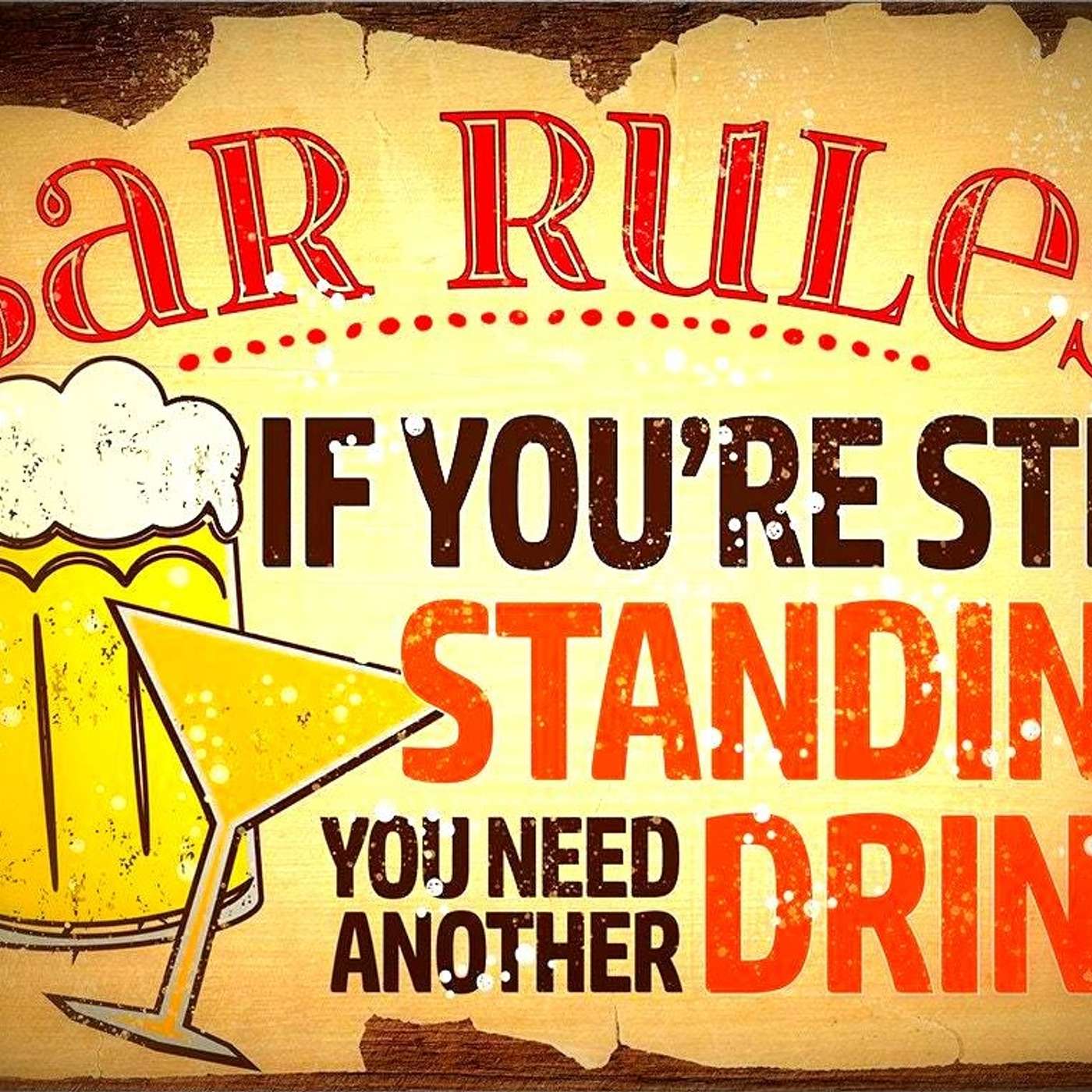
Rules
What's the difference between a rule that describes the world and one that governs it? Leigh, Jen, and Bob start with a complaint about Robert's Rules of Order and end up in the deep end: the categorical imperative, the social contract, the rule of law, and what it would mean to live without any rules at all. Full episode notes available at this link:https://hotelbarpodcast.com/podcast/rules---------------------SUBSCRIBE to the podcast now to automatically download new episodes!SUPPORT Hotel Bar Sessions podcast on Patreon here! (Or by contributing one-time donations here!)BOOKMARK the Hotel Bar Sessions website here for detailed show notes and reading lists, and contact any of our co-hosts here.Hotel Bar Sessions is also on Facebook, YouTube, BlueSky, Instagram, and TikTok. Like, follow, share, duet, whatever... just make sure your friends know about us! ★ Support this podcast on Patreon ★
You may also like







Get this podcast on your phone, Free


Create Your Podcast In Minutes
- Full-featured podcast site
- Unlimited storage and bandwidth
- Comprehensive podcast stats
- Distribute to Apple Podcasts, Spotify, and more
- Make money with your podcast
