
The Think Wildlife Podcast
https://api.substack.com/feed/podcast/1189522.rssEpisode List
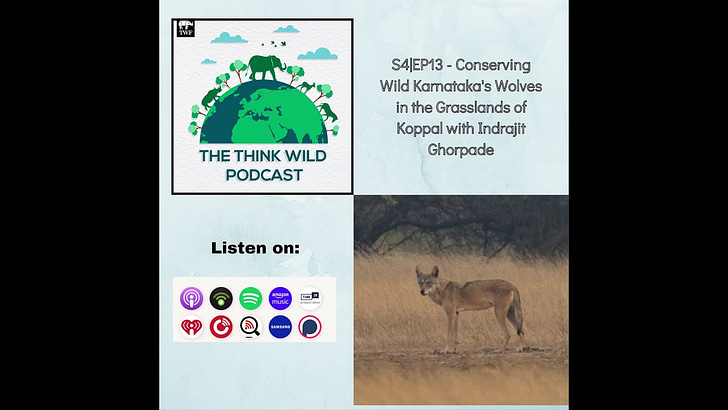
S4|EP13 - Conserving Wild Karnataka's Wolves in the Grasslands of Koppal
In this compelling episode of The Think Wildlife Podcast, host Anish Banerjee speaks with Indrajit Ghorpade, founder of the Deccan Conservation Foundation, about wolf conservation in the Koppal District of Karnataka and the overlooked biodiversity of the Deccan Plateau. The conversation offers a rare, ground-level perspective on the Indian wolf and the urgent need to rethink how India approaches grassland conservation and biodiversity management outside forested landscapes.Koppal District, located in the Deccan Plateau, represents one of the last strongholds of the Indian wolf, a subspecies of the gray wolf uniquely adapted to India’s arid and semi-arid grasslands. Often misunderstood and neglected, the Indian wolf has survived for centuries in human-dominated landscapes shaped by pastoralism and dryland agriculture. Indrajit explains how wolf conservation in this region is inseparable from protecting grassland ecosystems that are routinely misclassified as wastelands, despite supporting exceptional grassland biodiversity.The episode explores the ecological importance of open grasslands for species such as wolves, blackbucks, foxes, hyenas, and ground-nesting birds, and why the loss of these habitats has driven widespread declines across Indian biodiversity. Indrajit reflects on how tiger-centric conservation narratives have overshadowed species like the Indian wolf, leading to gaps in policy, funding, and public awareness. Through years of fieldwork, research, and advocacy, his work has helped establish India’s second wolf sanctuary at Bankapur, demonstrating that targeted protection can make a measurable difference even in fragmented landscapes.A key theme of the discussion is coexistence. Wolves in Koppal largely survive outside protected areas, navigating livestock grazing, agriculture, roads, and renewable energy infrastructure. Indrajit unpacks the realities of human–wolf interactions, the role of free-ranging dogs, hybridization concerns, and the importance of education in reducing conflict. Rather than portraying wolves as threats, the episode reframes them as keystone predators essential for regulating ecosystems and sustaining long-term biodiversity conservation.Listeners will gain insight into why grassland conservation is central to the future of Karnataka biodiversity and the biodiversity of India more broadly. From blackbucks roaming open plains to wolves using rocky outcrops as breeding refuges, the episode highlights how wild Karnataka extends far beyond forests and protected reserves. This conversation is essential listening for anyone interested in wolf conservation, Indian wolf conservation, gray wolf conservation, grassland biodiversity, and the future of biodiversity management in India’s most neglected ecosystems.#wolf #wolfconservation #IndianWolf #Indianwolfconservation #graywolf #graywolfconservation #grassland #grasslandconservation #biodiversityconservation #biodiversitymanagement #Indianbiodiversity #grasslandbiodiversity #blackbucks #wildKarnataka #Karnatakabiodiversity #biodiversityofKarnataka #biodiversityofIndia Get full access to The Think Wildlife Podcast at anishbanerjee.substack.com/subscribe
S3|EP12 ~ Restoring India’s Oceans through Artificial Reefs for Marine Biodiversity Conservation with Oishinee Chakraborty
India’s coastal waters hold immense promise—and growing peril. In this episode of the Think Wildlife Podcast, host Anish Banerjee speaks with Oishinee Chakraborty from the Kuddle Life Foundation, a young organization redefining marine conservation in Pondicherry through science, community collaboration, and artificial reefs.Oishinee introduces listeners to the Foundation’s origins—founded in 2020 by Punit Dhandhania and Hans Dhandhania, who transformed a small circle of ocean enthusiasts into a leading grassroots force for marine ecology and biodiversity conservation. With limited institutions working on ocean protection in southern India, Kuddle Life fills a critical gap by creating local, science-driven projects that link marine ecosystems, coastal livelihoods, and sustainable development.At the heart of their work lies the artificial reef program—a groundbreaking effort to restore degraded marine ecosystems and revive marine biodiversity. Oishinee explains that space is the ocean’s most limiting factor, and artificial reefs—built using eco-friendly materials like concrete and steel—mimic the natural hard surfaces that corals, sponges, and fish larvae need to attach, grow, and form thriving underwater communities. These structures replicate some functions of natural coral reefs, acting as catalysts for marine biodiversity management and ecosystem recovery.The process of building an artificial reef begins with community engagement. Fisherfolk are invited to share local ecological knowledge and help identify suitable sites for reef deployment. Scientists then assess seabed topography, water quality, and existing biodiversity before designing reef modules—each over 500 kg and a meter tall. Local divers and fishermen help deploy the structures less than five kilometers offshore, making the effort both participatory and empowering.Monitoring continues for years, as reefs mature and attract a diversity of marine wildlife. In Pondicherry, Kuddle Life has recorded remarkable results: a 20% rise in dissolved oxygen, increased chlorophyll levels, and nearly a fourfold growth in fish abundance. For local fishers, incomes have doubled—from ₹5,000 to ₹10,000 per day—while fuel costs have halved because fishing now occurs closer to shore. These outcomes highlight how marine biodiversity conservation can drive both ecological and economic resilience.Globally, artificial reefs have become vital tools for restoring marine ecosystems damaged by climate change, overfishing, and pollution. Yet, as Oishinee reminds us, nothing can replace natural coral reefs. Artificial structures can only supplement lost habitat, not substitute for nature’s complexity. Still, by reviving degraded areas and promoting sustainable fishing, these reefs help maintain ocean productivity in a warming world.Beyond reef restoration, the Kuddle Life Foundation runs educational and research programs across India. Through marine litter surveys, bycatch reduction initiatives, dive training, and youth internships, the foundation is building a generation of ocean stewards. Its unique for-profit dive center reinvests earnings into conservation, while volunteers support marine ecology projects both underwater and onshore—from data analysis to biodiversity monitoring.Oishinee also discusses the challenges of sustaining NGO work in India—funding barriers, bureaucratic delays, and the slow pace of conservation impact. Yet, she finds hope in the growing public interest in marine biodiversity, particularly when students and non-biologists approach her asking how they can help. That curiosity, she believes, is the first step toward lasting ocean change.This episode reveals how grassroots innovation, science, and compassion are reshaping marine biodiversity hotspots along India’s coast—proving that ocean recovery begins not just beneath the waves, but within communities themselves.#artificialreefs #marineecology #marineecosystems #marinebiodiversity #marineconservation #marinewildlife #marinebiodiversityhotspot #marinebiodiversityconservation #biodiversityconservation #biodiversity #biodiversitymanagementAbout the HostAnish Banerjee is an early career ecologist, with a MSc in Ecology, Evolution and Conservation from Imperial College London. He is the founder of Think Wildlife Foundation and a biodiversity policy analyst at Legal Atlas. He is also the author of the following field guides:Field Guide to the Common Wildlife of India: https://amzn.in/d/2TnNvSEField Guide to the Mammals of Singapore: https://amzn.in/d/gcbq8VG Get full access to The Think Wildlife Podcast at anishbanerjee.substack.com/subscribe
S3|EP11 ~ Guardians of Nepal’s Wildlife: Tackling Poaching, Human-Wildlife Conflict, Orchid Conservation and Community Engagement with Greenhood Nepal
Nepal is home to some of the world’s most iconic wildlife — from tigers, rhinos, and elephants to lesser-known species like pangolins and medicinal orchids. Yet behind its breathtaking biodiversity lies a complex struggle against wildlife poaching, illegal wildlife trade, and habitat loss. In this episode of the Think Wildlife Podcast, we speak with Kumar Paudel, founder and director of Greenhood Nepal, one of the nation’s leading conservation organizations working to combat wildlife crime and promote community conservation across the Himalayas.Kumar shares his inspiring journey from a childhood in the mountains of Nepal to leading national efforts in biodiversity conservation. Through his work with Greenhood Nepal, he has helped transform the country’s conservation landscape — from early advocacy against poaching and corruption to the establishment of community-based monitoring networks and policy reform. Under his leadership, Nepal became the first nation to achieve zero poaching of rhinos, elephants, and tigers, an achievement rooted in strong enforcement, military protection, and deep community engagement.The conversation delves into the evolution of Nepal’s conservation success. Kumar discusses how community intelligence and local anti-poaching networks have become vital in protecting wildlife across national parks and buffer zones. Yet, he warns that while attention often centers on charismatic megafauna like tigers and rhinos, smaller and lesser-known species such as pangolins, tortoises, and orchids face rising threats from illegal wildlife trade and unsustainable harvesting.Greenhood Nepal’s work along the China–Nepal border provides critical insights into cross-border wildlife trade networks, revealing the motivations behind trafficking and empowering enforcement agencies through training, data sharing, and behavioral change campaigns. Kumar also highlights their pioneering research on orchid conservation, mapping over 500 native species — including more than 100 medicinally important orchids — and developing sustainable management plans that align with CITES compliance.The discussion also explores pangolin conservation, where Greenhood has led community outreach, identified priority habitats, and hosted Nepal’s first Pangolin Conservation Roundtable, catalyzing national policy action. Kumar explains how the team’s on-ground efforts — from habitat restoration to education and enforcement — have shaped the future of biodiversity management in Nepal.Beyond enforcement, Kumar reflects on the importance of compassion and understanding. His most memorable conservation experience came from visiting prisons and speaking with wildlife offenders, gaining firsthand insights into the socio-economic pressures that drive poaching and wildlife trade. His reflections underscore that sustainable conservation depends on addressing poverty, awareness, and opportunity — not just punishment.We also revisit Nepal’s remarkable success in tiger conservation, where populations have nearly tripled between 2010 and 2022, and discuss emerging challenges such as human–wildlife conflict. As Nepal continues to balance conservation and development, Kumar calls for stronger investment in coexistence strategies, habitat restoration, and community-led solutions.This episode offers an in-depth look at the intertwined issues of wildlife crime, community conservation, and biodiversity preservation in one of the world’s richest ecological regions. Tune in to learn how Nepal’s story of resilience, innovation, and collaboration continues to inspire the global conservation movement.About the HostAnish Banerjee is an early career ecologist, with a MSc in Ecology, Evolution and Conservation from Imperial College London. He is the founder of Think Wildlife Foundation and a biodiversity policy analyst at Legal Atlas. He is also the author of the following field guides:Field Guide to the Common Wildlife of India: https://amzn.in/d/2TnNvSEField Guide to the Mammals of Singapore: https://amzn.in/d/gcbq8VG#Nepal #tigers #elephants #rhino #wildlife #wildlifeconservation #wildlifecrime #poaching #wildlifepoaching #hunting #wildlifetrade #illegalwildlifetrade #conservation #biodiversity #biodiversityofNepal #biodiversityconservation #biodiversitymanagement #orchids #orchidconservation #pangolins #communityconservation #communityengagement5 Get full access to The Think Wildlife Podcast at anishbanerjee.substack.com/subscribe
S3|EP10 ~ Can Biodiversity Credits Build a Nature-Positive Future? | Dr. Samuel Sinclair, Co-Founder, Biodiversify
As the global biodiversity crisis intensifies, the race is on to design financial systems that protect nature rather than destroy it. In this episode of the Think Wildlife Podcast, Dr. Samuel Sinclair, co-founder of Biodiversify, unpacks the evolution of biodiversity credits, the limitations of the current biodiversity credit market, and the urgent need for credible biodiversity conservation finance. Based in the UK, Biodiversify works with global corporations, governments, and NGOs to make businesses truly nature positive—moving beyond carbon neutrality to measurable biodiversity net gain.Dr. Sinclair traces his path from fieldwork in Tanzania and anti-poaching initiatives with the African Wildlife Foundation to pioneering frameworks that help major brands like Kering, Primark, Tetra Pak, and Amazon integrate biodiversity management into corporate strategy. He explains why biodiversity credits have not scaled like carbon credits, emphasizing the lack of standardized metrics, corporate incentives, and clear biodiversity credit standards. For credits to be effective, he argues, they must directly address business risks—such as threats to commodity supply chains—and become tied to real ecological outcomes.The discussion delves into the emerging biodiversity finance landscape: from the EU Corporate Sustainability Reporting Directive (CSRD) and Taskforce on Nature-Related Financial Disclosures (TNFD) to Science-Based Targets for Nature (SBTN). These frameworks are transforming how companies assess, report, and invest in biodiversity. Sinclair explains how Biodiversify helps clients navigate these systems, ensuring their corporate biodiversity credits and biodiversity net gain commitments align with global best practices.We explore the critical difference between nature credits and carbon credits, why biodiversity cannot be reduced to a single global metric, and how new biodiversity credit regulations could create markets that reward genuine ecological restoration. Sinclair also reflects on his field experiences across Africa, where conservation taught him that protecting ecosystems is as much about people as wildlife.This episode is a must-listen for conservation professionals, sustainability officers, and anyone curious about investing in biodiversity as the next frontier in environmental finance. Learn how corporate action, regulatory innovation, and on-the-ground conservation can merge to halt biodiversity loss and deliver a nature-positive future.About the HostAnish Banerjee is an early career ecologist, with a MSc in Ecology, Evolution and Conservation from Imperial College London. He is the founder of Think Wildlife Foundation and a biodiversity policy analyst at Legal Atlas. He is also the author of the following field guides:Field Guide to the Common Wildlife of India: https://amzn.in/d/2TnNvSEField Guide to the Mammals of Singapore: https://amzn.in/d/gcbq8VG#biodiversity #biodiversitycredits #biodiversitycreditmarket #biodiversityconservation #biodiversitymanagement #biodiversitypreservation #biodiversityhotspot #biodiversitynetgain #naturepositive #biodiversitycrisis #biodiversitymarkets #biodiversityfinance #investinginbiodiversity #biodiversityconservationfinance #biodiversitycreditstandards #corporatebiodiversitycredits #biodiversitycreditregulations #differencebetweennaturecreditsandcarboncredits Get full access to The Think Wildlife Podcast at anishbanerjee.substack.com/subscribe
S3|EP9 ~From Near Extinction to Recovery: How Arctic Foxes Were Saved in Svalbard | Nina Elisabeth Eide
In this episode of the Think Wildlife Podcast, we travel to the frozen frontiers of the Arctic to uncover one of conservation’s most inspiring success stories — the revival of the Arctic fox in Svalbard and Fennoscandia. Host Anish Banerjee is joined by Nina Elisabeth Eide from the Norwegian Institute for Nature Research (NINA), who shares her remarkable two-decade journey studying and protecting wild canids in one of the world’s harshest environments.Once reduced to barely 40–60 individuals, the Arctic fox population in Scandinavia teetered on the edge of extinction due to overhunting, climate change, and competition with red foxes. Through dedicated efforts in wild canid conservation, the population has rebounded more than tenfold to nearly 600 foxes — a triumph made possible by scientific research, adaptive management, and international cooperation.Nina describes how her PhD work in Svalbard explored the ecology and spatial behaviour of Arctic foxes, revealing how these resilient predators adapt to shifting prey availability across coastal and inland tundra. She explains their extraordinary biological adaptations — from thick fur and fat reserves to metabolic slowdown — that allow them to endure months of Arctic winter without freezing even at –40°C.The discussion delves deep into the innovative conservation measures behind the Arctic fox’s recovery:Supplemental feeding stations strategically placed near den sites to enhance pup survival and reproduction.Red fox control programmes that limit competition in critical Arctic habitats.A successful captive-breeding and reintroduction programme, which has released over 460 foxes into the wild, boosting eight distinct sub-populations across Norway, Sweden, and Finland.Long-term genetic monitoring, collecting nearly 800 DNA samples annually to track individuals, maintain genetic diversity, and assess the success of reintroduced foxes.Beyond the science, Nina reflects on the emotional highs of conservation — from the joy of releasing foxes into the wild to the collective sense of achievement when a once-critically endangered species begins to recover. Yet, she warns that ongoing threats like climate change, habitat fragmentation, and red fox expansion still pose challenges to the long-term survival of Arctic biodiversity.This episode offers a rare glimpse into the perseverance and ingenuity that define modern wildlife conservation. It highlights how collaboration between scientists, governments, and local communities can restore fragile ecosystems and preserve the delicate balance of Arctic biodiversity.Join us to learn about the ecology, behaviour, and conservation of one of the Arctic’s most charismatic species — and what its recovery means for the broader effort to safeguard biodiversity hotspots under a changing climate.Whether you are a wildlife enthusiast, conservation biologist, or simply someone inspired by stories of nature’s resilience, this conversation captures the essence of why protecting wild canids like the Arctic fox is vital for the future of our planet’s biodiversity and nature.About the HostAnish Banerjee is an early career ecologist, with a MSc in Ecology, Evolution and Conservation from Imperial College London. He is the founder of Think Wildlife Foundation and a biodiversity policy analyst at Legal Atlas. He is also the author of the following field guides:Field Guide to the Common Wildlife of India: https://amzn.in/d/2TnNvSEField Guide to the Mammals of Singapore: https://amzn.in/d/gcbq8VG#ThinkWildlifePodcast #ArcticFoxes #WildCanids #FoxConservation #WildCanidConservation #SvalbardBiodiversity #ArcticBiodiversity #ArcticBiodiversityConservation #Biodiversity #BiodiversityConservation #BiodiversityHotspot #Ecology #Wildlife #Nature Get full access to The Think Wildlife Podcast at anishbanerjee.substack.com/subscribe









Get this podcast on your phone, Free


Create Your Podcast In Minutes
- Full-featured podcast site
- Unlimited storage and bandwidth
- Comprehensive podcast stats
- Distribute to Apple Podcasts, Spotify, and more
- Make money with your podcast