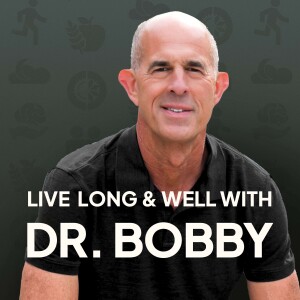
Live Long and Well with Dr. Bobby
https://rss.buzzsprout.com/2297572.rssEpisode List
#67 Stress Reduction: What Actually Works—and What’s Just Wellness Hype
Send us Fan MailStress is everywhere and so is the marketing. Nearly half of US adults say they feel stressed often, and the wellness world is ready with a supplement, a lab panel, or a pricey device for every symptom. We wanted a cleaner answer: what is stress, what can we measure at home, and what actually reduces stress in a way that’s grounded in real studies rather than hype.We start by defining stress in a practical way: stress rises when the demands you perceive exceed the resources you think you have. That helps explain why stress can feel so intense even when there’s no single “stress blood test” to prove it. From there, we walk through simple, objective tracking tools you can use right away, led by the Perceived Stress Scale (PSS-10). We also talk about supportive signals like resting heart rate and heart rate variability (HRV), and why cortisol testing often creates more confusion than clarity in day-to-day life.Then we get into what works. The strongest evidence supports unsexy basics like better sleep and regular exercise, plus approachable mind-body tools like breathwork and mindfulness meditation. We also cover two surprising areas with research behind them: music therapy and aromatherapy (often lavender). Finally, we call out common red flags and popular myths, including “adrenal fatigue,” questionable supplement stacks, and consumer vagus nerve stimulation gadgets that borrow credibility from real implantable medical devices without delivering real proof.If you want a plan you can trust, we outline an N of 1 stress reduction experiment: measure your baseline, test one change for a week or two, re-measure, and keep only what moves your numbers and your life. Subscribe, share this with a stressed-out friend, and leave a review on Apple or Spotify, then send us a note with what you tried and what actually worked for you.
#66: A big coffee study won't change what I do....
Send us Fan MailVisit my websiteBold claims make great headlines; clear evidence makes better habits. We take a hard look at the widely shared study suggesting two to three cups of coffee cut dementia risk by 20 percent and unpack what those numbers really mean for your brain and your daily routine.First, we break down the Harvard JAMA research: massive cohorts of nurses and physicians, decades of follow-up, and self-reported diet data that carry real strengths and built-in limits. We explore why observational studies can’t prove causation, how confounders like sleep, exercise, and income can bend results, and why tea showing similar benefits while decaf shows none points to caffeine yet refuses a tidy explanation. Then we translate relative risk into absolute terms to show how a big percentage drop can still be a small difference in real life, and we discuss the publication bias that comes from testing many hypotheses and promoting only the eye-catching hits.Next, we turn to trials where the science gets sharper. The CRAVE study randomized coffee days in healthy adults with continuous heart monitoring and found no rise in atrial abnormalities that lead to atrial fibrillation, though there was a bump in benign PVCs. For those with a history of AF, the DCAF trial offers a surprise: participants who kept drinking coffee had almost half the recurrence rate compared with those who quit, suggesting caffeine didn’t worsen outcomes and might even help. The message for most people is reassuring—coffee isn’t the arrhythmia trigger it’s often made out to be.Our bottom line is practical and personal. If coffee fits your life and doesn’t wreck your sleep, enjoy one or two cups without expecting miracles. Protect your rest first, because sleep debt is a far clearer risk to cognition than a second espresso is a remedy. Stay curious, ask how a study was designed, and look for consistent results across methods before changing routines. If you learned something helpful, tap follow, share this episode with a friend who loves their morning brew, and leave a quick review to help others find the show.
#65: Can I Eat All the Salt That I Want?
Send us Fan MailYou read everywhere that you “should” cut salt—especially if your blood pressure is up. But salt also makes food enjoyable. In this episode, I walk through the human evidence (not animal studies) and frame salt as a risk–benefit tradeoff: when does sodium meaningfully matter, for whom, and how can you test your sensitivity?Big questions we answerIf you have high blood pressure: does lowering salt always help?If your BP is normal but you have heart/kidney risk: does salt matter?If you’re basically healthy: how worried should you be?Key takeawaysSodium is essential (nerves, muscles, fluid balance)—the issue is dose and individual response.Most sodium comes from packaged/restaurant foods (not your salt shaker).Salt restriction lowers BP, but the average effect is modest compared with typical BP meds (context matters).Salt sensitivity varies: roughly ~30% of healthy people and ~40–50% of people with hypertension may be “salt-sensitive” (with higher rates in older adults, women, and some ancestry groups).If you’re salt-sensitive—especially with hypertension—being mindful of sodium is likely worth it. If you’re not, the “must be low-salt for everyone” story is less clear.Practical: Do an N-of-1 salt sensitivity testMeasure home BP daily (or a few times/day) for a weekGo lower-sodium for 1–2+ weeks (at least within guidelines, possibly lower)Track BP changeAdd salt back and watch what happensOptional: repeat the low-salt phase for confirmation If BP shifts meaningfully (often ~3–5 mmHg+), you may be salt-sensitive.Food reality check (why sodium adds up fast)~10% of a 2,300 mg/day sodium “budget”: 2 slices bread, 1 Tbsp ketchup, or a pinch of salt~1/3: 1 cup canned soup, 1 slice pizza, or a Big Mac~1/2: frozen lasagna, a few deli slices, or a 6” cold-cut sub Cooking mostly from whole foods makes staying lower-sodium much easier.Studies & resources mentioned (links embedded)CDC hypertension awareness/treatment/control stats: https://www.cdc.gov/nchs/products/databriefs/db511.htmHypertension outcomes review (risk of events/death): https://pmc.ncbi.nlm.nih.gov/articles/PMC8292050/Population sodium/BP overview (JACC): https://www.jacc.org/doi/10.1016/j.jacc.2019.11.055DASH-Sodium trial (NEJM): https://www.nejm.org/doi/full/10.1056/NEJM200101043440101Sodium restriction meta-analysis (BP/outcomes): https://pmc.ncbi.nlm.nih.gov/articles/PMC12624901/Salt sensitivity overview (AHA/Hypertension): https://www.ahajournals.org/doi/10.1161/HYPERTENSIONAHA.123.17959Heart failure trials/meta (salt restriction): https://www.ahajournals.org/doi/10.1161/CIRCHEARTFAILURE.122.009879Salt substitute trial (NEJM): https://www.nejm.org/doi/full/10.1056/NEJMoa2105675Call to action Are you going to run your own N-of-1 salt test? If you do, I’d love to hear what you learn.Reminder: I’m an educational resource, not your physi
#63 The Million Dollar Question: Which Health Predictions Actually Help You Live Longer?
Send us Fan MailCan you predict when “bad things” will happen to your health—and more importantly, can you do anything about it? In this episode, I break down which prediction tools actually help you live long and well (because you can act on them), and which ones are mostly expensive fortune-telling. Joined by cardiologist Dr. Anthony Pearson (author of The Skeptical Cardiologist), we dig into heart-risk calculators, dementia genetics, and why biological age clocks aren’t ready for prime time.Guest: Dr. Anthony Pearson, cardiologist and writer of The Skeptical Cardiologist (Substack)Key topics & takeawaysWhy “prediction” only matters if it changes what you do—and improves real outcomes.A red flag to watch for: is the person promoting the tool also selling the test, supplements, or “hacks” to fix it?A sobering reality check: even doctors’ YouTube claims often lack strong evidence (and the least evidence-based content gets more views).Heart disease risk equations: the gold standard in prediction because we can reduce risk factors (BP, LDL/ApoB, smoking, diabetes) and clinical trials show outcomes improve.But even good tools miss people: a study of
#64 The Allure of Alternative Medicine: Beautiful Theories...Not Much Evidence
Send us Fan Mail
You may also like



Get this podcast on your phone, Free


Create Your Podcast In Minutes
- Full-featured podcast site
- Unlimited storage and bandwidth
- Comprehensive podcast stats
- Distribute to Apple Podcasts, Spotify, and more
- Make money with your podcast