The Pragmatic Engineer
https://api.substack.com/feed/podcast/458709.rssEpisode List

Stop being skeptical about AI for development with Charity Majors
Brought to You By:• Antithesis – verify your system’s correctness without human review or traditional integration tests – and avoid bugs or outages.• WorkOS – everything you need to make your app enterprise ready.• Buildkite – CI software built to absorb whatever your coding agents throw at the build queue—In 2025, it was rational to be skeptical about AI, but in 2026 it’s clear that AI is changing all of the industry, and there’s less and less place for skepticism. This take is from one of my favorite voices in software reliability and observability: Charity Majors, CTO and cofounder of Honeycomb, co-author of Observability Engineering. (Note: the second edition of Observability Engineering is out, and it’s pretty much a full rewrite of the book, I recommend grabbing it if you’re building reliable systems)In this episode, I sat down with Charity to discuss how her thinking on AI has evolved, why she believes it is becoming a foundational part of software engineering, and what that means for how teams build, review, and ship software.We explore how AI is changing the economics of code generation, why reliability and verification are increasingly the bottlenecks, and why the rise of non-deterministic systems requires more engineering discipline. Charity shares her views on code reviews, observability, DevOps, leadership, and why both AI skeptics and enthusiasts are getting important things right.—Timestamps00:00 Intro02:56 How Parse led to Honeycomb06:00 The limits of individual productivity metrics09:08 How Charity’s perspective on AI has evolved13:50 Rewriting code vs. editing code19:20 Production as a stage of development22:14 Code reviews26:56 Non-deterministic systems31:11 Sensible uses of AI37:41 The two AI camps44:40 Why AI works so well for building software49:42 DevOps55:13 Modern observability1:00:40 Handling context overload1:01:56 What’s new in Observability Engineering’s 2nd edition1:07:45 What effective leadership looks like1:10:25 Engineering management: what is changing?1:16:31 Junior engineers1:18:01 AI fatigue1:21:39 Book recommendations—The Pragmatic Engineer deepdives relevant for this episode:• Shipping to production• Deepdive: How 10 tech companies choose the next generation of dev tools• Why is Meta destroying its engineering organization?• When AI writes almost all code, what happens to software engineering?• Are AI agents actually slowing us down?• Observability: the present and future, with Charity Majors• The third golden age of software engineering – thanks to AI, with Grady Booch—Production and marketing by https://penname.co/. For inquiries about sponsoring the podcast, email podcast@pragmaticengineer.com. Get full access to The Pragmatic Engineer at newsletter.pragmaticengineer.com/subscribe
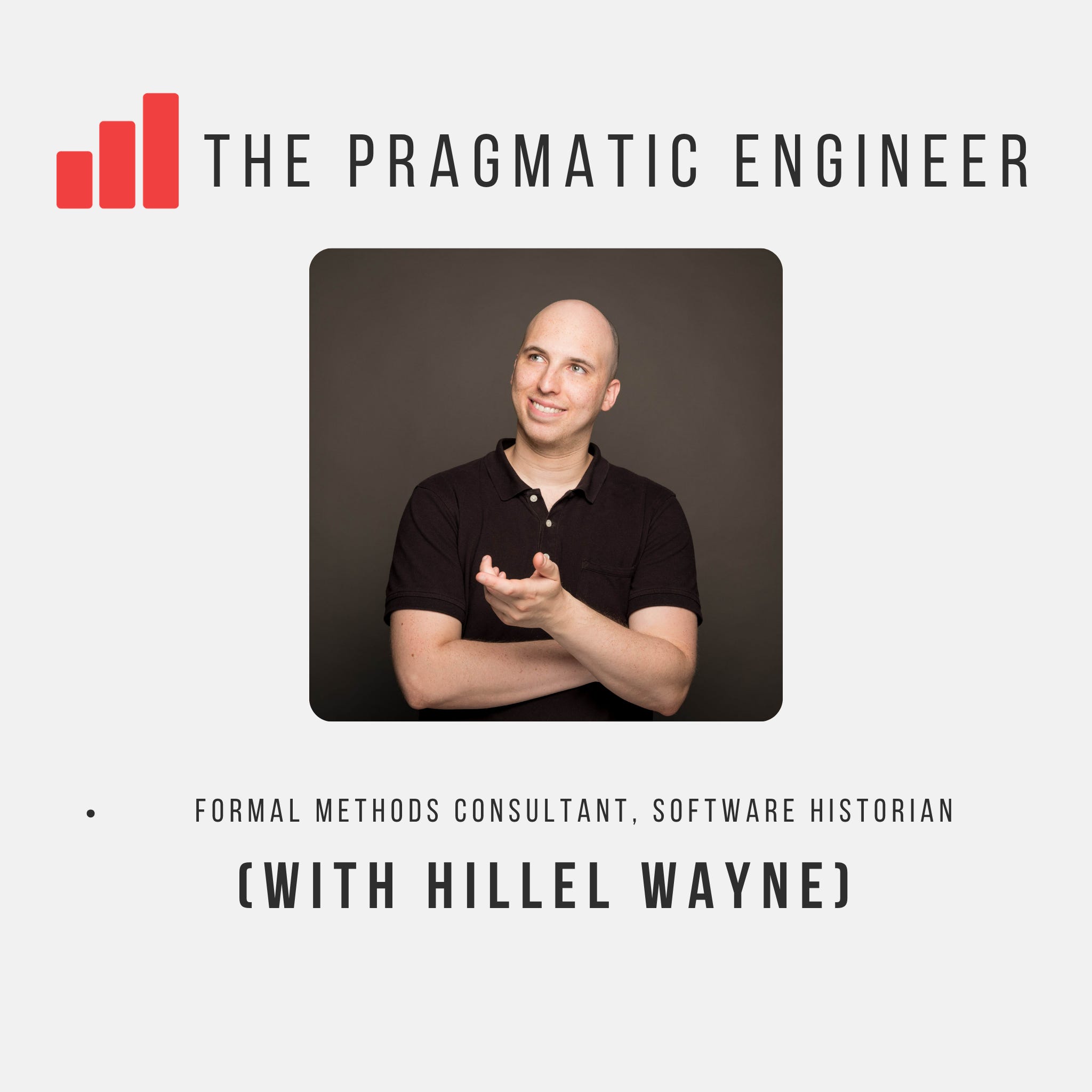
Formal methods with Hillel Wayne
Brought to You By:• Antithesis – verify your system’s correctness without human review or traditional integration tests – and avoid bugs or outages.• turbopuffer – a vector and full-text search engine built on object storage. It’s fast, cheap, and extremely scalable.• WorkOS – everything you need to make your app enterprise ready.—There’s a popular theory that AI will finally make formal verification mainstream because mathematical proof of correctness will be needed when machines write most or all of the code. But will this happen? Today, I’m talking with one of the best people to tackle the prediction. Hillel Wayne is a formal methods consultant, educator, and author, who’s deeply interested in software history. In this episode of Pragmatic Engineer podcast, I sit down with Hillel to compare software engineering with traditional engineering, discuss where formal methods fit into modern software development, and we explore why they are essential for some of the world's most complex systems. We cover the formal specification language, TLA+, walk through several formal verification tools, examine why distributed systems are so difficult to reason about, and look into whether AI will make formal methods accessible to more engineering teams.—Timestamps00:00 Intro03:21 The Crossover Project10:26 What software engineering does better14:19 What traditional engineering does better17:06 Formal methods28:21 TLA+: what it is and demo35:47 TLA+ at Amazon36:59 Ways distributed systems break39:52 Formal methods and systems thinking45:09 The value of learning math49:12 What TLA+ is good for and isn’t51:39 Alloy: a declarative language for software modeling57:42 Other formal methods tools1:00:13 Property-based testing1:04:20 AI and the need for formal verification1:11:18 Logic for programmers1:13:24 Hillel’s 2025 prediction on AI’s impact1:20:19 Book recommendation—The Pragmatic Engineer deepdives relevant for this episode:• How to debug large, distributed systems: Antithesis• How AWS S3 is built• Paying down tech debt• How Big Tech does quality assurance (QA)• Bug management that works• Resiliency in distributed systems—Production and marketing by https://penname.co/. For inquiries about sponsoring the podcast, email podcast@pragmaticengineer.com. Get full access to The Pragmatic Engineer at newsletter.pragmaticengineer.com/subscribe

Context engineering with Dex Horthy
Brought to You By:• Antithesis – verify your system’s correctness without human review or traditional integration tests – and avoid bugs or outages.• Buildkite – CI software built to absorb whatever your coding agents throw at the build queue.• Sentry – application monitoring software considered “not bad” by millions of developers.—Knowing how LLM contexts work and how to work around context limitations – aka “context engineering” – is becoming more important for software engineers working with LLMs. Let’s look into what works and what doesn’t, today.In this episode of The Pragmatic Engineer podcast, I sit down with the CEO and cofounder of HumanLayer, Dex Horthy, who coined the term “context engineering”. We discuss the ideas behind this context engineering, harness engineering, loop engineering, software factories, why his approach to AI-assisted software development has evolved, and how HumanLayer is helping engineering teams automate more of the software development lifecycle without sacrificing code quality.—Timestamps00:00 Intro03:35 Dex’s path into tech05:36 Early work in platform engineering07:30 Replicated13:26 Metalytics14:38 12-factor agents20:29 Context engineering25:40 Harness engineering28:13 Context overload32:47 Loop engineering46:36 Software factories before and after AI52:35 Automation limits57:20 Three options for automating1:01:02 RPI framework1:06:18 Intentional compaction1:13:50 Token harder vs. token smarter1:18:46 AI slop1:21:17 HumanLayer1:31:11 Book recommendation—The Pragmatic Engineer deepdives relevant for this episode:• How Uber uses AI for development: inside look• Are AI agents actually slowing us down?• AI Tooling for Software Engineers in 2026• Vibe Coding as a software engineer• How Claude Code is built• AI Engineering in the real world• The AI Engineering Stack• How AI-assisted coding will change software engineering: hard truths• The creator of OpenClaw: "I ship code I don't read"—Production and marketing by https://penname.co/. For inquiries about sponsoring the podcast, email podcast@pragmaticengineer.com. Get full access to The Pragmatic Engineer at newsletter.pragmaticengineer.com/subscribe

The Pragmatic Engineer AMA
Brought to You By:• Antithesis – verify your system’s correctness without human review or traditional integration tests – and avoid bugs or outages.—In this special “ask me anything” episode of Pragmatic Engineer podcast, I am in the hot seat facing questions sent in by subscribers that are read out by guest Volodymyr Giginiak, CTO and cofounder of Wordsmith AI, a legal tech startup (note: I’m an investor).I tackle your questions on the software industry, AI, hiring, engineering organizations, career growth, the business model of the Pragmatic Engineer, and more. We also discuss where software engineering is headed, and I offer advice on some specific situations. Thanks to everyone who sent questions!—Timestamps00:00 Intro01:56 From Uber to writing09:22 AI-native SDLC14:00 AI and hiring19:06 Engineers currently thriving22:18 Junior roles24:44 Meta’s war mode27:54 AI at Big Tech vs. startups36:46 Tech debt41:36 Types of engineering managers44:40 Measuring AI productivity48:30 The value of CS degrees50:53 AI at Pragmatic Engineer56:09 Future-proofing your career1:01:36 The EU job market1:03:55 Making money as a creator1:08:20 What’s next for The Pragmatic Engineer1:09:27 Bunq and Pollen1:13:38 Spotting trends1:14:33 Book updates1:15:20 Favorite books & tech products1:17:13 What won’t change in engineering—The Pragmatic Engineer deepdives relevant for this episode:• State of the software engineering job market in 2026• The impact of AI on software engineers in 2026: key trends. • How 10 tech companies choose the next generation of dev tools • The reality of tech interviews—Production and marketing by https://penname.co/. For inquiries about sponsoring the podcast, email podcast@pragmaticengineer.com. Get full access to The Pragmatic Engineer at newsletter.pragmaticengineer.com/subscribe
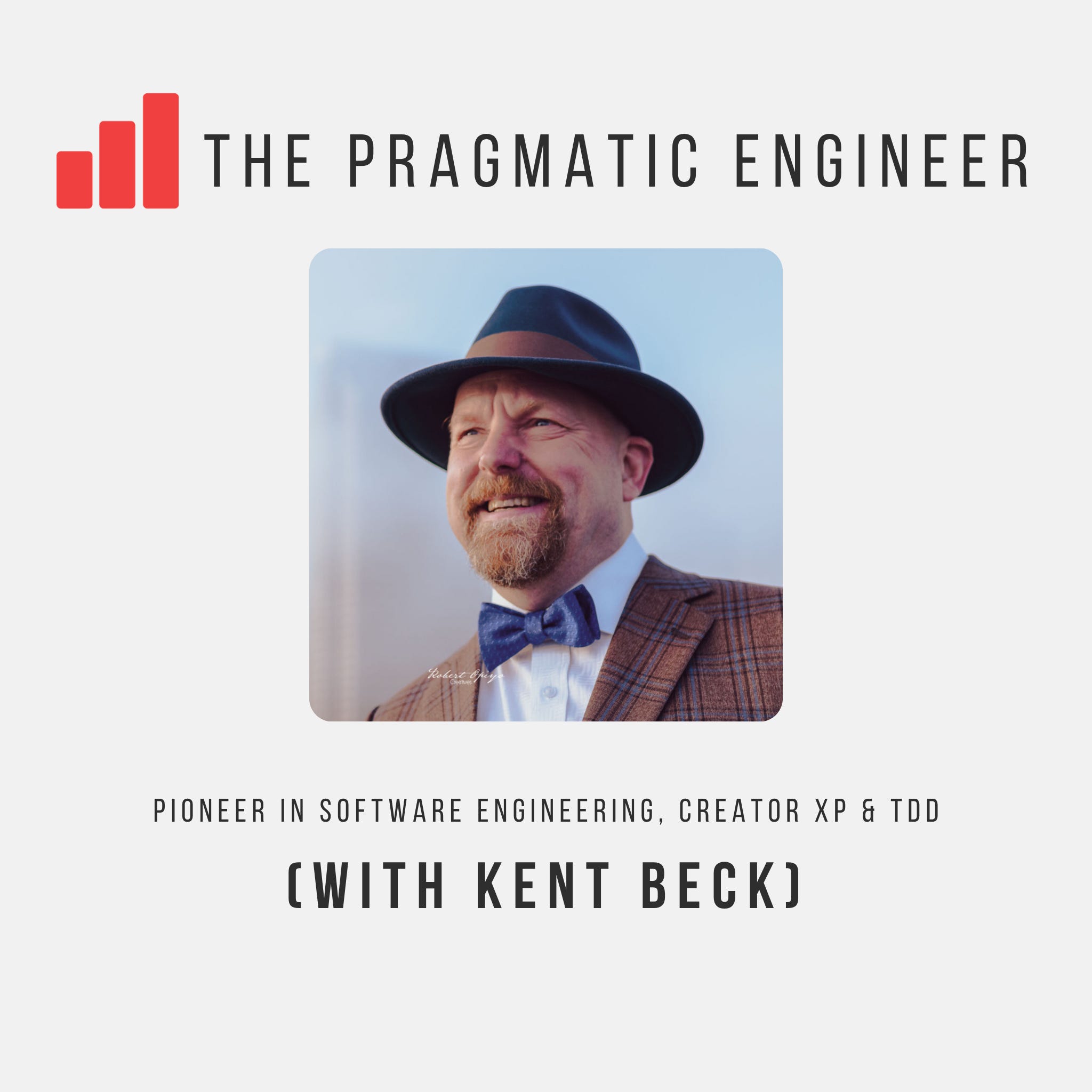
How Kent Beck shapes the software engineering industry
Brought to You By:• Antithesis – verify your system’s correctness without human review or traditional integration tests – and avoid bugs or outages.• turbopuffer – a vector and full-text search engine built on object storage. It’s fast, cheap, and extremely scalable.• WorkOS – everything you need to make your app enterprise ready.—Few have made as big an impact on software engineering as this week’s guest on the Pragmatic Engineer podcast, Kent Beck. He created Extreme Programming, pioneered test-driven development (TDD), co-created JUnit, and is one of the authors of the famous ‘Agile Manifesto’. But these days, he's re-examining many ideas for the age of AI, and says we’re failing to accumulate trust during this new era at the same high rate as new code is being accumulated.In this episode of the Pragmatic Engineer podcast, Kent and I dig into his journey from discovering Smalltalk in the early days of personal computing, to helping define modern software engineering practices. We explore the origins of TDD, design patterns, Extreme Programming, and Agile – along with some lessons learned at Apple and Facebook.Kent explains why he believes software engineering is about far more than writing code, why no one yet knows exactly how engineers should work alongside AI agents, and how his "explore, expand, extract" framework can help engineers navigate major technology shifts.—Timestamps00:00 Intro03:47 Human engineers aren’t going away08:00 Kent's path into tech13:50 Undergraduate and graduate studies17:21 Kent’s first programming job18:54 The rise and fall of Smalltalk27:04 Working with Ward Cunningham37:36 Design patterns44:05 Working at Apple51:08 CRC Cards59:29 Testing tools in the language1:04:22 The C3 project with Martin Fowler1:09:54 Extreme Programming1:16:25 Developing TDD1:25:07 Writing the Agile Manifesto1:30:00 Agile’s impact1:32:40 Agile’s downside1:37:32 The Dotcom Bust1:44:30 Lessons from working at Facebook1:59:44 Kent’s ‘Good to Great’ program at Facebook2:06:07 Soft skills engineers need to learn2:09:30 AI and the challenges of acceleration2:15:53 Explore, expand, extract2:22:33 What Kent is excited about—The Pragmatic Engineer deepdives relevant for this episode:• Measuring developer productivity? A response to McKinsey – co-written with Kent Beck• TDD, AI agents and coding with Kent Beck• Paying down tech debt• The past and future of modern backend practices—Production and marketing by https://penname.co/. For inquiries about sponsoring the podcast, email podcast@pragmaticengineer.com. Get full access to The Pragmatic Engineer at newsletter.pragmaticengineer.com/subscribe
You may also like









Get this podcast on your phone, Free


Create Your Podcast In Minutes
- Full-featured podcast site
- Unlimited storage and bandwidth
- Comprehensive podcast stats
- Distribute to Apple Podcasts, Spotify, and more
- Make money with your podcast
