Talking Real Money - Investing Talk

Talking Real Money - Investing Talk

https://rss.buzzsprout.com/2607021.rss
342 Followers 1.9K Episodes
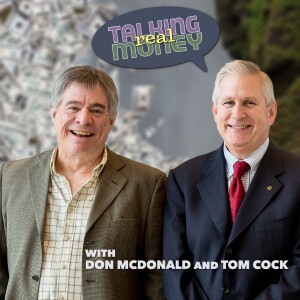
Financial talk radio veteran, Don McDonald and former host of Serious Money on PBS, Tom Cock, join forces to talk about real money issues. In each episode, they solve real money problems, dole out real investing (not speculating) advice, and really explain the financial issues that effect all of us. Plus, it's actually fun! Talking Real Money is a podcast designed to provide the real help we all need to enjoy a really great future. Call in with your questions anytime at 855-935-TALK (8255).

Episode List

Three Ways to Wealth

Jul 13th, 2026 5:00 PM

Money Monday has arrived, and Don kicks off a new weekly series based on his book Financial Physics. The first “law” may surprise you: according to Don, every dollar ever earned comes from just three sources—luck, theft, or work. He and Tom debate where investing belongs, why entrepreneurship remains one of the best paths to wealth, and how much luck really contributes to financial success.Then they answer a listener’s retirement planning question about whether to finance a Florida townhouse or withdraw money from a Roth IRA. Along the way they discuss Roth conversion strategy, Florida HOA reserve funds, special assessments, and why building a retirement plan should always come before deciding where the money comes from.00:00 Welcome to Money Monday00:12 A new weekly Financial Physics series begins01:35 Why anonymous two-star book reviews are so frustrating02:40 Free Financial Physics book giveaway03:50 Rule #1: There are only three ways to make money04:45 Luck—including investing, lotteries, and inheritance06:35 Theft, fraud, and unethical financial products07:55 Why successful investing combines work and luck10:30 How most great fortunes are actually built12:10 Entrepreneurship, risk, and creating wealth13:35 Understanding just how large a trillion dollars really is15:50 The biggest takeaway from Rule #117:15 Preview of next week’s rule: Supply and Demand18:15 Why listener questions slow down during the summer19:15 Listener Question: Should a retiree finance a Florida townhouse or withdraw money from a Roth IRA?21:10 Florida HOA reserves and avoiding expensive surprises24:30 Why retirement planning comes before choosing an account26:00 Why the Roth IRA is probably the last account to tapQuestions? Comments? Click!

Question Onslaught

Jul 10th, 2026 5:00 PM

Tom’s on vacation, but the listener questions are not. In this packed Q&A episode, Don tackles one of the most common retirement dilemmas: if your Social Security and annuity income already cover your expenses, do you still need a traditional emergency fund?From there, the questions keep coming. Don weighs in on what to do with “lazy money” earning only 3%, whether a MYGA is really a better deal than a CD ladder, how to structure a taxable brokerage account for long-term growth, and where to keep nearly $300,000 set aside for a home purchase in the next two to three years.He also takes on a thoughtful question about managing a taxable portfolio for elderly in-laws who need additional income for memory care, and wraps up with a step-by-step explanation of how inherited IRA money can potentially be used to fund backdoor Roth contributions.Along the way, you’ll hear why “guaranteed” doesn’t always mean what insurance companies want you to think it means, why simplicity often beats ETF overengineering, and why liquidity still matters—even in retirement.0:05 – Intro and why Tom is getting buried in listener questions while on vacation1:14 – Don thanks listeners and mentions Apple featuring Litreading1:58 – How to send recorded questions at TalkingRealMoney.com2:16 – Question 1: Do retired investors still need a six-month emergency fund if Social Security and annuities cover expenses?3:14 – Why Don still favors stable, liquid emergency money even in retirement4:30 – Question 2: What should retirees do with “lazy money” that’s earning only about 3%?5:28 – Don’s preference for CD ladders over MYGAs and why “guaranteed” doesn’t mean risk-free7:33 – Question 3: How should a high-income investor build a long-term taxable portfolio at Vanguard?10:03 – Don’s case for simplifying with AVGE or DFAW instead of mixing multiple ETFs11:24 – Question 4: Is a five-year MYGA better than a five-year CD ladder?12:01 – Why Don still leans toward CDs despite the higher MYGA yield and tax deferral pitch14:16 – Question 5: Best place to keep $291,000 earmarked for a home purchase in two to three years14:46 – Money market vs. high-yield savings vs. CDs vs. BND for short-term house money17:04 – Question 6: How to structure a $300,000 taxable portfolio for elderly in-laws who need extra monthly income for memory care18:37 – Why Don would keep lots of liquidity, use only a little equity, and skip muni bonds in a 22% bracket20:50 – Question 7: Can inherited IRA proceeds be used to fund a backdoor Roth for both spouses?22:40 – Don’s step-by-step answer, including opening new IRAs and watching out for the pro-rata rule25:07 – Don plugs The Line Uncrossed and offers a free one-hour advisor meeting25:42 – Reminder to send questions and be patient while Tom is on vacationQuestions? Comments? Click!

Tom Tests Don

Jul 9th, 2026 5:00 PM

In what may be our last quiz, ever, Tom turns the tables and puts Don in the hot seat with a Wall Street Journal high-school personal finance quiz—covering the Magnificent Seven, Roth IRAs, TIPS, efficient markets, yield curves, market risk, and dollar-cost averaging. Don does reasonably well, but not without protesting a dubious “debt avalanche” question and getting tangled up in a couple of accounting and risk terms. After the quiz-show nonsense, the guys tackle a listener question from Joseph in Pennsylvania: should your stock/bond allocation be based on a fixed percentage of your portfolio, or should it be driven by how many years of spending you want buffered in safer assets? Tom and Don explain why the answer depends on more than just income needs—it also depends on your emotional tolerance for volatility, your need for growth, and the role fixed income plays in helping you stay invested when markets get ugly.0:22 Tom becomes quizmaster and introduces the Wall Street Journal high-school personal finance quiz2:12 Question 1: Which stock is not part of the Magnificent Seven?3:47 Question 2: Which retirement account does not require withdrawals at a certain age?5:09 Question 3: TIPS, STRIPS, Series I bonds, and inflation-adjusted principal6:58 Question 4: Debt payoff strategies and the disputed “debt avalanche” answer9:13 Question 5: Efficient market hypothesis10:12 Question 6: What an inverted/downward-sloping yield curve says about future rates11:25 Question 7: Return on equity math and a heavily leveraged company12:56 Question 8: What it means when net present value equals zero14:44 Question 9: Why putting your emergency fund in stocks creates market risk16:52 Question 10: Unsystematic risk versus broad market risk18:57 Question 11: Dollar-cost averaging20:06 Tom and Don wrap up the quiz and revisit the “debt avalanche” controversy21:11 Listener question from Joseph in State College, Pennsylvania21:34 Should bond allocation be based on a fixed percentage or on years of spending?22:07 Risk tolerance vs. risk profile: why income needs are only part of the equation23:26 Why a 5-year spending buffer in safer assets can make sense in retirement24:13 The emotional role of bonds and fixed income during market declinesQuestions? Comments? Click!

The Right Withdrawal Rate?

Jul 8th, 2026 4:00 PM

Tom and Don tackle one of retirement’s hardest questions: how much can you safely spend from your portfolio without blowing up the rest of your life? They walk through the familiar 4% rule, flexible withdrawal strategies, why a flat 10% withdrawal is usually fantasyland, and why the “right” spending rate depends heavily on your age, timeline, and tolerance for adjusting in bad markets. They also answer a listener question about a 22-year-old’s investment allocation and close with a timely discussion of the latest Social Security trust fund warning, what it actually means, and the only real ways Congress can fix it.00:12 — How much can you safely spend in retirement? Tom and Don tee up the big question: 4% rule, 5% flexible rule, or something more personalized.02:08 — Survey shocker: many people think they need 30 years of income saved before retiring comfortably.03:03 — Longevity math: how long retirement might actually last, and why that matters for withdrawal rates.04:40 — Can you really withdraw 10% a year? Tom and Don push back on overly aggressive retirement spending assumptions.05:59 — Why generic withdrawal rules fall apart in real-life retirement planning.06:25 — Every retiree needs a personalized withdrawal strategy based on their own timeline and circumstances.07:17 — Retiring at 60 vs. 70: why earlier retirement makes even “safe” withdrawal rates riskier.09:04 — Why it’s worth having a professional review your retirement withdrawal plan, even if you’ve used calculators.09:58 — The case for flexible withdrawals: spending more in strong markets and less in weak ones.10:20 — Three common retirement planning mistakes: not saving enough, not knowing your needed return, and taking the wrong amount of risk.12:16 — Listener question: a 22-year-old with $28,500 invested wants to know if his allocation makes sense.13:28 — Breaking down DFAW, VT, and VTI: overlap, diversification, and whether the portfolio is too complicated.16:21 — The bigger story: a 22-year-old already has a terrific head start on retirement savings.17:56 — Social Security update: the trust fund could run short in 2032 if nothing changes.18:37 — The only real ways to fix Social Security: raise taxes, cut benefits, or some combination of both.19:52 — Why scary Social Security headlines should not automatically push people to file early.21:22 — One possible fix: raising or removing the payroll tax cap.23:27 — The demographic problem under Social Security: too few workers supporting too many retirees.Questions? Comments? Click!

Mom (Dad) and Money

Jul 7th, 2026 5:00 PM

As parents age, money can get more complicated—bill paying, account access, healthcare decisions, investment management, and eventually the possibility that someone else may need to step in. In this episode, Don and Tom walk through how families can start that conversation before a crisis hits. They cover when to begin talking, what adult children should know about accounts and spending, why durable powers of attorney need to be checked with custodians in advance, and the importance of reviewing wills, beneficiaries, and backup decision-makers. They also talk about the emotional side of these transitions, including independence, trust, and the danger of children projecting their own investing preferences—or financial self-interest—onto aging parents.Then they answer two listener questions: one about whether it’s time to fire an evasive advisor charging 1% plus expensive funds, and another about alternative career paths in financial planning beyond the traditional CFP route.0:05 – Intro: the hard conversation families need to have about aging and money1:00 – When parents—or you—reach the point where financial help may be needed1:56 – Tom’s family experience and the challenge of stepping in gracefully3:17 – Why families should talk early about money, spending, and where accounts are held5:24 – Account access, passwords, and why digital organization matters more than ever7:38 – Durable power of attorney: why you need one and why custodians should review it in advance9:01 – Backups for everything: POAs, wills, beneficiaries, and successor decision-makers10:02 – Why adult children should meet their parents’ financial advisor before a crisis11:07 – When a trusted advisor can help if parents don’t want children directly involved11:28 – How to approach the conversation as an adult child without expecting instant control12:28 – Don’t project your own investing style onto your parents’ retirement portfolio13:28 – The uncomfortable reality of greed and inheritance influencing family decisions13:40 – Why this belongs at the top of the planning checklist for older families14:07 – How to send your own questions to Talking Real Money14:58 – Listener question: Is it time to fire a wealth manager who won’t answer basic questions?17:15 – Don and Tom’s verdict on an advisor charging 1% while dodging accountability18:48 – Listener question: Are there good financial-planning career paths besides becoming a CFP?20:41 – The regulatory reality of giving investment advice for a fee22:32 – Relationship roles, planning roles, and the growing specialization inside advisory firmsQuestions? Comments? Click!

Get this podcast on your phone, Free

Create Your Podcast In Minutes

  • Full-featured podcast site
  • Unlimited storage and bandwidth
  • Comprehensive podcast stats
  • Distribute to Apple Podcasts, Spotify, and more
  • Make money with your podcast
Get Started
It is Free