
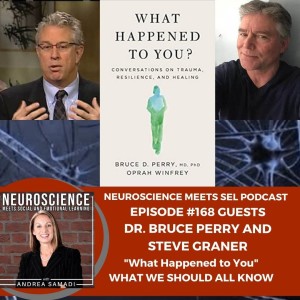
Dr. Bruce Perry and Steve Graner on What We Should ALL Know About ”What Happened to You” and Writing a Book with Oprah Winfrey
Welcome back to the Neuroscience Meets Social and Emotional Learning Podcast EPISODE #168 with a much-awaited conversation with someone I have been quoting since we launched this podcast, after getting to know his work on a deeper level when I tuned into a video training series[i] he conducted during the beginning of the Pandemic to help people around the world to better understand how the brain works while under stress. I learned specific ideas on how to reach those who were most affected during and after those very difficult days from this video series that he created for educational purposes for people to view and share. I learned so much from this series that connected the dots for me with trauma and the brain, while inspiring our episode #52[ii] on "Igniting Your Personal Leadership to Build Resiliency.”
Watch this interview on YouTube here https://youtu.be/ixOZFwTAtCQ
Learn more about The Neurosequential Network here https://www.neurosequential.com/
See past Neuroscience Meets Social and Emotional Learning Podcast Episodes here. https://www.achieveit360.com/episodes/
On This Episode You Will Learn:
✔︎ What drew Steve Graner to work with The Neurosequential Network, and how he used his background in sports to create the Neurosequential Model for Education.
✔︎ What Dr. Perry learned from writing a book with his good friend, Oprah Winfrey.
✔︎ Why we must all understand our genes and past to understand why we behave the way that we do.
✔︎ Dr. Perry's vision to help others in many sectors like sports, education, caregiving, and supervision to become "brain-aware"
✔︎ What we should all know about the brain and how to regulate, relate and reason with others at home and in our workplaces.
✔︎ What is the power differential and why it is so important for our students in the classroom and our workplaces--especially if you are in a position of leadership.
Last summer, I reached out to American psychiatrist, Dr. Bruce Perry, who is currently the senior fellow of the Child Trauma Academy in Houston, Texas and an adjunct professor of psychiatry and behavioral sciences at the Feinberg School of Medicine in Chicago, with the hopes he could come on the podcast and help us to dive deeper with an understanding of how traumatic events impact the brain. I was specifically concerned with the impacts of the Pandemic generationally, because one of his trainings explained the research from families from the Katrina Disaster in 2005 showed how the offspring of those families exposed to this level of stress response had an increase of substance abuse issues. I thought about the Pandemic and how I was hearing about the increase in depression, anxiety and substance use increasing, and wondered if Dr. Perry could provide some ideas on how to reduce the impact that the Pandemic was having on the world, our future generations, educational systems and he let me know that he would come on the podcast, as soon as his next book that he was writing was complete. I understood, as writing a book takes intense focus, so I went back to work, and knew we would have a conversation in the future. This spring, I watched the release of that book he was writing and realized it was with Oprah Winfrey called What Happened to You: Conversations on Trauma, Resilience and Healing[iii], and knew that when the timing felt right, I would reach out, to have that discussion on this new book that I knew would answer all of the questions I had.
I'm Andrea Samadi, author, and educator from Toronto, Canada, now in Arizona, and like many of our listeners, have been fascinated with learning and understanding the science behind high performance strategies that we can use to improve our own productivity in our schools, our sports, and workplace environments. My vision is to bring the experts to you, share their books, resources, and ideas to help you to implement their proven strategies, whether you are a teacher working in the classroom or online, a student, or in the corporate environment
Sometimes there is no such thing as timely, as the minute this book came out, the buzz hit social media, and everyone was posting about how important and timely the content was and I couldn’t miss the impact it was having on people from all different sectors, around the world. I knew it! I had so many questions after that video series and thank goodness Dr. Perry wrote this book that I knew would take that deeper dive into understanding the impact of trauma on the brain. I finally knew it was time to reach out to Dr. Perry when my good friend Ruthie, an educator, held up her phone as she passed me on the hiking trails, and showed me she was listening to his audiobook, shouting back to me as she ran by “You had better interview Dr. Perry because EVERY educator must read, understand and implement this book!” It was the right time, so I reached out to Dr. Perry’s office that morning and booked the interview and knew Dr. Perry would keep his word, and he did.
I just didn’t realize how difficult this topic was going to be as I dove into the book. I know that the Pandemic has shown us that we need change moving forward in our schools, raising our own children at home and for our future generations we are leading to thrive in their workplaces. So with this interview, I will take many deep breaths, as the stories that illuminate this needed change are difficult, from the first few pages, right to the very end of the book.
This book is for “anyone with a mother, father, partner, or child who may have experienced trauma. And, if you’ve ever had labels like “people pleaser,” “self-sabotager,” “disruptive,” “argumentative,” “checked out,” “can’t hold a job,” or “bad at relationships” used to describe you or your loved ones, this book is for you. Or if you simply want to better understand yourself and others, this book is for you, too.” (What Happened to You)
Let’s meet Dr. Bruce Perry and Steve Graner, Project Director from the Neurosequential Network, and uncover the power of asking “What Happened to You?” instead of “What’s Wrong with You?”
Welcome Dr. Perry and Steve Graner! Thank you so very much for taking the time to speak with me and help others to learn more about the work you are both focused on at the Neurosequential Network your most recent book, Dr. Perry, that you wrote with Oprah Winfrey, What Happened to You, that gave me what I was looking for—a deep dive into understanding the impact that trauma has on our brain, specifically, for our future generations.
Before we get to the questions (and I had to narrow them down) there were many, but I would like to orient our listeners to how you both began this work, if I could begin with Steve because your background with sports resonated with a lot of the posts I see connected to Dr. Perry/ Megan Bartlett and her work at the Center For Healing and Justice Through Sport. With all we hear in the media with regards to abuse/trauma in the field of sport these days, I wonder what drew you to your work with the Neurosequential Network as a Project Director with Dr. Perry?
Dr. Perry, the first thing I wondered has to do with your friendship with Oprah that began when she reached out to you in 1989 while you were working in your lab and when someone said “Oprah’s calling” you said “Yeah right, take a message” thinking he was joking.
You say that back when you began this work, you were always trying to make connections with how trauma impacts the brain and behavior, and never quite getting it right. I wondered what have you learned from your time with Oprah, her reflections back to you, and the impact that her point of view had on this connection between trauma and the brain that you’ve been focused on for your whole career?
MAKING SENSE OF THE WORLD (Q1-4)
I picked the beginning of the book as the main focus of interview today, because many of us reading your book have not had any training on the brain/neuroscience and trauma, with one question to help us to connect the dots to help us make sense of how our brain works, and some final thoughts on what we should all know to heal and make change moving forward. Does that sound like a good plan if each of you can chime in with your thoughts?
Q1: Steve and Dr. Perry, Oprah opens up the book with saying that she believes that “the acorn contains the oak. And through her work with you she says that “If we want to understand the oak, it’s back to the acorn we must go.” This question we could spend the whole interview with, I heard my mentor, speaker Bob Proctor[iv] talking a about how an oak tree develops from the gene that lies within the acorn when I was in my late 20s and I could think about what that meant for a lifetime. Why is it so important for us to think back to our genes, and maybe even generations of our genes to understand why people behave the way that they do and understand “this patterned plan” in each acorn or ourselves?
Q2: 20 years ago, trauma was never considered a factor in a person’s health, let alone something we should consider as an educator in the classroom, a coach on the field, or a parent looking to break generational habits/beliefs. When writing this book, what was your vision to help others become “brain-aware” something that is important for all of us to understand in EVERY sector of work? (In medicine, like with your example of Tyra/diabetic), and especially in the classroom with our students as teachers must deal with behavior before they can get to “teaching” the curriculum and Steve, with your thoughts of why this is so important in the sports world?
Q3: To understand why people behave the way they do, with the brain in mind, you start put with Mike trying to help his wife understand his PTSD and why he acts the way he does.
You explain it with (your famous upside down triangle) with the brain in mind, or the example in the classroom with the student, Sam, who connected the smell of Old Spice of his teacher to his alcoholic father, or Tyra later in the book with her connection to the sirens and her friend’s death. Or your co-worker Mike, who jumped when the door slammed. There are many examples throughout the book, all teaching us “what happened to you?”
For those of us who want to be “brain-aware” and have not taken a course in neuroscience, can you explain what we should all know about the brain, stress and trauma and the 4 interconnected parts of the brain (brain stem, diencephalon, limbic and cortex)?
Q4: I first came across your work through Dr Lori Desautels who would often quote you, and when the pandemic began, you began doing trainings to help those working with people with trauma and I joined many of those meetings[v], learning so much that I shared on the podcast to help others who might be struggling.
I always wondered what is the meaning behind the name of your company that’s on all of your slides, and the link I clicked on to access your trainings? What is neuro sequential? Then Oprah asked why it’s so important to understand the sequence of our brain in chapter 5—and I had an Aha Moment!
“Everything sequential happens in a sequence and the way our brain processes experiences is sequential” and in order to get to the reasoning part of the brain, or the cortex, we must get through the lower parts of the brain.
I think this is the most important concept to understand in the book since “effective communication, teaching, coaching, parenting—all require awareness of this sequence of engagement”
Can you explain what gets in the way of “getting to the cortex” or the challenges we have with reasoning with someone when they are dysregulated, and how we can recognize this dysregulation to do something about it?
This will give us an understanding of The Neurosequential Network and how it applies to our everyday life.
Q5: As we are all learning this new information, and becoming “brain-aware” for those in positions of leadership, can you explain the importance of the “Power Differential” on how to be aware of this cognitive disadvantage that is felt by our students in the classroom, or those we are leading in our work environments so we can truly be leading with our brain in mind?
Q6: I know that we have only scratched the surface of this topic with these questions, but I know that I can’t have you for an entire day, so could you give us what would be your final thoughts that we should know about when connecting the dots on “What Happened to You” that we haven’t talked about today to help us to be better leaders, educators, parents, and members in our communities?
Dr. Perry, and Steve Graner, I wish we could stay on the line all day, but know that with each time we read your book and make connections to the training you have at the Neurosequential Network, and other leaders in this new field of educational neuroscience, that we will gain more clarity to make sense of the world, become more “brain-aware” and connect the dots, helping ourselves and others to heal. Thank you both for the time you have taken to help me to share this information for those listening around the world to make shifts in their own life, that will have generational shifts for the future that my children and their children will benefit from. You’ve given us hope and a new vision at a time when we all needed it the most.
Thank you!
BIO DR. PERRY
Dr. Perry is the Principal of the Neurosequential Network, Senior Fellow of The ChildTrauma Academy and a Professor (Adjunct) in the Departments of Psychiatry and Behavioral Sciences at the Feinberg School of Medicine at Northwestern University in Chicago and the School of Allied Health, College of Science, Health and Engineering, La Trobe University, Melbourne, Victoria Australia.
Over the last thirty years, Dr. Perry has been an active teacher, clinician and researcher in children’s mental health and the neurosciences holding a variety of academic positions. His work on the impact of abuse, neglect and trauma on the developing brain has impacted clinical practice, programs and policy across the world. Dr. Perry is the author, with Maia Szalavitz, of The Boy Who Was Raised As A Dog, a bestselling book based on his work with maltreated children and Born For Love: Why Empathy is Essential and Endangered. Dr. Perry's most recent book, What Happened to You? Conversations on Trauma, Resilience, and Healing, co-authored with Oprah Winfrey, was released in 2021.
BIO STEVE GRANER:
Steve Graner is the Neurosequential Networks' NME Project Director as well as a ChildTrauma Academy Fellow. Mr. Graner grew up in Bismarck, ND, received his Bachelors Degree from the University of Sioux Falls, and completed his Masters Degree in Curriculum and Instruction at Minnesota State University Mankato. With thirty-three years teaching English at Erik Ramstad Middle School in Minot, North Dakota, Mr. Graner has also coached cross country and track and field, receiving Coach of the Year honors in ND for both high school and middle school cross country. Mr. Graner is best known for his creative approaches to teaching and coaching and combines a love of the arts and sports with the passion for pedagogy.
FOLLOW THE NEUROSEQUENTIAL NETWORK:
https://twitter.com/NeuroSequential
Neurosequential Model in Education https://www.neurosequential.com/nme
Neurosequential Model in Sport https://www.neurosequential.com/nm-sport
FOLLOW DR. BRUCE PERRY
https://twitter.com/BDPerry
FOLLOW ANDREA SAMADI:
YouTube Channel: https://www.youtube.com/c/AndreaSamadi
Website https://www.achieveit360.com/
LinkedIn: https://www.linkedin.com/in/samadi/
Facebook: https://www.facebook.com/Achieveit360com
Neuroscience Meets SEL Facebook Group https://www.facebook.com/groups/2975814899101697
Twitter: https://twitter.com/andreasamadi
Instagram: https://www.instagram.com/andreasamadi/
RESOURCES:
30 Quotes from What Happened to You by Bruce D. Perry and Oprah Winfrey by Kenneth Wong May 30th, 2021 https://millennial-grind.com/30-quotes-from-what-happened-to-you-by-bruce-d-perry-and-oprah-winfrey/
What Happened to You Visual Synopsis by Dani Saveker https://www.visualsynopsis.com/full-collection/what-happened-to-you-oprah-winfrey-amp-bruce-perry-visual-synopsis-by-dani-saveker
Meeting Children Where They Are: The Neuroseqential Model of Therapeutics October 1, 2021 by Allison Cooke Douglas, MS https://adoptioncouncil.org/publications/meeting-children-where-they-are-the-neurosequential-model-of-therapeutics/
Neurosequential Model in Education https://www.neurosequential.com/nme
Neurosequential Model in Sport https://www.neurosequential.com/nm-sport
Neuroscience Meets Social and Emotional Learning Podcast EPISODE #53 Inspired by Dr. Bruce Perry on “Self-Regulation and Your Brain: How to Bounce Back Towards Resiliency” https://andreasamadi.podbean.com/e/self-regulation-and-your-brain-how-to-bounce-back-towards-resilience/
Neuroscience Meets Social and Emotional Learning Podcast EPISODE #56 with Educational Neuroscience Pioneer Dr. Lori Desautels on her NEW Book “Connections Over Compliance: Rewiring Our Perceptions of Discipline” https://andreasamadi.podbean.com/e/educational-neuroscience-pioneer-dr-lori-desautels-on-her-new-book-about-connections-over-compliance-rewiring-our-perceptions-of-discipline/
REFERENCES:
[i] COVID 19 Stress, Distress and Trauma Series https://www.neurosequential.com/covid-19-resources
[ii] Neuroscience Meets Social and Emotional Learning Podcast EPISODE #52 inspired by Dr. Bruce Perry on “Igniting Your Personal Leadership That Builds Resiliency” https://andreasamadi.podbean.com/e/igniting-your-personal-leadership-that-builds-resiliency-inspired-by-dr-bruce-perry/
[iii] What Happened to You: Conversations on Trauma, Resilience and Healing https://www.amazon.com/What-Happened-You-Understanding-Resilience/dp/1250223180
[iv] Neuroscience Meets Social and Emotional Learning Podcast EPISODE #66 on The Legendary Bob Proctor on “Social and Emotional Learning: Where it All Started” https://andreasamadi.podbean.com/e/the-legendary-bob-proctor-on/
[v] COVID 19 Stress, Distress and Trauma Series https://www.neurosequential.com/covid-19-resources
More Episodes



Get this podcast on your
phone, FREE