Justin Riddle Podcast
https://www.justinriddlepodcast.com/justinriddle?format=rssEpisode List
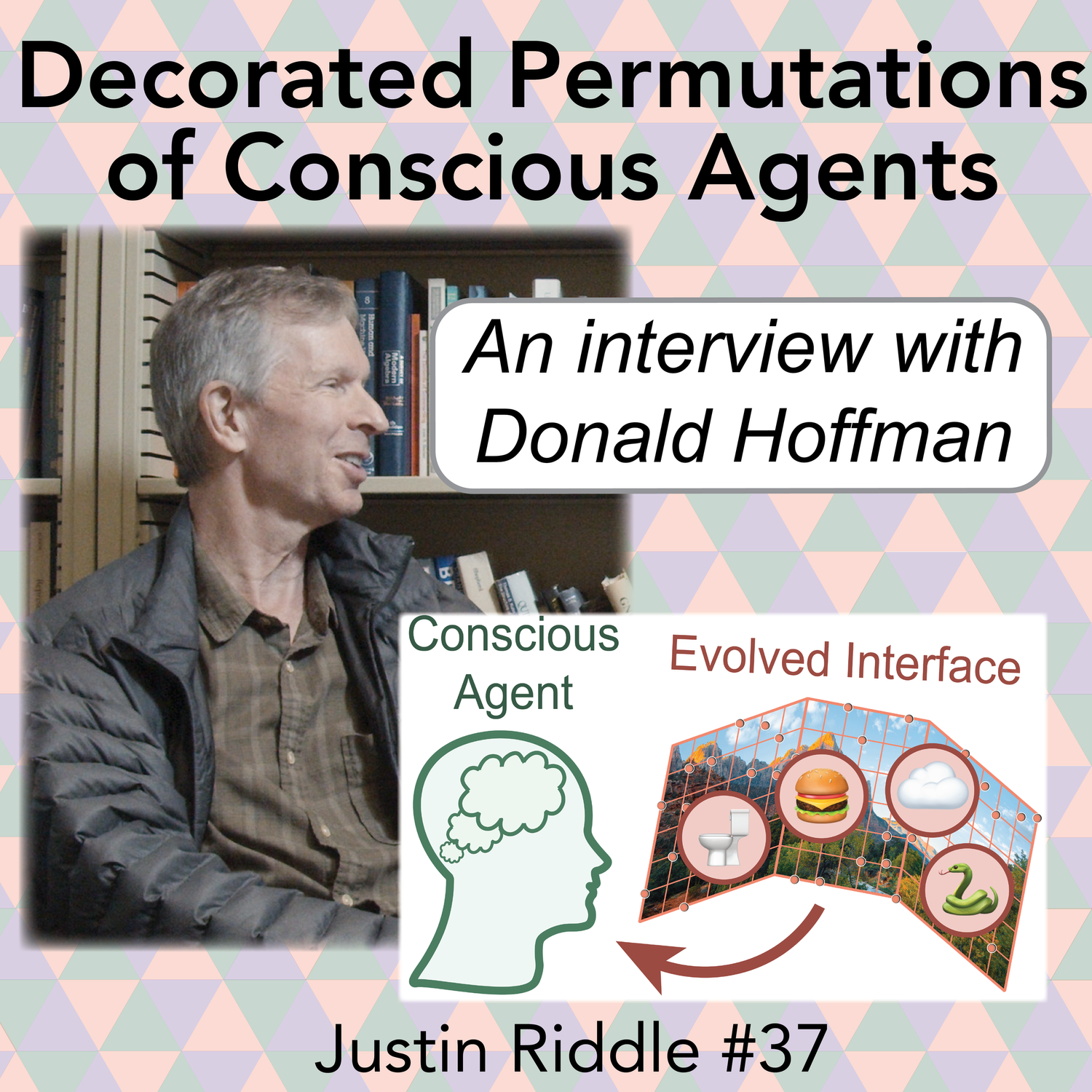
#37 – Decorated permutation in conscious agents: an interview with Donald Hoffman
In episode 37 of the quantum consciousness series, Justin Riddle takes a deep dive into Donald Hoffman’s conscious agent model and relates it to the leading theories of quantum consciousness. The structure of this episode is an introduction to Hoffman’s model of conscious agents, then an interview with Don Hoffman in November 2022, and finally some reflections on the implications of this model. Hoffman begins by describing the interface theory of perception: we have mistaken the external “physical” world to be fundamental reality. But this external world that we see around us is an evolved interface that was created through billions of years of evolution and cannot be trusted. The world you experience is like a video game – with icons, side quests, and abstract motivations to win victory points. The “real” world is not directly accessible to us through our perceptual systems and there is a great illusion at play. Hoffman then proposes his Conscious Agents theory, in which the universe is comprised of conscious beings interacting with each other. He describes these conscious agents as Markov Chains – probabilistic systems that move through a set of possible experience and action states while learning from their interactions with the world at large. Finally, he proposes that conscious agents are composed of conscious agents resulting in a fractal nested hierarchy of beings from the scale of the entire universe down to the Planck scale. This nested hierarchy is fundamental and now just needs to be mapped into modern particle physics in order to complete his theory of everything. Here, he introduces “decorated permutations” which are a way to map the Markov Models of his conscious agents into geometric structures. With this mapping, he claims to connect his agents to fundamental geometric forms at the core of reality, such as the amplituhedron, and then that amplituhedron can derive space-time, particle physics, and quantum mechanics. His theory is very Platonist in its essence and relies on a geometric depiction of reality. At the end of the episode, I praise the ability of Hoffman’s theory to connect the nested hierarchies of beings into a substrate for mathematical forms to arise, but also caution that his model throws away the physical world and mental world to some degree to focus exclusively on the Platonic world of forms. Living within a hyperdimensional geometric form may result in the same nihilistic conclusions that our lives are just unfolding as sub-projections of this universal form. Can we salvage the human spirit from unmoving crystalline geometry? I hope you enjoy!
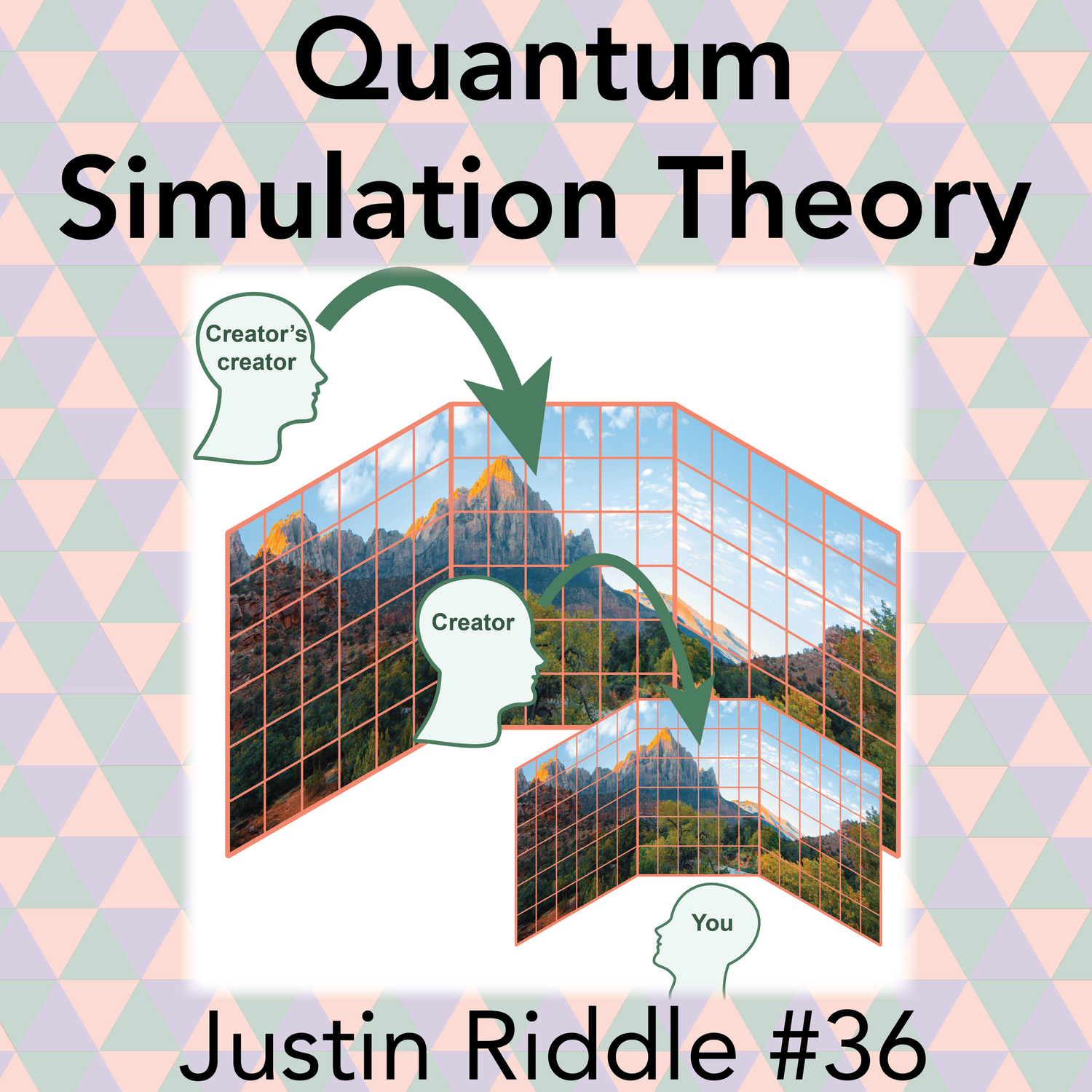
#36 – Quantum Simulation Theory: the limitations of simulating a quantum reality
In episode 36 of the quantum consciousness series, Justin Riddle describes the popular simulation hypothesis and discusses the implication of running the simulation using quantum computers. First off, Justin makes the argument that the foundation of the simulation hypothesis is strictly based in a digital computer framework. If the world is deterministic and digitizable, then it could in principle be simulated. But, if the world is quantum mechanical – with superposition, measurement, and entanglement – then the world might be non-deterministic or require simulation of the entire universe to capture all the necessary information to make the simulation perfect. Luckily, quantum computer scientists have been working on the concept of simulation for decades. Universal quantum simulation is the theory that if you set up a quantum computer to have the same inputs and the same quantum circuit, then you will get the same probability distribution on different quantum computers. However, when you measure that output, then you get a random digital output drawn from that probability distribution. This means that you can simulate the wave function but measurement fundamentally disrupts the simulation and creates divergence. If you were attempting to simulate a quantum system, then you simulation would start to diverge with each subsequent measurement and by the time you are multiple measurements into the future, reality might be unrecognizably different from the simulation. This massively reduced the controllability and the conclusion is reached that a quantum simulation that fully approximates the world is not sustainable for any substantial amount of time. Second is the problem of scaling. In a digital computer, you can write code that derives a more complicated world from some simple principles. However, in a quantum system, the informational complexity of the system explodes exponentially at every evolution of the wave function. Scientists running quantum simulations of molecular interactions for example are looking to create quantum computers with comparable complexity to those chemical systems in order to simulate them. This is a challenge for the simulation hypothesis because the creator of the simulation would need to have a computer as big as the universe itself in order to run the simulation – there does not appear to be any effective compression techniques for quantum computers. Third, the no-cloning theorem of quantum mechanics states that each wave function is uniquely identifiable and cannot be copied in principle. While the probability distribution of a quantum system can be approximated by other quantum computers, the array of entanglement relationships of a quantum system to the world at large cannot be simulated. This means that any quantum simulation will not be a perfect replication in principle, which could lead to an uncanny valley where the simulation is missing something and appears fake despite attempts to enhance the realism. With all of these metaphysical arguments in mind, there is still a persistent phenomenology of feeling like you are in a simulation. For example, high doses of psychedelic drugs can induce the dissociative feeling that everything around you is fake and this is the first moment of your life. If you were a quantum computer living within a physical brain, then the experience of accessing the data of your brain might be akin to the feeling of living in a simulation. Here you are in the moment collapsing the wave function and entering unique moments of time, but the data you are accessing in your brain contains the narrative construct of your life and knowledge. Hence, a removal of typical “neural access” might create the perception of living in a simulation. Lots to think about in this one! Hope you enjoy

#35 - Digital AI is not Conscious: the role of quantum computers and the mind in the AI revolution
In episode 35 of the Quantum Consciousness series, Justin Riddle explores the role of quantum computers in the current revolution in digital artificial intelligence (AI). First, Justin describes some of the basics of large language models at a high level. In essence, digital AI can be conceptualized as a series of weighted matrices trained by fitting and updating the weights according to patterns found in extensive training sets of data. While these digital AI systems are indeed quite powerful as tools, it is important for us to determine what "knowledge" is being acquired. One option is that there is no universal truth, and meaning is arbitrary. This viewpoint leads to the most significant perceived risk: that this AI might start optimizing for arbitrary values that do not align with human values, the classic example being turning the planet into a massive paperclip factory. This "alignment problem" is what leads people to assert that we need a moratorium or ban on these AI systems. However, the alternative viewpoint is that there is a universal truth at the core of reality, akin to Plato's world of forms or mathematics. If mathematics is universal, then there are two subsequent outcomes. Either the digital AI can fully map this Platonic world of math, or it can only approximate these forms. Given arguments from Gödel's incompleteness theorem and the residual mystery of quantum mechanics, it is unlikely that digital systems of formal logic will be able to map mathematics fully. Thus, we are left in the middle ground: there is a universal truth, and digital AI is approximating aspects of this universal truth. The second topic of the episode is the role of quantum computers with respect to digital AI. Justin describes how digital computers represent the ultimate mastery of the physical aspect of reality, while quantum computers are composed of the fundamental pieces of the universe. At the very least, quantum computers will provide an exponential speedup in the training and execution of digital AI, but are also likely to deviate substantially from digital AI because there are additional aspects of their functioning that remain mysterious. How will the digital AI revolution and the quantum revolution compare? Digital AI will significantly expand our capacity to remember, access, and learn information, but this is a physical tool that will be external to our bodies and minds. However, if the mind is truly a quantum computer, then quantum computer technologies will likely need to be implanted within the nervous system to directly expand the computational capacity of your mind. At the end of the episode, Justin speculates that the expansion of the mind with quantum technology may inadvertently lead to transcendent experiences that defy our current understanding of ourselves and our place in the universe. It sure is an interesting time to be alive on this planet!

#34 - In defense of freewill: three ways that consciousness might collapse the wave function
In episode 34 of the Quantum Consciousness series, Justin Riddle puts forth a defense of freewill. In a deterministic universe guided by physical principles, there is no room for freewill. Surely, we must succumb to the crushing reality that our choices do not matter, that the self is an illusion, and that the very concept of time is illusory – nothing more than a social construct or hallucinations. While this is indeed the typical mainstream opinion on the state of our consciousness, quantum mechanics offers some chance that we could escape from determinism. The Schrodinger’s equation explains that quantum systems evolve into a superposition of multiple different possible futures. Then, upon measurement, the wave function of possibilities collapses into a definitive reality. But this process is apparently random. The stochastic (random) nature of this process leaves room for something beyond pure determinism. Perhaps it is simply probabilistic, and not deterministic, or perhaps there is some chance that consciousness could impose its will on this collapse process. At the very least, if freewill is not illusion, the only apparent room for its influence is at this moment of collapse. In this episode, we explore three different ways in which freewill could find its way into the collapse of the wave function. In the first model, the superposition provides the choices for possible futures. These choices are given to the mind, and the mind chooses which of these options to collapse into the physical world. Henry Stapp and John von Neumann postulated that this could be the case, but there must be additional checks from nature on this multiple-choice selection process. The second framing is through the quantum Zeno effect, where you have the option to pay attention to some series of thoughts or to let those thoughts go. This ability of “free won’t” could be a way by which the mind is able to influence the rate and timing of collapse of the wave function rather than the actual choice within the probability distribution. The third and final way that is presented is defined as “form will”. In this model, the human mind chooses a set of values, or forms, that are applied to a situation. Instead of choosing a particular behavior or response, the mind applies a flavor of quantum algorithms to the problem and then whatever the resulting output of that quantum computation is will determine the actual actions that are carried out. In all, each of these three manners for freewill to influence the physical world are speculative and require there to be large-scale quantum computers within the brain. In my opinion, these new models of freewill are necessary for us to escape the crushing nihilism that is inherent to a physicalist / determinist reality.
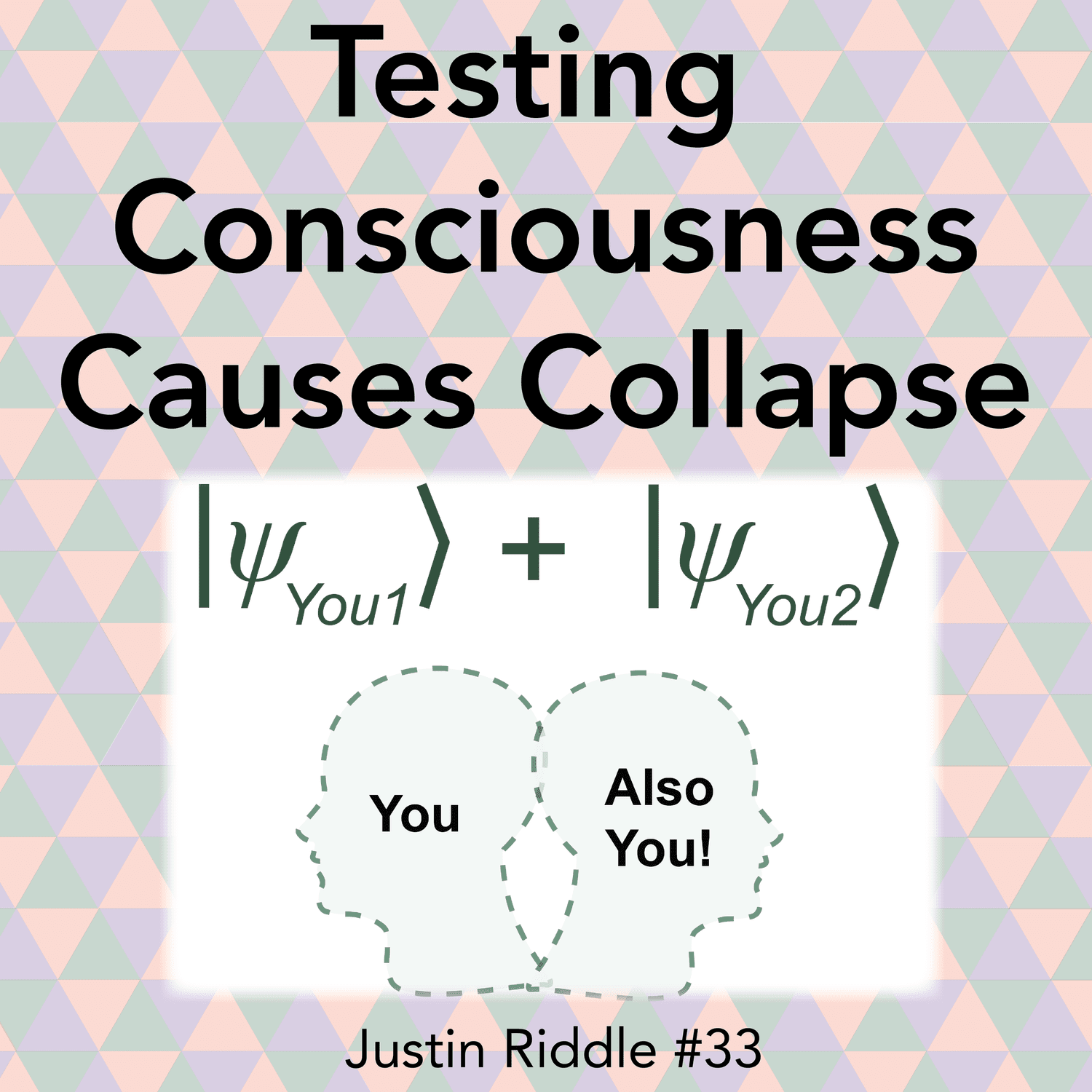
#33 – Testing consciousness causes collapse: an interview with Kelvin McQueen
In episode 33 of the Quantum Consciousness series, Justin Riddle interviews Kelvin McQueen on his recent theory on how consciousness might collapse the wave function. Kelvin is a professor of philosophy at Chapman University who investigates the nature of consciousness and role it might play in quantum mechanics. The measurement problem in quantum mechanics is that there is a smoothly and deterministically evolving superposition that is abruptly “measured” and reduced to a finite physical state, but it is unclear what constitutes a measuring device. In collaboration with David Chalmers, Kelvin explores the hypothesis that the measurement device in quantum mechanics might be consciousness. However, consciousness is typically an ill-defined vague idea that does not produce any tangible upgrade to the mystery of what a measuring device is. Here, Kelvin uses the definition of consciousness from integrated information theory (IIT) by Giulio Tononi. Consciousness is the minimally reducible information state of a system, which is defined as a recurrent network of interconnected nodes that predict the next state of the system. According to Kelvin, this definition allows for testable predictions to be made regarding the role of consciousness. In the upgraded quantum IIT theory, the nodes are quantum bits (or qubits) and the edges are entanglement relationships. Thus, QIIT defines an interconnected quantum computer (of sorts…) as consciousness and this reduces the wave function. Furthermore, the collapse of the wave function is not instantaneous but instead is continuous, drawing from the continuous spontaneous localization theory of quantum mechanics. Altogether, these ideas present a picture where consciousness is integral to a fundamental description of the physical universe and might provide room for an expanded sense of self. In this interview, I interrupt intermittently to describe the relevant ideas with graphical representation and compare this model to the Orchestrated Objective Reduction model by Stuart Hameroff and Roger Penrose. There are some amazing new ideas that Kelvin McQueen describes in this episode, so be sure to check it out!






Get this podcast on your phone, Free


Create Your Podcast In Minutes
- Full-featured podcast site
- Unlimited storage and bandwidth
- Comprehensive podcast stats
- Distribute to Apple Podcasts, Spotify, and more
- Make money with your podcast